
The legal profession is entering a new phase where Artificial Intelligence (AI) has moved from early trials into everyday practice. Legal teams use AI to simplify complex tasks, strengthen compliance, and focus on higher-value work.
Rather than replacing professionals, AI supports them by handling large volumes of data, spotting patterns, and managing routine activities. As a result, lawyers have more time to concentrate on strategy, negotiations, and client advisory work.
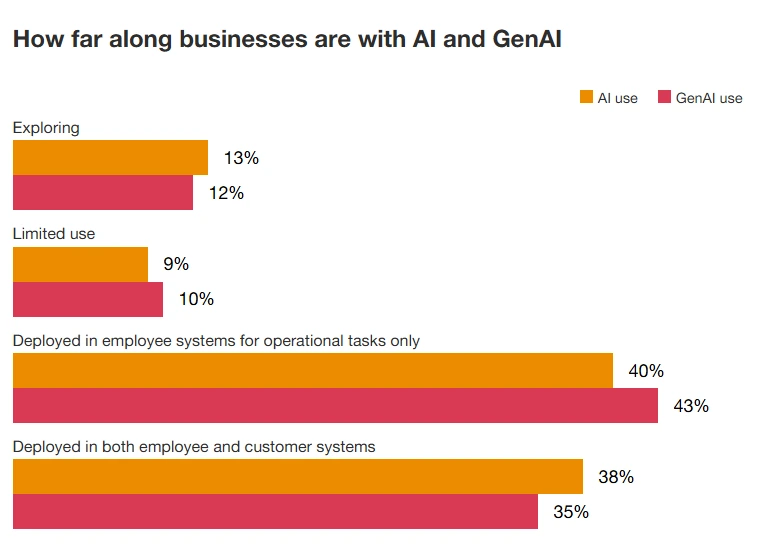 Source: PwC
PwC research shows how quickly organizations are advancing with AI. Only a small share of organizations remains in the exploratory stage, while more than three-quarters already have AI embedded in employee systems or in both employee and client-facing processes. Within that group, 43% are using Generative AI (GenAI) for operational tasks, while 35% have extended it into customer interactions.
For legal teams, this momentum is a clear signal. AI is becoming part of everyday operations across industries, placing legal departments in a position to guide its responsible use.
By preparing now, teams can reinforce governance, safeguard confidentiality, and ensure adoption aligns with professional as well as regulatory expectations.
For AI adoption in legal teams, preparation shapes the outcome. Secure, workflow-driven integration improves efficiency, strengthens compliance, and supports long-term sustainability.
Success depends on aligning people, processes, and governance in ways that reinforce professional practice. By following proven approaches, legal teams can capture AI’s value while minimizing unnecessary risks.
How AI is Reshaping Legal Team Workflows?
Legal teams are steadily incorporating AI into daily practice, reshaping workflows, redefining responsibilities, and reinforcing oversight. Adoption evolves as a cycle where roles adapt, collaboration deepens, and governance matures with experience.
Balancing innovation with careful governance is essential. The process typically involves:
Identifying Use Cases: Teams should target workflows where AI delivers efficiency with minimal disruption. Core areas include contract review, document classification, compliance monitoring, and risk assessment.
Building Governance Structures: Oversight defines who approves AI outputs, how results are validated, and which measures protect data. Safeguards such as audit trails and controlled access strengthen accountability, reduce risk, and help teams demonstrate compliance if challenged by regulators or clients.
Developing Workforce Skills: Legal professionals should feel confident using AI without becoming technical experts. Training enables them to interpret outputs critically, recognize system limitations, and incorporate results into their decisions. Building these skills fosters confidence and ensures human judgment remains central.
Ensuring Regulatory Alignment: AI adoption requires strict adherence to privacy laws, confidentiality obligations, and professional standards. Teams must remain alert to evolving regulations, since non-compliance can lead to penalties or reputational harm. Structured oversight supports compliance while minimizing risk exposure.
Driving Cultural Change: Organizational culture influences adoption. Teams should see AI as a complementary resource, not a threat. Transparent communication, phased implementation, and visible leadership support foster trust and positive engagement with new technology.
Preparing Legal Teams for Responsible AI Use
Legal teams that begin with a structured approach are more likely to achieve benefits while minimizing disruption. Early preparation establishes a foundation for sustainable adoption.
Conducting a Readiness Assessment: The first step is to review workflows, technology, and staff readiness. A readiness assessment identifies inefficiencies and highlights areas where AI can be introduced effectively. Evaluating whether processes can support policy-driven implementation ensures accountability and consistency from the outset.
Defining Clear Objectives: Deloitte’s AI for In-House Legal: 2025 Predictions report shows 93% of Chief Legal Officers believe Generative AI delivers tangible value. Over two-thirds of organizations plan to increase investment in GenAI in the coming year. Legal teams benefit from setting clear goals such as accelerating document review, improving compliance oversight, and increasing accuracy in risk assessments. These objectives help measure impact and ensure adoption delivers on expectations.
Establishing Governance Frameworks: Governance structures should be created before AI is implemented. These frameworks define accountability, outline review processes, and ensure ethical use. Having governance in place from the start creates transparency and builds trust in outputs.
Selecting Pilot Use Cases: Starting small allows teams to test AI capabilities, identify challenges, and gather staff feedback. Lessons learned from pilots inform broader rollouts, making transitions smoother.
Securing Leadership Buy-In: Leadership engagement ensures resources, signals organizational commitment, and reassures staff. Visible support encourages confidence and keeps initiatives aligned with long-term strategy.
Challenges Legal Teams Face in Using AI
Adopting AI in the legal sector presents opportunities alongside hurdles. Recognizing challenges early allows leaders to plan realistically and reduce friction.
Complexity of Legal Data: Legal information is often vast, varied, and unstructured, ranging from contracts and compliance records to case law and regulatory updates. AI systems must be trained to interpret this information accurately, but preparing and standardizing such data requires significant effort. Many organizations underestimate the resources required for data readiness, slowing implementation in the process.
Skepticism and Resistance to Change: Lawyers and support staff may hesitate to trust AI applications, fearing that automation could replace human judgment or reduce their roles. The profession has long relied on precedent and manual analysis, so encouraging responsible use of AI’s support functions requires careful communication. Addressing this skepticism is essential to encourage acceptance and demonstrate that AI is a complement, not a replacement, for legal expertise.
Integration with Existing Systems: Legal teams often use a combination of case management software, compliance platforms, and secure document repositories. Integrating AI with these existing systems can be challenging, especially when legacy infrastructure lacks flexibility. Without smooth integration, AI’s benefits risk being underutilized, leading to frustration among users.
Skills Gaps Among Legal Professionals: Many legal professionals have limited exposure to advanced technologies. While they excel in legal reasoning, they may not be fully prepared to understand or leverage AI-driven insights. Bridging this gap requires targeted training programs that focus on practical applications rather than technical engineering, ensuring professionals feel confident using new systems.
Concerns Around Accuracy and Reliability: Legal practice demands precision, and errors can carry serious consequences. If AI outputs are not carefully validated, teams may worry about inaccuracies in contract analysis, risk assessments, or case predictions. Building processes for human oversight is critical to ensure that AI recommendations remain trustworthy.
Regulatory and Ethical Uncertainty: The rules surrounding AI use in legal contexts are still evolving. Questions about client confidentiality, data privacy, and liability remain unresolved in many jurisdictions. Until clearer frameworks are established, legal teams must carefully balance innovation with compliance, often proceeding more cautiously than in other industries.
Cost and Resource Allocation: AI deployment is often perceived as costly, especially when factoring in licensing fees, infrastructure upgrades, and training programs. Smaller firms or departments may struggle to justify the investment without a clear demonstration of return on value. Strategic planning and phased implementation can help mitigate this challenge.
A recent ACEDS survey confirms that data privacy or confidentiality (56%) remains the top barrier to adoption, followed by cost (47%), lack of education/training (34%), and the risk of AI producing misleading outputs (31%), even as more legal professionals become knowledgeable about AI.
These challenges make it clear that adopting AI in the legal field is about more than adding new systems. It takes planning, close teamwork between IT and legal staff, and a culture that values continuous learning. Success also depends on people being ready to adopt AI responsibly, not just on the technology itself.Top of Form
Preparing Legal Professionals for AI-Enabled Work
Training ensures that staff are prepared to use AI responsibly and integrate it effectively into legal practice. Without adequate training, adoption risks falling short of expectations.
Understanding AI Fundamentals: Staff should gain a foundational understanding of how AI systems function, including how data is processed and outputs are generated. Familiarity reduces uncertainty, allowing professionals to engage with outputs more confidently.
Evaluating Performance: Legal professionals must be equipped to measure whether AI systems perform reliably and consistently. Training on metrics such as accuracy, error rates, and relevance enables informed judgment about when outputs can be trusted.
Recognizing Bias: AI often reflects patterns and biases present in training data. Training programs should emphasize how to identify, question, and mitigate bias, ensuring outcomes remain balanced, fair, and aligned with professional standards.
Protecting Data: Confidentiality is central to legal work. Training should cover secure data handling, privacy regulations, and responsible use of sensitive information to prevent accidental breaches and safeguard client trust.
Critical Interpretation: AI should support decision-making, not replace it. Professionals need to learn how to interpret results in context, integrating outputs with their expertise to maintain accountability.
Managing Security Risks: Awareness of potential vulnerabilities, such as unauthorized access or malicious inputs, prepares staff to act quickly if problems arise. Training should include security best practices while reinforcing workflow consistency.
Together, these areas ensure that AI becomes a reliable partner to legal professionals while preserving the role of human judgment.
The Role of Ethics and Regulation in Legal AI
Ethics and regulation are not optional considerations in legal AI adoption; they form the foundation of sustainable and trustworthy use. Legal teams must treat compliance and ethical responsibility as ongoing commitments.
Professional Responsibility: Lawyers have obligations related to confidentiality, competence, and fairness. Even when AI assists in decision-making, ultimate responsibility rests with the legal professional. Ensuring that AI outputs do not undermine these obligations safeguards both clients and the organization.
Data Protection Compliance: Regulations such as the EU’s GDPR and other local privacy laws impose strict requirements on how data can be processed and stored. AI systems must be aligned with these regulations from the outset. Non-compliance can lead to penalties, reputational harm, and loss of client confidence.
Reputation and Trust: Clients rely on legal teams to uphold ethical standards. Transparent and ethical AI adoption strengthens trust, while misuse or errors can damage credibility. Ethical practices reassure clients that their information and interests are handled responsibly.
Evolving Legal Standards: Regulatory frameworks surrounding AI continue to evolve globally. Teams must monitor developments to ensure their practices remain compliant. Staying informed allows organizations to adjust quickly and maintain accountability in an environment of constant change.
Ethical Oversight Committees: Many organizations establish internal committees or oversight groups to monitor AI adoption. These bodies provide guidance on responsible use, review emerging risks, and update governance policies. Having structured ethical oversight demonstrates a commitment to long-term accountability.Top of Form
How Legal Teams Can Evaluate and Monitor AI Vendors?
Vendor selection is a critical determinant of the success, reliability, and compliance of AI adoption. Legal teams must carefully evaluate potential vendors to ensure alignment with organizational objectives.
Due Diligence: Teams should examine a vendor’s track record, certifications, and history of successful deployments. Assessing whether the vendor provides platforms that are compliance-ready and adaptable to regulatory changes ensures that legal obligations can be met efficiently. Evaluating transparency, documentation, and user support also helps avoid unexpected operational or legal challenges.
Contractual Safeguards: Clear agreements establish expectations and accountability. Contracts should specify ownership of data, service levels, liability for errors, and reporting requirements. Detailed contracts ensure that vendors remain responsible partners, reducing risks to both operations and client trust.
Transparency Standards: Vendors should clearly explain how AI systems function, what data informs outputs, and how models are trained. Teams must understand the methodology to interpret results accurately and address any discrepancies. Transparency fosters trust among staff and clients while enabling informed oversight.
Bias Testing: Teams should confirm that vendors evaluate AI models for bias regularly. Documentation of fairness assessments, mitigation strategies, and monitoring processes helps ensure that outputs remain equitable and defensible in legal or regulatory contexts.
Ongoing Oversight: Even after deployment, monitoring vendor performance is essential. Regular check-ins, audits, and performance reviews maintain accountability and ensure the AI continues to meet objectives, adhere to regulatory requirements, and operate reliably.
Change Management Strategies for AI
Adopting AI represents a significant operational shift. Change management ensures that staff, processes, and systems adapt smoothly while maintaining efficiency and compliance.
Visible Leadership Support: Leaders play a pivotal role in demonstrating commitment to AI adoption. Active engagement from senior management reinforces the strategic importance of AI and encourages staff participation.
Inclusive Engagement: Staff should be involved in discussions about AI adoption, with opportunities to provide input and raise concerns. Engaging teams early reduces resistance and fosters a sense of ownership over new processes.
Clear Communication: Staff must understand what is changing, why it matters, and how risks will be managed. Workflow visibility should also be emphasized so employees can see how AI integrates into existing processes and contributes to better outcomes. Clear communication prevents confusion and builds confidence in the system.
Phased Rollouts: Gradual implementation allows teams to adjust to new processes and troubleshoot issues before full-scale adoption. A phased approach minimizes disruption to ongoing legal work while providing valuable lessons for scaling AI across broader operations.
Recognition of Progress: Celebrating milestones and acknowledging successful adoption reinforces positive behavior. Recognition helps maintain momentum, motivates staff, and strengthens organizational culture around AI.
Risk Management Strategies for AI in Legal Practice
Risk management is integral to AI adoption in legal environments. Proper planning ensures technology supports operations safely and effectively.
Pre-Adoption Risk Assessment: Teams should identify potential operational, ethical, and legal risks before deployment. Understanding risks in advance allows mitigation measures to be built into workflows and governance frameworks.
Maintaining Documentation: Accurate records of data sources, decision-making processes, and oversight activities help maintain accountability. Documentation also provides evidence of due diligence in case of audits or regulatory inquiries.
Ongoing Monitoring: Teams must continuously monitor AI systems for performance, bias, and security concerns. Compliance-focused oversight ensures the technology operates in line with evolving legal and regulatory standards, maintaining both effectiveness and accountability.
Fallback Systems: Maintaining human review processes allows teams to intervene when AI outputs are uncertain or unexpected. Fallback systems act as safety nets that preserve legal accuracy and professional judgment.
Liability Planning: Clearly defining accountability and potential liabilities in internal policies and vendor contracts ensures that legal responsibilities are well understood. Planning for liability helps prevent operational disruption and protects client interests.
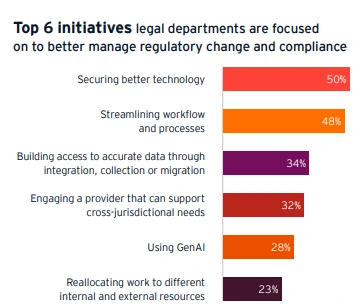
Source: EY
Research from EY’s 2025 General Counsel Study shows a similar pattern. Legal departments rank securing technology (50%) and streamlining workflows (48%) above GenAI adoption (28%), highlighting that governance and reliable systems remain the first priority. The findings reinforce the idea that AI works best when built on strong foundations of technology, process, and data.
Long-Term Considerations for Responsible AI in Legal Teams
AI adoption is a continuous process shaped by business priorities and regulation. Careful planning helps organizations sustain progress, improve efficiency, and keep legal practices aligned with shifting demands.
Continuous Learning: Staff and systems must evolve alongside AI technology. Regular training programs, updates, and learning opportunities help professionals maintain proficiency while keeping up with new AI capabilities.
Scaling Adoption: After successful pilot implementations, AI can be expanded to other practice areas. Governance structures must remain robust, and workflows should remain adaptable enough to integrate AI without disrupting operations or professional responsibilities.
Permanent Oversight: Establishing review bodies or committees ensures ongoing accountability. Long-term oversight monitors AI outputs, updates policies as needed, and ensures compliance and fairness are maintained consistently.
Client Engagement: Soliciting feedback from clients helps ensure that AI solutions are providing value and meeting expectations. Regular engagement allows teams to refine approaches and demonstrate transparency and professionalism.
Monitoring Regulation: Legal and data privacy standards evolve continuously. Teams must remain vigilant, adapting policies, workflows, and vendor agreements to comply with new regulatory requirements and avoid legal risks.
Conclusion
AI technology offers transformative potential for legal teams, enabling increased efficiency, stronger compliance, and more strategic use of professional expertise. By adopting structured practices, teams can maximize benefits while minimizing risks, maintaining professional accountability, and enhancing client trust.
Long-term success depends on continuous oversight, ethical awareness, and adaptable workflows. With careful planning, transparent governance, and consistent training, legal professionals can harness AI responsibly to support better outcomes and create a resilient, future-ready practice.
The post AI Adoption in Legal Teams: Best Practices for Responsible Integration appeared first on Knovos.