
Digital transformation has become a key focus for modern legal teams as workloads expand steadily. It supports faster turnaround expectations while helping teams respond to evolving regulatory demands across jurisdictions.
Legal departments and law firms evaluate legal technology capabilities that improve information management with consistent accuracy. They also strengthen defensibility and uphold professional standards through more transparent processes and reliable operational support.
As AI adoption grows, responsible implementation is becoming a core requirement for legal and compliance leaders. PwC’s 2025 US Responsible AI Survey reports that 58% of respondents say responsible AI improves return on investment and organizational efficiency, and 51% cite improved cybersecurity and data protection as a key benefit.
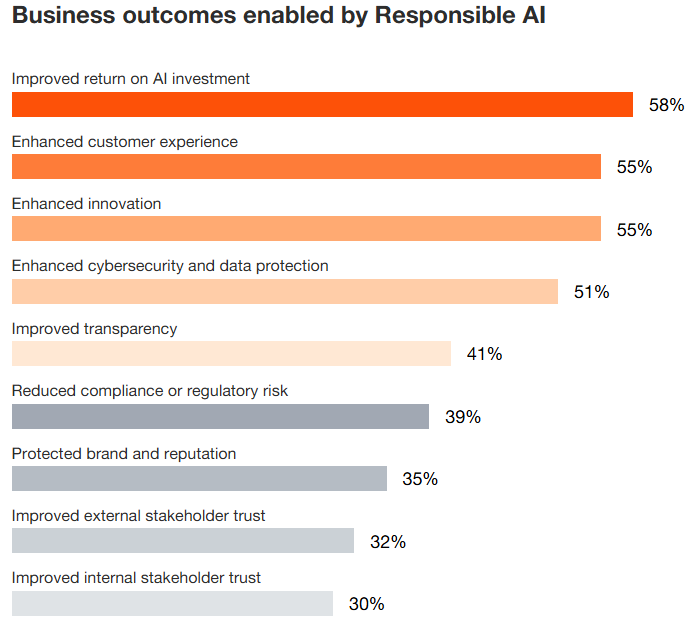
Source: PwC
PwC further notes that 61% of organizations describe their responsible AI maturity as strategic or embedded. In these stages, responsible AI is integrated into core operations rather than treated as an isolated initiative.
Legal-specific survey findings also underline why implementation discipline matters. In the ABA 2024 Legal Technology Survey findings summarized by the Maryland State Bar Association, accuracy was cited as a major concern by 75% of respondents.
AI integration in legal workflows matters because it combines attorney judgment with structured, data-driven support. When integrated responsibly, AI reduces repetitive effort without compromising legal interpretation, privilege, or ethics.
A step-by-step approach helps teams embed AI into existing operating models with minimal disruption. It also aligns implementation with governance requirements and enables clear measurement of impact over time.
What this Step-By-Step Guide Covers
- How to assess data readiness and workflow dependencies
- How to define success metrics and defensibility standards
- How to select the right workflow for an AI pilot
- How to match AI capabilities to document review automation and contract automation
- How to design governance for compliance automation and auditability
- How to scale responsibly across legal operations
Why AI Enablement in Legal Operations Needs a Structured Foundation
Legal workflows are interconnected, governed by strict obligations, and dependent on human oversight for interpretation and risk decisions. A structured approach ensures AI strengthens the workflow rather than introducing new uncertainty.
Clear objectives, a realistic view of current processes, and disciplined selection of use cases help avoid over-automation in areas that should remain attorney-led.
AI typically delivers the most outstanding value in work characterized by repetition, high document volume, or time-sensitive triage. Examples include document classification, contract abstraction, compliance monitoring, matter intake routing, and review prioritization in discovery.
The goal is to support consistent execution, improve throughput, and preserve defensible process controls through audit logs, review protocols, and clear accountability.
- Common integration failure patterns and how legal teams can avoid them
- Unclear ownership and escalation paths, addressed by defined roles, review thresholds, and documented decision rights
- Weak data hygiene, addressed by metadata standards, controlled vocabularies, and taxonomy alignment before piloting
- Low auditability, addressed by audit logs, approval capture, and traceable records for how outputs were produced and validated
- Misaligned success measures, addressed by baseline metrics and workflow-specific targets agreed upfront
- Over-automation of interpretive decisions, addressed by mandatory attorney review for privileged, high-risk, or judgment-dependent work
AI-Enabled Legal Operations for Document Review Automation and Compliance Automation
AI-enabled legal operations strengthen document review automation through faster triage, classification, prioritization, and consistent summaries. As a result, compliance automation improves alert routing, interpretation consistency, and audit readiness with controlled oversight across jurisdictions.
Step 1: Map the Workflow and Assess Data Readiness
Map the workflow from intake to completion to identify decision points, dependencies, and data gaps. Document:
- Each step and its decision points
- Volume and types of documents involved
- Dependencies and handoffs across teams
- Systems used across the workflow, such as DMS, CLM, and matter management
- Exception paths, rework drivers, and escalation patterns
- Where audit logging and approvals are required
In parallel, assess data readiness. AI performance depends on consistent inputs and well-governed content.
If documents are unorganized, mislabeled, or inconsistent, teams may need metadata standardization, template alignment, controlled vocabularies, or taxonomy updates before a pilot begins.
Apply this mapping and readiness check to a shortlist of candidate workflows, not the full operating model.
Step 2: Establish Success Metrics and Defensibility Criteria Before Starting
Define success measures before implementation to ensure evaluation remains objective. Depending on the workflow, metrics may include:
- Reduction in review turnaround time
- Improved consistency in document summaries or issue spotting
- Higher accuracy in classification or routing
- Reduction in manual effort for repetitive steps
- Increased throughput for high-volume review queues
- Enhanced compliance visibility and reporting readiness
Also, define defensibility criteria. For regulated and dispute-sensitive work, teams often require audit trails, documented review steps, role-based permissions, and a clear record of how outputs were generated and validated.
Define sampling thresholds and validation rules, so outputs can be tested consistently during pilots and scale-up.
Step 3: Identify a Workflow with Measurable Potential
Select a starting point that consumes significant time, follows repeatable patterns, or creates bottlenecks that slow delivery. Strong candidates often include:
- Reviewing standard agreements
- Extracting clauses from large contract portfolios
- Summarizing key obligations for renewal or repapering cycles
- Sorting and tagging documents for discovery
- Managing compliance-related alerts
- Handling routine matter intake classifications
Starting with one workflow creates clarity around goals, data inputs, escalation paths, and expected operational outcomes.
Confirm the workflow has sufficient data access, a clear owner, and a risk profile suitable for a controlled pilot.
Step 4: Select the Right AI Capability for the Workflow
Match the capability to the task rather than forcing a single approach across all work. Common options include:
- NLP models for clause identification, summarization, concept grouping, and context-aware extraction
- Machine learning models for categorization, prioritization, relevance prediction, and pattern detection
- RAG-based systems for grounded responses based on internal policies, playbooks, and approved sources
- Automation engines for routing, structured data capture, notifications, and standardized outputs
Alignment is essential for document review automation and contract automation, where accuracy, traceability, and repeatability drive adoption.
For each capability, define how results will be validated, such as attorney sampling, benchmark datasets, or exception reviews.
Step 5: Build Governance, Oversight, and Review Guidelines
Governance keeps usage responsible and defensible by defining controls, accountability, and review expectations. Establish:
- Human review requirements for interpretive, privileged, or high-risk decisions
- Policies defining acceptable uses, restricted uses, and required approvals
- Escalation paths for questionable outputs or conflicts with policy
- Documentation standards for inputs, sources, assumptions, and validation steps
- Audit trails capturing key actions, context where applicable, and output consumption
- Processes for updates, monitoring, and model change control when rules shift
Governance design is where compliance automation intersects with legal oversight. Controls should support regulatory expectations, internal policy requirements, and audit readiness.
Assign decision ownership for approvals, exceptions, and model updates, so accountability remains clear during scale
Step 6: Choose a Deployment and Integration Approach that Supports Governance
Integration should reflect technical architecture, data residency requirements, and privilege protections. Common approaches include:
- Embedded AI within existing systems such as DMS, CLM, and matter management
- API driven connections between AI services and internal repositories
- Private deployments for privileged or high-sensitivity workloads
- Hybrid models that balance vendor services with internal controls
For generated outputs, require permission-aware retrieval and traceable citations to the source documents or approved policy text used, so responses remain defensible and reviewable.
Ensure integrations preserve permission boundaries and write audit logs into systems used for review and reporting.
Step 7: Run a Focused Pilot Using Real Workflow Scenarios
A pilot should mirror real working conditions to validate performance, usability, and process impact. Strong pilots:
- Use a limited but representative dataset
- Compare results against baseline metrics
- Include attorneys, paralegals, and legal operations users
- Identify usability issues, exception handling gaps, and unclear outputs
- Validate that audit logs, permissions, and review steps operate as designed
- Document lessons learned and update playbooks before scale-up
Example scenario for contract automation: test clause extraction and obligation summaries on a defined set of executed agreements, then validate results against attorney-reviewed baselines.
Step 8: Train Users and Provide Structured Adoption Support
Training should build confident, consistent adoption by clarifying responsibilities, boundaries, and escalation steps. Cover:
- How to interpret recommendations and confidence indicators
- When attorney review is mandatory
- How to handle privilege and sensitive content
- How to report inaccuracies and provide feedback
- How escalation and exception handling work in practice
- How outputs should be documented for defensibility
Adoption improves when teams understand where AI helps, where it does not, and how accountability is maintained.
Provide short playbooks for common exceptions, so decisions remain consistent across teams and matters.
Step 9: Scale Gradually with Safeguards and Standardization
After the pilot demonstrates value, expand in controlled phases to maintain quality and governance alignment. Scaling may include:
- Extending the workflow to other practice groups or business units
- Adding new document types and templates
- Integrating outputs into reporting or dashboards for legal operations and compliance
- Standardizing taxonomies, naming conventions, and review protocols
- Expanding role-based permissions and audit coverage
- Implementing sampling plans for ongoing quality checks
Example scenario for eDiscovery analytics: after validating classification and prioritization in one matter type, extend to additional matter profiles with controlled sampling and continuous quality monitoring.
Use phased rollout gates tied to success metrics, audit readiness checks, and exception rate thresholds.
Step 10: Monitor, Refine, and Evolve the Workflow
Ongoing monitoring sustains reliability by tracking accuracy, drift, exceptions, and feedback across workflow changes. Monitoring should track:
- Output accuracy and consistency over time
- Model drift, bias signals, and exception rates
- User feedback trends and recurring failure patterns
- Changes in regulations and internal policy that impact workflow logic
- Alignment between AI-supported outputs and attorney judgment standards
- Audit readiness indicators such as completeness of logs and approvals
Operational refinement should be treated as part of ownership. Continuous improvement is how workflow modernization becomes sustainable, repeatable, and defensible.
Review metrics and governance performance on a scheduled cadence, then update models, rules, and training accordingly.
Practical Considerations for Responsible Integration
Responsible integration depends on clear safeguards that protect legal judgment, privileged information, and defensible execution. These considerations help teams operationalize the approach with consistent controls, accountable ownership, and continuous improvement.
- Maintain attorney oversight for interpretive, privileged, or risk-focused decisions
- Use approaches that support traceability and auditability
- Protect privileged data through secure deployment, access controls, and retention alignment
- Document workflow changes to support audits, investigations, and defensible process reviews
- Establish clear ownership across legal, IT, compliance, privacy, and legal operations
- Build feedback loops so recurring errors lead to measurable improvement
Key Takeaways
Embedding AI within legal processes delivers measurable value when executed through structured, governed implementation practices. Teams start by selecting suitable workflows, preparing data, and defining success metrics before deployment begins.
They match capabilities to each task, ensuring outputs remain consistent, traceable, and aligned with policy. With phased scaling and oversight, legal teams improve throughput and consistency while preserving defensibility throughout.
Used responsibly, it supports review automation, contract automation, eDiscovery analytics, and compliance automation at scale. Legal interpretation and accountability remain with professionals, reinforced by review protocols, audit logs, and governance.
The post AI Integration in Legal Workflows: A Step-By-Step Implementation Guide appeared first on Knovos.