
In the highly anticipated copyright decision of 4th December CJEU has ruled that as regards the scope of copyright protection for works of ‘applied art’ the author’s personality must be reflected in the works for which copyright protection is claimed through his ‘free and creative choices’ without a stricter requirement than for traditional copyright protected works.
Product lines affected include design furniture and other functional design products such as lighting fixtures, kitchen appliances, footwear and other fashion accessories, jewellery and consumer electronics.
As a consequence of the decision copyright infringement will depend on whether the reproduction is ‘recognisable’ when comparing the two products rather than an ‘overall visual assessment’ test.
The CJEU, in making this preliminary ruling, joined two furniture cases: Swedish Mio (C-580/23) and German USM Haller (C-795/23).
Referral C-580/23 (Mio) of the Swedish Court
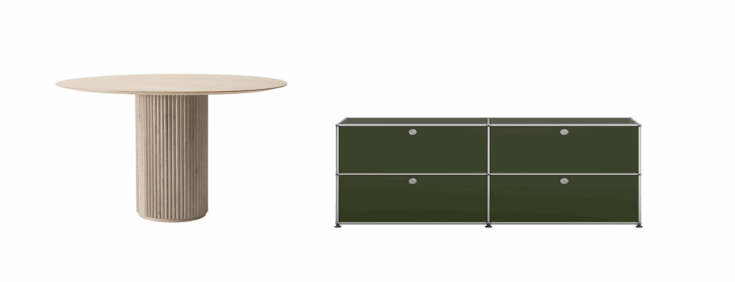
The first case relates to an allegedly infringing dining table in the ‘Cord’ series produced by the Swedish company Mio which has strong similarities with the original dining table in the ‘Palais Royal’ series produced by the Swedish plaintiffs Galleri Mikael & Thomas Asplund. Asplund brought action based on copyright infringement claiming their tables were protected by copyright as works of applied art. The defendants argued that the tables were not sufficiently original to claim copyright protection and even if they were, the copyright was so limited and restricted that the differences between the models of tables was not sufficient to demonstrate copyright protection.
The Court of Appeal stayed the proceedings and referred questions to the CJEU for a preliminary ruling on Directive 2001/29/EC.
Referral C-795/23 USM Haller System
The second case relates to a modular furniture system produced by the Swiss company USM Haller characterised by the assembly of chrome tubes and connecting balls to form a furniture structure into which coloured metal panels are inserted. The defendant, the German company Konetra initially sold spare parts online then manufactured, offered and marketed its own furniture system, identical to that of USM. USM claimed that Konektra’s offer infringed copyright in the USM Haller system as a work of applied art. While the Court of 1st Instance in Germany upheld the claims, on appeal the Higher Regional Court, Dusseldorf Germany dismissed the claims. The Federal Court of Justice in Germany stayed the proceedings referring questions to the CJEU for a preliminary ruling.
The CJEU was required to give interpretations on Arts 2(a), 3(1) & 4(1) of Directive 2001/29/EC on Harmonisation of certain aspects of copyright and related rights in the information society.
Key CJEU Findings
- Works of applied art are not subject to a higher or stricter ‘originality’ threshold that other copyright works;
- Aesthetic appeal is not relevant while a reflection of the creator personality in the work and evidence of his ‘free and creative’ choices are;
- Infringement findings are not to be based on the ‘overall visual impression’ comparing the two objects but rather whether creative elements are recognisable in the allegedly infringing work.
What is the ‘originality’ test for copyright for applied art?
The court found that ‘originality’ in copyright in applied-art cases requires that:
- the creators’s personality be reflected in the work through the creator’s ‘free and creative choices’;
- Works satisfying the condition of originality may be entitled to copyright protection, even if the creation is partly dictated by technical considerations, provided that the technical constraints have not prevented the creator from reflecting his or her personality in that work, as an expression of ‘free and creative’ choices;
- The ‘originality’ assessment is found in the product itself and not in external factors which may be taken into account but are not necessary or decisive.
This broadly follows the recommendation of the Advocate General on 8th May 2025 and aligns with the approach taken in the earlier established case law in Brompton Bicycle (C-833/18) and Cofemel (C-683/17).
The court confirmed that this protection applies to the work as a whole and/or to components or individual parts of a utilitarian work, provided they contain elements which are the original expression.
Regarding ‘artistic and aesthetic considerations’, the CJEU held that while artistic and aesthetic elements may play a part in creative activity, the fact that a work of applied art is artistic or aesthetic does not, alone, make it possible to determine whether that work constitutes an intellectual creation reflecting the freedom of choice and personality of its author, thereby meeting the requirement of originality (Cofemel C-683/17). The decisive factor is the latter.
Choices dictated by technical constraints
For works of applied art, the work is usually influenced by technical, ergomic and safey constraints which do not, in themselves establish any originality. To establish originality the author has to go beyond these constraints.
The court stated that choices dictated by various constraints (such as technical constraints or regulations) which bind the author during the creation of the work are not creative. They are not free choices and do not bear the imprint of the author’s personality by giving the work a unique appearance.
Relevance of intentions of the author be taken into account?
While both the creative process and the author’s intentions or explanations about the creative process may be taken into account, these are not the base for the assessment nor are they decisive. The author’s intentions lie within the realm of ideas. They are protected only in so far as the author has ‘expressed’ them in the work concerned. ‘Internal intentions’ are only relevant if they manifest themselves externally in the visible object created.
Other Factors
On the question of shapes the CJEU confirm that a work can still be protected if, despite using existing shapes, those shapes are arranged in such a way that they express a creative decision.
Inspiration from existing works does not appear to be negate copyright protection as long as the later work is a variant which has originality even if the degree of originality is low.
Presentation at museums or trade fairs and recognition in professional circles after creation are not necessary or decisive although they may be taken into account because originality arises at the time of creation.
Generally factors external to and subsequent to the creation have limited relevance. The focus remains squarely on the product itself and whether it embodies creative choices.
Relationship between design and copyright
The court negates the view that the primary regime for utilitarian products is design law and the copyright law is an exception. A product protected by registered design may also be protected under copyright law if the copyright protection criteria are met – namely the ‘originality’ as defined above.
Generally design law protects products intended for industrial production that are both new and have individual character for a limited time (25 years). When it comes to infringement an ‘overall similar impression’ test is applied in design law. By contrast copyright law focuses on the expression of the author’s intellectual creation. The protection is for the life of the author plus 70 years so considerably longer.
The CJEU has held that copyright serves different purposes, pursues different objectives and is subject to distinct rules than design; there is no automatic connection between grant of protection under design law and the grant of protection under copyright law. While they are not mutually exclusive and may be granted cumulatively, this is however limited to certain situations.
Copyright Infringement
Under copyright law, an infringement is the consequence of use of the work without the author’s consent. This is the case even where it concerns a relatively minor part of the work. While in the past an assessment of copyright infringement for applied art might have been thought to be based on all the facts to hand, this decision clarifies that the ‘overall visual assessment’ test when comparing the products and the level or degree of creativity are not relevant.
A two step test
Firstly, ‘free and creative choices’ need to have been made by the author to acquire originality with an expressed imprint of the author’s personality incorporated in the work. The extent of the protection does not depend on the degree of creative freedom exercised by its author, and the protection can not be inferior to that which any other work within the scope of the directive is entitled.
Secondly, if free and creative choices have been made then, in order to establish copyright infringement, it is necessary to determine whether the creative elements of the protected work have been reproduced in a recognizable manner in the allegedly infringing product.
The mere possibility of a similar creation (ie an independently created work – without knowledge of the copyright protected work) cannot justify a refusal to grant protection.
It is not clear from the decision who precisely decides whether the reproduction is ‘recognisable’. Ultimately this final decision rests with the presiding Judge however whether expert witnesses evidence or survey evidence may be admitted is not addressed here. It will be interesting to see how this decision is now applied by the relevant Swedish and German national courts.
The decision still leaves open what exactly ‘creative choices’ entail and what exactly the meaning of ‘a reflection of the author’s personality’ involves. By way of example, If a furniture designer uses an unusual and repetitve colour combination or a distinctive striped pattern in most or all of his/her range of work does that reflect his personality? If he/she repeatedly uses certain material combination or shape combinations (for example metal with ceramic or unusually placed triangular shapes as features in his/her kitchen utensils which others on the market do not use) are these ‘creative choices’ which define the author? The answer to these questions remains vague and subjective. Certainly, even if the courts no longer strictly apply an ‘aesthetic or artistic distinctiveness test’ or an ‘overall impression’ comparison the need to examine each case on its facts and merits will remain paramount. Reliance on technical design experts may also be the way forward in infringement actions. Or are these difference in approach semantic rather than substantive?
What does this mean for ‘applied art ‘designers on a practical level?
As stated above, the decision confirms that no higher standard of copyright has to be overcome for works of applied art than for other copyright works. However originality is not to be presumed so it is expected that any claimant in an infringement case would need to provide evidence based on facts that ‘free and creative choices’ have been made in defining the final outcome of the product in question.
Manufacturers of applied-art works should think carefully about documenting all the unique and creative elements of their works to fully benefit from the possibility of copyright protection. Ultimately the CJEU emphasizes that cases will be assessed on their own particular and individual merits.
The decision certainly creates uncertainty and challenges for businesses operating in the design furniture reproduction sector. If their products are recognisable as imitations they could be caught under copyright infringement provisions which, given that copyright arises automatically without the need for registration or fees, may provide wider and stronger rights than those acquired through registering designs. Caution will certain need to be taken by reproduction companies if they create ‘new’ products using 3D AI generated prompting systems based on recognizable elements of other applied art designs which are successful in the marketplace.