
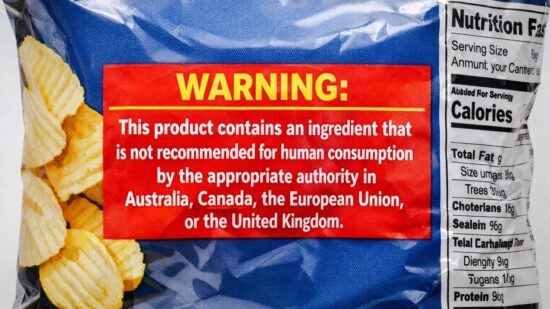
Businesses across the country face a consequential legal and commercial crossroads as Texas Senate Bill 25, branded the Make Texas Healthy Again Act, thrusts state level food labeling regulation into uncharted constitutional and regulatory territory. The stakes are high: companies that manufacture, market, or sell food products may soon confront unprecedented warning requirements that could upend longstanding federal standards and expose them to severe penalties.
What the Texas Law Will Require
Under Section 9 of the Act, any packaged food product sold in Texas that contains one or more of 44 listed ingredients must bear this statement on its label:
“WARNING: This product contains an ingredient that is not recommended for human consumption by the appropriate authority in Australia, Canada, the European Union, or the United Kingdom.”
This requirement applies to food labels developed or copyrighted on or after January 1, 2027, and carries the threat of civil penalties up to $50,000 per day per product and potential criminal sanctions for noncompliance. Such sweeping label mandates would apply even if products comply with federal labeling requirements under the Federal Food, Drug, and Cosmetic Actand related federal standards.
To many in the food and beverage sector, the text of the warning itself raises concerns: it purports to tie regulatory judgments to foreign jurisdictions’ rules where no such blanket “not recommended for human consumption” classification exists for many of the listed substances. Plaintiffs in the ensuing litigation argue this renders the warning inaccurate and misleading, a point we return to below.
But key to others is that as a Make America Healthy Again (MAHA) inspired law, it champions a regulatory shift that emphasizes strict ingredient disclosure and transparency rather than any banning of products or specific additives.
The 44 Ingredients Subject to the Warning Requirement
Based upon information in the legislative history file, ingredients include: Acetylated esters of mono- and diglycerides (acetic acid ester), Anisole, Azodicarbonamide (ADA), Butylated hydroxyanisole (BHA), Bleached flour, Blue 1 dye, and more ..
The Federal Court Challenge: First Amendment at the Forefront
On December 5, 2025, four food industry associations filed a federal lawsuit, American Beverage Association et al. v. Paxton, seeking to invalidate Section 9 on multiple constitutional and statutory grounds.
Central to the complaint is the contention that the required warning constitutes an unconstitutional compelled speech requirement under the First Amendment. The associations argue that Texas is forcing businesses to disseminate a government scripted message that is content based and misleading, without any actual factual determination by a U.S. regulatory authority like the FDA. They are heard to complain the cited authority is foreign regulatory policy not U.S. science nor U.S. law, but would science in Boston be better that from Brussels?
On December 12, 2025, the associations moved for a preliminary injunction to halt enforcement of the warning label requirements while litigation proceeds, citing irreparable harm from forced speech and the operational costs of redesigning packaging and websites to comply with the statute.
Federal Preemption and Vagueness
Beyond First Amendment challenges, the lawsuit asserts that Section 9 is preempted by federal food labeling law. Federal law already mandates specific ingredient disclosures and governs the content of food labels to achieve nationwide uniformity. Plaintiffs argue that Texas’s add on warning disrupts this uniform scheme and creates confusion over which standards govern labeling in interstate commerce.
Further, the complaint claims Texas’s language is unconstitutionally vague because it fails to delineate clearly when federal preemption applies and provides no workable framework for companies to determine whether a given product falls under the statute or existing federal requirements.
Commerce Clause Implications
The plaintiffs also assert that Section 9 violates the dormant Commerce Clause by forcing national or regional food producers to alter labels or formulations on a nationwide basis to avoid a patchwork of state laws. This is a familiar concern for businesses operating across state lines: a label requirement that applies only in Texas may effectively dictate manufacturing and marketing decisions elsewhere due to the economic impracticality of producing separate SKU variants.
Amicus Support and Broader Significance
The legal challenge has attracted support from the U.S. Chamber of Commerce, Pacific Legal Foundation, and Goldwater Institute, amplifying the case’s potential implications for commercial speech doctrine, federal preemption, and the limits of state authority in regulating food labeling.
What is Next
Why should business leaders outside the food sector care? Because this is not just about ingredients, it is about regulatory strategy. The Make Texas Healthy Again Act is explicitly aligned with the broader “Make America Healthy Again” movement, which a recent YouGov poll found that among those aware of MAHA, large majorities (72% to 78%) felt MAHA’s values on food, medicine, and agriculture reflected their own. A similar bill has already been drafted for introduction in the 2026 Maryland legislative session. Other states will follow, each adding its own variations and political gloss.
This Texas warning label law represents a pivotal collision of state regulatory ambition with entrenched federal authority and constitutional protections. For business leaders, this moment demands close legal and strategic attention: from First Amendment principles to federal preemption, the outcomes of these early challenges will resonate well beyond Texas, potentially shaping how and where food ingredients and other matters are disclosed to consumers in the United States.
Despite all of that, at this time of value alignment, including health policy views, because this MAHA inspired law involves ingredient disclosure and transparency rather than outright banning products or specific additives, it is widely popular and will likely survive judicial challenges.
_________________________
Join us for the next in our webinar series at the Intersection of Business, Science, and Law, “Everything You Always Wanted to Know about Environmental Law (But Were Afraid to Ask)” on Tues, Feb 17 at 9 am. The webinar is complimentary, but you must register here.