
Legal CRMs simplify client management and improve retention by centralizing data, automating communication, and identifying at-risk clients. Losing clients is costly – not just in revenue but in future opportunities and reputation. Studies show a 5% increase in retention can boost profits by 25% to 95%. Here’s how legal CRMs help:
- Centralized Data: All client info – contact details, case updates, and communication history – is stored in one place for easy access.
- Automation: Reminders, follow-ups, and personalized messages (e.g., birthdays or case milestones) run automatically, reducing manual effort.
- Client Behavior Insights: Analytics flag disengaged clients early, so you can act before they leave.
- Client Portals: 24/7 access to case updates builds trust and reduces anxiety.
- Post-Case Workflows: Tools like automated feedback requests and drip campaigns maintain relationships after case completion.
Legal CRMs aren’t just about organization – they strengthen relationships, reduce churn, and ensure no client feels overlooked. Simple tools, big results.
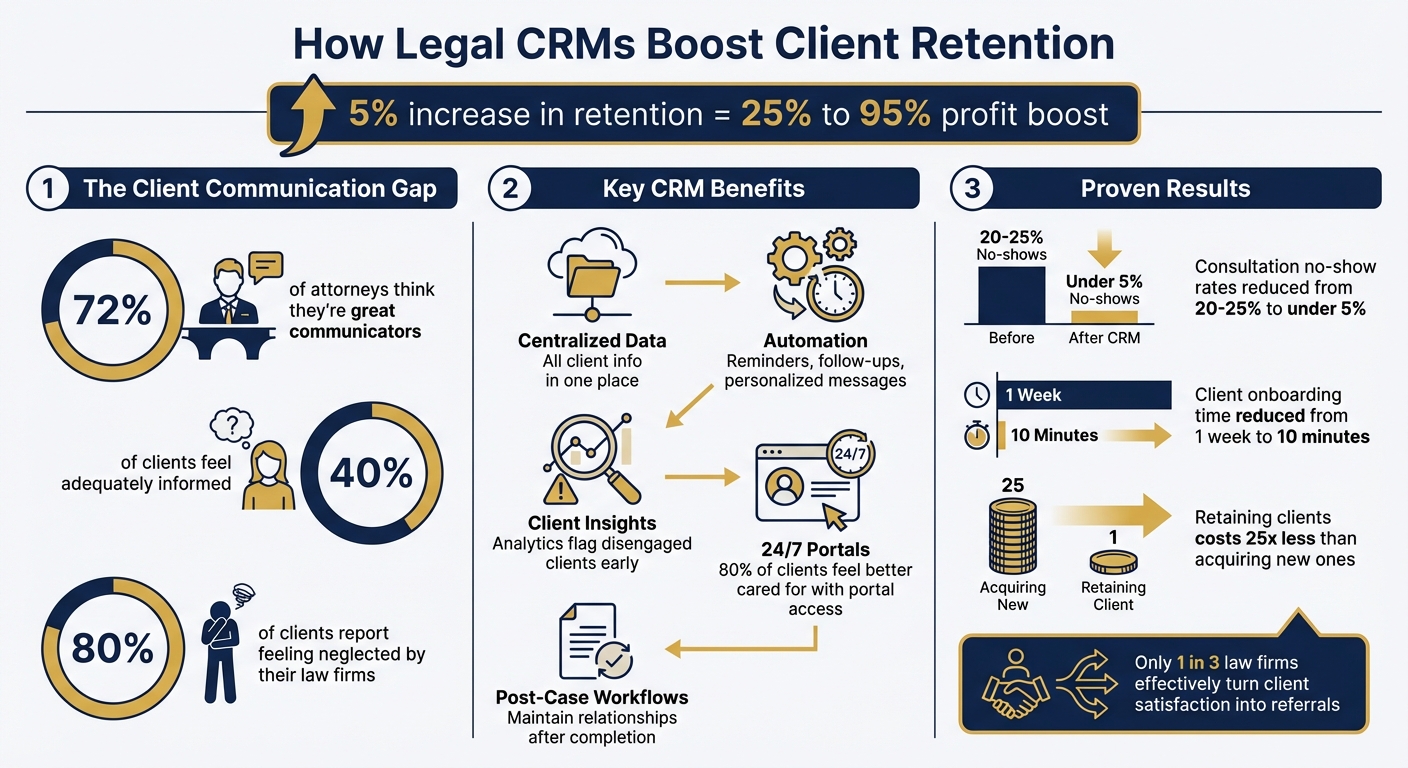
How Legal CRMs Improve Client Retention: Key Statistics and Benefits
How CRMs Support Client Retention
Legal CRMs bring everything together – client details, interaction histories, case notes, and even preferences – into one easily searchable database. No more hunting through scattered systems or files. This centralized setup forms the backbone for specialized features designed to help law firms keep their clients happy and engaged.
What Makes Legal CRMs Different
Legal CRMs go beyond simple data storage. They’re specifically designed to tackle challenges unique to legal practices. These systems align perfectly with the workflows of law firms, offering tools like matter-specific forms, intelligent routing, and seamless integration with legal software.
For instance, an immigration law firm can track critical timelines like naturalization dates, while a personal injury firm can stay on top of case milestones and settlement progress. This level of customization ensures that each firm has what it needs to manage cases efficiently.
What’s more, legal CRMs don’t just help with active cases – they also smooth out the process of turning leads into clients. Features like custom online intake forms and one-click eSignatures can reduce client onboarding time drastically, from a week to just 10 minutes.
CRM Features That Drive Retention
Legal CRMs pack in features aimed squarely at boosting client retention. Communication, automation, and visibility are the key pillars here. For example, automated drip campaigns keep your firm in clients’ minds even after their cases are resolved. Task automation ensures no follow-ups or important dates – like birthdays – slip through the cracks. These tools have even helped reduce consultation no-show rates from 20–25% to under 5%.
Relationship tracking tools are another game-changer. By analyzing how clients interact with your firm via email, phone, or text, these tools can flag disengaged clients early. This gives firms a chance to step in and address concerns before they escalate, strengthening long-term loyalty.
Client portals also play a huge role. They provide 24/7 access to documents and case updates, which not only reduces anxiety but also builds trust. In fact, 80% of clients report feeling better cared for when they have access to such tools. On top of that, analytics and reporting features help firms understand which lead sources bring in the most loyal clients and uncover trends in overall satisfaction.
sbb-itb-95f4849
CRM Strategies to Improve Client Retention
Centralizing Client Information for Better Service
Legal software for paralegals and attorneys simplifies client management by bringing all their details – contact info, case updates, intake progress, notes, and communication history – into a single, accessible location. This eliminates the chaos of scattered data, where vital information often gets buried in emails, paper files, or spreadsheets.
With these consolidated profiles, firms can deliver personalized service on a larger scale. By tracking client preferences, key dates (like birthdays or case anniversaries), and engagement trends, you can tailor interactions to make clients feel valued. Imagine a client calling in and any team member being able to pick up the conversation seamlessly, thanks to a complete view of their history. This consistency fosters trust and reassures clients that they’re more than just another case. Tools like The Legal Assistant are designed to integrate client data and streamline workflows, ensuring every interaction is logged and easily accessible.
“By centralizing client data in one location, legal professionals can ensure nothing is overlooked while enhancing communication and client satisfaction.” – American Bar Association
The stats tell a compelling story: while 72% of attorneys think they’re great communicators, only 40% of clients feel adequately informed. Centralizing data bridges this gap by giving your team a unified and complete picture. Syncing your CRM with email contacts and practice management tools creates a single, automated source of truth. Using standardized intake templates also ensures every team member collects consistent, high-quality information from the start.
Automating Client Communication
Once you’ve centralized client information, automation can keep the communication flowing. Drip campaigns, for instance, send personalized emails or texts triggered by case milestones or status updates. The key is to avoid sounding robotic – use CRM data to populate personal details in messages, making them feel authentic.
Multi-channel engagement is another game-changer. Combine automated emails and texts for reminders, document requests, or updates. Text messages, in particular, often outperform emails in engagement, especially when timing is critical. Some firms even use AI email assistants to handle high volumes of inquiries efficiently.
“By following up with your clients regularly and keeping them up to date (even when there isn’t a big update or action needed), you show that you are committed to their success in the long term and that you see your relationship with them as more than a transaction.” – Docketwise
Logic-based intake forms also elevate the client experience by asking relevant follow-up questions based on initial responses. This ensures you gather the right details from the beginning. Additionally, automated feedback requests after key case milestones can help identify clients who may be at risk of disengaging. By combining timely, tailored messages with automation, you strengthen relationships and improve retention.
Tracking Client Interactions and Satisfaction
After automating outreach, the next step is tracking every client interaction to spot signs of disengagement early. A CRM should consolidate all emails, calls, and texts into a single record, so clients never have to repeat themselves to different team members.
Quick response times are crucial – delays are a common source of dissatisfaction. Use CRM analytics to flag clients who haven’t heard from you recently, especially during slower periods in their case. Many clients (around 80%) report feeling neglected by their law firms, often because communication only happens when there’s major news. Scheduling proactive check-ins during case lulls can help maintain engagement.
Some advanced CRMs even offer predictive tools to gauge client sentiment in real time. They can categorize clients as promoters, passives, or detractors, helping you prioritize outreach to those most at risk. And here’s why it matters: a 5% boost in client retention can increase profits by 25% to 95%.
“Firms that measure their client experience through post-case surveys and net promoter scores (NPS) equip themselves with real data. This data can be used to spot trends and identify at-risk clients before an escalation (or a bad review) happens.” – Case Status
Reporting tools can also highlight where prospects or clients drop off in your pipeline, revealing bottlenecks that need fixing. Automated post-milestone surveys capture satisfaction data while the experience is still fresh. By consistently monitoring interactions, firms can address concerns quickly, reinforcing trust and loyalty.
Identifying and Rewarding Client Loyalty
Using CRM Data to Identify Loyal Clients
Your CRM system can be a goldmine for spotting loyal clients. Use custom tags to organize clients based on case type, engagement history, or professional status. For example, mark your “VIP” clients or “Top Referrers” to ensure they receive top-notch communication and tailored service.
Referral source tracking is another essential tool. It helps you trace new engagements back to their origins, giving you insight into high-value referral networks. As Intapp puts it:
“By connecting the client intake process to CRM, it becomes possible to link a new client or engagement with the person who referred the work and thus closing the loop and gaining this knowledge”.
Regularly analyze lead source reports to identify which referral partners bring not just the most clients but the best ones. Pay close attention to case volume, value, and realization rates – these metrics reveal who your most valuable clients are. Realization rates, which measure the gap between what’s billed and what’s collected, are especially important. They highlight clients who might be eroding profitability through excessive discounts. To keep relationships strong, set up alerts for high-value clients who haven’t been contacted recently.
Here’s a quick breakdown of key metrics to track:
| Metric Category | What to Track | Why It Matters |
|---|---|---|
| Financial Value | Matter profitability & realization rates | Highlights which clients contribute most to your bottom line |
| Advocacy | Referral source tracking | Identifies “brand advocates” driving high-value word-of-mouth growth |
| Engagement | Interaction frequency & communication logs | Ensures healthy relationships with consistent touchpoints |
Once loyal clients are identified, they can become the centerpiece of your retention strategies.
How to Reward Client Loyalty
After pinpointing your loyal clients, it’s time to show your appreciation. Start by automating milestone recognition – send personalized greetings or small gifts for birthdays, case anniversaries, or other notable dates.
You might also consider tiered loyalty programs. These programs reward clients for referrals or for using multiple services. Perks could include discounted rates, priority scheduling, or access to exclusive resources like webinars or legal libraries. The key isn’t lavish spending but demonstrating that you value their loyalty.
Timing is everything when it comes to asking for referrals. Use CRM workflows to request reviews or referrals during “emotional high points”, such as after a successful case resolution or a positive milestone. This is crucial because only 1 in 3 law firms effectively turn client satisfaction into referrals. And let’s not forget: retaining clients costs significantly less than acquiring new ones – up to 25 times less, in fact. Even a 5% increase in retention can lead to profit boosts ranging from 25% to 95%.
To maintain connections with former clients, set up automated “drip” campaigns. Quarterly updates or educational newsletters can keep you on their radar for future legal needs.
Maintaining Client Relationships After Case Completion
Using your CRM effectively after a case wraps up can make a big difference in retaining clients over the long haul.
Following Up for Future Legal Needs
Just because a case is closed doesn’t mean the relationship ends. Former clients can be a great source of repeat business, often at a lower cost than acquiring new ones.
Your CRM can help by tracking interaction history and relationship health, making it easier to anticipate when a client might need your services again. For instance, you can set up automated reminders for important dates like case anniversaries, statute of limitations deadlines, or regular check-ins. A good example is programming a task for a six- or twelve-month follow-up after the case concludes.
To make your follow-ups more impactful, segment your clients based on the type of case or their interests. This ensures your communication is relevant. For example, a client who worked with you on a real estate matter shouldn’t receive updates about family law. Instead, send them content related to property law changes or market trends that could affect them directly. This kind of tailored outreach keeps your firm in their minds without bombarding them with irrelevant information.
These personalized follow-ups can seamlessly connect with automated workflows, helping you nurture relationships even after the case is closed.
Managing Former Clients with CRM Workflows
CRMs can also help you transition clients from active cases to long-term relationship-building workflows. For instance, you can set up “if/then” rules so that when a case is marked as settled or a final invoice is sent, the client is automatically added to a post-case workflow. This ensures no client is overlooked.
“Even after a matter is settled, you can keep clients in the loop regarding new service offerings or other areas of interest via email drip campaigns.” – Rocket Matter
Through targeted drip campaigns, you can share timely legal updates or educational content. Additionally, you can automate feedback requests, asking for reviews or testimonials right after a case closes. This not only leaves a positive final impression but also helps build your firm’s credibility. You might also schedule messages for personal milestones, like birthdays or the anniversary of a case resolution, to maintain a personal connection.
Measuring CRM Performance for Client Retention
To keep clients coming back, it’s essential to evaluate workflows and automated touchpoints by focusing on key metrics.
Key Metrics to Track
Start by looking at communication and engagement metrics. Keep an eye on email delivery, open rates, and click-through rates. These indicators show whether your outreach is resonating and your contact lists are active. If open rates are slipping, it might be time to tweak your messaging or clean up outdated contact lists.
Response times are another major factor. Quicker replies can significantly improve client satisfaction and loyalty. Use your CRM’s time stamps to ensure your team is meeting expected response times.
Relationship health is equally important. CRMs can track how often you interact with clients and flag any drop in communication frequency, allowing you to reengage before it’s too late.
Beyond these, focus on lifecycle metrics like repeat business frequency and referral generation. These reveal client loyalty and help pinpoint potential bottlenecks in your processes.
“CRM analytics provide actionable insights into client behavior and satisfaction, guiding firms in refining their retention strategies and enhancing the client experience.”
- LexisNexis InterAction+
By monitoring these metrics, you can lay the groundwork for retention strategies that truly make an impact.
Using Data to Improve Retention Strategies
Data is only useful if you act on it. Use these insights to shape proactive retention strategies. Focus on leading indicators like engagement frequency and matter velocity rather than relying solely on past revenue data.
“If your firm is focused instead on lagging (historical) indicators like revenues, you won’t have visibility into problems while there’s still an opportunity to course-correct.”
- Intapp
Your CRM can help you identify at-risk clients. Watch for signs like slower project progress or a decline in the number of practice areas a client engages with – these can signal dissatisfaction or potential churn.
Segmentation analysis is another powerful tool. Break down your client data by case type, location, or engagement history to identify which groups are more likely to stick around.
Feedback loops are essential for continuous improvement. Use your CRM to collect Net Promoter Scores (NPS) and satisfaction surveys. Set up alerts to track engagement intervals, so you can address issues before they escalate.
Lastly, calculate the financial impact of retention. Measure your Customer Lifetime Value (CLV) to see the total revenue a client generates over time. Compare this with your Average Client Retention Cost (total CRM and engagement tool expenses divided by total clients). Even small improvements in retention – like a 5% increase – can lead to a 25% profit boost, proving the value of strong CRM strategies.
Conclusion
Building strong client relationships is the backbone of repeat business and referrals. Legal CRMs play a vital role by centralizing client information, automating communication, and offering insights that help deliver tailored services. These tools empower law firms to develop trust and loyalty, which, in turn, encourages repeat clients to invest more. By consistently focusing on client needs, firms can adopt a forward-thinking strategy that anticipates and addresses those needs effectively.
“Client retention stands as a cornerstone of success for law firms, fostering enduring relationships and sustaining growth.”
- LexisNexis InterAction+
The challenge lies in shifting from reactive to proactive relationship management. With the help of your CRM, you can spot clients at risk of leaving, reward loyal clients with exclusive perks, and automate follow-ups to keep your firm top-of-mind. Streamlining intake processes, improving response times, and offering personalized experiences show clients that they are valued for more than just their cases.
When implemented thoughtfully, a legal CRM doesn’t just organize data – it transforms how your firm connects with clients, setting the stage for long-term success.
FAQs
Which CRM features improve client retention the most?
Centralized client information, automated reminders for timely communication, personalized experiences via client segmentation, and relationship management tools are key elements that contribute to retaining clients. Together, these features build stronger connections, improve satisfaction, and lead to better retention outcomes.
How do I identify at-risk clients using CRM data?
To spot clients who might be at risk, keep a close eye on your CRM data for warning signs like slower progress on matters, declining revenue, or fewer interactions. CRMs help by centralizing client information and providing a clear view of activity history, making it easier to identify these patterns early. With this insight, you can take action – whether through personalized outreach or other strategies – to address concerns and strengthen client relationships, boosting retention in the process.
What should I automate after a case is closed?
After wrapping up a case, it’s smart to set up automated systems that keep your clients engaged and strengthen your relationship over time. For starters, consider automating follow-up messages, sharing updates on legal changes that might affect them, and scheduling periodic check-ins to gauge their satisfaction.
You can also automate reviews of client feedback and plan outreach efforts to maintain trust. A Customer Relationship Management (CRM) system is a great tool for this – it centralizes client data, making it easier to deliver consistent and personalized communication. This approach not only keeps clients happy but also boosts the chances of repeat business and referrals.
The post How Legal CRMs Boost Client Retention appeared first on The Legal Assistant.