
The debate of whether AI has shaped eDiscovery is no longer a question, but a testament to a complete architectural revolution.
As we navigate 2026, the legal industry has graduated from the experimental phase where machine learning was a luxury reserved for “Big Law” mega-cases.
Today, AI has transitioned into the very foundational bedrock of the legal process, an invisible but indispensable engine that powers every stage of eDiscovery.
What was once a high-cost add-on has matured into the industry’s standard nervous system, democratizing the ability to parse through petabytes of data with a level of surgical precision that human review alone could never achieve.
The Shift from Utility to Strategy: Why “Traditional” AI is No Longer Enough
As AI becomes the ubiquitous “nervous system” of eDiscovery, a new challenge has emerged for legal teams: The Plateau of Generalization. While off-the-shelf AI solutions have successfully standardized the EDRM, they operate as a “one-size-fits-all” solution. In a world where every firm uses the same generic algorithms, the technological playing field is leveled, and the competitive advantage disappears.
The revolution we are witnessing in 2026 is the transition from using AI to owning the intelligence and aiming for deployment flexibility. Standard models are trained on broad datasets to be “generally helpful,” but legal victory often hinges on the highly specific, the nuanced, and the proprietary.
This is the catalyst for the next architectural leap: moving beyond vendor-locked black boxes toward a more surgical, customizable, and defensible framework.
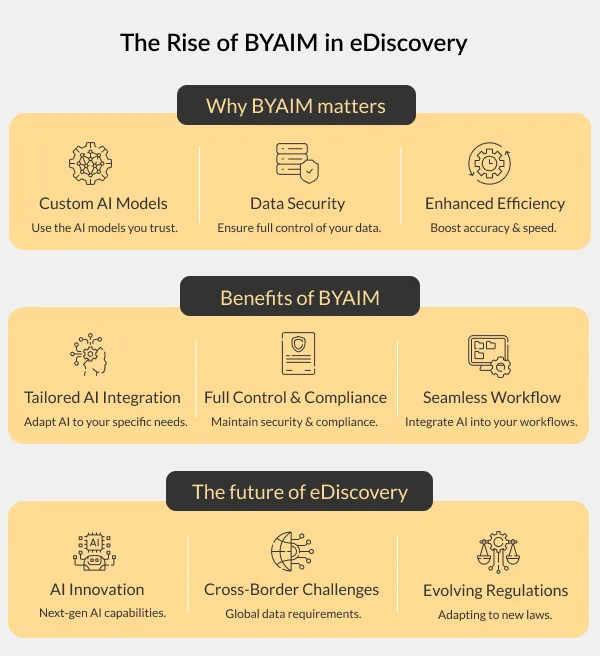
Value Differentiator of Bring Your AI Model (BYAIM)
To truly redefine legal intelligence, firms are now reclaiming control over the “brains” behind their discovery process.
By shifting from consumers of AI to orchestrators of models, legal teams can move beyond mere efficiency into the realm of strategic differentiation.
- Matter-Specific Context: Generic tools often struggle with niche industry jargon. BYAIM allows you to use models specifically fine-tuned for sectors like fintech, biotech, or energy, ensuring the AI understands the “dialect” of the evidence.
- Knowledge Portability: Organizations can capture “institutional DNA” by using models that have learned from years of past case outcomes, ensuring that every new matter starts with a wealth of pre-existing intelligence.
- Absolute Data Sovereignty: By deploying custom models within a private, controlled environment, firms ensure their sensitive coding strategies and proprietary algorithms remain private, never leaking into a vendor’s public training set.
Strategic Advantages Explained
Deploying your AI models offers a level of precision that generic algorithms simply cannot match. Here is why forward-thinking firms are making the switch:
- Matter-Specific Precision: Generic models may struggle with industry-specific jargon or unique corporate coding. BYAIM allows you to use models pre-trained on similar past matters, ensuring the AI understands the context from day one.
- Enhanced Cross-Matter Learning: Organizations can curate models that improve over time. By feeding the AI signals from multiple case teams, the model becomes a repository of institutional knowledge, recognizing patterns unique to your business or practice.
- High Cost and Time Savings: While traditional AI reduces review time, BYAIM supercharges it. By culling majority of non-responsive data through high-confidence classification, legal teams can focus expensive human review only on the “gray areas”.
- Reduced Risk and Bias: Custom models allow for greater transparency and “explainability”. You can audit exactly why a model made a decision, reducing the risk of “hallucinations” or hidden biases often found in black-box commercial tools.
- Strategic Early Case Assessment: With a custom model, you can analyze massive datasets in hours rather than weeks, allowing for faster decisions on whether to settle or proceed to trial.
The Gaps: What Happens Without BYAIM
When an eDiscovery workflow lacks the flexibility of BYAIM, several critical gaps emerge that jeopardize defensibility and efficiency of a case:
- Cold-Start Problem: Requires thousands of manual tags to “train” the system for each new case.
- Contextual Accuracy: May miss nuances in industry-specific slang or technical documentation.
- Data Silos: Knowledge gained in case A stays in case A; teams repeat the same work.
- Vendor Dependency: Stuck with the proprietary logic and updates of a single software provider.
The Strengths: What Happens With BYAIM Deployment
- Data-rich Environment: Reuses knowledge from prior matters to hit the ground running immediately.
- Contextual Relevance: High sensitivity to specific corporate nomenclature and “legal-speak”.
- Integrated Data System: Institutional “wisdom” is captured and deployed across the entire enterprise.
- Self-reliant Deployment: Freedom to use the most advanced, specialized models (e.g, specific NLP or LLMs).
Without BYAIM, legal teams often find themselves in a cycle of redundant review. They spend hours re-coding documents identical to those they reviewed in previous litigation, leading to “reviewer fatigue” and an increased risk of human error.
Addressing Data Privacy Concerns with BYAIM
Safeguarding client private data remains a core requirement in any eDiscovery environment, particularly when AI capabilities are involved.
In several regions, the use of a fixed or in-built AI model within an application can raise concerns around data residency, regulatory compliance, and the acceptability of how data is processed, which may limit adoption.
A BYAIM approach helps address these constraints by allowing organizations to integrate their own trusted AI, aligned with internal governance and regional requirements.
This enables teams to leverage advanced AI outcomes while maintaining stronger control over how sensitive matter data is handled, where it is processed, and how security and privacy expectations are enforced.
BYAIM – Orchestrating the Next-Gen Paradigm in Legal Deployment Solutions
Industry leaders across the legal-tech spectrum, including pioneers at Knovos, view Bring Your Own AI Model (BYAIM) as the standard for enterprise-grade deployment in 2026. They don’t see it as just another feature, but as a “Strategic Decoupling” of the software from the intelligence.
Industry leaders believe that by 2027, eDiscovery platforms that don’t support BYAIM will be viewed as obsolete. The competitive edge has moved from “having AI” to “how well you can deploy the AI you already trust.
Conclusion
Ultimately, the rise of BYAIM is more than a technical upgrade; it is the final piece of the puzzle in creating a truly defensible, scalable, and sovereign legal enterprise.
As we move through 2026, the firms that dominate will not be those that simply “use AI,” but those that orchestrate it, leveraging custom intelligence to turn mountains of data into clear, actionable legal strategy. In this new era, BYAIM is the architect of a future where legal excellence is defined by the depth of a firm’s institutional knowledge and the precision of the models they choose to deploy.
The post Strengthening Deployment Architecture – The Rise of BYAIM in eDiscovery appeared first on Knovos.