
Hey there Legal Rebels! 👋
I’m excited to share with you the 87th episode of the LawDroid Manifesto podcast, where I will be continuing to interview key legal innovators to learn how they do what they do. I think you’re going to enjoy this one!
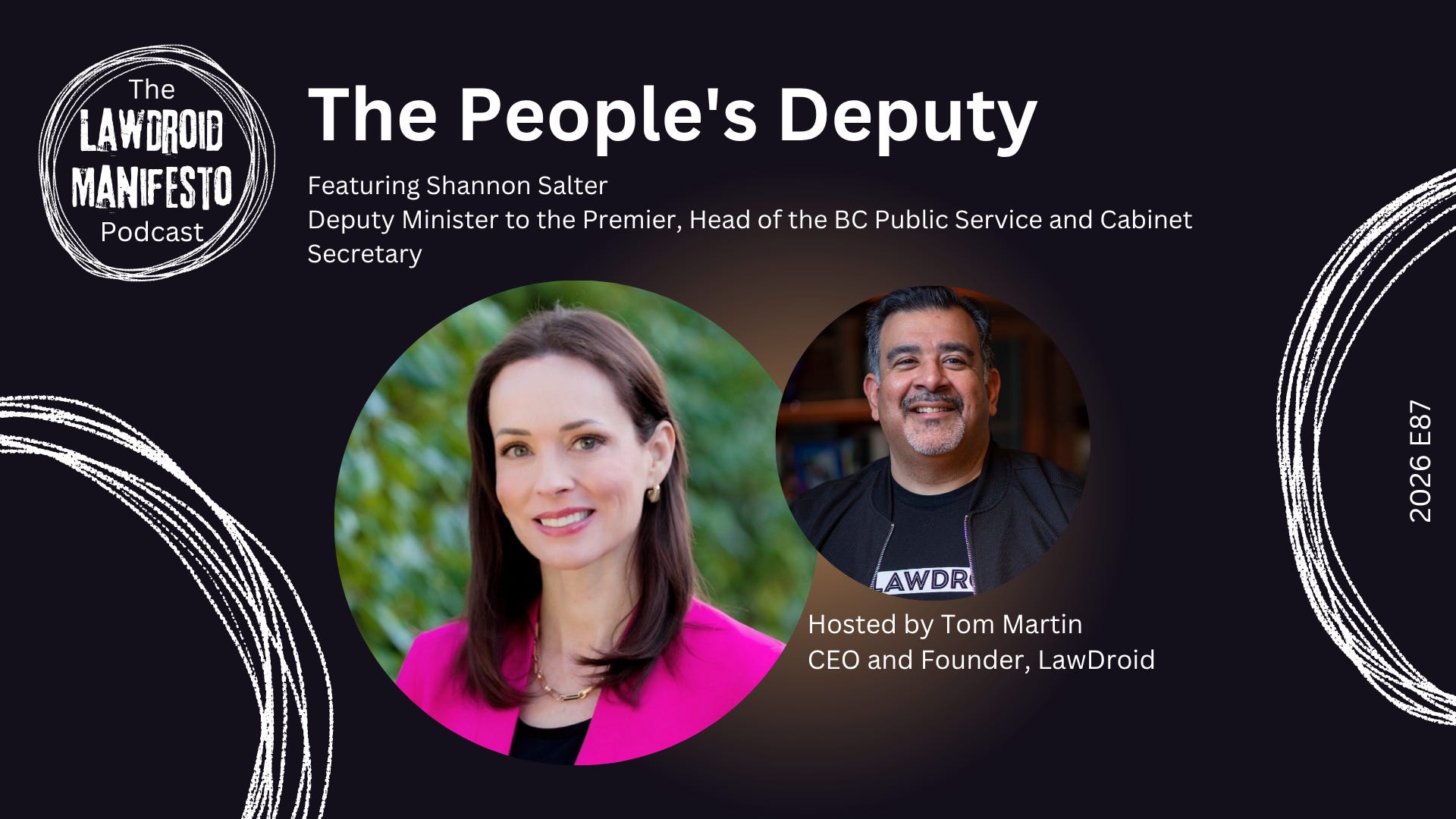
I’ve known Shannon Salter for years as the Founding Chair of the British Columbia Civil Resolution Tribunal, Canada’s first online tribunal. She’s always impressed me as one of the smartest, humble, and most effective people that I know. She approaches legal innovation not from a tech-first standpoint, but with a people-first commitment. Now, as Deputy Minister to the Premier of BC, she can effect positive change for the people who need it at a whole new level. That’s why I’ve dubbed her, “The People’s Deputy.”
If you want to understand how a government can rebuild its relationship with citizens from the ground up, you need to listen to this episode. Shannon is at the forefront of reimagining public service delivery in British Columbia and brings a unique perspective shaped by her years transforming access to justice.
From the Civil Resolution Tribunal to Government 3.0
Join me as I interview Shannon Salter, Deputy Minister to the British Columbia Premier, Cabinet Secretary, and head of the BC Public Service. Shannon previously served as Deputy Attorney General and Deputy Minister responsible for housing, and before that spent almost eight years as founding Chair of the BC Civil Resolution Tribunal, Canada’s first online tribunal.
In this insightful episode, Shannon walks through her path from a homeschooled childhood on Salt Spring Island to the highest levels of BC government. She explains how she built the Civil Resolution Tribunal from a piece of legislation with no staff and no office into a system that resolves small claims, strata, and motor vehicle accident disputes by designing every step around the person with the most barriers to access, not around the technology itself.
Shannon also shares how those same lessons now inform Connected Services BC, a government-wide initiative aiming to give citizens one front door for every interaction with the state by 2030. She discusses the promise and the risks of AI in closing the information gap between ordinary people and expensive professional expertise, and reflects on what has kept her going through decades of public service work.
The Skinny
Shannon Salter has spent her career proving that justice and government systems work best when they are built around the people who use them. As founding Chair of BC’s Civil Resolution Tribunal, she took an empty piece of legislation and turned it into Canada’s first online tribunal, one designed for plain language, accessibility, and asynchronous use rather than the pomp and formality that keeps ordinary people at arm’s length from the legal system. That same philosophy now guides her work as Deputy Minister to the BC Premier, where she is helping lead Connected Services BC, an effort to consolidate government services around life events so citizens stop having to repeat the same information to different ministries. Along the way, Shannon reflects on her unconventional homeschooled upbringing on Salt Spring Island, her early disillusionment in law school, and how AI could help close the long-standing information asymmetry between everyday people and expensive legal or financial expertise, if it is built responsibly.
Key Takeaways
-
Design justice and government systems around the person with the most barriers to access, and everyone else will be served well too.
-
The BC Civil Resolution Tribunal succeeded because it treated continuous improvement as an enduring obligation, not a one-time project, publishing participant satisfaction surveys month after month.
-
People’s subjective sense of fairness, whether they felt heard and treated with respect, matters as much to access to justice as the substance of a decision.
-
Connected Services BC aims to give BC residents one login and one front door for government services by 2030, inspired by the Dutch “life events” model.
-
Government already holds most of the information it repeatedly asks citizens to provide, and reducing that administrative burden builds trust.
-
AI has real potential to correct information asymmetry by giving ordinary people access to legal and government knowledge they could otherwise never afford.
-
A homeschooled, unstructured childhood exposed to people far outside her peer group shaped Shannon’s capacity to empathize across different walks of life.
-
Law school tends to erode the optimism and sense of agency students arrive with, and Shannon encourages students to hold onto their own definition of success.
-
Sustainable, energizing work comes from aligning your career with your purpose, not from chasing a conventional definition of success.
-
Legal professionals need to rethink their value proposition and regulatory model, because AI will force that reckoning quickly.
Notable Quotes
-
“It’s about bringing the justice system to where people are, building it around their lives, accounting for the bundle of skills and abilities and challenges that people have and offering them fluidity and flexibility and respect and dignity in how we help them solve their problems.” Shannon Salter [26:17 to 26:48]
-
“Design for the person who has the most barriers to accessing justice and assume that if you do that, it’s going to work for everybody else.” Shannon Salter [28:51 to 29:08]
-
“Continuous improvement is not a one time commitment. It is an enduring obligation.” Shannon Salter [31:53 to 32:07]
-
“People’s subjective views of fairness are kind of the biggest thing that informs their perception of the administration of justice.” Shannon Salter [33:10 to 33:20]
-
“There is a special kind of exhaustion that comes from spending your days doing things that are not aligned with your purpose.” Shannon Salter [44:26 to 44:50]
-
“AI is going to be the brute force that makes that happen in a hurry.” Shannon Salter [42:56 to 43:15]
Clips
One Front Door For Government
Push Services Before You Ask
Why Law School Crushes Idealism
What Judges See Behind the Curtain
Shannon Salter’s career traces a clear line from a self-directed childhood on a small Gulf Island to reshaping how millions of British Columbians experience their government. Whether she was building the Civil Resolution Tribunal from nothing or now leading the effort to give citizens one front door to government services, her guiding principle has stayed the same: design for the person with the fewest resources and the most barriers, and trust and access will follow for everyone else. As AI reshapes how people find legal and government information, Shannon’s decades of hands-on experience offer a grounded, human-centered blueprint for what comes next.
Closing Thoughts
Talking with Shannon always reminds me why I got into this work in the first place. Long before “generative AI” became part of our everyday lexicon, Shannon was already proving what it actually takes to close the access to justice gap between people and the systems that are supposed to serve them: humility, relentless iteration, and a willingness to ask people directly whether they felt heard. What strikes me most about her is how she describes the Civil Resolution Tribunal not as a technology project but as a people project that happened to need technology. That distinction matters more than ever as AI-first tools flood into legal and government services. The tools will keep changing. The discipline of designing for the person with the least access, and then measuring whether you actually helped them, is the part that lasts. Shannon has lived that discipline for over a decade, and BC is all the better for it. I hope this conversation gives you as much to think about and act on as it gave me.