Hey there Legal Rebels! 👋
I’m excited to share with you the 85th episode of the LawDroid Manifesto podcast, where I will be continuing to interview key legal innovators to learn how they do what they do. I think you’re going to enjoy this one!
This session was one of my favorites from the LawDroid AI Conference and I don’t want you to miss out on it. If you’ve ever felt uneasy about the “women are falling behind in AI” headlines, you need to listen to this episode. Professor Cat Moon and three of the sharpest voices in legal innovation take that story apart live, with no guardrails, and no holds barred.
Rewriting the “Falling Behind” Story
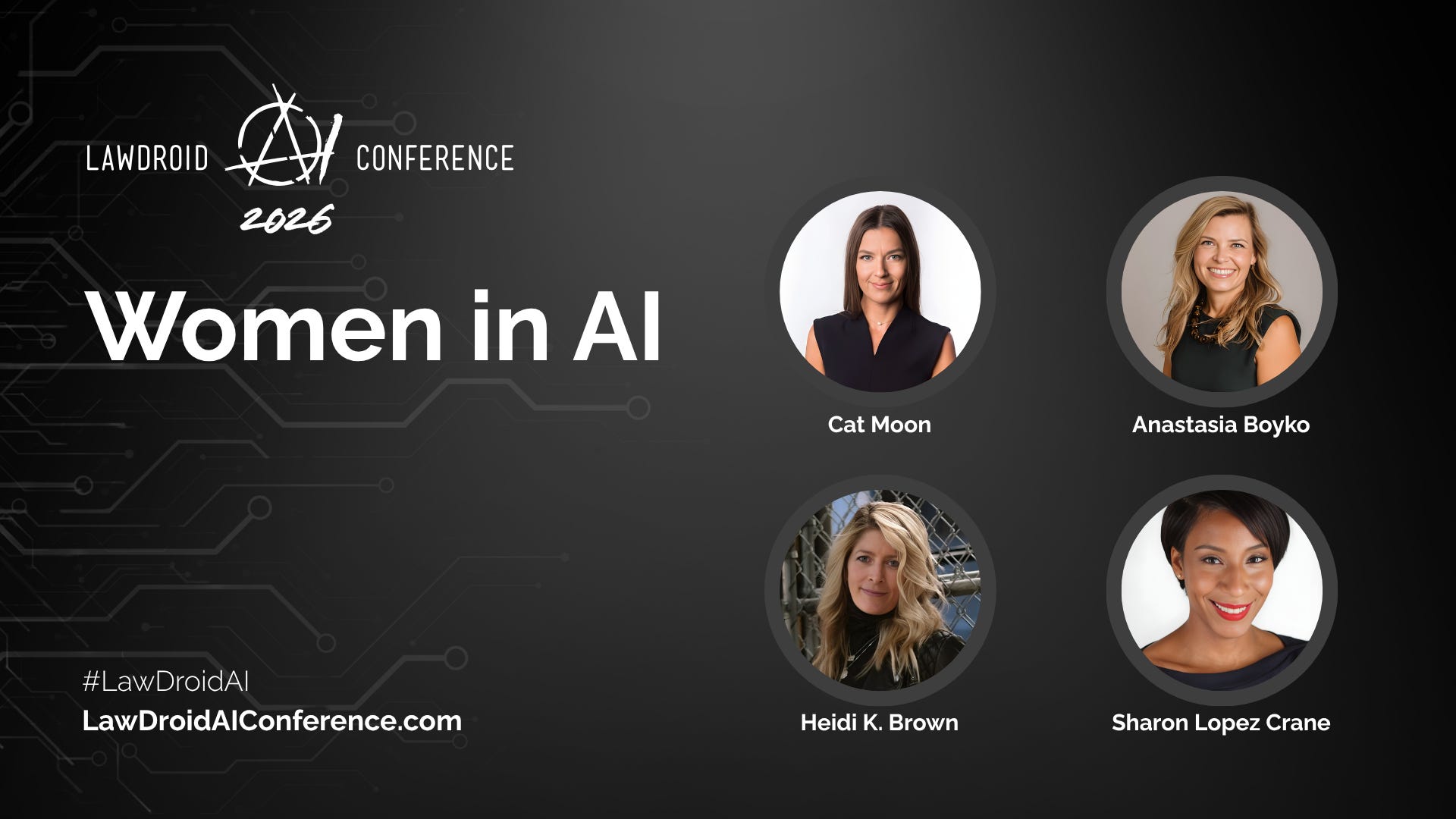
Join me as I share a panel recorded live at the third annual LawDroid AI Conference, “Women In AI,” moderated by my friend Cat Moon, professor of the practice at Vanderbilt Law School and co-director of the Vanderbilt AI Law Lab.
Cat brought together Anastasia Boyko, legal innovation consultant and legal futurist, Heidi Brown, associate dean for upper-level writing at New York Law School, and Sharon Crane, president of Practicing Law Institute (PLI), for an unscripted conversation about a headline that will not go away: women are falling behind in AI.
This is a conversation about narratives, judgment, and who actually gets to set the standard for what “ahead” means.
The Skinny
Cat Moon opens with a provocation: the “women are falling behind in AI” story isn’t based on facts, it’s a narrative, one that measures the wrong thing and influences women to doubt their own judgment. From there, the panel digs into what’s actually happening: women aren’t absent from AI, they’re being intentional about it, while the loudest voices online — many times male voices — mistake volume for leadership. The conversation moves through visibility versus competence, who gets invited onto panels and why, and closes with a hard question: if the legal profession automates its current values as-is, billable hours, prestige hierarchies, advocacy without judgment, does AI fix the profession, or just amplify its failures?
Key Takeaways
-
The “falling behind” narrative measures frequency of AI use, not competence, and sets male usage patterns as the standard everyone else is judged against
-
Being loud (LinkedIn thought leadership, hot takes, demos) is being conflated with being ahead; visibility isn’t vision, and capital isn’t competence
-
Real skill-building with AI looks like the medical “see one, do one, teach one” model: it’s slow, iterative, and can’t be shortcut by a fast prompt
-
Panel composition is a choice, not a constraint. When “no women were available” comes up, it’s usually a sign organizers didn’t look past the same few names
-
The deepest risk isn’t automating tasks, it’s automating the legal profession’s existing flaws (billable hour incentives, prestige hierarchies, advocacy without judgment) at scale
Notable Quotes
-
“We are not falling behind in AI. We’re not behind. We are intentional, we are watching, we are thinking, we are paying attention, we are talking. We are doing.” Cat Moon [6:31 to 6:45]
-
“My first legal writing and generative AI class I taught in 2024 was only 23% women. My next cohort rose to 57% women. And then my legal research and AI class that I just wrapped literally yesterday was 66%.” Heidi Brown [9:47 to 10:02]
-
“Men aren’t ahead of us in AI. They’re louder, they dominate the LinkedIn thought leadership circuit… and being the loudest in line is not the same as being the one worth listening to.” Cat Moon [17:07 to 17:56]
-
“We are looking not for the loud person but for the trusted, credible person who’s got their hands dirty, either experimenting on themselves or with students or with colleagues.” Sharon Crane [22:54 to 23:08]
-
“We have an aspirational obligation to help people who can’t afford to get help. And we’re failing, because we have a 92% failure rate.” Anastasia Boyko [39:51 to 40:01]
Clips
Men Aren’t Ahead — They’re Just Louder
Women Aren’t Behind in AI
We Are Automating Away Our Failures
Thought Leadership Is Often Performative
Underneath the disagreement, all four panelists land in the same place: the technology isn’t the risk. Building the next decade of legal practice on the profession’s current, unexamined values is. Whether that shows up as billable-hour incentives or who gets handed the microphone, AI will scale whatever foundation it’s given, noble or not.
Closing Thoughts
I love Cat’s line about the narrative being the trap. We’ve all seen those “women are falling behind” posts and nodded along without asking what’s actually being measured and even if it’s true. This panel didn’t let that slide, and it didn’t let anyone off the hook either, including the profession’s own comfortable habits. That’s the kind of conversation I want more of on this show: less demo-and-hype, more discernment, curiosity and thoughtfulness. Let’s go!
By the way, if you would like to meet other superlative legal innovators in person, and enjoy an exceptional awards gala celebration, don’t miss the Oscars of Legal Innovation: the American Legal Technology Awards, this October 25, 2026, in Boston. Reserve your Early Bird tickets today and save $100.