
Hey there Legal Rebels! 👋
I’m excited to share with you the 90th episode of the LawDroid Manifesto podcast. This one is something special! Every year, in our run-up to the American Legal Technology Awards later this month, we host four legal industry executives to discuss the state of the industry.
ALTA co-founder Patrick Palace leads the discussion with leading legal executives:
Ed Walters, VP of Legal Innovation and Strategy at Clio and former CEO of Fastcase, Ann Cosimano, General Counsel of ARAG, Suresh Khanna, CEO of Smith.ai, and Sharon Crane, President and CEO of the Practising Law Institute
If you want to understand where AI is actually taking the legal profession, not the hype version, but the practical, in-the-trenches version, you need to listen to this episode. This panel brings together four leaders who sit at very different vantage points on the industry, legal research and practice management, insurance-backed legal plans, intake and the business of client acquisition, and legal education, and together they paint a remarkably consistent picture of where things are headed.
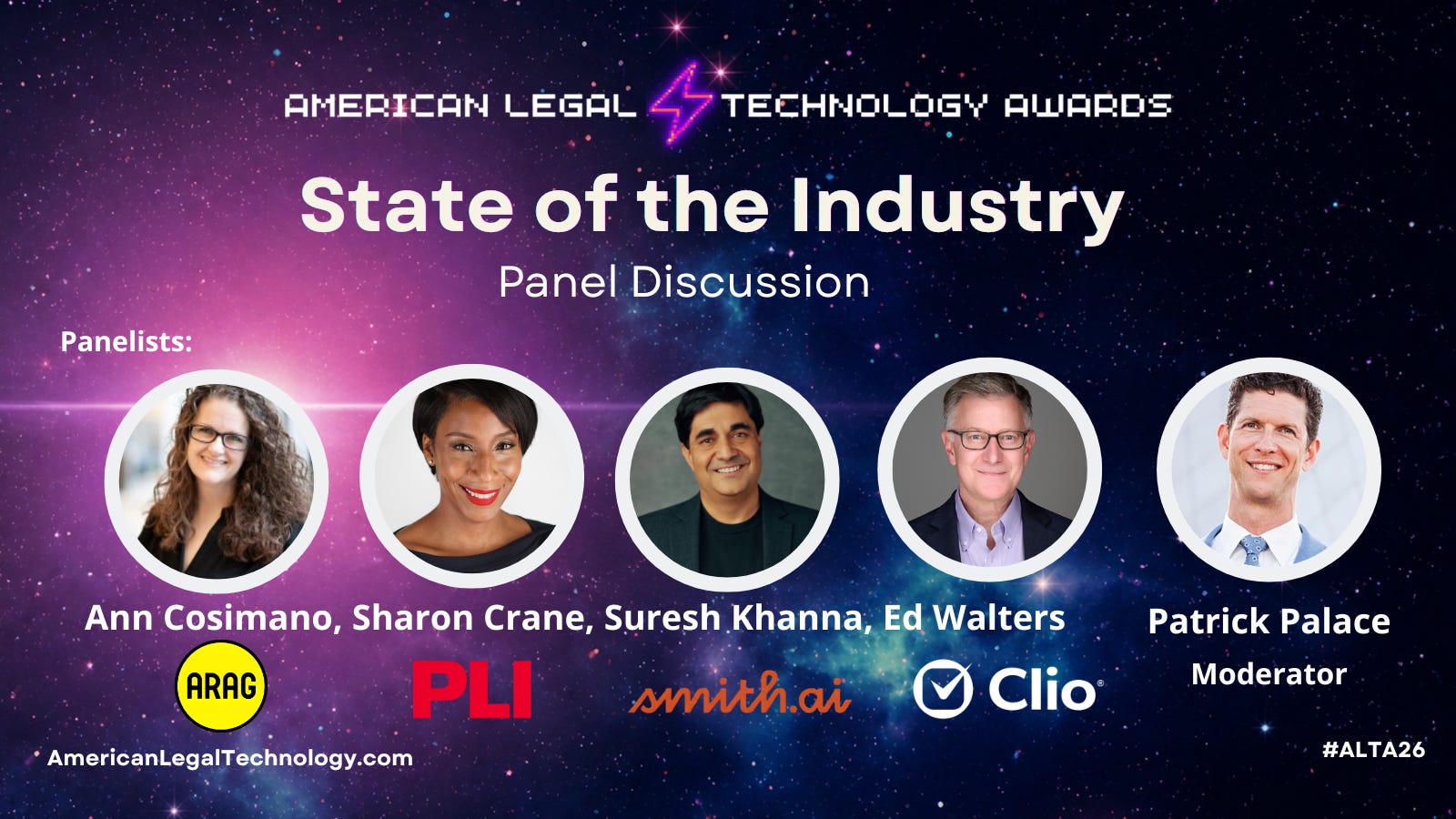
State of the Legal Industry: AI, Access to Justice, and the Business of Law
In this wide-ranging conversation, the panel covers how AI is moving legal review from the beginning of the work to the end, why mediocre AI output no longer counts as legal work, and why the brute force compute work that used to train junior associates is disappearing. Ann Cosimano shares what ARAG is seeing across its national network of attorneys, including rising disciplinary actions tied to improper AI use and a split among attorneys on actual adoption. Suresh Khanna makes the case that the front office, intake and client acquisition, is the next frontier for legal technology, arguing that most law firms run a sales process that would get someone fired at a typical tech company. Sharon Crane explains how PLI built an AI-ready lawyer competency framework to help attorneys and firms assess their own readiness beyond just tool training.
The panel closes with predictions for the year ahead, covering AI becoming invisible infrastructure, courts struggling to keep pace with a flood of AI-assisted filings, and a wave of consolidation that could reshape which firms exist a decade from now.
The Skinny
This is the seventh annual State of the Legal Industry webinar from the American Legal Technology Awards, moderated by Patrick Palace. The panel, Ed Walters of Clio, Ann Cosimano of ARAG, Suresh Khanna of Smith.ai, and Sharon Crane of PLI, walks through how AI is changing where legal review happens, what counts as real legal work versus commodity output, and how the business of law itself is shifting. Ed argues that supervision of AI output is moving to the end of the process where it always belonged, and that brute force compute work, the kind firms used to bill clients to train associates, is better done by machines now. Ann describes how ARAG is using AI to help members categorize legal issues in plain language and flags a rise in disciplinary actions tied to improper AI use among network attorneys, alongside survey data showing attorneys remain cautious adopters. Suresh argues that law firm intake is a sales funnel most firms run badly, and that the next competitive battleground in legal tech is the front office, not the back office. Sharon explains PLI’s new AI-ready lawyer competency framework, built around fluency, oversight, and governance rather than tool-specific training. The panel discusses courts being overwhelmed by self-represented litigants using AI, firms overspending to keep pace with the technology race, and closes with predictions ranging from AI becoming invisible infrastructure to a coming wave of law firm consolidation driven by profitability rather than revenue.
Key Takeaways
-
Legal review is shifting from the front of the process (hiring credentialed people and trusting their output) to the end (validating citations, checking for hallucinations, confirming the work holds up).
-
Mediocre AI output is not legal work. Clients can generate a first draft themselves; the value lawyers add is human judgment, discernment, and counseling layered on top.
-
Brute force compute work, document review, due diligence, contract clause hunting, is better handled by machines now, which forces firms to rethink how they train associates.
-
ARAG is seeing a rise in disciplinary actions tied to improper AI use among its network attorneys, often connected to hallucinated case citations used in filings.
-
Attorney AI adoption remains split. ARAG’s survey found 44% using AI in some form and 53% not using it at all, compared to an industry-wide figure cited at 69% across private practice and in-house roles combined.
-
Intake and client acquisition is described as the next major frontier in legal tech, with many firms running an outdated, inconsistent sales process despite the high value of each qualified lead.
-
PLI built a five-pillar, 20-competency AI-ready lawyer framework covering fluency, critical oversight, and governance, designed to help firms assess where their training gaps actually are.
-
Courts are seeing a rising volume of filings from self-represented litigants using AI, often well-formatted but containing hallucinations, while courts themselves lack the budget and tools to keep pace.
-
Panelists expect AI to become invisible, embedded infrastructure rather than a standalone feature, within the next few years.
-
Predictions for the next decade include law firm consolidation driven by profitability rather than revenue, with better-run firms acquiring or absorbing larger but less efficient ones.
Notable Quotes
-
“Mediocre answers, the kind of output of AI tools, even great AI tools, are not the kinds of things that clients are or should pay for.” Ed Walters [05:42 to 06:05]
-
“We’re seeing a higher occurrence of disciplinary actions related around improper use of AI.” Ann Cosimano [14:15 to 15:02]
-
“Most law firms aren’t built to run a great intake process. It’s really hard. It’s amazingly valuable. It’s probably the most valuable sales funnel in small business.” Suresh Khanna [22:49 to 23:01]
-
“If I’m sitting in the hospital with a concussion, calling PI firms on Google, the last thing I want to do is talk to a robot.” Suresh Khanna [25:40 to 26:03]
-
“It’s less about the tools and more about the practitioner and how do you use any tool.” Sharon Crane [29:45 to 30:24]
-
“I think it puts us in a great place because this is what lawyers go to school for, is to be counselors.” Sharon Crane [33:25 to 34:35]
-
“AI can generate the information, it can’t generate trust. The future of the profession belongs to the lawyers who combine technology with judgment, ethics, and human connection.” Ann Cosimano [50:44 to 51:07]
-
“The biggest law firm in the world 10 years from now, 2036, doesn’t exist today.” Ed Walters [55:03 to 55:40]
Clips
Abundance Often Feels Overwhelming to Lawyers
Mediocre Answers Are No Longer Legal Work
Law Firms Are Losing Leads at Intake
AI Will Become Invisible Infrastructure
Across four very different vantage points, insurance-backed legal services, legal research and practice management, intake and client acquisition, and legal education, this panel arrived at a strikingly similar place. AI is pushing lawyers toward the top of their skill set: judgment, empathy, and counseling, while pulling them away from brute force work that clients no longer want to pay for. The risks are real, hallucinated citations, disciplinary actions, overwhelmed courts, but so is the opportunity, a front office and an access-to-justice gap that technology is only beginning to address. The firms that win won’t be the ones with the flashiest AI. They’ll be the ones that turn it into trust.
Closing Thoughts
What struck me most about this panel is how much agreement there was across four people who approach the legal industry from completely different angles. Nobody on this stage is arguing that lawyers are becoming obsolete. Quite the opposite, every one of them is describing a profession that gets to spend more time on the parts that actually require expertise and humanity: judgment, empathy, counseling, trust. The brute force work is going away, and that’s not a loss, it’s an improvement, for good.
Thanks to Patrick for moderating, and to Ed, Ann, Suresh, and Sharon for bringing such different, complementary perspectives to the table. See you at the American Legal Technology Awards Gala in Boston this weekend!