
In the previous article, the focus was on what Singapore introduced in the new Health Information Bill and why it raised expectations for access control, traceability, and governance. Those requirements matter because healthcare teams need to share more information for continuity of care, while still demonstrating strong safeguards over sensitive data.
That is where execution becomes the differentiator. Organizations need a practical way to manage sensitive patient information in day-to-day workflows, especially when records move across teams, external partners, and multiple systems.
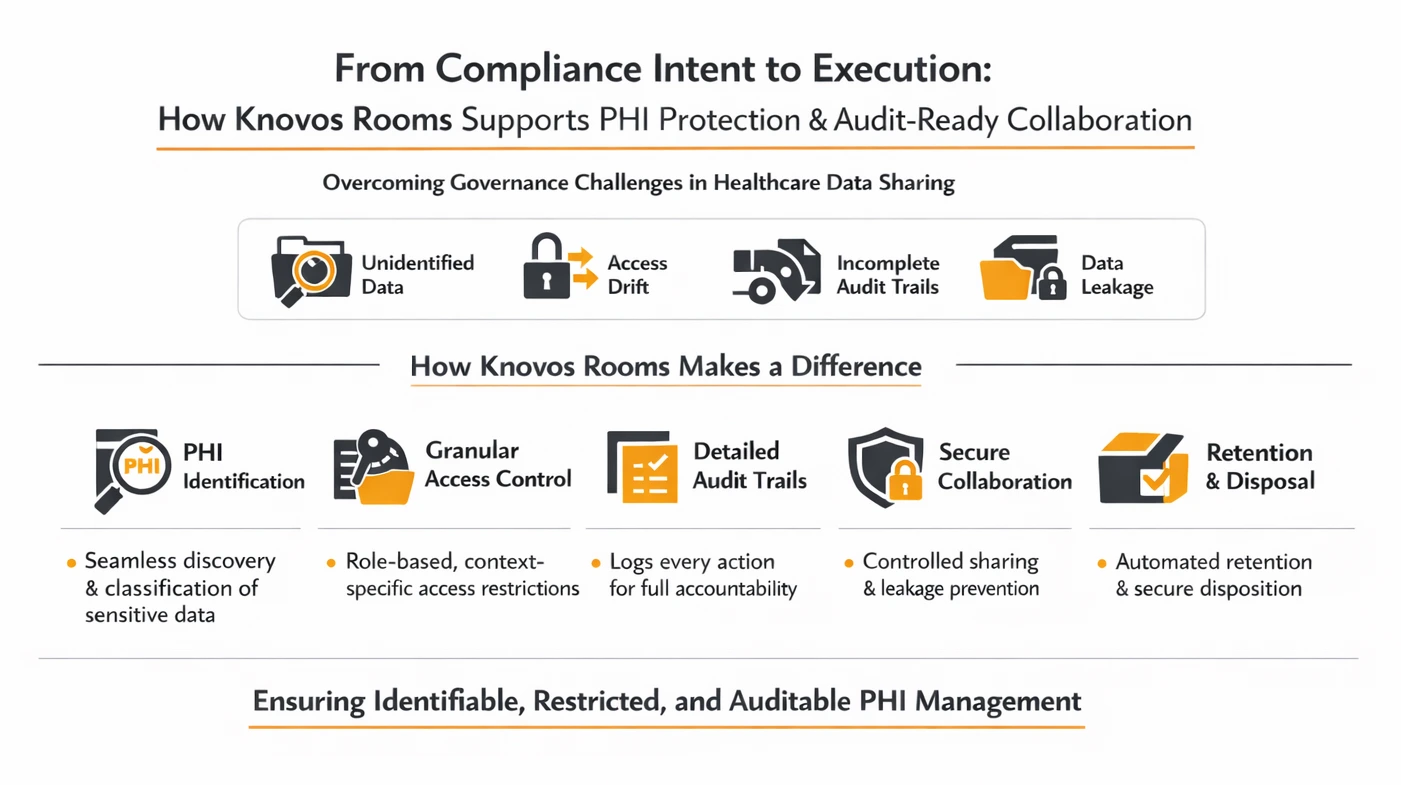
Why governance breaks down in real workflows.
Most breakdowns happen in predictable places.
- Sensitive information is not consistently identified across repositories and formats
- Access controls drift as more stakeholders get involved
- Audit trails are incomplete or hard to interpret during an investigation
- Collaboration creates leakage risk through uncontrolled forwarding or downloads
A governance approach that works in practice must address these points without slowing operational work.
How Knovos Rooms supports compliance execution
Knovos Rooms is positioned as a secure collaboration solution designed for handling highly sensitive information, making it well-suited for healthcare data governance and NEHR-related compliance needs.
-
PHI identification
Healthcare organizations cannot protect what they cannot reliably find. Knovos supports the identification and classification of personal data within its repository.
In a healthcare context, PHI is a high-risk category of personal data. This capability can be applied to identify PHI across healthcare content so teams can route sensitive records into controlled workflows, apply access restrictions earlier, and reduce accidental exposure during sharing and collaboration.
-
Granular access control aligned to treatment context
Knovos Rooms enables organizations to define who can access what, down to individual files, and restrict access based on roles, projects, or treatment context.
This aligns with the requirement that access must remain limited to authorized professionals and permitted purposes.
-
Action-level audit trails that support accountability
Every action in Knovos Rooms is logged, including who accessed a document, when it was accessed, and what actions were taken such as viewed, downloaded, and shared.
This supports compliance reviews and strengthens investigation readiness when unauthorized access is suspected.
-
Secure collaboration with controls that reduce leakage risk
Healthcare often requires collaboration across teams and institutions. Knovos Rooms supports secure document sharing and digital rights management, including prevention of unauthorized forwarding or downloads in controlled sharing scenarios.
-
Retention and secure disposition
Knovos Rooms supports defined data retention policies and secure disposition of records when no longer required.
Conclusion
Singapore’s Health Information Bill increases the need for provable controls around sensitive health data. For organizations handling PHI, practical readiness depends on three outcomes.
- PHI can be identified consistently across rooms.
- Access can be restricted at a granular level based on role and purpose
- Every critical action remains auditable, including viewed, downloaded, and shared
Knovos Rooms supports these outcomes through secure collaboration, granular access control, action-level audit trails, and PHI-aligned discovery and classification capabilities.
The post From compliance intent to execution: how Knovos Rooms supports PHI protection and audit-ready collaboration appeared first on Knovos.