
When your law firm is stretched too thin, it impacts everything – client service, employee morale, and financial performance. Here’s how to tell if you’re facing a staffing problem:
- Missed Deadlines: Filing delays or slow client responses signal overwhelmed staff.
- Administrative Backlogs: Unprocessed files, delayed invoices, and bottlenecks slow operations.
- Burnout: Over 70% of legal professionals report stress, with many working weekends to keep up.
- Low Productivity: Attorneys spend just 38% of their day on billable work, losing revenue potential.
- Overtime Dependency: Relying on extended hours hides deeper capacity issues.
If these challenges sound familiar, it’s time to act. Assess staffing needs using metrics like utilization rates, revenue per employee, and employee feedback. Then, consider solutions such as hiring, automation, or flexible staffing to lighten the load and improve efficiency. Addressing these issues now can prevent long-term damage to your firm’s reputation and bottom line.
Signs Your Law Firm Needs More Staff
Spotting staffing shortages early can help prevent small problems from snowballing into major setbacks.
Missed Deadlines and Slower Client Response Times
If your firm is consistently missing filing deadlines or taking too long to return client calls, it’s a clear sign that your team is stretched too thin. Often, it’s not about negligence – attorneys are simply overwhelmed with tasks that pull them away from client communication.
“A client complaining that it is difficult to get a meeting, phone call, or email response from an attorney is often a sign that your staff may be too busy.” – Filevine
This issue worsens when attorneys spend their time on non-legal tasks like answering calls, entering data, or tracking down information. These delays don’t just frustrate clients – they also affect billing. On average, it takes law firms 43 days to bill for completed work. Missed deadlines and delayed responses only stretch this timeline further, harming cash flow and eroding client trust.
Growing Administrative Backlogs
Missed deadlines are just the tip of the iceberg. Administrative tasks often pile up, creating bottlenecks like unprocessed case files, delayed invoices, and backlogs in billing. When senior attorneys or partners are forced to step in to handle tasks like scheduling or time tracking, it’s a clear sign that support staff levels are insufficient.
“A bottleneck isn’t just a pile of paper on a desk. It shows up as friction points like clunky intake, manual payment chasing, duplicate data entry, or missing documentation.” – Bryce Tarling, Clio
These bottlenecks don’t just slow things down – they hold up payments. The median collection lockup (the time between sending invoices and receiving payment) is 32 days. Without enough staff to follow up on unpaid invoices or finalize billing, tasks linger unfinished, creating a ripple effect that impacts the firm’s financial health.
Employee Burnout and High Turnover Rates
Overworked employees often show signs of burnout, with 54% citing understaffing and lack of resources as key contributors. When 42% of attorneys work Saturdays and 32% work Sundays just to stay afloat, burnout is almost inevitable.
This comes with a hefty price tag. 53% of firms report higher turnover among support staff, and replacing each employee costs an average of $1,207 in training expenses alone. High turnover creates a vicious cycle: as staff leave, their workload falls on remaining employees, increasing their stress and making them more likely to quit.
Decreasing Productivity and Rising Error Rates
When attorneys are only logging 3.0 billable hours in an eight-hour workday – a utilization rate of just 38% – it’s a sign that too much time is being spent on non-billable tasks. Constant task-switching can reduce productivity by as much as 9%, and frequent interruptions increase the risk of mistakes.
Even the most reliable employees can start making errors when they’re overwhelmed. Critical steps get missed, deadlines slip, and the firm’s realization rate (hours billed vs. hours worked) can drop below the industry average of 84%. These mistakes can lead to client complaints, compliance issues, or even malpractice risks.
Overreliance on Overtime
When overtime becomes the norm instead of an occasional solution, it’s a sign of structural understaffing. Firms relying on extended hours to keep up are masking a deeper problem that’s bound to catch up with them. The scramble to record time on Fridays becomes routine, adding stress and increasing the likelihood of errors.
The most telling sign? 60% of law firms are turning down new business because they simply don’t have the capacity to handle it. When a firm has to say no to revenue-generating opportunities because the team is maxed out, it’s not just an operational challenge – it’s a barrier to growth. These warning signs underline the need for a thorough staffing review.
How to Assess Whether Your Firm is Understaffed
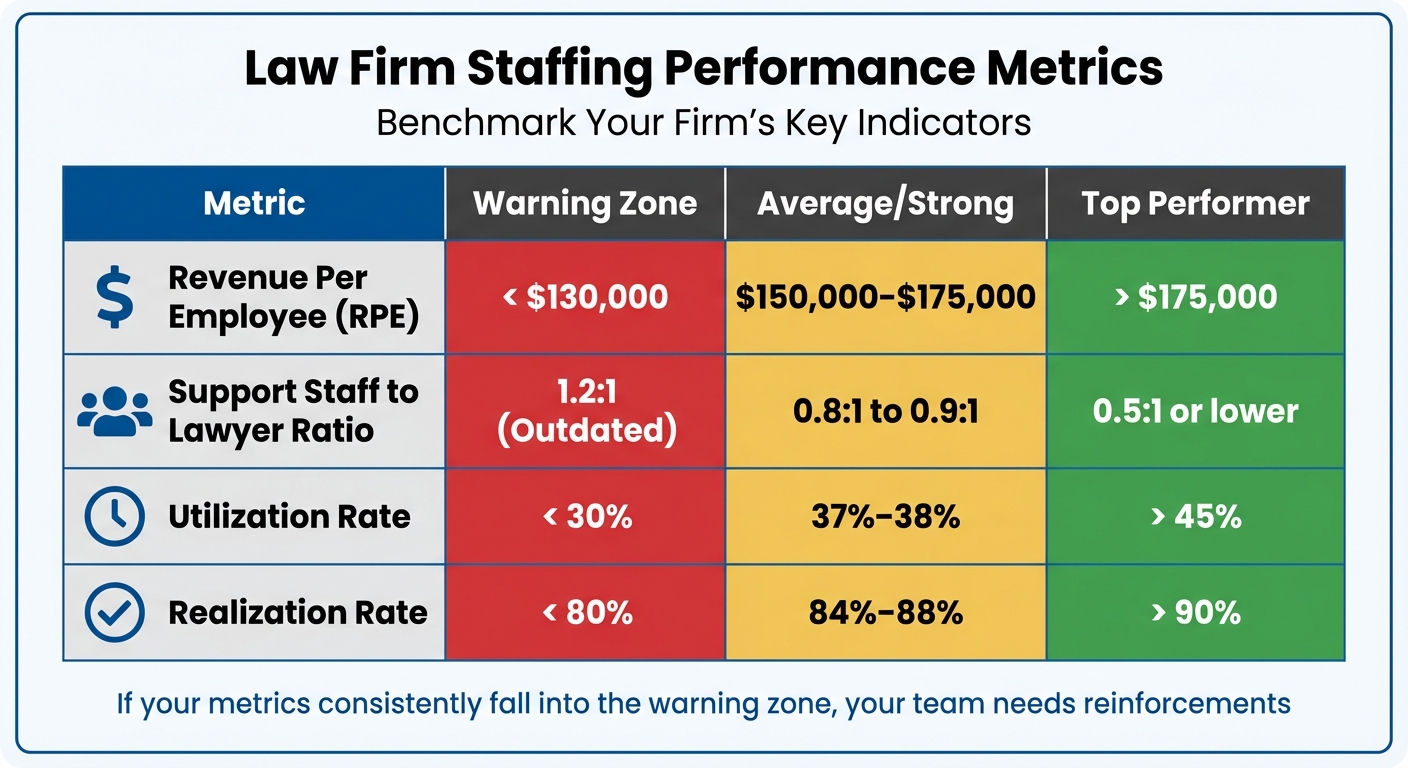
Key Law Firm Performance Metrics: Warning Zones vs Top Performers
Once you’ve spotted warning signs of understaffing, it’s time to quantify those gaps. This involves analyzing data, gathering employee feedback, and comparing your current capacity to actual demand.
Using Workload Metrics to Pinpoint Gaps
Start by tracking Revenue per Employee (RPE), which is calculated by dividing total revenue by the number of full-time employees (FTEs). For mid-sized firms, RPE below $130,000 suggests inefficiency, while $150,000–$175,000 reflects strong performance. This metric is comprehensive, covering the contributions of everyone involved – not just attorneys, but also paralegals, billing staff, and support teams.
Next, evaluate your utilization rate (the percentage of time spent on billable work). Ideally, this should be 37–38% of the workday. Pair this with your realization rate – the percentage of billable hours that are actually collected – which should fall between 84–88%. A low utilization rate often points to excessive administrative tasks, while a realization rate under 84% could indicate inefficiencies, billing errors, or client disputes.
Don’t forget lockup metrics, which measure the time it takes to convert work into cash. A median delay of 93 days is standard, but longer delays may signal a need for more billing or collections staff. Lastly, review your support staff ratio. Modern firms typically operate with 0.8–0.9 support staff per attorney, a shift from the older 1.2:1 standard. If your ratio dips below 0.8:1 without robust automation, you might be understaffed.
Gathering Employee Feedback Through Surveys
While metrics provide hard data, your team offers critical context. Surprisingly, 69% of law firms lack visibility into their support staff’s workload. This gap can hide inefficiencies that numbers alone won’t reveal. Employee surveys can help uncover “emotional friction” – tasks that are draining or frustrating. Ask questions like:
- “Which parts of your workday feel most exhausting?”
- “What disrupts your ability to focus?”
These insights highlight hidden bottlenecks. For instance, if staff report spending too much time switching between software tools, you’ve identified a productivity drain. Similarly, if a crucial task relies solely on one person’s memory, you’ve uncovered a single point of failure. Feedback can also reveal misaligned responsibilities, such as attorneys handling administrative tasks that support staff could manage. In hybrid work setups, this visibility becomes even more critical. In fact, 91% of staff believe better workload transparency would boost effectiveness. Combine these survey findings with your metrics to get a fuller picture of your staffing needs.
Comparing Current vs. Ideal Staffing Levels
With your data and feedback in hand, compare your current staffing levels to what’s needed. Start by calculating strategic capacity – subtract time spent on training, admin work, and non-billable activities from the total available hours. Then, match this against client demand in hours. A negative gap means you lack the capacity to meet current needs, let alone expand.
Here’s a quick look at how key metrics stack up:
| Metric | Warning Zone | Average/Strong | Top Performer |
|---|---|---|---|
| Revenue Per Employee (RPE) | < $130,000 | $150,000–$175,000 | > $175,000 |
| Support Staff to Lawyer Ratio | 1.2:1 (Outdated) | 0.8:1 to 0.9:1 | 0.5:1 or lower |
| Utilization Rate | < 30% | 37%–38% | > 45% |
| Realization Rate | < 80% | 84%–88% | > 90% |
For accuracy, count part-time employees proportionally (e.g., a half-time employee equals 0.5 FTE). If your metrics consistently fall into the warning zone, the conclusion is clear: your team needs reinforcements.
sbb-itb-95f4849
Solutions to Address Understaffing
When your firm faces understaffing, there are three primary paths to consider: strategic hiring, leveraging technology for efficiency, and adopting a flexible staffing model. A mix of these strategies can help create a more adaptable and effective solution.
Planning Your Hiring and Recruitment
Start by identifying the purpose of your hire. Is it to reduce attorney workload, increase revenue, or expand services? A task audit can clarify this by breaking down daily responsibilities into tasks attorneys must handle themselves and those that can be delegated to support staff. For example, you might need a paralegal to manage discovery, a billing specialist to reduce delays, or an administrative assistant to handle intake calls.
Once you’ve identified the role, focus on finding the right fit. This isn’t just about skills – it’s about alignment with your firm’s core values. A poor hire can cost around $15,000, so investing time in the hiring process pays off. Use tools like cover essays, video responses, or case studies to enhance screening. For top candidates, consider assigning a paid homework task that reflects real job responsibilities, allowing you to evaluate their skills and adaptability.
If you’re hiring support staff, rethink the traditional one-to-one support model. In 2021, Fox Rothschild LLP introduced an Attorney Resource Center (ARC), where a team of 40 specialized staff supports 350 attorneys. This approach divides responsibilities, with billing handled by specialists while the ARC team manages tasks like filings, document processing, and conflict checks.
“How we got here was an overarching need to increase our efficiencies, to really make sure people were busy, people were well trained, people were being leveraged, and the right resources were doing the right task.” – Denise Dellaratta, Chief Practice Services Officer at Fox Rothschild LLP
Next, explore how technology can further streamline your staffing needs.
Using Legal Practice Management Software
Before expanding your team, consider how automation can improve efficiency. Research shows automation can reclaim up to 9% of annual work time. Legal practice management tools like The Legal Assistant consolidate tasks like billing, communication, and document generation into a single platform.
Automation is particularly effective for repetitive tasks such as appointment reminders, court date notifications, data entry for intakes, and invoice generation. Advanced AI features can draft invoices, extract deadlines from scheduling orders, and create calendar events automatically. These tools can also send automated invoice reminders and offer online payment options, helping to reduce delays in payments.
Additionally, these platforms provide better workflow visibility, which 69% of firms currently lack. By identifying where tasks are getting delayed or which team members are overloaded, leaders can redistribute work more effectively. Documenting workflows within the system also ensures continuity when key staff members are unavailable. With 79% of clients expecting a callback within 24 hours, automation helps meet these demands without immediately increasing staff.
Balancing Full-Time vs. Contract Staff
After evaluating hiring and automation, a mix of permanent and flexible staffing can address fluctuating workloads. The choice between full-time employees and contract staff depends on whether the workload increase is temporary or long-term. Permanent hires are better suited for sustained growth, while short-term demands might be better managed through outsourcing.
Here’s a comparison of full-time versus contract staff:
| Factor | Full-Time Employees | Contract/Virtual Staff |
|---|---|---|
| Cost | Higher: includes salary, benefits, taxes, and ~$1,207 training cost | Lower: hourly rates start at $12/hr, with no benefits or overhead |
| Implementation & Flexibility | Slower recruitment and onboarding; harder to scale down during slow periods | Quick access to pre-trained professionals; easily scaled up or down based on workload |
| Best Use Case | Core roles essential to daily operations (e.g., lead paralegal, office manager) | Managing seasonal peaks, temporary backlogs, or specialized tasks (e.g., e-discovery, legal research) |
Contract staffing shifts the responsibility for recruitment, training, and performance management to the service provider.
“With a flexible support model, firms can gain flexibility when and where they need it and ramp up or down as needed without burdening the operation with lengthy and expensive recruiting and training processes.” – Anthony Davies, Chief Revenue Officer at Forrest Solutions
This approach is especially useful as 75% of U.S. law firms report higher turnover rates among support staff.
Start by outsourcing high-volume, non-billable tasks like intake calls, appointment scheduling, or data entry. For specialized needs – such as international law, complex e-discovery, or niche legal research – contract professionals provide on-demand expertise without the long-term commitment of a full-time salary.
“The ultimate goal is to get the right task to the right person at the right cost.” – Ben Schmidt, JD, Consultant at Mattern & Associates
Conclusion
Understaffing can seriously impact both your firm’s financial health and its reputation. A staggering 92% of legal professionals report facing staffing shortages, with 72% feeling stressed, burnt out, or overwhelmed as a result. Client trust also takes a hit, especially when 79% of clients expect a callback within 24 hours.
Key warning signs of understaffing include missed deadlines, mounting administrative backlogs, employee burnout, declining productivity, and excessive overtime. Ignoring these issues can be costly – replacing a third-year associate can cost over $1 million, and training a new support staff member typically runs around $80,000. These red flags demand swift and thoughtful action.
To tackle understaffing, start by analyzing workload metrics like realization rates and revenue lockup to pinpoint bottlenecks. Gather employee feedback to understand where your team is struggling. From there, consider your options: hire strategically for critical roles, adopt legal practice management tools like The Legal Assistant to automate repetitive tasks and recover up to 9% of annual work time, or explore flexible staffing models that can adapt to fluctuating demand.
Technology is a powerful ally in addressing staffing challenges. With 91% of legal professionals acknowledging that strong tech solutions are key to client satisfaction, automating tasks like appointment reminders and invoicing allows your team to focus on delivering high-quality legal services. By combining the right people, streamlined processes, and effective technology, your firm can meet client expectations while safeguarding your team’s well-being.
Taking action against understaffing is essential to maintaining service quality and supporting your team. Whether through strategic hiring, automation, or flexible staffing solutions, addressing these challenges now can prevent the escalating costs of burnout, turnover, and lost revenue.
FAQs
What are the signs that my law firm might need more staff?
If your law firm is finding it hard to manage its workload, it could mean you don’t have enough staff to meet demand. Some clear signs include delays in handling cases, missed deadlines, or struggling to respond to client inquiries quickly. Team members feeling stretched too thin, showing signs of burnout, or making more mistakes than usual are also red flags.
You might also see a buildup of administrative tasks or notice that your team is spending too much time on non-billable work. These issues can hurt both client satisfaction and your firm’s overall productivity. Catching these warning signs early can help ensure your operations stay on track and your clients continue to receive the service they expect.
How can law firms effectively manage staffing shortages?
Law firms facing staffing shortages can take proactive steps to ensure workloads remain manageable and client service stays top-notch. A good starting point is to analyze workload trends to pinpoint when extra hands are necessary. By hiring during growth phases or times of higher demand, firms can prevent their current team from becoming overwhelmed, which helps maintain both productivity and client satisfaction.
Another approach is to embrace flexible staffing options. This might mean bringing in part-time or remote legal professionals, which can provide the agility needed to handle busier periods without overcommitting resources. On top of that, using legal practice management software can be a game-changer. Automating routine tasks like billing, scheduling, and document generation allows staff to focus on more critical, high-value responsibilities, easing the overall workload.
By blending thoughtful hiring strategies, adaptable staffing models, and smart use of technology, law firms can navigate staffing challenges while continuing to deliver outstanding results for their clients.
How does automation improve efficiency in a law firm?
Automation can transform how law firms operate by cutting down on time-consuming tasks like document generation, client intake, billing, and case management. By handling these repetitive processes, it frees up attorneys and staff to focus on more meaningful, billable work. The result? Saved time and fewer mistakes.
It also helps pinpoint bottlenecks in workflows and refines processes, which is especially helpful during peak periods or when the team is stretched thin. Tasks like client communication, scheduling, and conflict checks can be automated to boost productivity and improve client satisfaction. Plus, all of this contributes to better scalability and higher profitability for the firm.
The post Signs Your Law Firm Needs More Staff appeared first on The Legal Assistant.