
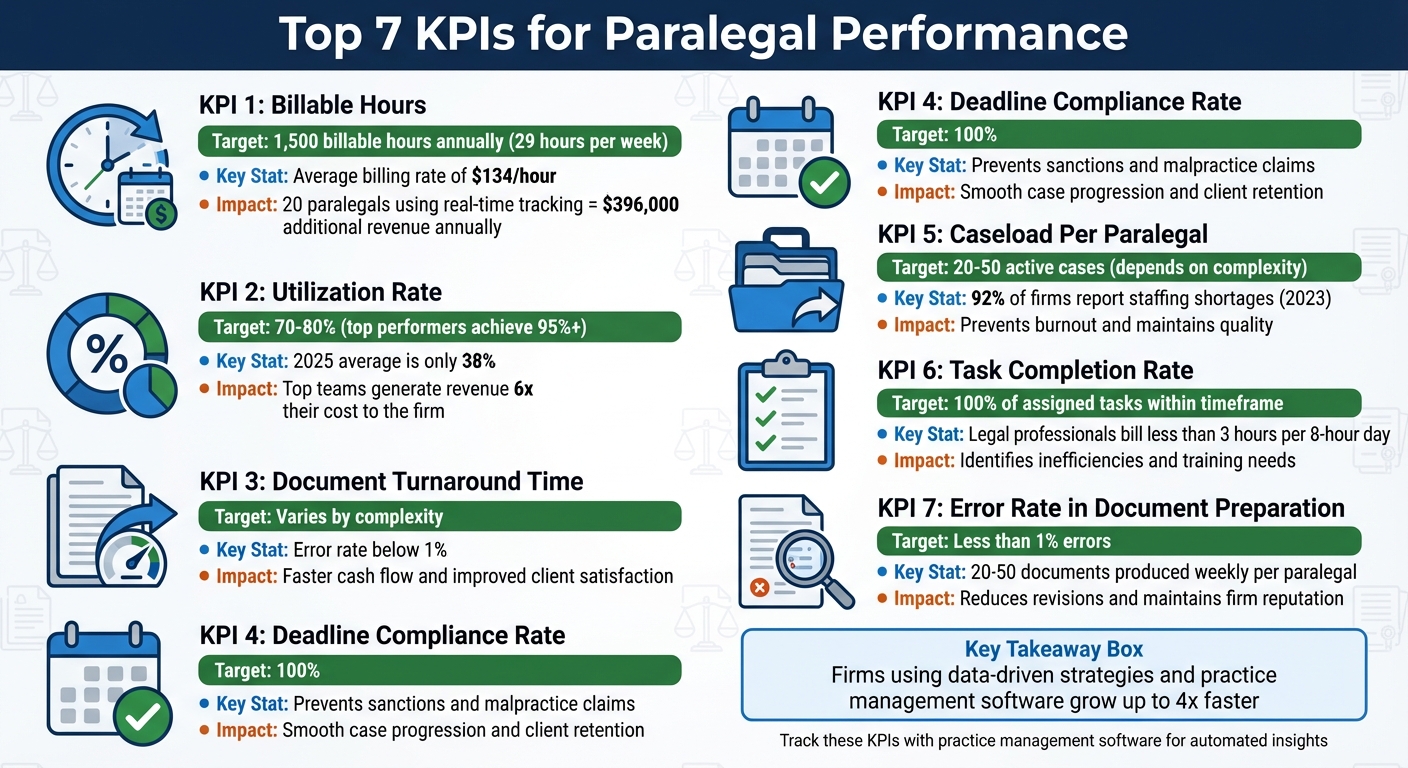
Paralegals are vital to law firms, but evaluating their work often relies on intuition instead of measurable data. Tracking key performance indicators (KPIs) ensures accountability, improves efficiency, and boosts profitability. Here are the 7 most important KPIs for assessing and improving paralegal performance:
- Billable Hours: Tracks time spent on tasks directly generating revenue. Aiming for 1,500 billable hours annually (29 per week) can significantly impact profits.
- Utilization Rate: Measures the percentage of work hours spent on billable tasks. Top teams achieve rates of 70–80% or higher.
- Document Turnaround Time: Monitors how quickly documents are completed, from drafting to filing. Faster turnaround improves cash flow and client satisfaction.
- Deadline Compliance Rate: Tracks how often deadlines are met. The goal is 100% to avoid delays, sanctions, or malpractice risks.
- Caseload Per Paralegal: Measures the number of active cases managed, typically 20–50 depending on complexity. Balanced workloads prevent burnout.
- Task Completion Rate: Evaluates the percentage of tasks finished within set timeframes, highlighting operational efficiency.
- Error Rate in Document Preparation: Tracks accuracy in legal documents. Firms aim for fewer than 1% errors to maintain quality and avoid costly revisions.
These metrics not only improve firm efficiency but also set clear, measurable goals for paralegal development. Tools like practice management software simplify tracking and provide real-time insights, helping firms make data-driven decisions to stay competitive.
7 Essential KPIs for Measuring Paralegal Performance in Law Firms
1. Billable Hours per Paralegal
Billable hours are a direct measure of how paralegal work contributes to a law firm’s revenue. This metric focuses on the time spent on chargeable legal tasks like legal research, drafting documents, eDiscovery, and client communication. However, tasks such as filing, photocopying, or scheduling are classified as non-billable and don’t count toward this total.
Measurability and Tracking Ease
Modern practice management software with digital timers makes it easier to track time in real-time, down to 1/10th of an hour. Delaying time entries, on the other hand, can lead to a loss of up to 4 hours per week or 15 hours per month. By ensuring precise tracking, firms can significantly boost their revenue.
Impact on Law Firm Efficiency
The financial impact of accurate billing is substantial. With an average billing rate of $134 per hour, shifting 20 paralegals from end-of-day time tracking to real-time entries could result in an additional $396,000 annually. Ann Pearson, Founder of Paralegal Boot Camp, highlights the importance of this practice:
If you happen to be a paralegal mentor for a new hire, one of the best things you can do for their career is to frankly, boldly, and clearly explain… Pay attention to your numbers! They do matter!
This highlights how improved billing practices can directly enhance a firm’s efficiency and profitability.
Relevance to Paralegal Responsibilities
Law firms typically set a goal of 1,500 billable hours per paralegal each year, which breaks down to about 29 hours per week. This target represents 70–80% of total work hours. To meet these benchmarks, it’s crucial to clearly distinguish between billable and non-billable tasks.
Potential for Performance Improvement
Accurate and detailed time entries can significantly improve realization rates, which currently average 88%. Tools like digital timers, breaking larger projects into smaller tasks, and conducting weekly audits can help paralegals enhance their accuracy and productivity. These strategies not only reduce billing adjustments but also strengthen the connection between individual performance and the firm’s overall profitability.
2. Paralegal Utilization Rate
The paralegal utilization rate highlights how much of a paralegal’s workday is spent on billable tasks compared to non-billable administrative duties. It’s calculated by dividing billable hours by total hours worked and multiplying by 100. For instance, if a paralegal logs 6 billable hours in an 8-hour day, their utilization rate is 75%. This metric provides a clear snapshot of productivity, enabling firms to track performance in real time and refine workflows to address inefficiencies.
Measurability and Tracking Ease
Tracking this metric has become straightforward with modern practice management software. Tools like The Legal Assistant can automatically record both billable and non-billable hours, generating real-time utilization reports. By logging all hours, firms can identify exactly where productivity dips and make informed adjustments.
Impact on Law Firm Efficiency
In 2025, the average utilization rate for law firms was just 38%, meaning legal professionals captured only about 3 billable hours out of an 8-hour workday. Solo firms fared even worse, with an average rate of 22%. As one industry expert points out:
“By tracking your firm’s productivity, you can locate areas where time is being wasted. By doing so, you can identify areas where time can be redirected to revenue‑creating opportunities.”
This metric is crucial for understanding how much time is spent on administrative tasks versus revenue-generating work. It also helps firms decide if they can take on new clients or need to reassess staffing levels.
Relevance to Paralegal Responsibilities
For paralegals, many firms aim for a utilization rate of 70–80%, meaning the bulk of their time should focus on billable activities like case management, document preparation, and client communication. A lower rate often signals that paralegals are tied up with non-billable tasks – such as invoicing, scheduling, or finding process servers – that could be delegated or automated. Shifting these tasks away from paralegals allows them to concentrate on revenue-generating work.
Potential for Performance Improvement
Top-performing paralegal teams can achieve utilization rates of 95% or more, generating revenue that can exceed six times their cost to the firm. Achieving this level of efficiency often involves automating repetitive tasks, outsourcing non-essential duties, and setting clear monthly goals. Firms using practice management software report saving an average of eight hours per week, time that can be reallocated to billable work. By focusing on these strategies, firms can significantly boost both productivity and profitability.
3. Document Turnaround Time
Document turnaround time measures how long it takes to complete a document from the initial request to the final version. This includes drafting, editing, formatting, and filing. Often referred to as the intake-to-resolution cycle time, it’s calculated by dividing the total days spent on all document requests by the number of requests completed. For instance, if a paralegal processes 40 documents over 200 days, the average turnaround time would be 5 days per document.
Measurability and Tracking Ease
To effectively track this metric, break the document lifecycle into distinct phases: drafting, editing, formatting, and filing. Each stage’s duration should be monitored, and documents should be categorized by complexity to ensure an accurate evaluation. Tools like The Legal Assistant simplify this process by automatically recording timestamps throughout the lifecycle, offering real-time insights without the need for manual tracking. This level of precision is essential for identifying inefficiencies and improving operations.
Impact on Law Firm Efficiency
Reducing document turnaround time benefits law firms by speeding up cash flow, as it shortens the gap between completing work and receiving payment. It also allows paralegals to focus on more billable tasks. On the flip side, longer turnaround times may signal resource shortages or ineffective processes. Firms should aim for a document production error rate below 1% to balance speed with quality. Faster, error-free document handling enhances client satisfaction and optimizes paralegal workflows.
Relevance to Paralegal Responsibilities
Document preparation is a cornerstone of paralegal work, directly influencing client outcomes and case progress. On average, paralegals manage 20 to 50 documents weekly, depending on complexity. Addressing workflow inefficiencies, such as bottlenecks, is essential for maintaining profitability. Using standardized templates and strong version control systems can significantly cut down the time spent on routine drafting tasks.
Potential for Performance Improvement
Automation offers a powerful way to improve turnaround times. Document assembly software and AI tools are especially useful for handling high-volume, low-risk documents. Breaking larger projects into smaller tasks also helps maintain both speed and accuracy. Peer review systems can further ensure quality while keeping turnaround times low. By combining automation, task segmentation, and quality checks, paralegals can boost productivity and accuracy, solidifying their role as key contributors to a law firm’s success.
4. Deadline Compliance Rate
The deadline compliance rate measures how often deadlines are met on time, including both internal milestones and legal deadlines. To calculate it, divide the number of deadlines met by the total number of deadlines, then multiply by 100. The goal for top-performing legal teams is 100%. This metric highlights whether paralegals are submitting motions, filing documents, and completing reviews within the required timeframes. Like document turnaround time, this metric sees major benefits from automation.
Measurability and Tracking Ease
Modern legal practice management tools make tracking deadlines much simpler. Using a central log, firms can categorize deadlines as “on time”, “late”, or “missed”. Tools like The Legal Assistant streamline this by sending automated reminders for upcoming tasks. The formula for SLA (Service Level Agreement) compliance is: (Matters Completed Within SLA ÷ Total Matters with SLA) × 100. This automation removes the need for manual spreadsheets and provides instant insights into performance trends.
Impact on Law Firm Efficiency
Sticking to deadlines is crucial for avoiding bottlenecks, maintaining smooth case progression, and keeping clients happy. Timely billing submissions also help speed up cash flow. On the flip side, missed deadlines can lead to sanctions, lost cases, or even malpractice claims. Teresa Matich from Clio underscores this point:
Monitoring the performance of pivotal aspects of your firm can make a major impact on your firm’s revenues, growth, and overall success.
A decline in compliance often signals issues like resource shortages or inefficiencies that need to be addressed quickly.
Relevance to Paralegal Responsibilities
Paralegals play a key role in managing case workflows and juggling multiple deadlines, from preparing depositions to filing motions. Adam Steele highlights their importance:
Paralegals are often responsible for managing case workflows and ensuring all deadlines are met. Measuring their efficiency is essential to smooth operations and client satisfaction.
Tracking this metric helps identify workload imbalances and ensures team members aren’t overwhelmed.
Potential for Performance Improvement
Breaking large projects into smaller tasks, setting automated reminders, conducting regular audits, and using root cause analysis can help maintain high compliance rates. Displaying rolling eight-week performance charts also keeps teams accountable and sets clear improvement goals.
5. Caseload per Paralegal
Caseload per paralegal tracks how many active cases each team member is managing. A typical range is 20 to 50 active cases, though this varies based on the complexity of the cases and how much attorney involvement is required. This metric is a helpful indicator of whether your team is understaffed or if workloads are unevenly distributed.
Measurability and Tracking
Modern practice management software makes caseload tracking straightforward. These tools offer real-time dashboards and “Cases Over Time” reports, helping firms monitor case progress and individual workloads. For example, some firms have seen their caseloads grow by 38% after adopting automated tracking systems. Platforms like The Legal Assistant provide visibility into active cases, making it easier for managers to identify and address workload imbalances before they escalate.
How It Affects Firm Efficiency
Managing caseloads effectively avoids bottlenecks and ensures resources are used efficiently. Emily Porter, Executive Director at Renner Otto, highlights a client-focused strategy:
Assign caseload based on clients, not attorneys. Standardization comes relative to the clients’ treatment rather than the attorneys’ preferences, and then you can more easily identify true burden on the paralegal.
This approach is especially relevant since 92% of firms surveyed in 2023 reported staffing or resource shortages. A sudden increase in the number of cases per paralegal often signals the need for more staff or upgraded technology. Proper caseload management helps firms meet KPIs, ensuring deadlines are met and utilization rates stay high.
Aligning with Paralegal Responsibilities
A paralegal’s capacity and strengths should guide task assignments. Some firms use intake committees to assess workloads and assign tasks based on availability, ensuring no one is overwhelmed. This strategy prevents “silent struggling” among staff and ensures deadlines are consistently met.
Opportunities for Improvement
Standardizing assignments by client rather than attorney can balance workloads and give a clearer picture of each paralegal’s responsibilities. Jaclyn Roberson, Senior Partner at Roberson Duran Law, PLLC, emphasizes this benefit:
Allocating work fairly can eliminate complaints and resentment. It can also boost morale and make each team member feel respected.
Regular team meetings can help coordinate ongoing assignments, while visualization tools that track caseload trends over time allow managers to adjust staffing before burnout becomes an issue.
sbb-itb-95f4849
6. Task Completion Rate
Task completion rate evaluates how effectively paralegals complete their assigned tasks within a set timeframe. This metric analyzes the total number of tasks completed by each paralegal compared to the number assigned. Breaking large projects into smaller subtasks – like dividing case preparation into interviews, document collection, and legal research – makes tracking more precise and manageable. It works alongside other KPIs to highlight daily operational efficiency.
Measurability and Tracking Ease
With modern practice management tools, tracking task completion is no longer a manual chore. Software like The Legal Assistant provides real-time updates on task progress and generates automatic productivity reports. These tools can also monitor key metrics, such as the percentage of deadlines met and the average time taken to achieve major case milestones. This streamlined tracking not only evaluates individual performance but also boosts overall firm efficiency.
Impact on Law Firm Efficiency
Understanding task completion rates can uncover inefficiencies and help redirect efforts toward revenue-generating activities. For example, legal professionals often bill fewer than three hours during an eight-hour workday, making it crucial to analyze how paralegals spend their non-billable time. Persistent low task completion rates may indicate the need for additional staff or upgraded technology to better support the team.
Relevance to Paralegal Responsibilities
This KPI directly ties into the key responsibilities of paralegals, such as managing documents, overseeing case progress, and meeting deadlines. By tracking task completion rates, firms can assess a paralegal’s ability to handle essential duties like document reviews, deposition preparation, and drafting motions. This provides clear benchmarks for performance while offering paralegals actionable goals and a pathway for professional development.
Potential for Performance Improvement
Task metrics can identify top-performing individuals, allowing firms to replicate their strategies across the team. Visual dashboards help prioritize daily tasks and monitor progress. Automating repetitive, non-billable tasks can free up time for more meaningful work. Additionally, regular audits of task logs ensure compliance with naming and filing standards, reducing wasted time spent searching for information.
7. Error Rate in Document Preparation
The error rate in document preparation tracks how often corrections are needed in paralegal-prepared documents. It’s calculated by dividing the total number of errors by the total number of documents produced. This KPI highlights the importance of quality in paralegal work. Many law firms aim for an error rate below 1%, making it a challenging yet critical metric to monitor.
Measurability and Tracking Ease
Firms can measure document accuracy using various data-driven methods. For example, tracking “invoice bounce-backs” – documents returned for corrections – offers insight into compliance with established guidelines. Regular audits of case files, along with peer or attorney reviews, ensure documents are complete, well-organized, and meet filing standards.
Monitoring key metrics helps maintain high standards of work quality and catch potential issues before they impact clients.
– Adam Steele, LinkedIn
Impact on Law Firm Efficiency
Mistakes in document preparation can ripple through the firm, leading to delays and inefficiencies. High error rates require frequent revisions, which consume attorney time and slow case progress. Considering that legal professionals often bill less than three hours per day, time spent fixing errors reduces profitability. Tracking document quality proactively helps avoid costly legal errors and minimizes the need for write-downs or discounts stemming from subpar work. This focus on quality ties directly to paralegals’ role in maintaining the firm’s overall efficiency and reputation.
Relevance to Paralegal Responsibilities
Preparing, reviewing, and managing legal documents is a central part of a paralegal’s job. With expectations to produce 20 to 50 documents weekly, the accuracy of these materials – ranging from court filings to client communications – affects both the firm’s reputation and client satisfaction. High accuracy not only meets internal standards but also reinforces client confidence in the firm’s services.
Potential for Performance Improvement
Document automation tools can significantly reduce manual entry errors. Standardized templates and robust version control systems help prevent outdated or incorrect drafts from being used. Additionally, analyzing error rate data can identify areas where further training is needed, particularly for tasks that rely on technology, like electronic filing. Tools such as Legal Assistant’s document generation features ensure consistent formatting and reduce the likelihood of mistakes, benefiting the firm’s overall workflow and quality assurance efforts.
Using Practice Management Software to Track KPIs
Tracking KPIs is crucial, but doing it manually with spreadsheets can lead to mistakes and inefficiencies. Practice management software like The Legal Assistant takes the hassle out of this process by automating data collection for all critical metrics. It logs work in real time, creates timesheets automatically, and directly connects paralegal activities to the firm’s revenue stream. This automation feeds into a unified dashboard, keeping all KPIs visible and up-to-date.
The centralized dashboard pulls together data from billing, task management, and document generation. This allows firm leaders to quickly access essential metrics like billable hours, task completion rates, and document turnaround times. As MyLegalSoftware aptly explains:
Think of KPIs as your firm’s dashboard. Without it, you’re driving blind.
The software’s built-in analytics tools remove the need for manual tracking by automatically measuring and presenting performance data.
Task management features provide a clear view of time spent on each case stage, identify bottlenecks, and use automated workflows to allocate resources efficiently. Meanwhile, document generation tools maintain consistent formatting and minimize errors from manual data entry.
Conclusion
Measuring paralegal KPIs goes beyond simply gathering numbers – it’s about using that information to make smarter decisions that help your firm grow. As David Girolami from BDC explains, Key Performance Indicators allow business owners to “make informed decisions based on actual data, not just gut instinct”. Without these metrics, it becomes harder to identify both strengths and areas that need improvement.
Firms that embrace data-driven strategies and practice management software have seen growth rates up to four times faster. Tracking KPIs not only fosters accountability but also gives paralegals clear objectives for their professional development. This approach strengthens profitability while improving client service and keeping your firm competitive.
To harness the value of these insights, start small and stay consistent. Focus on 5–6 key metrics that align with your firm’s priorities, and review monthly reports to catch trends early. Balance productivity measures, like billable hours, with quality-focused metrics, such as meeting deadlines and ensuring document accuracy. This helps maintain high standards without overburdening your team.
FAQs
How does practice management software help track paralegal performance?
Practice management software, such as The Legal Assistant, makes it easier to track paralegal performance by bringing all essential metrics together in one place. It automatically keeps tabs on data like billable hours, task completion rates, and document processing times, providing real-time updates on productivity, accuracy, and efficiency.
With tools like this, law firms can establish clear KPIs, measure performance against benchmarks, and pinpoint areas that need attention. Automated tracking minimizes manual errors, saves valuable time, and generates detailed reports for consistent evaluation. This approach not only boosts accountability but also helps firms make smarter decisions and improve overall efficiency.
How can paralegals minimize errors in legal documents?
Paralegals can reduce mistakes in legal documents by following a structured approach to reviewing and editing. A key step is implementing a thorough proofreading process, where documents are reviewed multiple times and by various team members to spot any errors that might have been missed.
Using standardized templates and checklists is another effective way to ensure consistency and accuracy across all documents. Additionally, tools like legal practice management software can automate repetitive tasks, cutting down on human errors while also saving time and improving accuracy.
Why is it important for law firms to track billable hours accurately?
Accurately tracking billable hours plays a key role in a law firm’s profitability. It ensures that all client work is properly documented and invoiced, reducing the chances of lost revenue. At the same time, transparent billing practices help foster trust with clients, as they can clearly see the value of the services provided.
Keeping a close eye on billable hours also allows firms to evaluate productivity and pinpoint areas that may need improvement. This insight helps streamline operations, boosting income potential while laying a solid foundation for long-term growth and financial stability.
The post Top 7 KPIs for Paralegal Performance appeared first on The Legal Assistant.