
Repurposing legal content can save time, expand your reach, and maximize the value of your existing materials. By transforming a single piece of content into multiple formats – like blog posts, social media snippets, videos, or infographics – you can engage diverse audiences across platforms without starting from scratch. This approach also boosts SEO, strengthens your online presence, and ensures compliance with legal advertising standards.
Key Takeaways:
- Start with a content audit to identify high-performing or evergreen materials.
- Choose formats that align with your audience’s preferences (e.g., LinkedIn articles for professionals, Instagram Reels for visual content).
- Follow a structured process: extract key points, update for accuracy, and tailor for each platform.
- Use tools like analytics, design platforms, and scheduling software to streamline the process.
- Monitor performance metrics (clicks, engagement, consultations) and refine your strategy regularly.
Conducting a Content Audit
Before diving into repurposing, it’s crucial to know what you’re working with. A content audit is where it all begins – a systematic review of your existing materials to pinpoint the best candidates for repurposing. This step ensures you’re building on content that’s already shown its value.
Identify High-Performing Content
Start with the data. Use analytics tools to filter blog-specific URLs (like those containing “/blog/”) to separate educational posts from your main landing pages. Focus on pages that show strong metrics, such as high organic traffic, conversions (73%), email engagement (71%), website traffic (71%), engagement (69%), and social media analytics (65%).
Pay special attention to pages driving consultations, email signups, or client inquiries – these are your conversion powerhouses. Also, look for content with strong SEO indicators, including backlinks, referring domains, and solid keyword rankings. Tools like BuzzSumo can help identify blog posts with the most social media interactions, while Google Search Console highlights pages with steady click-through rates. Notice patterns in your top-performing posts – whether lists, FAQs, or interviews resonate most – and prioritize similar content for repurposing.
Prioritize Evergreen and Outdated Content
Evergreen content – topics like “what to do after a car accident” or “how to form an LLC” – stays relevant over time, making it ideal for repurposing. These pieces can be refreshed across various formats without losing their core value.
On the flip side, identify “content decay” – pages that have dropped in rankings or seen reduced organic traffic. Use Google Analytics to compare landing page performance month-over-month or year-over-year to detect significant declines. Break your content into four categories: nonperforming (delete and redirect), in need of transformation (complete overhaul), in need of tweaking (optimize), and good as is. Pages with many backlinks but low traffic are especially worth refreshing since they already have authority but need updates to regain visibility. Additionally, flag content impacted by changes in laws, court rulings, or industry standards for immediate revisions. These steps will guide your strategy for adapting content to new formats and channels.
Evaluate Suitable Formats
Once you’ve identified your best content, think about how to repackage it. Choose formats that align with both the content’s nature and your audience’s preferred platforms. For example, turn legal timelines into infographics or process details into downloadable checklists. Data-heavy content can be transformed into social media carousels or SlideShare presentations, which draw over 70 million unique visitors monthly.
Engagement metrics can also help you decide. Look for topics with high time-on-page or strong social shares to determine which ones deserve a format update. LinkedIn is great for professional articles and long-form posts, while Instagram works well for visual carousels or Reels. And since 54% of consumers want to see more video content from brands, consider converting written pieces into short video clips. Focus on one to three key pieces each month and repurpose them into multiple formats to maximize your efforts. Streamlining these workflows with legal practice software can further reclaim billable hours during the content creation process.
sbb-itb-95f4849
Choosing the Right Formats for Repurposing
Common Formats for Repurposing Legal Content
Once you’ve completed your content audit, the next step is choosing formats that align with your audience and marketing goals. Different legal clients have different preferences. For instance, corporate law clients often gravitate toward in-depth LinkedIn articles, while family law prospects are more engaged with visual content on platforms like Facebook and Instagram. Matching your format to the platform ensures your message resonates effectively.
Your goals should guide your format selection. If you’re aiming for brand awareness, focus on broad, engaging content such as infographics or short social posts. For lead generation, transform blog posts into gated resources like checklists or whitepapers to collect email addresses. If SEO is your priority, stick with keyword-rich blog posts to build authority in your niche.
Here’s an example: a 2,000-word blog post on estate planning could be repurposed into LinkedIn highlights, Instagram carousel posts, an email newsletter, a PDF checklist, and social proof quote cards.
“The best thing you can do is create a repurposing plan that you will stick to. Even if that means creating only two types of content and distributing on a few key channels.” – Justin Simon, Content Distribution Consultant
Consider your resources carefully. For example, recording a long-form video might take four hours, but extracting multiple short clips from it could take just 30 minutes using templates – saving you significant time compared to creating new videos from scratch. Visual content is especially powerful; pairing information with images can increase recall by 65% after three days, making formats like infographics a smart investment.
Comparison of Formats
The table below breaks down various formats to help you decide which ones align best with your goals and audience needs.
| Format | Time Investment | Audience Reach | SEO Benefits | Best Use Case |
|---|---|---|---|---|
| Blog Posts | High | Medium (Organic) | High (Keywords/Backlinks) | Establishing topical authority |
| Social Snippets | Low | High | Low (Direct) | Driving traffic to the main site |
| Infographics | Medium | High (Shareable) | Medium (Backlinks) | Explaining complex legal processes |
| Short Video Clips | Medium | Very High | Low | Humanizing the firm and boosting engagement |
| Whitepapers/eBooks | High | Low | Medium | Lead generation through gated content |
| Checklists | Low | Medium | Low | High-conversion lead magnets |
To match formats to the buyer’s journey, consider the stage your audience is in. For the Awareness stage, use social clips and infographics to introduce legal concepts. During the Consideration stage, blog posts and podcasts work well to educate and build trust. For the Decision stage, case studies and webinars can seal the deal.
Since 60-70% of legal search traffic happens on smartphones, always prioritize mobile-friendly formats. Use scannable text, responsive designs, and sticky footers for landing pages to ensure a seamless experience.
Legal Content Repurposing Checklist
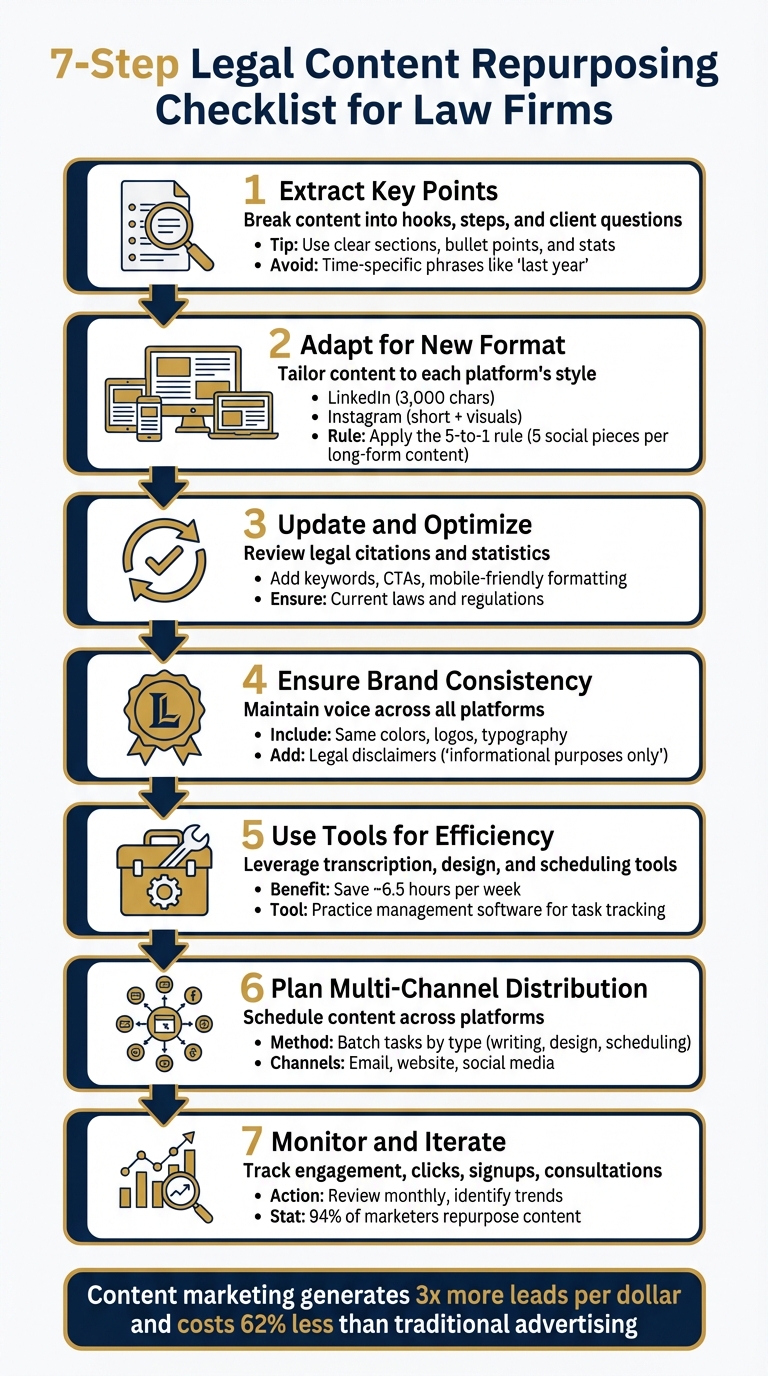
7-Step Legal Content Repurposing Process for Law Firms
Once you’ve picked the formats you want to work with, it’s time to get down to business. This checklist breaks down seven steps to turn one piece of legal content into multiple, high-performing assets. The idea is simple: save time while keeping quality intact. After all, content marketing generates three times more leads per dollar spent than traditional advertising and costs 62% less. By building on your audited content and chosen formats, you can make the most of your efforts while staying true to your firm’s voice and compliance standards.
Step 1: Extract Key Points
Start by pulling out the core ideas, data, and quotable moments from your content. For example, break a long blog post into smaller, digestible parts – like hooks, steps, or answers to common client questions. These bite-sized elements become the building blocks for repurposing.
“I start thinking about repurposing opportunities from the moment I’m reviewing a content brief. It’s a strategic part of content creation, with an eye on lifecycle and future engagement.” – Chima Mmeje, Senior Content Marketing Manager, Moz
Make your original content easy to dissect by organizing it with clear sections, bullet points, and stats. Avoid phrases like “last year” or specific dates that could make your content feel outdated too quickly.
Step 2: Adapt for the New Format
Tailor your content to fit each platform’s style and tone. For example, a LinkedIn article allows room for a professional, detailed analysis of up to 3,000 characters. Meanwhile, an Instagram carousel demands short, punchy text paired with visuals. Adapting content isn’t just about cutting down the word count – it’s about tweaking the tone, simplifying legal jargon for broader audiences, and presenting information in a way that resonates with each platform’s users.
Let’s say you have a blog post about landlord-tenant law. That could be transformed into:
- A LinkedIn article citing case law
- An Instagram carousel titled “5 Mistakes Landlords Make”
- A TikTok video answering “Can my landlord enter without notice?”
- A downloadable PDF checklist for property managers
Stick to the 5-to-1 rule: aim to create at least five smaller pieces of content for social media from each long-form piece. This approach ensures your efforts pay off.
Step 3: Update and Optimize
Legal content must stay accurate. Review and update any legal citations or statistics, ensuring all information is current and relevant. Laws change, and outdated facts can hurt your credibility. Add fresh data, confirm that cited regulations are still valid, and double-check everything against professional conduct guidelines.
Next, boost your content’s visibility. Naturally incorporate relevant keywords into headlines, captions, and meta descriptions to improve your search engine rankings. Add clear calls to action tailored to each format, like “Download our estate planning checklist” for a blog post or “DM us for a free consultation” on Instagram. Use bolded headings, short sentences, and bullet points to make your content easy to skim on web and social platforms.
Finally, test each piece for mobile compatibility. Responsive designs and readable fonts are non-negotiable when most users access content on their phones.
Step 4: Ensure Brand Consistency
Your firm’s voice and style should remain recognizable across all platforms. Whether it’s a LinkedIn post, Instagram story, or email newsletter, your audience should immediately know it’s from you. Stick with the same color palette, logo placement, and typography in your visuals. Keep the tone consistent too – if your blog is formal and authoritative, your social media should match unless you’re making a deliberate change.
Don’t forget legal disclaimers. For instance, a social media post offering legal tips should include a note like, “This content is for informational purposes only and does not constitute legal advice”. This protects your firm from misunderstandings or compliance issues.
Finally, space out your repurposed content over weeks or months. This avoids overwhelming your audience and gives each piece time to perform.
Step 5: Use Tools for Efficiency
Repurposing content at scale is much easier with the right tools. Use transcription software and design platforms to quickly create visuals. Scheduling tools help you organize when and where each piece goes live.
For firms juggling multiple projects, practice management software like The Legal Assistant can help you stay on track. Assign tasks, set deadlines, and monitor progress from start to finish. You can even plan content launches around key dates – like legal awareness months or your firm’s anniversary – without getting bogged down by constant context switching.
A streamlined workflow can save about 6.5 hours per week, freeing up your attorneys to focus on billable work instead of scrambling to create social media posts.
Step 6: Plan Multi-Channel Distribution
Creating the content is only half the job. The other half is making sure it gets in front of the right audience. Use scheduling tools to plan how and when each piece will be shared. Batch your tasks to stay efficient: spend one day selecting content, another writing captions, another creating visuals, and so on. This method reduces the mental strain of switching between tasks.
Don’t forget email newsletters. They’re a direct line to people who’ve already shown interest in your firm. Repurpose blog highlights into a monthly roundup or turn a popular infographic into an exclusive email resource. Use your website as the central hub for all repurposed content to drive traffic.
Step 7: Monitor and Iterate
Keep an eye on performance metrics for every repurposed piece – things like engagement rates, clicks, email signups, and consultation requests. These numbers will tell you which formats and platforms are worth your time. If Instagram carousels bring in more inquiries than LinkedIn articles, shift your focus toward creating more visual content.
Review your top-performing pieces monthly to spot trends. For example, do posts with client testimonials perform better than those with legal tips? Do shorter captions get more clicks? Use these insights to fine-tune your strategy. High-performing content can even be refreshed after six months with updated stats or examples before being repurposed again.
“The content repurposing calculus is pretty simple: get the greatest reach from the fewest resources.” – WordStream
While 94% of marketers repurpose their content, the ones who succeed are those who measure, learn, and adjust. Your first attempt might not be perfect, but the real magic happens through iteration. By constantly improving, you’ll extend your content’s lifecycle and make legal content marketing more efficient than ever.
Maintaining Quality and Compliance
Ensuring top-notch quality and compliance is essential when repurposing content, especially in the legal field. Every piece you publish must uphold your firm’s professionalism. Legal content carries an added layer of responsibility – any inaccuracies could mislead clients or harm your reputation. With around 30% of law firms maintaining blogs and over 75% active on social media, competition for attention is fierce. To stand out, your content must prioritize accuracy, originality, accessibility, and ethical integrity.
Accuracy and Legal Relevance
Legal standards are constantly evolving. A blog post that was accurate six months ago might now be outdated due to legislative changes or new case law. When updating content, always verify claims using reliable sources like the Legal Information Institute (LII), Westlaw, LexisNexis, or Bloomberg Law. Confirm that statutes remain valid, case law hasn’t been overturned, and data reflects the latest updates.
“In the legal world, change is the only constant. Staying abreast of the latest developments is essential.” – Annette Choti, Esq., Founder, Law Quill
When revising older posts, include a note at the top indicating: “This blog was updated on [Date] to include relevant developments”. Regularly scheduled reviews – quarterly or annually – can help identify outdated material before it becomes a liability. Archiving or redirecting irrelevant content also prevents confusion. For instance, one small firm of five attorneys improved efficiency by 30% after adopting a systematic legal research checklist. Additionally, audience comments on social media or blogs can reveal areas needing clarification or updates.
Avoiding Plagiarism and Duplication
Duplicating content across platforms can hurt your search rankings – Google’s algorithms penalize duplicate material. Beyond that, copying modified legal templates or analyses from other professionals without permission is plagiarism.
“Plagiarism in legal writing is when lawyers start copying the altered and amended templates of other lawyers without their permission.” – Zegal
Limit direct quotes to no more than 10% of your content. When using ideas from another source, rephrase them entirely in your own voice rather than making minor edits. Tools like CopyScape, Grammarly, Turnitin, or Compilatio can help ensure originality and proper citation. If you use AI tools for drafting, always revise the output to maintain authenticity. Consistent originality strengthens your authority and boosts search visibility.
Mobile Optimization and Accessibility
Repurposed content must be mobile-friendly. Check that it renders well on various devices, with clear fonts and responsive design, to ensure a smooth user experience.
Accessibility also involves simplifying complex legal concepts for readers with varying expertise levels. Use plain language without compromising accuracy, and break up content into short sentences and paragraphs for easier reading. Cross-linking repurposed formats, like videos or infographics, to the original detailed sources can guide readers to more comprehensive information.
Ethical Marketing Standards
Legal marketing operates under strict ethical rules. These often align with ABA Model Rules 7.1 through 7.3, which require that all communications be factual and not misleading. Your content should avoid guarantees or predictions about case outcomes and clearly state that it doesn’t provide legal advice or establish an attorney-client relationship.
Avoid terms like “specialist”, “expert”, or “specializing in” unless you hold the proper certifications. Also, steer clear of unverified claims like being the “best” or “top”. Different states have varying requirements: New York requires “Attorney Advertising” labels, Florida prohibits unverified quality claims, Texas mandates retaining marketing content for four years, and California enforces strict rules on specialization.
“This tightrope walk is one of the main reasons we started Lexicon Legal Content. Early after law school, I realized that it is difficult for law firms and marketing agencies to source and scale law firm content, as there was a lack of writers with the necessary skillset – namely, legal training and SEO know-how – to serve the market.” – David Arato, JD, Founder, Lexicon Legal Content
To ensure compliance, adopt a multi-step review process: initial drafting, legal compliance checks, and final attorney approval. If your firm operates in multiple jurisdictions, use templates with pre-approved language and state-specific disclaimers. Documenting ethical guidelines and sources for factual claims can help you navigate regulatory challenges while maintaining your firm’s credibility.
Conclusion
Repurposing legal content, when done right, can save time, extend the life of your content, and ensure compliance with legal and ethical standards. It’s not just about recycling old material – it’s about reimagining it to meet the needs of different platforms and audiences.
Key Takeaways
Repurposing legal content allows you to get more mileage out of your existing work while staying efficient. Start by auditing your content to find evergreen, high-performing pieces. Then, adapt these into formats that resonate with a variety of audiences, from blog posts to social media snippets. The process outlined here ensures that your content remains accurate, relevant, and aligned with your brand identity.
The numbers back it up: 60% of marketing teams repurpose content multiple times. Tools like The Legal Assistant can simplify the process by centralizing tasks like document generation and scheduling, leaving you more time to focus on strategy rather than admin work.
“Repurposing legal content is the simplest lever for small law firms to amplify expertise without multiplying costs.” – Catherine Russell, Founder, SEO My Law Firm
While the benefits are clear, it’s crucial to prioritize quality and compliance. Always double-check for legal accuracy, avoid duplicate content penalties, and adhere to your state’s advertising rules. A practical tip? Follow the “5-to-1 rule”: create five smaller pieces of content – like social media posts – from each long-form article. This approach helps you maintain a steady online presence without overextending your resources.
Next Steps for Law Firms
Here’s how to get started: take one high-performing blog post and transform it into two new formats. For example, create a one-page PDF checklist and a short video for platforms like LinkedIn or Instagram. Use tools like Google Analytics to identify which topics are already connecting with your audience, and prioritize those for repurposing. To streamline the process, batch tasks: record a video on one day, edit it the next, and draft social media captions on the third.
Track your progress by monitoring key metrics like consultations, email signups, and social engagement. With 87% of video marketers reporting positive ROI from video content, experimenting with new formats could open doors to reaching more clients. Use this checklist as your guide to stay consistent, build authority, and grow your practice – all while keeping your team energized and focused.
FAQs
How do I choose the best content to repurpose first?
To begin, pinpoint your best-performing content by analyzing metrics like page views, engagement rates, and client inquiries. Look for standout pieces, such as frequently visited blog posts or FAQs that your audience finds particularly useful. Give priority to evergreen content – topics that stay relevant over time – since these can be updated or repackaged with ease. This approach ensures you’re focusing on content with the highest potential to attract fresh audiences and generate meaningful outcomes.
How often should I review and update repurposed legal content?
Reviewing and updating repurposed legal content annually is crucial for maintaining its accuracy, relevance, and SEO performance. Consistent updates ensure your content remains useful and aligned with current legal standards while meeting the evolving needs of your audience.
What disclaimers should I include to stay compliant on social media?
Law firms using social media must tread carefully to avoid any misunderstandings or legal pitfalls. A key step is including clear disclaimers that state the content shared is strictly for informational purposes and does not amount to legal advice.
Additionally, it’s important to address issues like confidentiality, conflicts of interest, and the fact that engaging with the content does not create an attorney-client relationship.
To ensure these disclaimers are effective, they should be highly visible. Consider placing them prominently in your bio, at the bottom of posts, or anywhere they’re easy to spot. Also, make it a habit to review and update these disclaimers regularly to stay in line with changing regulations and the specific rules of your jurisdiction.
The post Legal Content Repurposing Checklist For Law Firms appeared first on The Legal Assistant.