
Law firms face a growing mental health crisis. Lawyers experience extreme stress due to relentless workloads, high-stakes environments, and a culture that prioritizes billable hours over well-being. In 2024, 69% reported anxiety, 36% faced depression, and 26% admitted to making significant errors due to mental health struggles. The financial impact is also severe, with firms losing $1,900 per employee annually and spending up to $500,000 to replace associates.
Key takeaways:
- Stress sources: Billable hour demands, poor management, and blurred work-life boundaries.
- Impact: Increased errors, absenteeism, and turnover.
- Solutions: System-wide policies, stress assessments, and tools like practice management software to reduce administrative burdens.
Law firms need structured stress management systems – not just perks like yoga classes – to address systemic issues. This includes clear work-life policies, mental health training, and leveraging technology to streamline tasks. Firms that prioritize well-being not only improve employee health but also boost retention and productivity.
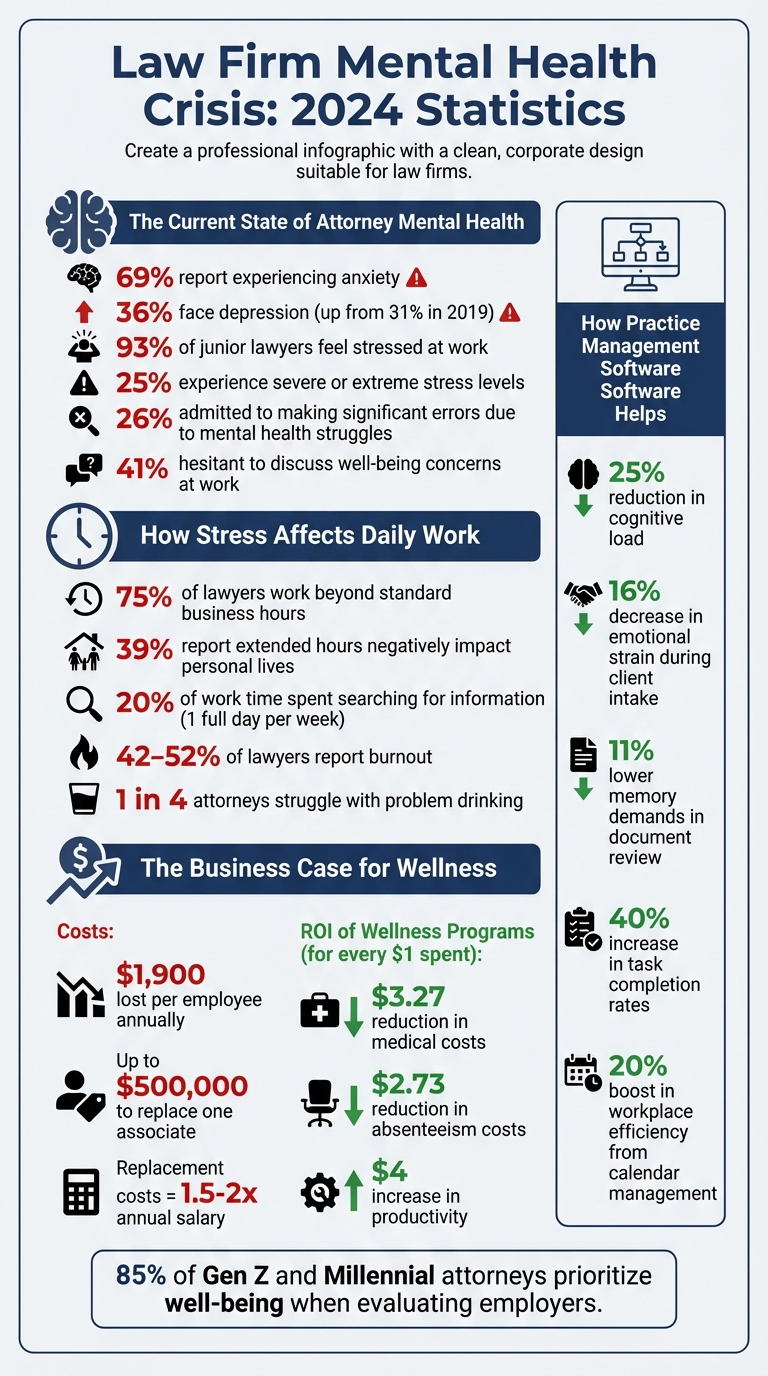
Law Firm Mental Health Crisis: Key Statistics and Financial Impact 2024
Evaluating Stress Levels and Determining Support Needs
Before tackling any problem, it’s essential to understand its scale. The 2024 ALM Law.com Compass survey reveals that 69% of legal professionals report experiencing anxiety, while depression rates have risen to 36%, compared to 31% in 2019. Yet, many attorneys remain reluctant to discuss their well-being with employers. These statistics highlight the need for structured and proactive stress evaluations.
How to Conduct Stress Assessments
To get started, use validated clinical tools to measure stress and related concerns. The Maslach Burnout Inventory (MBI) is a trusted tool for evaluating burnout, though it requires a licensing fee. For a cost-free alternative, the Oldenburg Burnout Inventory (OBI) assesses similar factors like exhaustion and disengagement. When screening for depression, the Patient Health Questionnaire-9 (PHQ-9) is highly recommended, while the Alcohol Use Disorder Identification Test (AUDIT) is effective for identifying substance abuse issues – both are available at no cost.
Anonymous surveys can provide honest feedback on workplace culture and individual well-being. These can be supplemented with quick pulse surveys during particularly stressful periods. A notable example is Kirkland & Ellis, which in 2019 appointed Robin Belleau as its first firmwide director of well-being. Belleau brought a clinical focus to the firm by introducing one-on-one assessments and resilience training programs.
Behavioral monitoring is another critical approach. Managers should be attentive to warning signs like missed deadlines, irritability, or sudden drops in productivity. Regular one-on-one meetings can help identify and address these issues early on.
“Large law firms were not a type of firm that we had a lot of contact with at the Lawyers’ Assistance Program… I was very excited to see that this is something that bigger law firms were starting to pay more attention to.”
– Robin Belleau, Firmwide Director of Well-being, Kirkland & Ellis
These assessment tools and strategies are key to uncovering the main stressors within a firm.
Common Sources of Stress in Law Firms
Once assessments are complete, they can help pinpoint the specific stressors affecting legal teams. A 2019 survey found that over 93% of junior lawyers felt stressed at work, with nearly 25% experiencing severe or extreme levels of stress. The main culprits? High workloads, demanding clients, insufficient support, and poor management practices.
Billing pressures play a major role in workplace anxiety. The constant need to track time and focus on revenue often overshadows the actual practice of law. On top of that, administrative tasks like transcription, document drafting, and scheduling create additional, non-billable stress.
Other stressors include vicarious trauma, especially for attorneys in family law or criminal defense, and a lack of control over job design, which leaves many feeling powerless to manage their workload. In response to these challenges, Reed Smith launched a Mental Health Task Force in January 2020, led by Partner Kimberly Gold. The task force grew to over 100 members worldwide and focused on areas like stigma reduction, policy development, education, substance abuse services, and outreach.
Firms can also use data to identify systemic stressors. For example, analyzing professional indemnity claims can reveal whether stress or overwork contributed to errors. Similarly, tracking absenteeism patterns can shed light on broader issues within specific departments. This evidence-based approach allows firms to implement targeted solutions rather than relying on anecdotal observations.
“The main causes of work-related stress were cited as being high workload, client demands and expectations, lack of support and ineffective management – all of these factors are in an employer’s control to change.”
– Kayleigh Leonie, Solicitor
Creating Firm-Wide Stress Management Policies
After identifying the stressors impacting your team, the next step is crafting policies to address them. Putting these policies in writing signals a genuine commitment to employee well-being. Studies show that investing in wellness not only reduces costs but also improves retention rates. This is crucial because replacing a junior associate can cost between 1.5 to 2 times their annual salary. With these benefits in mind, it’s time to focus on implementing clear, practical policies.
Setting Work-Life Balance Standards
Once stressors are identified, establishing clear work-life balance standards can help attorneys manage their workloads more effectively. These policies need to be specific and enforceable – vague encouragement won’t cut it. For example, firms like Nixon Peabody and Orrick, Herrington & Sutcliffe have rolled out formal flexible work schedules and generous parental leave policies, giving attorneys more control over their time. Others have introduced “Wellness Days”, which are monthly days off dedicated to personal health and recharging.
Revisiting billing models is another way firms can ease stress. Transitioning from billable-hour requirements to fixed fee or value-based pricing can reduce the constant pressure of tracking time. This change is particularly important when you consider that 75% of lawyers often work beyond standard business hours, and 39% report that these extended hours have negatively impacted their personal lives.
“If your partners are catching up on emails over the weekend or late at night, make it clear they should not expect a reply within 5 minutes to their midnight email”
– Dawn Anderson, Chief Human Resources Officer at Butler Snow
Additionally, appointing a dedicated resourcing manager can ensure work is distributed fairly, giving attorneys time to recover between intense projects. Firms like Akin Gump and Vinson & Elkins have also embraced on-site fitness facilities, recognizing exercise as a powerful way to manage stress.
Establishing Clear Communication Standards
Unclear communication can be a major source of stress. To address this, set explicit guidelines for after-hours communication, email response times, and meeting schedules. For instance, using email autoresponders after hours and setting reasonable response-time expectations can help manage both client and colleague needs. Encourage practices like calendar blocking for personal time and focused work sessions. Transparency also plays a key role – regularly sharing organizational updates and explaining management decisions can help employees feel informed rather than left in the dark.
Fostering a Supportive Workplace Culture
A supportive environment ensures that communication standards and work-life policies are more than just words on paper. Leadership must lead by example. Partners should make it clear that immediate responses are not required during off-hours.
Creating a culture of psychological safety allows attorneys to admit mistakes and set boundaries without fear of judgment or penalties. Firms like Kirkland & Ellis and Reed Smith have taken steps to normalize seeking help. For example, in 2019, Kirkland & Ellis appointed Robin Belleau, a licensed counselor, as its first firmwide Director of Well-Being. Belleau introduced a clinical approach, offering one-on-one assessments and ensuring external therapy providers understood the unique challenges faced by legal professionals.
Another cultural shift involves rethinking social events. Many firms rely on alcohol-centered gatherings, which can be exclusionary – especially since 1 in 4 attorneys struggle with problem drinking. By diversifying social activities to include creative, non-alcoholic options, firms can create a more inclusive environment where everyone feels welcome.
“Take care of your employees, and they’ll take care of your business. It’s as simple as that. Healthy, engaged employees are your top competitive advantage”
– Richard Branson
Setting Up Training and Support Systems
Creating effective training and support systems can provide your team with the tools they need to handle the daily stresses of legal work. These systems work best when they’re easy to access, free of stigma, and designed with the unique demands of the legal profession in mind.
Offering Stress Management Training
Programs like Mental Health First Aid (MHFA) teach practical skills, including a five-step plan to identify warning signs, listen without judgment, and encourage seeking help. Training managers to recognize mental health issues and hold supportive conversations is a key step. Senior attorneys and partners can also play a role by distributing workloads more evenly to prevent burnout.
Mindfulness and meditation sessions are another powerful tool. Studies show that 80% of attorneys experienced immediate benefits – both mental and physical – after participating in group mindfulness exercises during professional programs. Including mindfulness, meditation, and substance use education in Continuing Legal Education (CLE) requirements ensures attorneys can meet professional development goals while learning wellness strategies. This is especially important given that one in four attorneys face challenges with alcohol use.
Stigma reduction campaigns are equally critical. With 41% of attorneys hesitant to discuss well-being concerns at work due to fear of career repercussions, normalizing these conversations is essential. A great example is Reed Smith’s #StopTheStigma campaign, launched in March 2020. It featured videos of lawyers sharing personal mental health experiences and included leadership training to foster a more open workplace culture.
These initiatives build a strong foundation for introducing formal support systems like Employee Assistance Programs.
Implementing Employee Assistance Programs
Employee Assistance Programs (EAPs) offer confidential services, including assessments, short-term counseling, and referrals for issues like stress, substance abuse, or financial challenges. Despite being widely available – 82% of employers offer an EAP, according to a 2024 SHRM report – many employees don’t take advantage of them. In fact, a 2025 poll revealed that 26% of employees don’t know if their employer provides mental health benefits, and only 53% know how to access these resources.
To improve awareness, promote EAPs regularly through emails, flyers, and staff meetings. Ensure the program includes 24/7 crisis support and work with providers who understand the unique pressures of legal work.
Managers should also be trained to offer “formal referrals” when performance issues arise. For sensitive situations, administrators can consult EAP vendors for guidance before addressing distressed employees directly. Additionally, request detailed reports from your EAP provider that go beyond usage rates to measure clinical outcomes and productivity impact.
While formal programs are essential, fostering a sense of community through team-building activities can further strengthen workplace support.
Organizing Team-Building Activities
Team activities can improve relationships and reduce stress by encouraging collaboration. To avoid over-reliance on alcohol-centered events, review your firm’s social calendar and ensure at least half of the events include nonalcoholic options. Consider alternatives like wellness fairs, on-site chair massages, yoga classes, or group mindfulness sessions.
Wellness can also become part of everyday routines. For example, start meetings with a brief mindfulness exercise to set a calm tone or hold walking meetings outdoors instead of sitting in a conference room. Seyfarth Shaw has taken this a step further by offering $4,000 grants to employees for health, wellness, or community-focused personal projects. These initiatives send a clear message: well-being isn’t just an afterthought – it’s a priority.
“The idea behind these types of programs is we’re planting seeds. We hope they go out there and they multiply even though we may never know what our impact was.”
– Robin Belleau, Firmwide Director of Well-Being, Kirkland & Ellis
sbb-itb-95f4849
Using Technology to Reduce Administrative Stress
Incorporating technology into daily operations is a game-changer for law firms aiming to reduce administrative stress and improve efficiency. Tasks like billing, scheduling, and document management often contribute to significant stress levels, with 42%-52% of lawyers reporting burnout and 73% linking their work environment to mental health challenges[28,30]. This constant mental strain can lead to long-term exhaustion. Research shows that adopting legal practice management software can ease this burden: it reduces overall cognitive load by 25%, cuts emotional strain during client intake by 16%, lowers memory demands in document review by 11%, and increases task completion rates by up to 40%. On top of that, employees spend about 20% of their time – roughly one full day per week – searching for information, which technology can help address. By lightening the mental load, firms can focus on automating tasks more effectively.
Automating Routine Tasks with Practice Management Software
Practice management software, like The Legal Assistant, brings multiple case management tools under one roof. Instead of spending hours manually drafting documents, attorneys can use smart templates to merge client data into legal forms in minutes. Automated billing features eliminate the hassle of filling out timesheets or calculating billable hours manually, easing the stress of time tracking. For client onboarding, automated workflows guide staff through each step, reducing both emotional strain and repetitive data entry. Secure client portals let clients upload documents and check case updates on their own, cutting down on status-check emails and calls. By combining these tools into a single platform, firms minimize context switching, which can consume up to 9% of an employee’s annual work time.
Improving Team Communication and Task Management
Efficient communication is just as important as automation in reducing stress. Scattered case information – spread across emails, notes, and calendars – only adds to the chaos. Centralized matter management simplifies this by linking all relevant documents, emails, notes, and tasks to specific clients in one place[32,33]. Many platforms also include real-time collaboration tools, such as embedded chat and comment functions, to streamline team interactions. Automated task sequences further enhance workflows by creating tasks, dependencies, and deadlines based on the stage of a case[32,36]. Dashboards provide a clear overview of workloads and task progress, enabling senior attorneys to delegate responsibilities and monitor outcomes without constant follow-ups.
Managing Deadlines and Schedules More Effectively
Missed deadlines can be disastrous in the legal world, and automated calendars help prevent such risks by enforcing jurisdictional rules and sending timely reminders. As one IT professional aptly put it:
“Courts don’t care if your server was down. They want the filing on time.” – Corporate Technologies
Practice management software integrates with tools like Outlook or Google Calendar to flag scheduling conflicts and ensure deadlines are met. Studies indicate that effective calendar management can boost workplace efficiency by up to 20%. Advanced scheduling assistants powered by AI can analyze work patterns to recommend optimal times for focused work, breaks, and relaxation, promoting a healthier work-life balance. For users of The Legal Assistant, customizable calendars and event management tools allow teams to coordinate schedules, set automated reminders, and track case milestones seamlessly. Centralizing all case data with advanced search features eliminates the frustration of digging through physical files, while multi-user collaboration tools enable secure, real-time teamwork. This ensures attorneys can dedicate their energy to practicing law rather than navigating technological hurdles.
Monitoring and Improving Your Stress Management Framework
Tracking Results and Gathering Feedback
To evaluate how well your stress management framework is working, you’ll need a mix of hard data and personal insights. Start by conducting a baseline assessment to establish benchmarks for future comparisons. Key metrics to track include engagement levels, burnout risk, and turnover rates, particularly among your top performers. Research shows that for every $1 spent on wellness initiatives, medical costs drop by $3.27, absenteeism-related expenses decrease by $2.73, and productivity improves by $4.
Feedback is equally crucial. Use various channels to gather input. Anonymous pulse surveys are great for capturing real-time stress levels during busy periods, while 180/360 reviews allow team members to give candid feedback on leadership styles. Another simple yet effective idea is to kick off team meetings with a quick “wellbeing moment”, where everyone rates their stress on a scale of 1–5. This helps normalize regular check-ins. Kimberly Gold, Partner and Mental Health Task Force Chair at Reed Smith, emphasizes the importance of open dialogue:
“Success is our employees feeling comfortable talking openly about mental health and substance use issues and seeking help when they need it. That’s a really big cultural shift, but it may not be the easiest thing to measure.”
Break down your data by department, role, and location to distinguish broader organizational issues from team-specific challenges. Keep an eye on “presenteeism” – when employees show up but operate at less than 80% effectiveness – by using pulse surveys to estimate productivity loss due to stress. Other key indicators include employee assistance program (EAP) usage, participation in wellness events, and the number of employees reaching out for support. Remember, many attorneys may hesitate to share mental health concerns openly, so creating safe and anonymous feedback channels is essential. Use these insights to refine your framework periodically.
Reviewing and Updating Your Framework Regularly
Feedback is only useful if it leads to action. Regular reviews of your stress management framework are essential to keep it relevant and effective. While annual reviews are common, high-pressure workplaces may benefit from semi-annual updates. One practical approach is to review 25% of your framework every six months, ensuring the entire system is evaluated within two years. To stay proactive, schedule these reviews into your corporate calendar – January, for instance – rather than waiting for a crisis to prompt change.
Certain situations call for immediate updates. These include regulatory changes, major organizational shifts, policy violations that expose gaps, or the adoption of new tools like practice management software. Involve a mix of frontline employees, HR leaders, and supervisors in these reviews to ensure policies are not just theoretical but work in practice. Use quarterly pulse checks to track short-term progress and engagement levels.
Finally, document every revision with a clear audit trail, communicate updates to all staff, and require signed acknowledgment to confirm everyone is informed. This ensures transparency and accountability while keeping your framework aligned with both organizational goals and employee needs.
Conclusion
Building a strong stress management framework isn’t just the right thing to do – it’s also a smart financial move. Research shows that for every $1 spent on wellness programs, medical costs drop by $3.27, absenteeism-related expenses fall by $2.73, and productivity increases by $4. With 93% of junior lawyers reporting stress and 66% of solicitors facing high stress levels, the urgency for such initiatives is impossible to ignore.
The blueprint for success is clear: incorporate stress assessments, establish firm-wide policies, provide targeted training, and leverage supportive tools like The Legal Assistant (https://thelegalassistant.com). This practice management software simplifies administrative tasks, streamlines document creation, and keeps deadlines on track – allowing your team to focus on impactful legal work while maintaining balance.
Leadership plays a critical role here. As Richard Branson famously said, “Take care of your employees, and they’ll take care of your business. It’s as simple as that.” Healthy, engaged employees are any firm’s greatest asset. When firm leaders demonstrate healthy habits – like respecting personal time and encouraging breaks – they set a tone that empowers associates to follow suit. Top firms like Kirkland & Ellis and Reed Smith have already made strides by appointing well-being directors and forming mental health task forces.
This framework isn’t a one-and-done solution. It requires regular reviews, feedback, and updates to stay relevant as your firm grows and evolves. With 85% of Gen Z and Millennial attorneys prioritizing well-being when evaluating employers, investing in mental health initiatives is a powerful way to retain talent and attract the best candidates.
The legal profession’s mental health challenges won’t disappear overnight. But every firm that takes action contributes to meaningful change, fostering a healthier, more engaged workforce. By adopting these strategies, you create a workplace that benefits both your team and your bottom line.
FAQs
What are effective ways for law firms to assess employee stress levels?
Law firms can take a structured approach to understanding employee stress by using tools like regular surveys and assessments. These methods allow firms to gather insights into workplace well-being and pinpoint stress triggers, such as overwhelming workloads, long hours, or challenges tied to workplace dynamics.
Another key step is fostering open communication. When employees feel safe discussing their concerns – whether through confidential conversations or mental health check-ins – it becomes easier to identify and address issues. Training managers to recognize signs of stress and create a sense of psychological safety can also make a big difference. This not only helps in spotting problems early but also builds a culture where employees feel supported and valued.
What policies can law firms adopt to promote work-life balance and reduce stress?
Law firms can take meaningful steps to improve work-life balance and lower stress levels by focusing on employee well-being. For instance, establishing clear limits on work hours and offering flexible schedules can help team members juggle their personal and professional responsibilities more effectively.
To further support mental health, firms might provide access to counseling services, host mindfulness or meditation sessions, and encourage employees to prioritize regular mental health check-ups. Shifting away from traditional billing practices – like adopting fixed fees or value-based pricing – can also alleviate the intense pressure of meeting billable-hour targets, fostering a more balanced and supportive work environment.
By introducing wellness initiatives, managing workloads more thoughtfully, and encouraging open discussions about mental health, law firms can build a workplace culture that values both productivity and the well-being of their employees.
How can legal practice management software help reduce stress in law firms?
Legal practice management software is designed to make life easier for law firms by streamlining day-to-day operations and cutting down on repetitive administrative work. Tasks like document creation, billing, and managing to-do lists become automated, giving attorneys and staff more time to concentrate on what truly matters – serving their clients.
These tools also serve as a central hub for tracking case details, deadlines, and communications, helping ensure no critical detail is overlooked. With better organization and smoother workflows, law firms can not only ease workplace stress but also boost productivity and deliver a better experience for their clients.
The post Stress Management Framework for Law Firms appeared first on The Legal Assistant.