
What Makes eDiscovery Evolved
“We always overestimate the change that will occur in the next two years and underestimate the change that will occur in the next ten.”
This famous quote by Bill Gates reminds us that lasting success depends on continuous evolution and adaptation. It’s a principle clearly mirrored in the ongoing trajectory of eDiscovery.
Similarly, the enduring success of eDiscovery solutions lies in their ability to continuously evolve and expand their utility beyond traditional litigation support.
Today, its role encompasses critical functions such as data breach response and handling privacy or subject rights requests, accelerating its transformation through broader application.
These expanded applications are reshaping the eDiscovery landscape and paving the way for new trends that emphasize privacy, governance, and structured digital workflows.
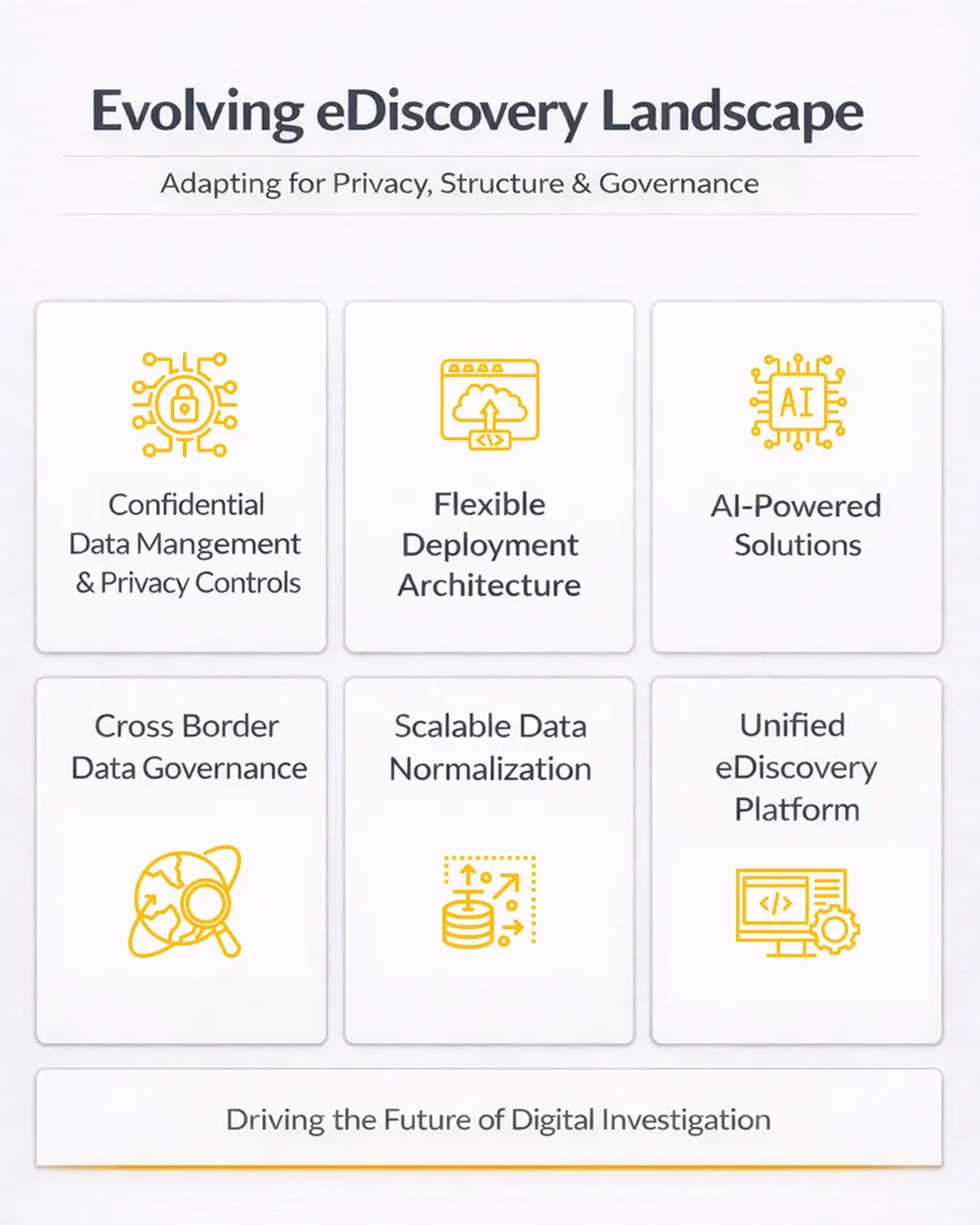
Driven by these evolving use cases and rising organizational demands, the six major shifts are explained by privacy, structure, and governance within modern digital workflows.
- Confidential Data Management & Privacy Controls – Safeguarding sensitive data with privacy frameworks.
- Flexible Deployment Architecture – Integrating individual deployment types to ensure total data privacy and control.
- AI-Powered Solutions – Enabling intelligent automation through active LLM models, accelerating faster insights.
- Cross-border Data Extraction and Governance Integration – Navigating multi-regional matters with compliance and data regulation at its core.
- Scalable Data Normalization – Standardizing vast datasets acceptable to the court and throughout the production output.
- Comprehensive Platform & Integrated Technology – Unified solutions into comprehensive ecosystems for end-to-end workflows.
A Deep Dive into the Nitty-Gritty of Six Shifts
Unlocking these shifts reveals how privacy, governance, and technology redefine modern eDiscovery. Each transformation is more than a trend; it is a structural modification shaping digital workflows. Exploring these six forces is driving the next era of intelligent discovery.
Shift 1: Confidential Data Management and Privacy Controls
The evolution of eDiscovery has been deeply intertwined with the rise of global privacy regulations, most notably the General Data Protection Regulation (GDPR).
After the General Data Protection Regulation (GDPR) enforced strict data confidentiality controls in 2018, eDiscovery workflows were reshaped to prioritize the protection of sensitive information, including PII (Personally Identifiable Information), PHI (Protected Health Information), and private communications. This enforcement also introduced privacy-aware review processes as a standard practice.
Following this enforcement, another development was introduced in 2021 – present, covering Technical Privacy Controls and Pseudonymization.
Regulators and respective authorities began focusing on technical measures as essential considerations for data protection.
These fundamentals are now widely incorporated into modern eDiscovery platforms through:-
- Automated PII detection
- Data masking and redaction implementation
- Encrypted data processing environments
- Granular role-based access controls
How do These Developments influence Modern eDiscovery?
Collectively, these considerations transformed eDiscovery into a privacy-oriented legal technology practice.
Modern platforms now integrate:-
- Secure data processing environment
- Defensible audit trails and governance reporting
- Automated detection of sensitive data
- Region/jurisdiction- aware data transfer controls
- Privacy-centric review models.
Shift 2: Flexible Deployment Architecture
Legacy eDiscovery deployment architectures in eDiscovery were primarily dependent on on-premise infrastructure and siloed solutions, leading to inefficiencies and limited scalability in legal data workflows. They were designed for a period when data volumes were smaller, infrastructure was localized, and regulatory requirements were less complex.
As digital evidence sources expanded and legal workflows became more global, several limitations of these traditional architectures became evident.
Below are the shortcomings primarily linked with legacy deployment:-
Limited Scalability
Traditional architectures were built around fixed infrastructure. As data volumes rose due to email archives, collaboration platforms, and cloud applications, organizations struggled to scale processing and storage without significant hardware upgrades.
High infrastructure and maintenance costs
Legacy deployments required substantial investment in physical servers, storage systems, backup infrastructure, and dedicated IT resources.
Slow System Upgrades and Innovation Cycles
Updating legacy systems often required manual installation, infrastructure downtime, and extensive compatibility testing.
Challenges With Cross-Border Data Governance
Legacy architectures were rarely designed with global data privacy regulations in mind. Managing data residency requirements, jurisdictional controls, and cross-border transfers often requires complex manual processes.
BYC And BYAIM – The Future-ready Deployment Solutions
Today, new deployment opportunities have transformed the way eDiscovery is embraced.
By adapting Bring Your Cloud (BYC) and Bring Your AI Model (BYAIM), firms now operate within a flexible, scalable, and privacy-aware framework. This modern approach eliminates dependency on localized servers and effectively addresses the challenges of cross-border data governance, positioning eDiscovery as a dynamic discipline aligned with global digital workflows.
BYC – BYC, also known as Bring Your Own Cloud(BYOC), is all about cloud independence and deployment on your terms. This means you decide where our platform runs, whether on-premises in your data center, in your private cloud, or in a preferred public cloud region. Your data stays in environments you trust, under your governance, and within your chosen jurisdictions.
BYAIM – BYAIM, also known as Bring Your Own AI(BYOAI), is a deployment approach that lets organizations plug in their preferred AI models. Instead of being locked into a single vendor’s AI, you can use any model. From public LLM services (like OpenAI or Google Gemini) to private or open-source models, or even proprietary AI engines.
Shift 3: AI-Powered Solutions
Traditional eDiscovery relied heavily on manual review, keyword searches, and linear workflows that were time-consuming and error-prone.
Time‑Consuming
Reviewing millions of emails or files manually could take months, delaying litigation or regulatory responses.
Error‑Prone
Human reviewers missed subtle context, relationships, or patterns that keyword searches couldn’t capture.
Costly
Large review teams drove up expenses, especially in complex cases.
Inflexible
Linear workflows couldn’t adapt to new requirements like privacy requests, breach investigations, or cross-border compliance.
Limited Insight
Keyword searches only scratched the surface; they couldn’t uncover hidden connections, sentiment, or anomalies in data.
Why Modern eDiscovery Integrated AI
- Active learning and LLM reduced manual document review
- Advanced analytics quickly find relevant documents and reasoning with excerpts
- Privacy-aware controls ensure compliance with GDPR and other regulations
- Intelligence allied to uncover hidden patterns beyond keywords
Shift 4: Cross-border Data Extraction and Governance Integration
The integration of cross-border governance frameworks has evolved eDiscovery into a globally compliant, privacy-oriented practice. This ensures:-
- Faster resolution of multi-jurisdictional matters
- Reduced risk of regulatory penalties
- Streamlines collaboration across international teams
- Defensible workflows that stand up to international regulatory needs
The previous legacy was limited with:
- Manual compliance checks for each jurisdiction
- High risk of violation with international data transfers
- Fragmented workflows that lacked transparency and defensibility
- Limited adaptability to evolving privacy regulations
Shift 5: Scalable Data Normalization
In earlier eDiscovery, manual data conversion processes often introduced inaccuracies and inconsistencies, ultimately affecting the reliability of production outcomes in litigation, investigation, and regulatory contexts.
This includes:-
Fragmented Data
Different formats required manual conversions, slowing workflows.
Inconsistency
Lack of standardization led to errors and disputes over admissibility
Limited Capacity
Legacy systems couldn’t handle the exponential growth of digital evidence
High Costs
Manual normalization demanded large review teams and extended timelines
Revolutionized Updates
- Automating normalization across diverse data sources
- Embedding compliance standards into workflows
- Reducing costs and human error
- Enabling faster, more reliable production in litigation, investigations, and regulatory matters.
Shift 6: Comprehensive Platform & Integrated Technology
The era of fragmented, siloed systems is over. Today, it’s more about holistic platforms integrating multiple solutions into a unified ecosystem, delivering end-to-end workflows that are faster, more defensible, and privacy-aware.
How do comprehensive technologies help?
Unified Ecosystem
Processing, review, analytics, and production are all managed within a single platform, eliminating the inefficiencies of juggling multiple, detached software systems.
Seamless Integration
Built-in integrations with enterprise systems (email, collaboration apps, cloud storage) streamline data ingestion and reduce manual handling.
End-to-End Governance
Integrated audit trails, reporting, and compliance checks ensure defensibility throughout the lifecycle of digital evidence.
Enhanced User Experience
Legal teams, IT, and compliance professionals work within one environment, improving collaboration and reducing training overhead.
Conclusion
The journey from traditional to modern eDiscovery workflows has profoundly advanced the legal tech discipline. These innovations have not only reduced the burden of manual labor but also delivered outcomes that are more productive, precise, and on time, ensuring evidence presented in court is both reliable and defensible.
As a result of these advancements, complex eDiscovery operations have evolved into streamlined processes that once seemed overwhelming can now be expedited with efficiency, adding real value to critical matters that demand strict deadlines and involve chaotic, large-scale data collections.
The post 6 Emerging Shifts Reshaping eDiscovery Needs appeared first on Knovos.