
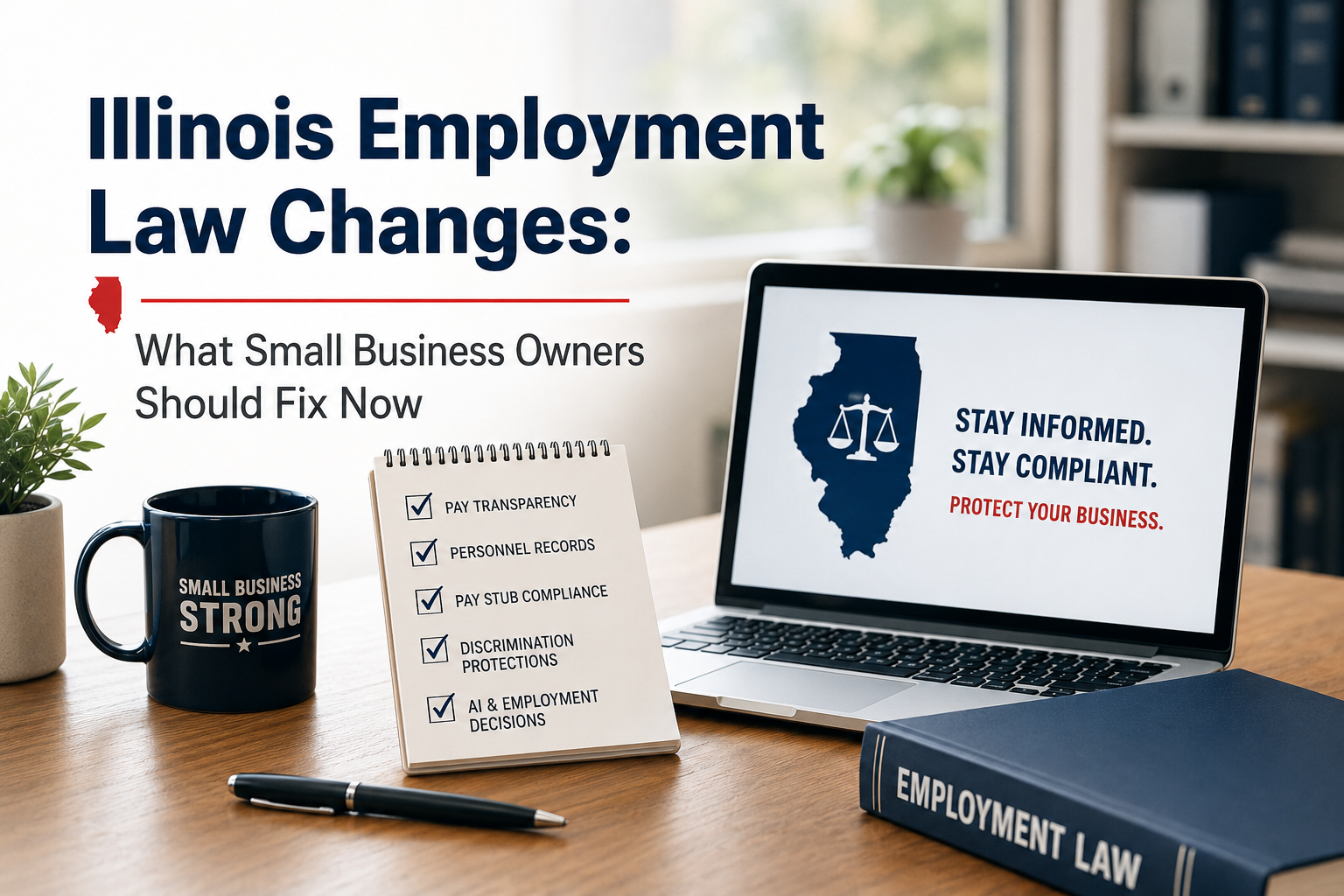
 What changed? Illinois strengthened pay transparency mandates, expanded personnel file access rights, tightened pay stub requirements, broadened anti-discrimination protections to cover family responsibilities and reproductive health decisions, added restrictions on AI used in hiring, tightened severance and confidentiality agreement rules, and extended employee rights regarding employer-issued devices under VESSA, all effective in 2025–2026.
Who is
Guest Post: Mapping AI Risks: Insights from 2025 10-K Filings


In the following guest post, Evan Bundschuh and Burkhard Fassbach share and analyze their research into the AI-related Form 10-K disclosures of 26 U.S.-listed public companies, in order to assess the level and significance of public companies’ disclosure statements pertaining to artificial intelligence. Evan is Vice President at GB&A, a
Ten Things: Have a More Productive Day (Ten Simple High-Impact Productivity Hacks for In-House Counsel)
One of my most recent books is on productivity for in-house lawyers.[1] Ironically, the book is over 400 pages long so it may not be the most productive use of your time to meander through it looking to pick up a useful nugget or two. At 400 pages it does make for
Indiana Federal Court Finds You Cannot Rely on AI As a Replacement for Good Lawyering
On April 14, 2026, United States Magistrate Judge Tim A. Baker for the United States District Court for the Southern District of Indiana (the “Court”) entered an order in connection with certain unresolved discovery disputes in White v. Walmart, Case No. 25-cv-01120, finding Plaintiff’s counsel’s “exclusive reliance” on AI to identify discovery deficiencies in Defendant’s
Shareholder Proposals and ESG at a Crossroads: What Boards Should Know After the 2026 Proxy Season
The Weinberg Center’s fifth annual “ESG in the Boardroom” program, titled “Shareholder Proposals at the Crossroads: Boards, ESG, and the Future of SEC Rule 14a-8,” held April 28 in Wilmington, Delaware, brought together directors, jurists, advisors, and regulators to examine a governance environment in which boards are operating with less regulatory certainty and more direct
AI and Corporate Governance: Do Boards Need an AI Expert?

Artificial intelligence (AI) is an increasingly important part of business strategy for many companies. As AI has become increasingly important in the corporate world, some commentators suggest that corporate boards not only need AI fluency but in fact need a specialized AI expert. These suggestions about board expertise may present challenges for many boards,
NYC Proposes New Rules for Auto-Renewal Subscriptions

NYC advances proposed rules on subscription cancellations, expanding enforcement against negative option offers and outlining new disclosure and notice requirements.
Is This The Most Hallucinatory of All Legal Malpractice Cases?
There has been a lot of back and forth about AI mistakes in case citation, and overly unreasonable reliance on AI in guiding legal arguments. We think that Kleyman Law Group, P.C. v Kaloidis 2026 NY Slip Op 31557(U) April 13, 2026 Supreme Court, Kings County Docket Number: Index No. 502644/25 Judge: Heela D. Capell
Sullivan & Cromwell Discusses Warnings to Bank CEOs About Cybersecurity Risks of Anthropic’s New AI Model
On April 7, 2026, Treasury Secretary Scott Bessent and Federal Reserve Chair Jerome Powell convened an urgent, closed-door meeting with the CEOs of some of the nation’s largest banks to discuss the cybersecurity risks posed by Anthropic’s newly announced AI model, Claude Mythos Preview (“Mythos”).[1] According to news reports, the meeting was held to
The USPTO’s Foreign Applicant Rule Shifts Control of U.S. Patent Filings to Registered Counsel
The USPTO’s Foreign Applicant Rule Shifts Control of U.S. Patent Filings to Registered Counsel by Ed Khalili, J.d., Pharm
The USPTO’s Foreign Applicant Rule Shifts Control of U.S. Patent Filings to Registered Counsel
A structural change is coming to U.S. patent practice. Effective July 20, 2026, the United States Patent and Trademark Office will require that patent applicants