For nearly a decade, debates over ESG – environmental, social, and governance – disclosures have dominated corporate law and securities regulation. Should companies be required to disclose information about climate risk, workforce diversity, or governance practices? At first glance, this appears to be a policy question. In reality, it is a doctrinal one. The ESG
Law School Blogs
SEC Announces Enforcement Results for Fiscal Year 2025
Central to an effective enforcement program is determining which cases to bring and responsibly stewarding Commission resources. Regrettably, such resources have been misapplied in prior years to pursue media headlines and run up numbers, and in turn, led to misguided expectations on what constitutes effective enforcement.
Fiscal Year 2025 Results & Supporting Context
During fiscal…
Why the Verdict on Social Media Defective Design Harming Children Gets the Instinct Right But the Law Wrong

A California jury’s decision last week to hold Meta and YouTube liable for harms to a young woman’s mental health has been greeted as a watershed moment. Child safety advocates have called it Big Tech’s “Big Tobacco moment.” Parents who lost children to what they attribute to social media addiction embraced outside the…
People and Persons: A Necessary Distinction When Thinking about Firms, Ecology, and Artificial Intelligence
In two forthcoming book chapters, I argue for maintaining conceptual clarity about the difference between people – that is, the natural kind of the human species – and persons created as artificial entities with rights (and often but not always duties).[1] This distinction has long been recognized by philosophers and legal theorists, with one…
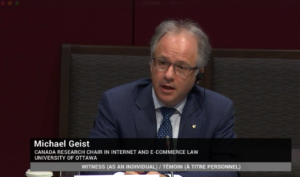
Setting Canada’s AI Policy Priorities: My Appearance Before the Standing Committee on Industry, Science and Technology

The Standing Committee on Industry, Science and Technology is one of several House and Senate committees currently grappling with legal, regulatory and policy challenges and opportunities presented by AI. I appeared before the committee yesterday alongside Yoshua Bengio and Colin Bennett. Bengio unsurprisingly garnered the lion’s share of the questions, but the committee did give…
The Law Bytes Podcast, Episode 262: Zack Shapiro on the Claude AI Native Law Firm

What are the limits of using AI to help run a legal practice? There is much discussion about what an AI future might look like, but with the rapid development of AI tools, the future may be now. The hot AI service of the moment is Claude AI, which targets various verticals, including software development…
Cleary Discusses Managing AI Risks: Legal and Governance Imperatives for Boards
AI adoption is now mainstream: 88% of businesses use AI in at least one function, with global spending expected to exceed $1.5 trillion in 2025 and approach $2 trillion in 2026. As organizations race to scale AI, many have relied upon traditional vendor risk management policies to vet third-party AI vendors and tools; however, implementation…
The Law Bytes Podcast, Episode 261: Ian Goldberg on the Privacy Risks of Age Assurance Technologies

Age verification, estimation or inference is seemingly all the rage right now. Vendors are promoting it as the solution to thorny challenges to limit access to certain sites and services and politicians are eager to legislate in that direction, including in Canada with Bill S-209.
Hundreds of scientists and technology experts from around the…
A Tale of Two Bills: Lawful Access Returns With Changes to Warrantless Access But Dangerous Backdoor Surveillance Risks Remain

The decades-long battle over lawful access entered a new phase yesterday with the introduction of Bill C-22, the Lawful Access Act. This bill follows the attempt last spring to bury lawful access provisions in Bill C-2, a border measures bill that was the new government’s first piece of substantive legislation. The lawful access…
Debevoise Discusses Judge Rakoff’s Written Opinion on AI-Generated Documents
We wrote recently about a decision in which Judge Rakoff of the Southern District of New York denied the claim of defendant Bradley Heppner that documents prepared by Heppner using the consumer version of the AI model Claude for legal research were privileged. On February 17, 2026, Judge Rakoff issued a written opinion explaining the…