On December 11, 2025, President Trump issued another Executive Order. This one is intended to promote “national dominance” in “a race with adversaries for supremacy.” To “win,” the Order says, AI companies should not be encumbered by state regulation. “The policy of the United States,” the Order says, is “to sustain and enhance the
Trademark
Hottest Patent Term of 2026? SMED.
Every year has its “it” term.In 2025, the crown belonged to AI, and rightfully so. AI dominated the headlines, flooded the USPTO’s dockets, and triggered more §101 rejections than any examiner would care to admit. If you worked in tech, you had to talk about AI. If you worked in patent law, you likely had…
Pursuing Copyright Clarity Amidst the Gen AI Creativity Revolution
Introduction
A collision is on the horizon. The collision is between a strict interpretation of the human authorship requirement under U.S. copyright law, and the ascendence of generative artificial intelligence (Gen AI) as an essential element of modern creativity. From publishing and advertising to music, film, media, and software development, AI systems are reshaping workflows and…
Dr. Thaler is Right, in Part
When Dr. Stephen Thaler asked the U.S. Supreme Court to reconsider the human authorship requirement for copyright protection last month, many observers dismissed the effort. Thaler’s claim—that his generative AI system should be recognized as the author of its own outputs—has been consistently rejected by courts and the Copyright Office. On its face, Dr. Thaler’s petition…
Modernizing the Machine: USPTO Tests AI Search and Streamlined Claim Review
Another day and another change at the USPTO. On October 8, the USPTO announced an Artificial Intelligence Pilot Program for pre-examination searches. Last week, on October 24, the USPTO followed with the Streamlined Claim Set Pilot Program aimed at accelerating examination through simplified claim structures. Together, these initiatives reflect Director John Squires’ drive to modernize…
USPTO Under Squires: A Look at the First Month
In a new Law360 article, Seyfarth partners Puya Partow-Navid and Brian Michaelis examine the early actions of newly appointed USPTO Director John A. Squires and their potential impact on patent eligibility, PTAB proceedings, and patent prosecution.
The piece explores Director Squires’ initial policy moves, including his decision to personally oversee AIA trial institution decisions and…
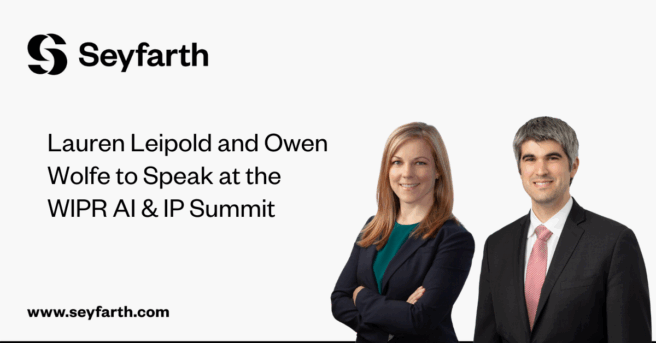
Seyfarth IP Partners, Lauren Leipold and Owen Wolfe to Speak at the WIPR AI & IP Summit

Tomorrow, October 9, 2025, Lauren Leipold and Owen Wolfe, Intellectual Property Partners at Seyfarth, will be speaking at the WIPR AI & IP Summit in New York.
Lauren and Owen will take part in the session “AI vs Copyright: Tackle the New Creative Battleground,” which will examine how generative AI is disrupting traditional copyright principles and the legal frameworks around them. The…
California’s AI Law Has Set Rules for Generative AI—Are You Ready
Starting January 1, 2026, California’s AI Transparency Act (SB 942) goes into effect, marking the first law in the U.S. to require built-in disclosures and detection tools for generative AI content. Do not panic (yet). This law does not apply to every system out there. In fact, many companies may be surprised to find they’re…
Voice Cloning

Lehrman v. Lovo, Inc.
On July 10, 2025, the federal district court for the Southern District of New York issued an Order granting in part and denying in part a motion to dismiss a putative class action lawsuit that…
AI Search Tool Coming to Design Patent Examination
The U.S. Patent and Trademark Office (USPTO) has announced the rollout of DesignVision, an advanced AI‑powered image search tool now integrated into the examination system for U.S. design patent applications. According to the Official Gazette notice published July 16, 2025, DesignVision enables examiners to perform federated searches of U.S. and foreign industrial design and trademark…