
AI is already a go-to for client legal questions
According to data from the latest Legal Trends Report, 57% of consumers say they either have or would use AI to answer their legal questions.
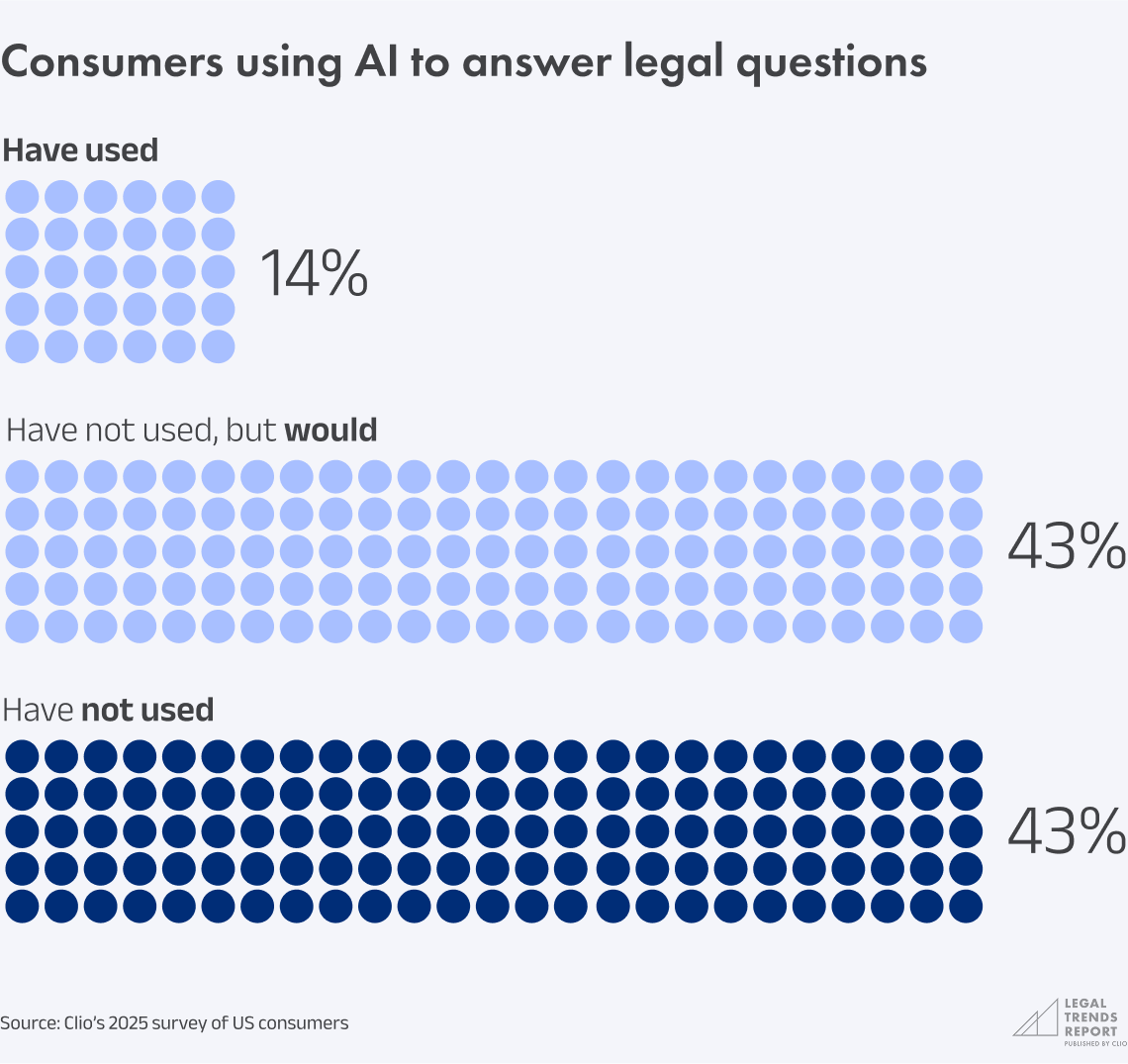
There are many good reasons for the trend. For one, the technology is simple to use and it’s available
Clio Blog
Latest from Clio Blog - Page 2
Emerging Legal Technology: How Clio Is Shaping the Future of Law
By Joshua Lenon
What is emerging legal technology—and why it matters now
Emerging legal technology refers to new tools (e.g., AI, automation, and legal analytics) that enhance how legal professionals manage, analyze, and deliver legal services. These technologies solve many of the challenges lawyers face today: time-consuming administrative work, rising client expectations, increasing competition, and growing pressure to…
A Lawyer’s Guide to ESG Compliance: Risks, Duties, and Opportunities
What are ESG legal requirements?
ESG legal requirements establish legal standards across a variety of environmental, social, and governance issues. These requirements serve multiple purposes, (1) ensure investors have material information about ESG-related risks, (2) mandate transparency about supply chain practices, and (3) set performance standards in areas like data privacy and workplace safety.
- Environmental
…
Harvey AI Alternatives: Legal AI for Law Firms
By Kate Rattray
The truth about Harvey AI: Impressive, but not built for every firm
Harvey AI helped spark the legal industry’s interest in generative AI. Built on OpenAI’s GPT technology and trained on legal data, it was developed to assist large organizations with drafting, contract analysis, and legal research. Its integrations through Microsoft Azure provide the scale…
OpenAI’s Usage Policies Update and the Case for Legal-Specific AI
What really happened in OpenAI’s latest usage policies update
On October 29, 2025, OpenAI released updated usage policies outlining what users can and can’t do with its products and services.
One line in particular sparked confusion, as many interpreted it as ending ChatGPT’s ability to answer legal questions entirely:
“You cannot use our services for…the…
Vera, Collbox, and Clearbrief: Clio App Integrations Powering the Future of Legal Work
2025 Winners at a Glance
Category
Winner
Why It Stood Out
Best New App
VERA
AI-powered timeline builder that extracts critical dates from any legal document and auto-syncs them to your Clio calendar—eliminating manual deadline tracking.
Best Business of Law App
CollBox
Dedicated A/R specialists plus automated outreach that recovers an average of $66,000 monthly…
Law Firm Consolidation: A Step-By-Step Guide to Mergers and Acquisitions
What is law firm consolidation?
Law firm consolidation refers to the process of combining two or more law firms or legal service providers into a single entity. Typically, this process will consist of either a merger, in which two firms combine their operations into one, or an acquisition, in which one firm acquires and absorbs…
9 Best Legal Research Resources: Databases, Tools and Software
What is a legal research tool?
A legal research tool is software designed to help legal professionals efficiently find and analyze legal information, such as statutes, case law, and legal journals. It offers advanced search capabilities, case analysis, and document management. Many legal research tools are now super-charged with AI, getting you answers faster, helping
…
How Paralegals Can Lead Technology Improvements in Law Firms
Why paralegals are key to law firm efficiency
Your role goes well beyond administrative support. You perform substantive legal work under attorney supervision: conducting legal research, drafting pleadings and discovery documents, managing complex case files, coordinating eDiscovery, and tracking critical deadlines. Much of this is billable, which means every inefficiency impacts both productivity…
Highlights from ClioCon 2025
Opening keynote by Jack Newton
Kicking off our 13th annual ClioCon in Boston, Clio’s CEO and Founder, Jack Newton set the tone for the two days with his opening keynote built on this year’s theme—Uniting Brilliance—and examined how innovation and technology are propelling the legal profession into a new era of transformation.
We…