

AI has fundamentally changed the way people search for information on the internet. Since March of 2024, Google has been serving AI overview for certain searches, which provide synthesized information pulled from a variety of sources – with citations to each source.
Google’s AI Overviews have moved beyond “experimental feature” to standard SERP real estate, appearing above sponsored ads and organic results. What’s more, is that legal searches trigger AI overviews almost 78 percent of the time – more than any other industry.
For law firms, this isn’t a minor update. It’s a fundamental change in how potential clients discover legal information—and how they discover you.
What does this mean? If your firm’s content isn’t showing up in that AI Overview, you’re invisible to a massive portion of searchers. And most law firms don’t even know it’s happening.
Most firms are still optimizing for the Google of 2023. They’ve built websites that rank for traditional keywords, but they haven’t adapted to the reality of AI-driven search. And the firms that move fast on AI Optimization (AIO) are already capturing visibility that their competitors are completely missing.
Why AI Overviews Matter More Than You Think
Let’s be direct: AI Overviews are not replacing traditional search results. They’re displacing them. When someone searches for a legal question, the AI Overview appears first. Sponsored results come next. Then organic listings. That’s your new hierarchy.
For law firms, the implications are profound. A potential client searching “how to modify a custody agreement” doesn’t scroll past the AI Overview to find your perfectly optimized blog post. They read the overview, get their answer, and if your content contributed to that overview, you might get a click. If it didn’t, you’re invisible.
But here’s what makes this opportunity for firms willing to adapt: most of your competitors aren’t doing anything about it yet. They’re still fighting over traditional keywords and optimizing for traditional SEO. They haven’t realized that AI Overviews require a fundamentally different approach to content strategy.
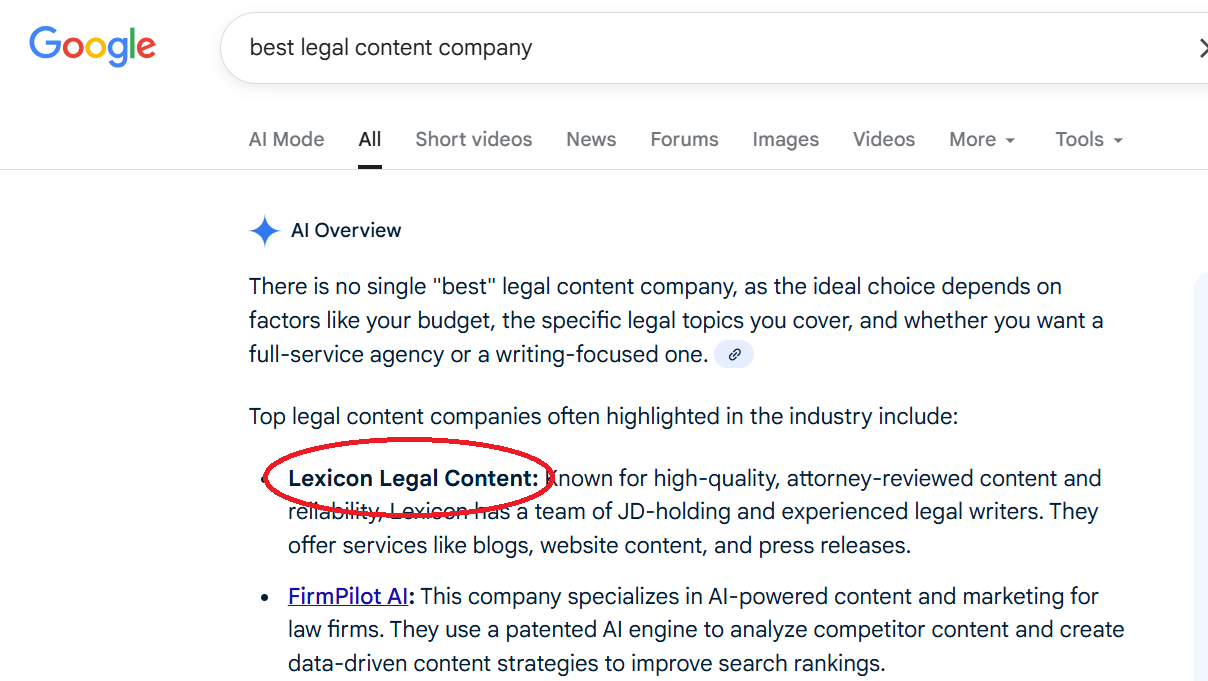
We consistently appear in the AI Overview for “Best Legal Content Company,” and it’s driven qualified traffic directly from searchers actively looking for exactly what we offer. That’s not an accident. It’s optimization.
The Foundational Rule Still Applies
Before I walk you through the tactics, here’s something critical: the core principle of SEO hasn’t changed. Create high-quality content that provides genuine value to your potential clients. That’s it. That’s been the rule for years, and it remains the rule today.
The difference? AI Overviews have made the specificity and clarity of that content even more important. You can’t hide behind vague, keyword-stuffed content anymore. AI systems are training on content that actually answers questions comprehensively and conversationally. Google is rewarding clarity and expertise.
So AI Optimization isn’t about learning a whole new game. It’s about playing the old game better—with greater precision, more direct language, and content structures designed for how AI systems actually read and synthesize information.
Three Tactics to Get Your Firm Into AI Overviews
1. Answer Long-Tail Queries With Precision
Remember the insight from our previous piece about long-tail keywords? They matter even more now—because they’re exactly what ends up in AI Overviews.
When someone searches for a specific legal question—”can a landlord charge for normal wear and tear in Colorado,” or “what happens to a business in a divorce”—they’re asking for a direct answer. And that’s what AI Overviews pull: comprehensive, direct answers to specific questions.
Here’s what this means for your content strategy: create blog posts and resources that answer these questions completely in the first 1-2 paragraphs. Not buried deep in the content. Not after an introduction. Upfront.
Why? Because AI systems are extracting that initial answer to display in the overview. If your content takes three paragraphs to answer a straightforward legal question, you’re not getting selected.
Practical example: Instead of a blog post titled “Custody Modifications” that buries the actual answer in paragraph four, write one that starts: “A custody agreement can typically be modified if there’s been a material change in circumstances—such as a parent’s relocation, change in income, or shift in the child’s needs. Here’s exactly when courts will approve modifications and what you need to prove.”
Answer first. Elaborate second. That structure is gold for AI Overviews.
2. Use Conversational Language That AI Systems Recognize
This one feels counterintuitive to lawyers. Legal writing traditionally favors formal language, complex sentence structure, and industry jargon. But AI systems—and more importantly, the people using them—respond better to conversational clarity.
When you write for AI Overviews, you’re optimizing for how actual humans ask questions. They don’t say, “What are the statutory requirements for initiating dissolution of matrimonial proceedings?” They say, “How do I start a divorce?”
Write the way your clients think, not the way legal briefs are written.
This doesn’t mean abandoning accuracy or authority. It means using shorter sentences, defining terms as you introduce them, and adopting an explanatory tone rather than a prescriptive one. Use “you” and “your” when appropriate. Break complex concepts into digestible chunks.
Concrete example:
Traditional legal writing: “Pursuant to the statute, the obligor shall be responsible for a prorated share of childcare expenses incurred by the obligee.”
Conversational for AI: “You’ll typically share childcare costs with the other parent. Here’s how that’s calculated in Colorado…”
AI systems are learning from content that sounds human and helpful. If your content reads like a legal manual, it’s less likely to be selected for an overview that serves everyday people searching for answers.
3. Implement Structured Data (Schema Markup) for Legal Content
This is where most law firms completely drop the ball. They create great content, optimize for keywords, but never tell Google what that content is.
Schema markup—structured data in a specific format—tells search engines and AI systems exactly what information your content contains. For legal content, this means marking up things like: legal advice, Q&A sections, definitions, credentials, and expertise areas.
Google’s AI systems use schema markup to better understand and extract information. When you properly mark up a blog post about family law, Google understands it’s a legal resource written by an expert. That context helps determine whether your content gets selected for an AI Overview.
Practical implementation:
Use FAQPage schema for Q&A-format content. Use LegalService schema to describe your practice areas. Mark up author credentials with Person schema that highlights relevant expertise. Use Answer schema for direct responses to common questions.
This isn’t optional anymore. Firms without schema markup are flying blind in the AI-driven search landscape. Firms with proper schema implementation are getting their content surfaced in AI Overviews because Google has a clear, machine-readable signal about what your content is and who wrote it.
You don’t need to become a schema expert—tools like Google’s Rich Results Test and platforms like Yoast can help—but you do need to implement this consistently across your blog and resource pages.
The Competitive Advantage Is Narrow
Here’s the reality: AI Overviews are still new enough that most law firms haven’t optimized for them. The firms that are—that are answering specific questions directly, writing conversationally, and implementing schema markup—are already seeing outsized visibility.
But that window won’t stay open forever. Within 12-18 months, firms will catch up. The competitive advantage will compress. The firms that move now have a head start. The firms that wait will be playing catch-up in a much more crowded field.
And none of this—none of it—requires abandoning the fundamentals. Create content that genuinely helps your potential clients. Answer their actual questions. Write with clarity and authority. Let AI systems understand what you’ve created through proper markup.
The game hasn’t changed. The playing field just got more visible.
Getting Started: Your Next Steps
- If you’re ready to implement AI Optimization, start here:
- Audit your existing content. Which blog posts and resources directly answer specific legal questions? Which ones bury the answer? Start there.
- Identify long-tail opportunities in your practice areas. What specific questions are your clients asking? Create comprehensive content targeting those questions with direct answers upfront.
- Implement schema markup on all legal content. Start with FAQ and LegalService schema. Make it machine-readable.
- Write conversationally. Audit a few existing pieces. Could they be clearer? More direct? Rewrite with your actual clients’ language in mind.
For a deeper framework on how to implement these tactics systematically, check out our 2025 AIO For Lawyers Guide – it walks through the full AI Optimization strategy with concrete examples and implementation checklists.
The legal search landscape is changing. The foundational principles remain constant: create real value, demonstrate expertise, answer questions clearly. But now, you also need to make sure AI systems can actually find, understand, and surface that value to the potential clients searching for it.
The firms that understand this distinction are already winning. The question is: will you?