
Editor’s Note: As December 23 approaches, a unique tradition quietly takes hold among cybersecurity, information governance, and eDiscovery professionals—one that strips away holiday excess in favor of sharp insight and well-earned candor. In this timely article, The Aluminum Pole in the Server Room: Festivus for the Rest of Us, Festivus is more than pop culture parody; it becomes a meaningful ritual for a sector overrun with noise, hype, and endless AI pitches.
By blending satire with actionable wisdom, the piece captures a moment of collective exasperation and professional resilience. From the deluge of “VIP” invites that aren’t, to the recursive swirl of tech journalism reporting on itself, this Festivus reflection shines with both bite and grace. It reminds us that in an industry where fatigue is often mistaken for failure, the true feat of strength is enduring with clarity and purpose.
Industry – Leadership Beat
The Aluminum Pole in the Server Room: A Festivus for the Rest of Us
ComplexDiscovery Staff
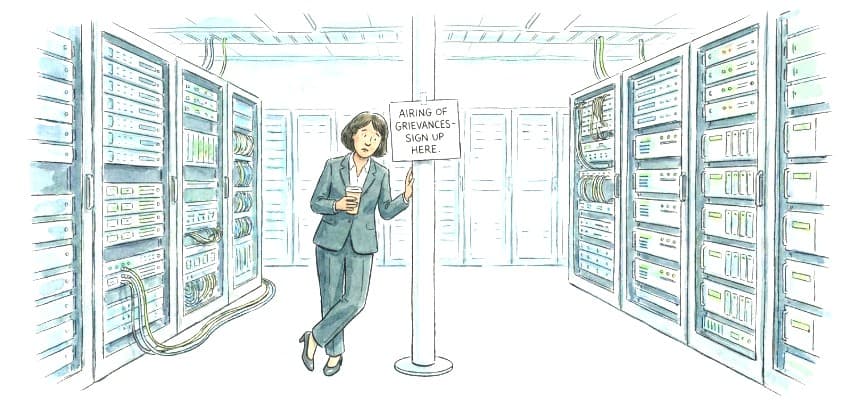
The unadorned aluminum pole stands in the corner of the Security Operations Center, reflecting the blinking LEDs of a server rack that hasn’t seen a quiet night since February. It offers no tinsel, no distraction, and certainly no AI-generated holiday cheer—only the cold, hard reality of Festivus.
For cybersecurity, information governance, and eDiscovery professionals, the upcoming date of December 23 marks a moment of necessary catharsis. Borrowed from the lore of Seinfeld as an anti-commercial alternative to holiday hype, this tradition resonates deeply with a sector exhausted by sales pitches. While the rest of the world wraps gifts, this niche community gathers around the high-strength-to-weight ratio of the aluminum pole to participate in the most essential of traditions: the Airing of Grievances.
The year 2025 has been long. The data tsunami predicted by analysts didn’t just arrive; it brought friends. Now, as the industry pauses before the inevitable breach or litigation hold of 2026, it is time to tell the others how they have disappointed us.
The VIP Invite That Wasn’t
The first grievance targets the inbox-clogging legion of event promoters. In 2025, the definition of “VIP” expanded to include anyone with a pulse and a LinkedIn profile. The sheer volume of “exclusive” summits, “intimate” roundtables, and “must-attend” galas reached a saturation point that bordered on a denial-of-service attack against productivity.
The frustration is universal across the sector. Executives routinely find themselves fielding multiple “exclusive” invitations to the same general admission webinar, only to discover that the “limited space” warning was merely a marketing tactic for a standard Zoom call.
The aggression of post-conference follow-ups has also intensified. Sales development representatives now treat a badge scan as a blood oath, pursuing attendees across email, phone, and social media with a tenacity usually reserved for state-sponsored threat actors.
Actionable Insight: Implement a strict “secondary channel” policy for events. Use a dedicated alias email for all conference registrations. If a vendor abuses the privilege with daily spam, burn the alias. For physical events, verify the “exclusivity” by checking the venue capacity; if it’s a hotel ballroom, you aren’t a VIP—you’re a lead.
The Echo Chamber of Meta-Journalism
As the airing continues, the focus shifts to the Fourth Estate—specifically, the corner of it occupied by tech and legal journalism. A distinct frustration has bubbled up regarding reporters who no longer report on the industry, but rather report on how other reporters are reporting on the industry.
In a year dominated by Generative AI headlines, the grievance is clear: too much aggregation, not enough investigation. Professionals are tired of reading the same press release rewritten five different ways. They are exhausted by “hot takes” that criticize the coverage of AI hallucinations without actually testing the underlying technology.
Practitioners are expressing fatigue with lengthy essays on the abstract ethics of AI journalism when their immediate needs are practical. They require validation on whether new retrieval-augmented generation tools actually work or if they risk hallucinating a privilege log. The demand is for functional intelligence, not philosophical circularity.
Actionable Insight: Audit your information diet. Prioritize sources that cite primary data—such as court dockets, regulator releases, direct interviews, or live panel reporting—rather than those that simply link to other opinion pieces. Use “site:” search operators to find the baseline source document before accepting the analysis.
Grace in View of Grievances
Yet, the unadorned aluminum pole is highly reflective, mirroring not just the flaws of others but the harshness of the observer. Amidst the catharsis of complaint, there is room for a moment of pause—a recognition that not every annoyance is born of malice.
The junior sales representative sending the fifth follow-up email is likely not trying to disrupt a CISO’s day, but rather striving to meet an aggressive quota in a tightening economy. The journalist aggregating a press release may be operating under severe resource constraints, lacking the time or budget for deep investigative work.
Often, what professionals perceive as exploitation is simply a lack of situational awareness or industry context. The “exclusive” invite sent to thousands may be a result of poor database management rather than deceptive or aggressive intent.
Showing grace does not mean lowering defenses, nor does it mean tolerating abuse. It means distinguishing between a calculated attempt to manipulate and a clumsy attempt to connect. However, if a polite “remove me” request is met with silence or continued spam, the “block” button transforms from a weapon of impatience into a legitimate tool of professional hygiene.
Actionable Insight: Adopt a “Pause and Verify” protocol. If a communication feels aggressive, pause to consider if it is a training issue. A polite, one-sentence correction preserves a potential relationship. But remember: persistent non-compliance is a valid trigger for filters. Grace allows for a second chance, not an endless loop of interruption.
Feats of Strength
Festivus does not end with complaints; it concludes with Feats of Strength. For this industry, resilience is the ultimate flex. The ability to weather the storm of vendor consolidation, the endless “year of the Linux desktop” predictions, and the regulatory shifts of 2025 proves that the professionals here are forged in fire.
The head of the household—or in this case, the shift commander or practice group leader—need not wrestle anyone to the floor. The mere act of closing a complex merger review or mitigating a ransomware incident without paying the ransom is victory enough. The aluminum pole stands tall, unembellished and honest, much like the raw logs and metadata that these professionals defend every day.
As the clock ticks toward the new year, the grievances have been aired, and grace has been dispensed. The air is clearer. The inbox is (briefly) quiet.
Are you ready to pin the New Year, or will the New Year pin you?
News Sources
- How a Fabricated Quote Nearly Ended a Career: Lessons for Legal Tech Professionals
- The New Office of Influence: Inside the Fear and Theatre of Legal Tech Events
- ‘Too Many Daves’ in eDiscovery? How High-Velocity Online Sharing May Be Undermining Critical Thought in the Industry
- From Brand Guidelines to Brand Guardrails: Leadership’s New AI Responsibility
- The ComplexDiscovery Operating Manifesto: A Commitment to Clarity and Contribution
Disclaimer: No aluminum poles were harmed in the making of this article.
Assisted by GAI and LLM Technologies
Additional Reading
- New York Courts Become Pressure Chamber for AI as NYT and Tribune Sue Perplexity
- The Agentic State: A Global Framework for Secure and Accountable AI-Powered Government
- Cyberocracy and the Efficiency Paradox: Why Democratic Design is the Smartest AI Strategy for Government
- The European Union’s Strategic AI Shift: Fostering Sovereignty and Innovation
Source: ComplexDiscovery OÜ
The post The Aluminum Pole in the Server Room: A Festivus for the Rest of Us appeared first on ComplexDiscovery.