
Friends,
In last month’s newsletter, we examined how strong venture capital (VC) momentum and artificial intelligence’s (AI) dominance collided with extended liquidity timelines to reshape exit strategies. While funding and deal activity surged, delayed initial public offering (IPO) windows fueled growth in secondary transactions, making direct secondaries and continuation vehicles essential tools for investors navigating record investment and prolonged exits.
This month, in Sunset 2025: The Year the Ground Moved Under Our Feet, we examine how geopolitical shocks, structural resets in talent and technology, and a disciplined return of the IPO market are reshaping dealmaking as firms brace for a 2026 defined by speed, flexibility, and reinvention.
As 2025 closes, the innovation economy looks less like a straight line and more like a series of sharp turns. What began as a year of cautious optimism quickly became a stress test for resilience. High interest rates and uneven inflation kept capital on edge in Q1, only for a trade war in Q2 to freeze cross-border dealmaking and inject geopolitics into every term sheet. By summer, a sweeping tax bill and tariff détente allowed a burst of activity — IPO windows cracked open, and deal velocity briefly rivaled 2021. Then came Q4’s gridlock and government shutdown, halting momentum and reminding founders and investors alike that volatility is now a defining characteristic.
Beneath the headlines, the deeper reset was structural. Talent strategies shifted from acquihires to blitzhires, as companies absorbed teams for immediate execution rather than optionality. AI and robotics moved from the periphery to the core, becoming infrastructure for enterprise operations and compressing innovation cycles from quarters to weeks. The IPO market returned with discipline, rewarding companies with real revenue and AI leverage while leaving others private. Geopolitics became a permanent variable in deal calculus, reshaping supply chains and risk models. For dealmakers, 2025 was not just about navigating turbulence — it was about rewriting playbooks mid-game.
Looking ahead to 2026, adaptability will define success. Optionality in exit strategies, structural creativity in financing, and a willingness to integrate technology at the operating-system level are no longer advantages; they are prerequisites. In a market where certainty means flexibility, the firms and founders who thrive will be those prepared to build — or rebuild — with speed, discipline, and vision.
As always, please do not hesitate to contact us if we can help you brainstorm solutions to a legal or business challenge you are facing or connect you to a potential investor, professional, or entrepreneur.
Spotlight on Preparing for IPOs, SPACs, and Unexpected Capital Market Shift
Preparing for IPOs, SPACs, and Unexpected Capital Market Shift | December 3, 2025
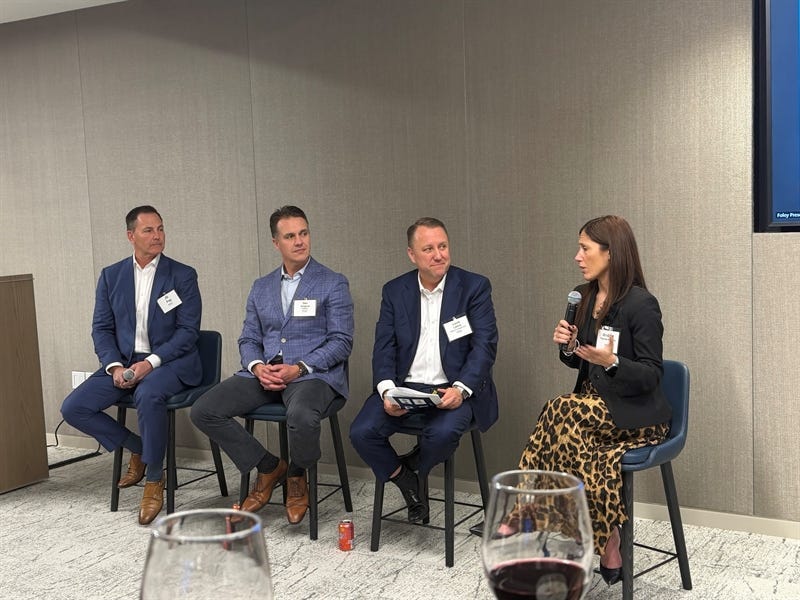
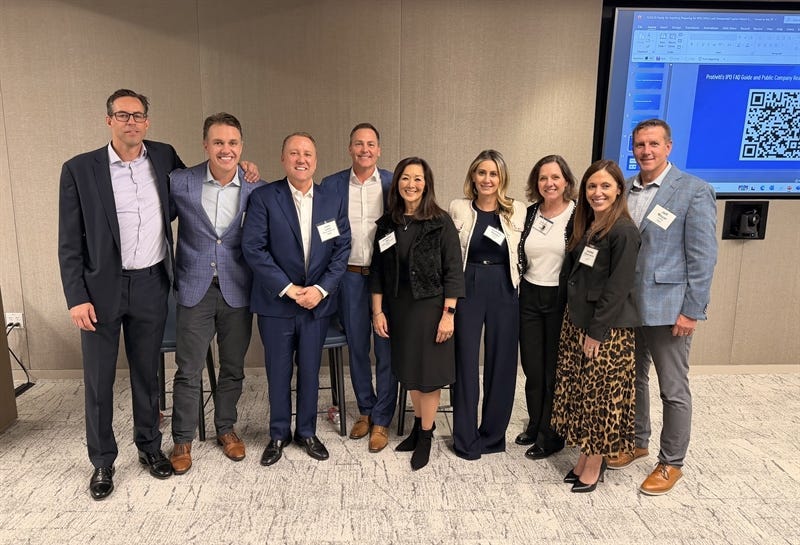
Foley, Protiviti, and SS&C Intralinks hosted Ready for Anything: Preparing for IPOs, SPACs, and Unexpected Capital Market Shifts at Foley’s Silicon Valley office, convening leading voices from Nasdaq, Matterport, and Protiviti for a standing-room-only discussion on navigating today’s volatile, algorithm-driven markets. Guided by moderator Louis Lehot and a distinguished panel including JD Fay, Dan Angius, and Andrea Vardaro Thomas, the program delivered candid insights, practical playbooks, and real-world war stories to help companies stay decision-ready and maintain multiple exit paths. Panelists emphasized that readiness is not a fixed date but an ongoing process, sharing strategies for operational discipline, scenario planning, and agility amid shifting liquidity tides and regulatory scrutiny. Attendees explored how to build investor-grade discipline early, operationalize public company muscle before it is needed, and rehearse hard choices to pivot quickly when market windows open — or close — unexpectedly.
The discussion covered IPO timing, special purpose acquisition company (SPAC) evolution, and private market pressures, offering actionable guidance for dual-track and multi-track exits. Panelists highlighted Chief Financial Officer (CFO)-level readiness signals such as generally accepted accounting principles (GAAP) discipline, audit and Sarbanes-Oxley Act (SOX) preparedness, and credible forecasting, alongside market indicators like volatility bands and investor appetite. They also addressed the SPAC reset, private investment in public equity (PIPE) scarcity, and heightened diligence expectations, while debunking myths around speed and certainty. Private equity dynamics, including fund cycles and valuation resets, were examined through the lens of scenario planning and stakeholder expectations heading into 2026. Closing takeaways urged companies to keep multiple paths viable, prioritize narrative integrity and operational rigor, and embrace agility as the unifying principle for thriving in unpredictable capital markets.
Events
Upcoming:
An Evening with Friends at the J.P. Morgan Healthcare Conference | January 12, 2026
Foley, Armanino, Berkley Life Sciences, and Cristcot are hosting an evening of networking and insight in the heart of one of the world’s leading life sciences hubs. This sophisticated event will bring together C-suite executives, visionary founders, and top-tier VC and private equity (PE) investors driving the next wave of innovation. Set against the backdrop of 25 Lusk’s iconic industrial-chic design, attendees can expect meaningful conversations, new connections, and a dynamic exchange of ideas shaping the future of the industry.
Recent:
The Next Era of Board Evaluations | December 8, 2025
Foley co-hosted this virtual program with NACD and Egon Zehnder, where Louis Lehot joined a distinguished panel to explore how governance practices are shifting from compliance-driven checklists to future-focused effectiveness. Panelists traced the progression from early SOX-era evaluations to today’s 360-degree processes emphasizing strategic alignment, cultural dynamics, and readiness for rapid change. Discussions highlighted best practices such as independent facilitation, skills matrices tied to emerging needs like AI and cybersecurity, and integrating evaluations into succession planning. Attendees gained actionable insights on fostering high-performance boards through candid feedback, continuous education, and courageous leadership — ensuring boards are asking the right questions at the right time.
State of Tech M&A | December 4, 2025
This exclusive Chief Executive Officer (CEO) summit focused on preparing tech founders for successful exits within the next 24 months. The event delivered actionable insights on navigating today’s complex exit environment, from evolving valuation metrics and rigorous due diligence to personal wealth strategies that maximize post-exit outcomes. Louis Lehot joined industry leaders to share perspectives on both the technical and emotional aspects of transitioning a company, while attendees connected with peers and left with practical tools to approach what may be the most significant financial event of their careers.
Thought Leadership
The Rush to Exit: PE Firms Pick Up the Pace in 2025
Private equity enters 2026 with a clear pivot toward accelerated exits after years of prolonged hold cycles. The exit window, dormant for much of the past few years, is reopening, and firms are moving quickly: PitchBook reports that 13% of PE-backed exits this year involved companies held less than three years, while a quarter were sold after three to five years — the highest share since 2022. This trend underscores a delicate balance between speed and sustainability; early exits require intentional acceleration to prove durable growth without sacrificing long-term trajectory. Short-term tactics like earnings before interest, taxes, depreciation, and amortization (EBITDA) optimization can boost valuations but risk stalling momentum post-sale. The firms that win will prioritize readiness over optics, preserving critical investments and aligning buyers with the next phase of growth. In short, 2026 will be about liquidity with discipline — accelerating maturity while safeguarding durability.
2026 Outlook: AI, IPOs, and the New “Normal” in Venture & Private Equity
The 2026 outlook is cautiously optimistic, but the market is settling into a “new normal” defined by creativity under pressure and structural adaptation. Private equity firms, facing frozen capital and aging portfolios, are leaning on hands-on strategies like AI-driven transformation, continuation vehicles, and net asset value (NAV) loans as traditional exits remain elusive. Meanwhile, AI continues to dominate headlines, yet its promise of cost reduction has largely failed to materialize; instead, overinvestment, regulatory fragmentation, and the race for AI-first products have introduced new risks and slowed software as a service (SaaS) growth. IPO momentum could return early in 2026 if interest rates fall, but macro uncertainty and valuation gaps persist. The year ahead will not be about quick flips or easy liquidity — it will test whether investors can operate effectively in an unpredictable, innovation-driven economy where certainty means adaptation, not stability.
A Look at Current Healthtech VC Trends
Healthtech is showing signs of renewed strength, with PitchBook reporting $3.9 billion in VC funding for the sector in Q3, pushing year-to-date totals ahead of 2024. Deal volume rose 12%, and median deal size hit a record $7.7 million, driven by analytics, operations, and telehealth segments. Exit activity surged to 42 deals, though total value remained modest at $200 million, reflecting acquisitions of smaller startups and a lack of IPOs — though several are expected in 2026. AI continues to dominate the narrative, with rapid adoption of ambient scribes and revenue cycle management tools delivering meaningful gains for providers. As AI integration accelerates and payors begin to follow suit, healthtech is poised for significant investor attention heading into the new year.
Deals
Foley Advises Helm Bank USA in Sale to Banco de Crédito del Perú
Foley & Lardner LLP served as legal advisor to the shareholders of Helm Bank USA in their agreement to sell 100 percent of the bank to Banco de Crédito del Perú (BCP), a subsidiary of Creditcorp Ltd.
Foley Advises Square Robot in New Funding and Partnership
Foley & Lardner LLP served as legal advisor to Square Robot, Inc., the global leader in submersible robotic tank inspection, in its recent funding and collaboration with Marathon Petroleum Corp. (NYSE: MPC)
Foley Represents FloWorks in Acquisition of Cranford Equipment Company
Foley & Lardner LLP served as legal advisor to FloWorks International, a leading specialty distributor of critical flow control products and portfolio company of Wynnchurch Capital, in its acquisition of Cranford Equipment Co. Inc (CEC).
Foley Represents 401GO in $33M Series B Financing
Foley & Lardner LLP represented 401GO, a fully-owned 401(k)-management platform, in its $33 million Series B funding round led by Centana Growth Partners. Additional investors include Next Frontier Capital, Rally Ventures, and Impression Ventures.
Additional Articles of Interest
Foley Featured for Roundtable Insights on 2026 AI, IPO, and Investment Trends
Brian Wheeler Recognized as a Top 40 Leader to Watch by ACG Silicon Valley
Louis Lehot Publishes on Government Shutdown Risks for Companies Eyeing IPO
Author

Louis Lehot
Partner, Venture Capital
Silicon Valley | San Francisco | Los Angeles