
Rapid turnover, multi-entity structures, and rising compliance demands are putting significant strain on the finance teams of real estate companies that still rely on manual, fragmented processes. These pressures surface as data gaps, slower reporting cycles, and limited clarity into critical indicators such as occupancy trends, delinquencies, and property-by-property performance. A recent Deloitte survey found that over 61 percent of real estate firms still operate on legacy systems, which reinforces how common these challenges are and why they persist across the industry.
Integrated bookkeeping and automation can help close those gaps by improving data accuracy and speed required for confident decision-making. By unifying finance data, standardizing workflows, and delivering real-time dashboards, investors, property managers, and accounting teams can optimize processes and build operational resilience to support real estate growth.
Why Fragmented Bookkeeping is Holding Real Estate Teams Back
Real estate finance teams are scaling portfolios faster than their accounting systems can support. Often, property management teams rely on separate platforms for rent collection, lease administration, AP/AR processing, bank reconciliations, and financial reporting. This creates data silos that make it challenging to maintain accurate and up-to-date financial information. Additionally, working with incomplete or delayed data slows analysis, complicates financial planning, and increases blind spots as portfolios expand.
Common barriers that restrict financial clarity and hinder real estate growth include:
- Property transactions stored across multiple systems, reducing version control and auditability.
- Inconsistent or mismatched data across AP, AR, rent rolls, and reconciliations.
- Month-end delays caused by manual accruals, missing documentation, and fragmented approval workflows.
- Limited visibility into real-time cash flow, unit-level profitability, and delinquency trends.
- Difficulty tracking upcoming obligations and budget-versus-actual spending.
Establishing a Single Source of Truth for Real Estate Finance
Operational resilience in real estate finance depends on the reliability, consistency, and timeliness of financial data. As portfolios expand, rent schedules become more complex, vendor activity increases, reconciliations multiply, and reporting requirements tighten. Integrated bookkeeping strengthens real estate operations by consolidating rental activity, vendor transactions, and tenant balances into a single financial ecosystem. This reduces duplicate entries, misclassifications, and reconciliation gaps while improving accrual accuracy and overall ledger consistency. With one source of truth, finance teams gain real-time visibility into income, expenses, and property-level performance, enabling reliable reporting and smoother month-end close cycles.
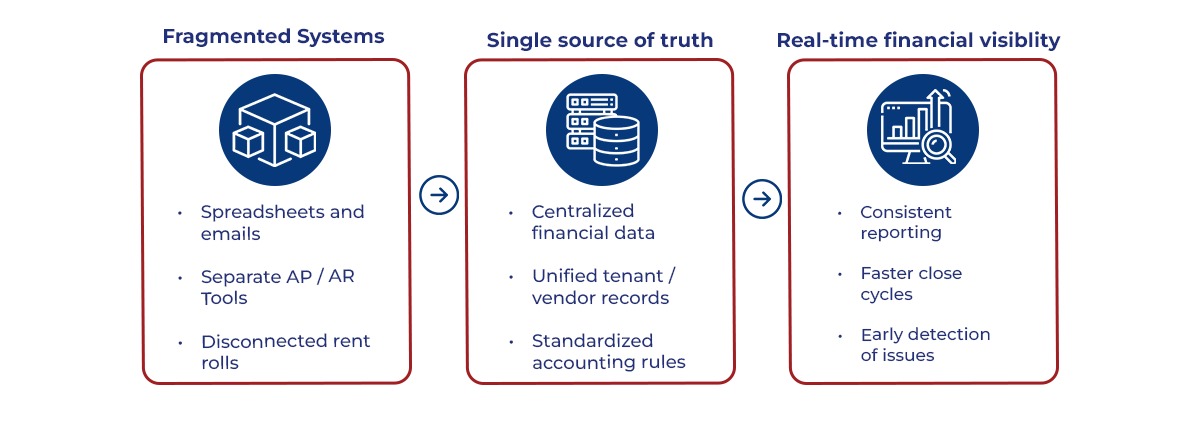
Integrated bookkeeping also strengthens governance across the finance function by enforcing consistent accounting rules, documentation standards, and data definitions as the portfolio grows. It enables organizations to establish predictable financial cycles, where entries, adjustments, and reconciliations follow a consistent structure, regardless of property, asset type, or entity. Clearer responsibilities between property teams, accounting, and asset management reduce handoff errors and improve accountability. Over time, the organization builds a stronger financial discipline, variance explanations become clearer, and budgeting discussions are grounded in accurate data.
The Automation Layer: Amplifying the Impact of Integration
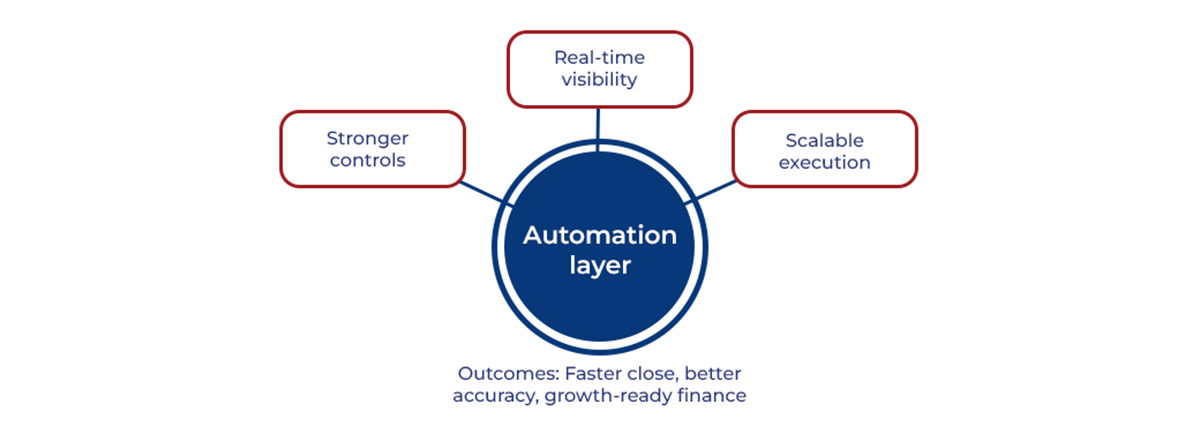
Automation takes the benefits of integrated bookkeeping to the next level. The result is a bookkeeping function that operates with greater speed, tighter controls, and a continuously updated view of portfolio performance, rather than relying on periodic reporting cycles.
How Automation Strengthens Real Estate Finance
1. Scalable execution without increasing staffing needs
Automation tools can take over the processing of high-volume, rules-based tasks, such as rent reminders, invoice matching, recurring journal entries, and scheduled payments. This stabilizes core accounting operations and reduces dependency on manual throughput, allowing for portfolio expansion without proportional increases in headcount.
2. Real-time visibility into performance drivers
Dashboards update as transactions occur, giving decision-makers an immediate view of:
- Rent roll stability
- Delinquencies and collections performance
- Expense pacing and vendor spend patterns
- Property-level profitability
- Cash flow position and burn rate
Real-time visibility helps executives adjust operating decisions earlier in the cycle, assess acquisition readiness quickly, and respond to performance trends with greater precision.
3. Stronger controls, reduced operational risk, and higher data integrity
Automated workflows enforce approval paths, timestamp activity, and maintain transparent audit trails across AP, AR, and general ledger entries. This strengthens governance, reduces last-minute financial adjustments, and improves the quality of investor reporting. When paired with integrated bookkeeping, automation transforms finance from an administrative cost center into a strategic capability. Real estate firms benefit from higher-quality data, more predictable financial cycles, and the operational agility required to scale portfolios, evaluate opportunities, and meet investor expectations with greater confidence.
Building a More Agile and Growth-Ready Real Estate Portfolio
Integrated bookkeeping and automation do more than streamline tasks. They add financial clarity and responsiveness required to evaluate opportunities quickly, manage risk well, and improve property performance at scale. With a more reliable financial foundation in place, real estate organizations can shift from reactive reporting to proactive portfolio management.
- Faster investment analysis and modeling – Standardized, accurate data improves the reliability of hold or sell assessments, cash flow projections, and rent roll modeling. Underwriting cycles shorten because assumptions rely on up-to-date financial inputs rather than delayed or manually assembled reports. This creates a more responsive investment engine that can evaluate opportunities as soon as they emerge.
- Stronger portfolio performance – Automation and integrated finance help operators identify performance drivers earlier. Real-time insight into delinquencies, expense pacing, and property-level margins supports more informed refinancing decisions, acquisition readiness evaluations, and cost optimization across vendors and service providers.
- Improved transparency and reduced financial risk – Consistent documentation, stronger audit trails, and accurate classification of capitalizable versus expansible items reduce compliance risk and last-minute financial corrections. These factors support smoother audits, clearer lender communication, and more reliable investor reporting.
- Higher tenant satisfaction and retention – Automated AR cycles reduce billing errors, speed up communication, and prevent avoidable disputes. Accurate bill-backs and timely reminders improve the tenant experience, which supports renewal rates and occupancy stability.
Consider the scenario of a mid-sized operator managing multiple properties across cities. Before integration, the team waited for month-end reports to understand delinquency spikes or rising vendor costs. After unifying their finance systems, those signals surfaced in real time, allowing them to adjust leasing incentives, renegotiate contracts, and model cash flow scenarios within hours instead of weeks. With clearer, up-to-date data, the organization moved from reactive reporting to proactive portfolio management.
The Gains Real Estate Companies Can Expect
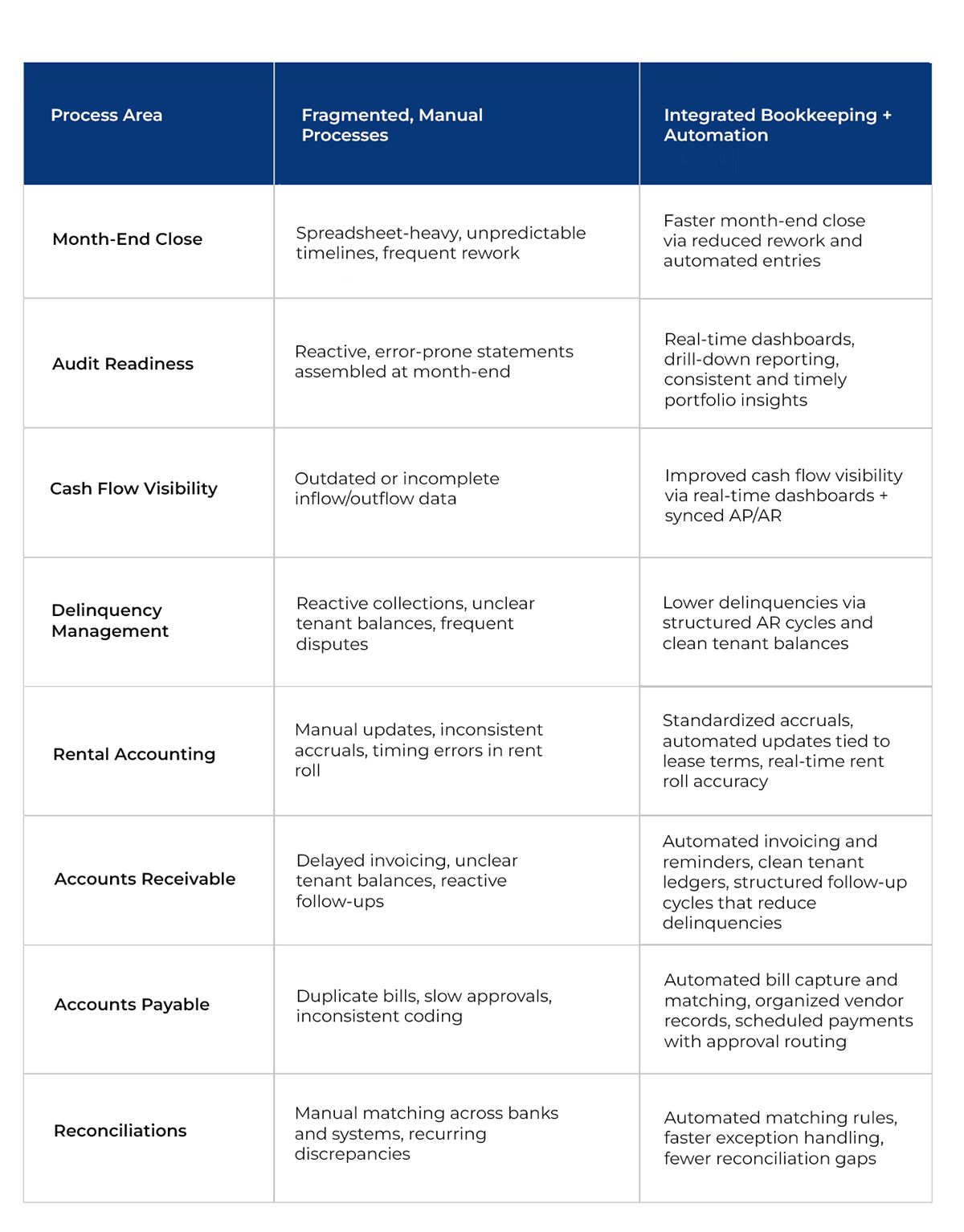
The Shift Real Estate Leaders Need to Prepare For
Real estate finance is entering a phase where advantage comes from creating a unified data architecture where signals are clearer, cycles are faster, and organizations can respond to market movements with greater precision. Most real estate teams are closer to this future than they realize. Those building with integrated data, standardized processes, and automation-enabled workflows will be the ones that shape new benchmarks for portfolio agility, capital allocation, and performance discipline.
Ready to build a smarter real estate finance engine?
Cogneesol works with real estate organizations to re-imagine their finance operations through integrated bookkeeping, automated workflow design, and consistent, portfolio-level reporting. To explore how these capabilities can support your team, learn more about our real estate services here.
The post How Integrated Bookkeeping and Automation Power Real Estate Growth appeared first on Cogneesol Blog.