
The risk environment facing organizations has undergone significant shifts. Ongoing trade wars, geopolitical instability, regulatory complexity, and rapid technological advancements have increased the challenges for risk management teams, rendering traditional ways of managing risks untenable.
According to the Forrester 2025 State of Enterprise Risk Management Report, 75% of businesses experienced at least one critical risk event in the past year, with cyberattacks and IT failures accounting for the maximum number of events worldwide. The study also shows that organizations lacking board-level visibility into their Enterprise Risk Management (ERM) programs are 20% more likely to encounter six or more critical risk events.
The diverse range of risks impacts regulatory compliance, operational stability, cybersecurity, strategic direction, and third-party relationships. The path forward is clear: organizations need to move away from fragmented and reactive risk management approaches and embrace Integrated Risk Management (IRM).
This guide outlines a practical roadmap for CFOs to transition to IRM, a centralized, interconnected framework for effectively managing today’s heightened risk environment.
The Effects of Siloed Risk Management
Recent governance failures highlight the risks in siloed, reactive methods with a narrow focus on compliance with a checklist approach.
Regulatory Penalties
In July 2025, the UK’s Financial Conduct Authority (FCA) fined Barclays £42 million for deficiencies in financial crime risk management. The FCA found that a static, siloed approach to compliance contributed to the failure and that Barclays lacked dynamic risk assessment and real-time monitoring.
In October 2024, TD Bank received a $1.8 billion fine from the U.S. Treasury for systemic non-compliance with Anti-Money Laundering (AML) requirements, marking the largest penalty ever under the Bank Secrecy Act.
Market Cap Decline
In July 2024, a CrowdStrike software update triggered a global IT outage, leading to a 25% drop in the company’s share price within days. This is besides the cost the company incurred in insurance payouts, estimated at $1.5 billion, and downtime costs of $2 million per hour for affected organizations. This event was not caused by operational risk mismanagement that set off a cascading failure across interconnected systems.
India’s leading airline experienced major operational disruption after failing to prepare for new crew schedules. Missing the compliance deadline caused over 1,600 flight cancellations in one day, while competitors met the new regulations without issue. This failure to manage operational risk and compliance resulted in a $4.5 billion loss in market capitalization and a 16% decline in share price over the next two weeks.
Loss of Reputation
Boeing’s ongoing challenges highlight how cultural and safety-related risk failures can accumulate over time. The company faces a $243.6 million fine and $1.77 billion compensation as airlines reconsider their fleet strategies. The resulting reputational damage has shifted the competitive landscape, with Airbus gaining market share at the expense of Boeing.
Defining Integrated Risk Management
Research by Baker Tilly and the Internal Audit Foundation found that 6 in 10 ERM programs are connected with an organization’s strategic planning. Yet, many organizations fail to use insights from the ERM program in strategic decision-making.
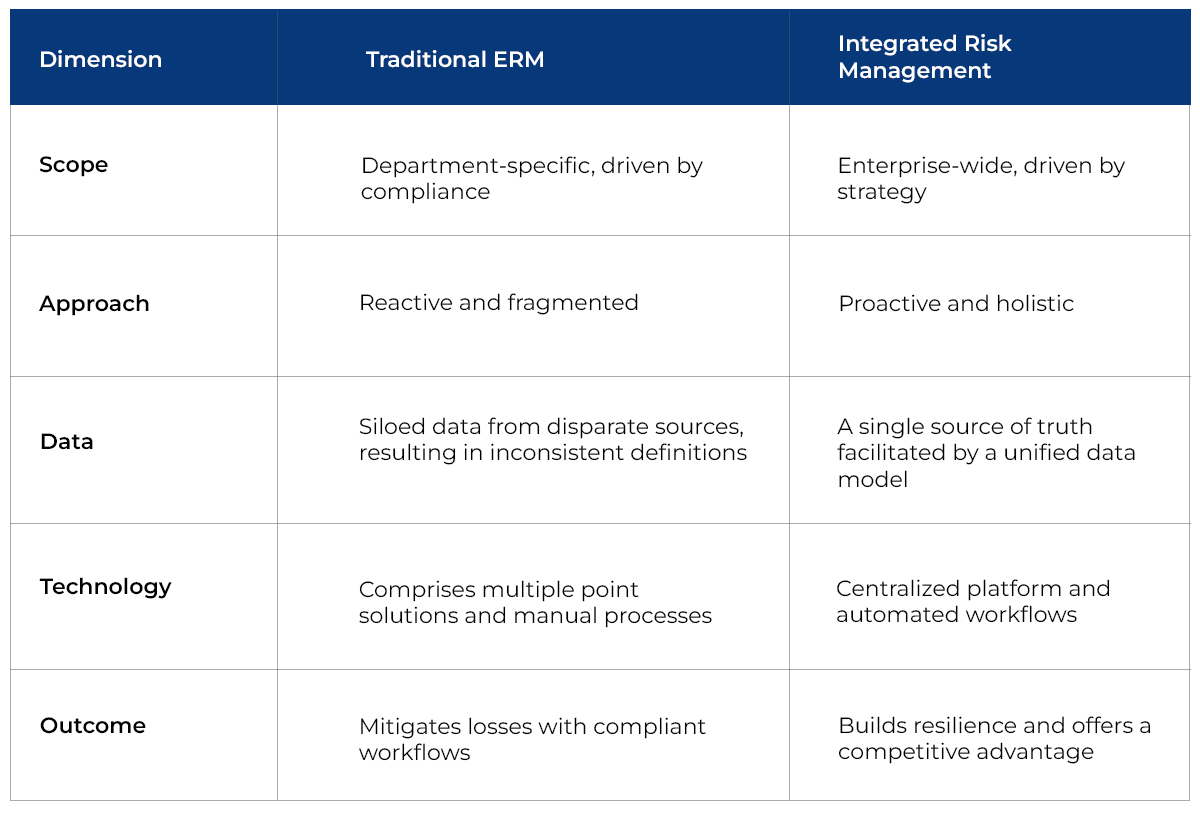
Traditional ERM focuses on identifying and addressing risks within individual business units. In contrast, IRM embeds risk management into the organization’s culture and business strategy, creating a unified approach.
By centralizing risk activities, leaders gain a comprehensive view of all risks and their potential impact across the business. IRM leverages advanced technology and aligns the strategy with core business processes, enabling organizations to improve performance, strengthen decision-making, and increase confidence in achieving their objectives.
The CFO’s Role in Bridging Financial and Non-Financial Silos
Today’s CFO is not only accountable for financial reporting but also plays a central role in shaping strategy and managing the organization’s risk profile. In Deloitte’s 4Q 2025 CFO Signals Survey, CFOs reported the highest confidence in their organization’s financial prospects. Notably, 59% of North American CFOs see this as an opportune time to take on additional risk.
As CFOs show a greater appetite for risk, a robust risk governance framework becomes essential. The Deloitte survey also highlights cybersecurity as one of the top three external risks on CFOs’ agendas. Given their oversight of strategy, operations, and finance, CFOs are positioned to drive IRM across the organization.
The following priorities can help CFOs strengthen risk management and create value:
- Build a risk-aware culture by embedding risk awareness into every stage of the organization, from strategic planning through execution.
- Secure executive sponsorship by demonstrating how IRM delivers both loss prevention and strategic value creation.
- Champion investment in IRM technology that breaks down data silos and provides a single source of truth for risk information.
Three Essential Elements for an IRM Framework
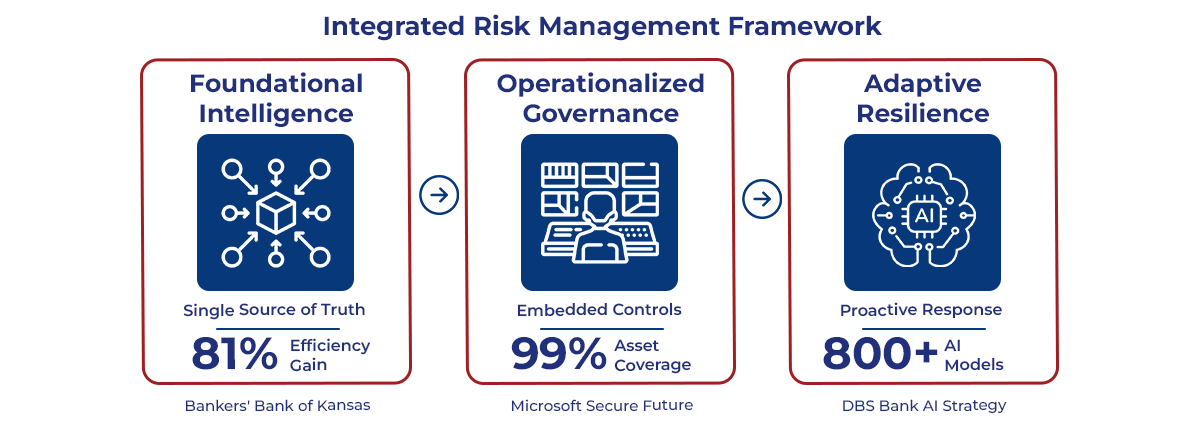
Effective implementation of an integrated risk management system depends on three pillars that guide organizations from risk identification to management and response. These pillars enable organizations to strengthen risk awareness across teams and build greater resilience.
1. Foundational Intelligence
Foundational intelligence serves as the starting point for an integrated risk management framework, establishing a single source of truth for risk data across the organization. This requires integrating and standardizing information from multiple systems through taxonomy creation and making risk data accessible via dashboards.
Take the case of Bankers’ Bank of Kansas with $100 million in assets, that managed risk with spreadsheets for decades. As regulations evolved and team members departed, the bank struggled to maintain institutional knowledge and effective risk management. Implementing an integrated platform reduced risk management hours from 160 to 30 per week, improved examiner feedback, and enabled real-time collaboration within the risk team.
2. Operationalized Governance
This pillar aims to embed risk management into daily operations by assigning clear responsibilities, standardizing processes, and automating workflows. These steps help organizations manage risk proactively and consistently across all functions.
Microsoft launched the Secure Future Initiative in November 2023 in response to significant international security concerns. In this multi-year effort, 34,000 engineers worked full-time on security solutions, removing over 6.3 million inactive tenants and achieving 99% coverage of all network assets.
These results demonstrate effective integration of security and risk management across all product design and operational areas.
3. Adaptive Resilience
The third pillar strengthens an organization’s capacity to detect, adapt to, respond to, and recover from disruptions.
DBS Bank became a global leader in artificial intelligence by building a strong risk management strategy from the outset. Instead of treating risk as a barrier, DBS established a comprehensive governance framework to manage AI-related risks before scaling its solutions.
This approach enabled the bank to deploy over 800 AI models across 350 use cases, with an expected economic return of more than SGD 1 billion by 2025. The bank’s ability to address new risks and drive large-scale innovation comes from this integrated strategy.
Strategic Recommendations for CFOs to Implement IRM
CFOs who want to lead the organization through an IRM transformation should take these steps:
- Develop a Single Source of Truth – Bring together all risk data from across the organization into a single, unified repository. Move away from spreadsheets, which create blind spots and prevent a consolidated risk view. Instead, use data management tools that provide real-time access to risk information, enabling teams to identify and address issues as they arise.
- Create a Clear Accountability Structure for Risk Management – Assign executive-level leaders to own each area of risk management, giving them the authority and resources to drive results. Set up governance structures that promote cross-functional collaboration, so risk owners can work together to address complex challenges.
- Embed Risk Management Practices into Daily Operations – Shift from periodic risk assessments to continuous monitoring using automation. Embed risk controls directly into daily operations through business process management, so teams can capture, track, and resolve risks in real time.
- Build Dynamic and Agile Capabilities – Develop capabilities for scenario planning and stress testing, so the organization can anticipate disruptions and prepare effective mitigation plans. Build technology resilience into the infrastructure, such as redundancies, to ensure business continuity during unexpected events.
- Maximize Use of Risk Technology – Research from the IIA Foundation shows that only 21 percent of organizations have adopted a Governance, Risk, and Compliance (GRC) platform, and six percent use AI for risk identification. Organizations that move quickly to implement AI and analytics for risk management will gain a significant competitive edge.
Embark on the IRM Implementation Journey
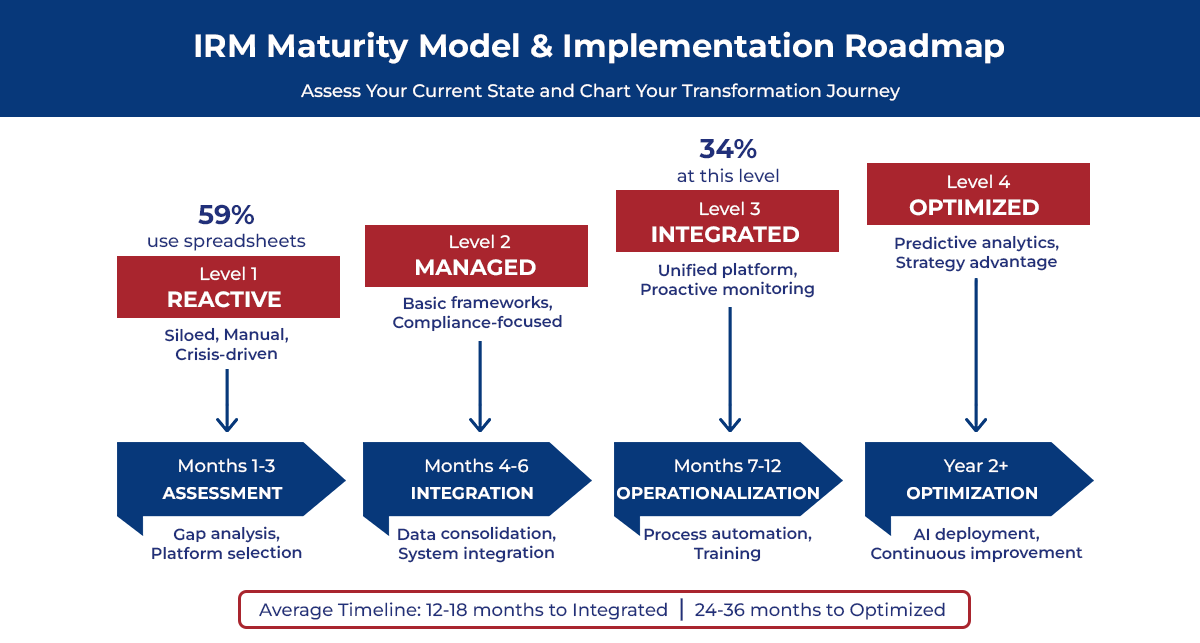
The time to move beyond traditional, siloed risk management and adopt an integrated approach is now. The consequences of inaction extend beyond regulatory actions to include loss of market value, operational disruptions, and diminished competitive advantage. These risks can fundamentally alter an organization’s performance trajectory.
The return on investment in IRM extends beyond compliance. It enables organizations to pursue growth with confidence, optimize resource allocation, and build resilience in a volatile environment. Organizations that invest in IRM today are positioning themselves as future leaders.
Cogneesol helps organizations accelerate their IRM journey by deploying its ADIS framework, which integrates financial expertise with advanced data management and analytics. This foundational support enables CFOs to establish themselves as strategic leaders in risk management and build adaptable, resilient businesses.
The post The CFO’s Guide to Integrated Risk Management appeared first on Cogneesol Blog.