
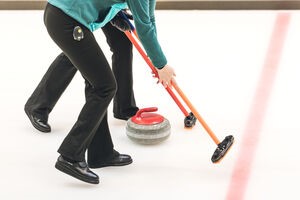
As the 2026 Winter Olympics captivate audiences, one sport in particular―curling―stands out as the perfect metaphor for the challenge of prosecuting AI inventions before the US Patent and Trademark Office (USPTO). Both arenas demand foresight, adaptability, and strategic thinking, whether it’s guiding a stone across the ice or shepherding an AI patent application through evolving legal terrain. Victory, in either case, belongs to those who embrace teamwork and anticipate the unexpected. Curling is often misjudged as slow or simple, but insiders know that it’s a chess match on ice, where teams slide polished granite stones across pebbled sheets, aiming for the house—the scoring target—while simultaneously disrupting the opposition’s setup. Wins are earned through foresight, precision, and the ability to pivot strategy as conditions change.
Just as innovation in curling equipment and strategy can shift the outcome on the ice, success in AI patent prosecution hinges on ingenuity and adaptability. Practitioners must respond to shifting legal guidance much like curlers adapt to changing ice, always ready to refine claims and strategies in response to examiner feedback. For further details, see our blog covering the USPTO’s recent guidance on subject matter eligibility for software inventions, emphasizing the need for well-defined technical solutions in claims and specifications.
At first glance, curling and patent prosecution seem worlds apart. Curling, with its slow-burning suspense and icy precision, is a Winter Olympic sport defined by tactical brilliance and teamwork. Patent prosecution—especially for artificial intelligence (AI) inventions—unfolds in the legal arena, shaped by statutes, examiner judgment, and ever-shifting case law. But look beneath the surface, and the parallels become hard to ignore, as both demand sharp strategy, adaptability, and a relentless pursuit of advantage, especially as the AI patent landscape evolves.
This blog explores how the subtle tactics of curling mirror the complexities of securing patent protection for cutting-edge AI technologies.
AI patent prosecution requires applicants to navigate statutory requirements, examiner scrutiny, and evolving legal precedent with tactical skill. Recent decisions and USPTO guidance emphasize that AI-related inventions must demonstrate genuine technical innovation—not just abstract ideas dressed up in machine learning jargon. For example, a recent Federal Circuit decision affirmed dismissal of software patent claims that recited only abstract, result-focused language without a specific technological solution, reinforcing the need for claims to clearly describe how results are achieved, as discussed in our blog.
Like curlers choosing when to play offensively or defensively, patent practitioners must decide whether to argue eligibility or amend claims for narrower protection to keep momentum toward allowance. USPTO memoranda discussed in our blog, highlight that applicants can submit evidentiary declarations under 37 C.F.R. 1.132 to support eligibility, particularly when the specification lacks explicit technical improvement language.
Sweeping—curling ’s signature move—offers another fitting analogy. Sweepers deftly influence a stone’s path without direct contact; likewise, careful drafting and well-timed arguments guide patent outcomes without altering the invention’s core. As discussed in our blog, Courts have made clear that AI jargon alone cannot rescue an abstract claim; clarity and technical substance are essential.
Timing is crucial. Curling teams may sacrifice immediate points for strategic advantage later, much like patent applicants who secure allowance on narrower claims and leave the door open for future continuations. USPTO’s recent AI eligibility guidance as discussed in our blog underscores the benefits of incremental prosecution over overreaching claims that risk stalling progress.
Both curling and AI patent prosecution are governed by evolving rules. Curling’s playbook, which covers delivery, sweeping, and scoring, has changed several times in recent years. Patent law leans on statutes like 35 U.S.C. §101 and a shifting body of judicial interpretation. Recent court decisions, as discussed in our blog, have further refined eligibility for AI inventions, demanding technical specificity and a solid foundation.
Teamwork is essential in both worlds. Curling teams rely on coordination between skips, sweepers, and throwers; AI patent prosecution depends on close collaboration between inventors and attorneys to overcome examiner objections. In either case, communication breakdowns can be costly.
In the end, both curling and AI patent prosecution reward those who master nuance, adapt quickly, and execute with precision. These contests are won by intellect and strategy, not brute force. As AI transforms innovation and the law evolves, the curling rink remains a fitting metaphor for this dynamic legal landscape.
Success—on the curling sheet or at the USPTO—belongs to those who know the terrain, play by the rules, and act with purpose.