
Finance leaders face persistent volatility from multiple directions, with pressure building to accurately predict cash flow, protect margin, and optimize operational cost. Challenges are expected to intensify as external factors, such as inflation, fluctuating demand, supply chain disruptions, and a shortage of F&A talent, threaten the viability of existing plans.
Predictive analytics offer CFOs the visibility and certitude they seek in this environment.
Although most organizations understand the importance of predictive analytics, they are constrained by fragmented ERPs, manual reconciliations, and outdated planning systems. High costs and scarcity of in-house expertise add to the difficulty of unlocking the true potential of financial data.
Organizations can no longer wait for perfect data or a fully built analytics team. The gap is growing between companies that use predictive insights and those that rely on historical reporting.
Getting Started with Predictive Analytics: Four Targeted F&A Initiatives
| Use Case | Challenge | Critical Data | Outcomes |
| Cash Flow Forecasting | Historical averages miss payment shifts and economic shocks | Cash flow history, AR/AP aging, payment patterns, economic indices, and real-time ERP feeds | Increased savings, reduced obsolescence, faster decisions, and improved liquidity |
| Revenue and Demand Forecasting | Market volatility makes resource allocation difficult | Sales data (24-36 months), customer orders, market trends, seasonality, competitor pricing | Higher forecast accuracy, increased sales, and better production alignment |
| Budget Variance Prediction | Reactive analysis catches deviations too late | Budget vs. actual (3-5 years), departmental spending, project timelines, vendor contracts | Faster variance analysis, proactive management, and swift month-end close |
| Working Capital Optimization | Static policies miss dynamic cash conversion opportunities | Supplier terms, customer payment patterns, DSO trends, demand forecasts, AP/AR aging | Lower inventory costs, reduced idle cash, and improved net working capital |
Gain Actionable Intelligence with Predictive Analytics
Each use case addresses a gap in traditional historical reporting, enabling finance teams to move toward forecasting outcomes using machine learning and AI models.
1. Cash Flow Forecasting
Traditional cash flow forecasting relies on historical averages that do not account for changes in payment patterns, seasonal shifts, or external economic shocks. This makes it difficult to manage liquidity and higher borrowing costs, leading to missed investment opportunities.
Today, ML models analyze past sales data, market trends, customer behavior patterns, and external factors to generate revenue forecasts that adapt as conditions change.
The treasury team of the Association of Finance Professionals built an in-house AI model that predicts incoming cash from its global supplier network in USD, forming the foundation for its foreign exchange hedging program. With the AI model, forecast accuracy increased from 70% to 96% and USD exposures were reduced by 25-50 million per month.
Critical Factors to Consider:
- Forecast Horizon: Set daily, weekly, or monthly prediction needs. Treasury operations need daily forecasts, whereas strategic planning can be a monthly activity.
- Decision Ownership: Identify who is responsible for acting on forecasts, with set limits for when a credit line can be activated.
- Scenario Capability: Ensure models can simulate shocks with manual override of assumptions.
- Data Requirements: Historical cash flow, receivables and payables aging, payment patterns, economic indices, and real-time ERP/banking feeds.
- Data Refresh Frequency: Set how often to update data in real time versus once a week or a month, depending on data volatility.
Measurable Outcomes
Increased operational savings, reduced dead stock in inventory, and faster decision-making.
2. Forecasting Revenue and Demand
Traditional methods of predicting revenue rely on historical averages and manual inputs. However, market volatility, seasonal shifts, and changes in customer behavior make it hard to allocate resources across the organization.
ML models analyze past sales data, market trends, customer behavior patterns, and external market factors to generate revenue predictions that adapt quickly.
Mastercard’s test-and-learn platform forecasts customer behavior in banks and stores to support pricing strategies and revenue management across payment products.
Critical Factors to Consider:
- Forecast Granularity: Assess business complexity to determine whether forecasts should be at the SKU, category, or total revenue level.
- Decision Integration: Forecasts must directly inform production planning, procurement, and capacity decisions rather than remain isolated in financial reports.
- External Signals: Incorporate market indicators, competitive intelligence, and macroeconomic data that influence demand patterns.
- Data Required: Historical sales data, customer order patterns, market trends, economic indicators, seasonality factors, promotional calendars, pipeline data, and competitor pricing information.
- Scenario Planning: Develop models that evaluate multiple demand scenarios, best case, base case, and worst case, to support strategic planning.
Measurable Outcomes
Achieve greater forecast accuracy, higher sales, and improved alignment between production and demand.
3. Budget Variance Prediction and Analysis
Traditional variance analysis is reactive, so finance teams only learn about deviations after they occur, making them harder to fix. Manual variance investigation takes time for FP&A and only provides information about the past.
Predictive models review past budgets, departmental spending, and project timelines to anticipate changes before they occur. AI-powered systems run continuous scenario simulations, adjust assumptions as the market changes, and show probable outcomes in real time.
A global financial organization revamped its analytics pipeline by adding predictive models that not only analyze historical data but also forecast future events and identify issues. This reduced the need for manual variance checks and improved forecast reliability.
Critical Factors to Consider:
- Materiality Thresholds: Set specific dollar and percentage thresholds (usually 10%) to focus only on important differences and avoid analysis paralysis over minor ones.
- Predictive Lead Time: Choose the best forecast window (30, 60, or 90 days ahead) to give all departments enough time to act.
- Root Cause Automation: Use machine learning models to automatically identify the causes of variation, rather than investigating each one manually.
- Data Required: 3-5 years of historical budget vs. actual data, departmental spending patterns, project timelines and milestones, vendor contract terms, headcount and pay data, and seasonal business cycles.
- Strategic Alignment: Link variance predictions to business goals, shifting finance from cost control to a strategic partner that supports business growth.
Measurable Outcomes
Faster variance analysis, shorter corrective action cycles, proactive budget management, and a faster month-end close.
4. Working Capital Optimization
Traditional working capital management uses static policies that miss dynamic optimization opportunities. Excess working capital ties up cash that could be used for growth, while too little working capital makes operations harder and strains supplier relationships.
Predictive models help businesses optimize cash conversion cycles by forecasting inventory levels, identifying early payment discount opportunities, and predicting when customers will pay.
An international biotech company used an agentic AI system to identify contract leakages equivalent to nearly 4% of its total spend, translating to a potential $40 million value opportunity on a $1 billion cost base.
Critical Factors to Consider:
- Cross-Functional Ownership: Ensure everyone knows who is responsible for cash (finance), inventory (supply chain), and receivables (sales) by using the same KPIs and sharing responsibility.
- Optimization Trade-Offs: Find the right balance between working capital efficiency and operational risks. For example, ultra-lean inventory saves money but increases the risk of stockouts during supply disruptions.
- Supplier Relationship Management: Ensure that optimizing payments does not harm key supplier relationships. Keep the terms you agreed upon with key vendors.
- Data Required: Supplier payment terms and discount structures, customer payment patterns and DSO trends, demand forecasts, supply chain lead times, and AP/AR aging.
- Dynamic Policy Adjustment: Instead of fixed policies such as net 45 terms, use dynamic recommendations that factor in cash flow, customer creditworthiness, and available discounts.
Measurable Outcomes
Lowered inventory holding costs, reduction in idle cash, faster payment processing, and improved net working capital.
The Process Foundations that Drive FP&A
High-quality input data is essential for accurate predictive models. Efficient P2P processes allow finance teams to track committed spend and vendor liabilities before transactions reach the general ledger. Streamlined O2C processes ensure revenue recognition and receivables aging are accurately reflected in the cash position. Closed R2R cycles provide reliable actuals for variance analysis and rolling forecasts.
When these processes are slow, manual, or fragmented, predictive models rely on incomplete or outdated data. This reduces the reliability of model outputs and lowers finance leaders’ confidence in forecasts and cash flow predictions. Leading organizations treat P2P, O2C, and R2R not just as operational workflows, but as key drivers of data quality.
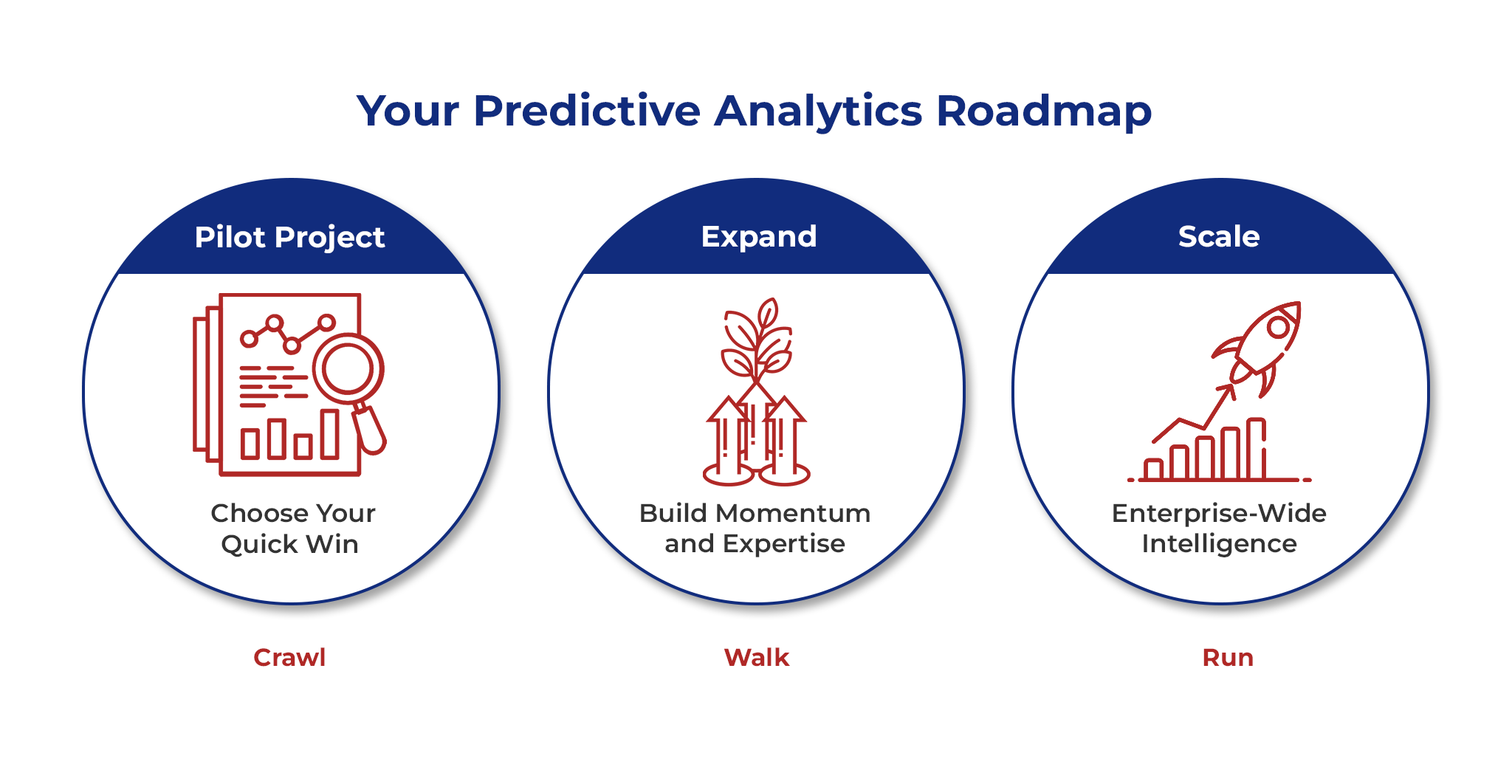
Prioritize Your Predictive Analytics Journey
Finance leaders must rethink how they create value for the business. This means adopting AI-powered, data-driven strategies that enable the shift from historical reporting to forward-looking analysis.
Cogneesol’s ADIS framework leverages automation, data intelligence, and domain-specific workflows to drive transformation at scale. By reducing multi-step processes by up to 75% and minimizing system interactions through rule-based workflows, ADIS enables seamless integration across teams and locations.
Unlike traditional approaches that focus on automating every task, ADIS targets areas that deliver the most value. Its modular design allows organizations to tailor solutions for finance, legal, compliance, and insurance workflows.
Explore Cogneesol’s FP&A solutions today to accelerate your predictive analytics journey and turn intelligent finance into a sustained competitive advantage.
The post 4 Use Cases Where Predictive Analytics Transforms Finance Decision-Making appeared first on Cogneesol Blog.