
For today’s CXOs, cash flow has moved beyond being a finance metric reviewed after the close. It has become a leadership priority, particularly in mid-market organizations where working capital discipline directly influences resilience, growth, and risk tolerance.
Volatility across demand cycles, interest rates, and customer payment behavior has increased the cost of delayed or inaccurate cash insight. Leaders are expected to make decisions faster, yet many still rely on cash data that is fragmented across Accounts Receivable (AR), Accounts Payable (AP), General Ledger (GL), and spreadsheets. This lag between operational activity and financial insight reduces confidence at moments when clarity matters most.
Finance automation that connects these processes and delivers reconciled, real-time cash insight increasingly separates organizations that manage liquidity proactively from those that react after the close. Industry research shows that automation in AR alone has helped organizations reduce Days Sales Outstanding (DSO) by up to 15 days, accelerating the conversion of revenue into cash and strengthening short-term liquidity.
This gap highlights a broader leadership issue. Cash outcomes today are not shaped by intent or tooling alone. They are shaped by how well finance processes are connected, governed, and executed end to end.
Why Traditional Finance Automation Falls Short
Over the last decade, many organizations have invested heavily in finance automation through RPA, OCR, and point solutions. These initiatives often succeed in reducing manual effort and improving local efficiency. Yet for many CXOs, the expected improvements in cash flow and visibility fail to materialize in a meaningful way.
This happens because, in most cases, automation is applied at the task level rather than the operating-model level.
- Invoicing is automated, but exception handling still moves through email and spreadsheets.
- Reconciliations run faster, but remain concentrated around the month-end close.
- AR, AP, and GL are optimized independently, with limited coordination across processes.
The result is pockets of efficiency that improve activity metrics but fail to deliver end-to-end cash insight.
This creates a familiar leadership challenge. Finance teams execute transactions more quickly, yet leadership continues to receive delayed or qualified views of cash positions. Decisions slow down not because information is unavailable, but because it is not sufficiently connected or reconciled to be trusted in real time.
Cash flow optimization needs coordinated execution across Order-to-Cash (O2C), Procure-to-Pay (P2P), and Record-to-Report (R2R), with shared ownership of cash outcomes rather than functional handoffs. Cash optimization is a system-level capability, not a process tweak.
End-to-End Automation Improves Cash Flow Visibility and Outcomes
For finance leaders, cash visibility is not about seeing numbers sooner. It is about seeing reconciled, decision-ready cash positions while actions can still be taken. This level of visibility emerges only when cash inflows, outflows, and balances are managed as part of a connected finance system rather than as separate functional activities.
When O2C, P2P, and R2R operate in coordination, cash positions reflect operational reality instead of post-close estimates. In this model, billing and collections activity, payment execution, and reconciliation are continuously aligned, reducing the gap between transaction activity and leadership insight.
According to the 2024–2025 Growth Corporates Working Capital Index, 80 percent of top-performing companies reported improved business metrics after adopting working capital solutions that include automation and integrated cash management practices. These organizations also demonstrated shorter cash conversion cycles and more predictable cash flow performance, signaling stronger visibility into liquidity.
In practice, end-to-end automation improves cash visibility in three critical ways:
- Reconciled cash data that reflects actual inflows and outflows, giving leaders confidence that reported cash positions match operational reality.
- Embedded controls within daily finance workflows that surface issues early and reduce the need for manual validation after the close.
- Clear ownership for exceptions so discrepancies are resolved quickly and accountability does not get lost across teams.
The outcome is trusted visibility. Finance teams spend less time validating numbers and more time interpreting signals. Issues are identified earlier, ownership is clearer, and leadership can move from reacting to cash flow variances to proactively managing liquidity.
How End-to-End Automation Impacts Cash Outcomes
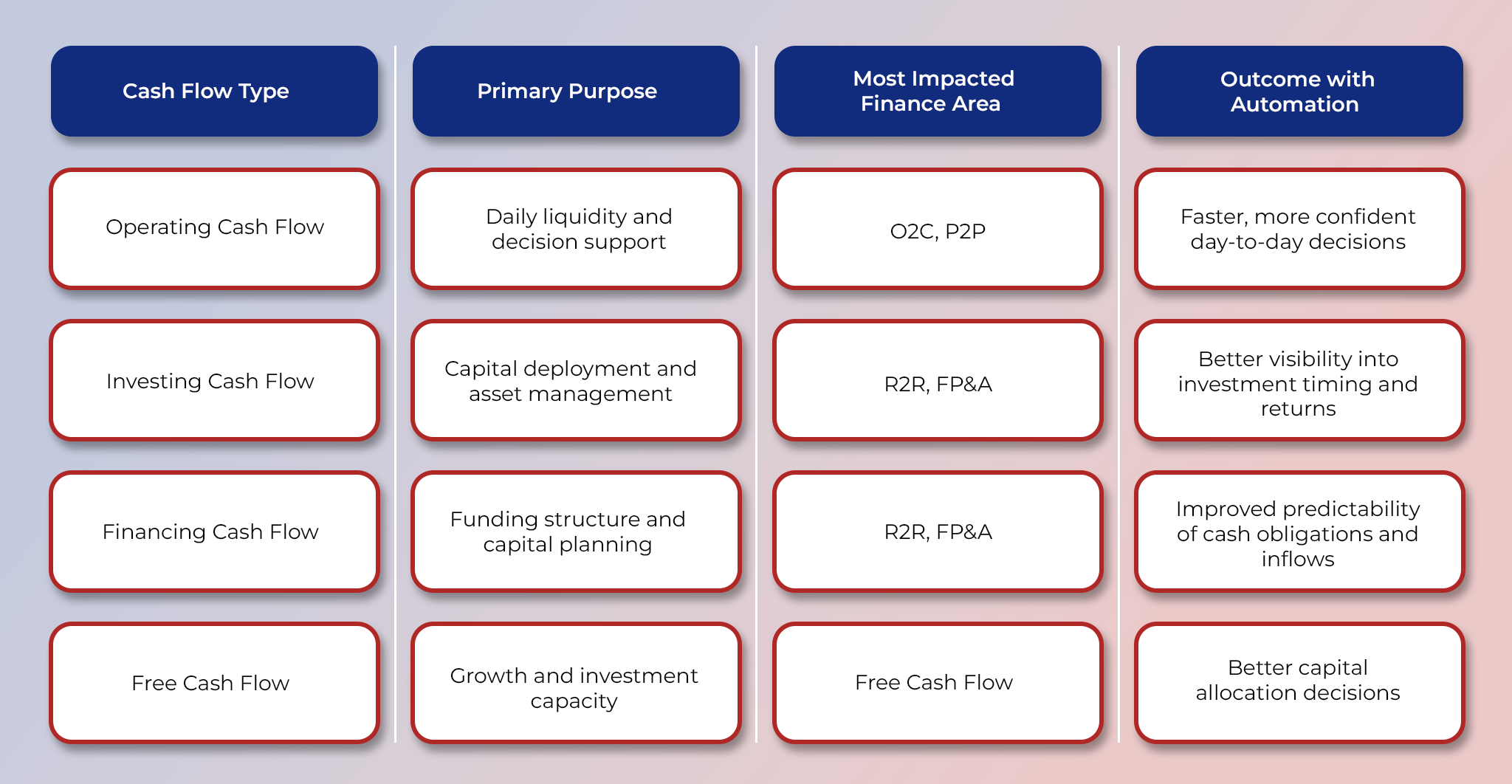
Together, these cash flow categories reflect how value is created, deployed, and sustained across the enterprise. When automation connects execution across O2C, P2P, and R2R, leadership gains a consistent and reconciled view across operating, investing, and financing activities, while free cash flow becomes a reliable indicator of strategic capacity rather than a retrospective calculation.
Automation as a Foundation for Operational Resilience
In today’s disruptive business landscape, operational resilience is less about absorbing large-scale shocks and more about maintaining stability as the business evolves across cycles of growth, change, and constraint. This shift is increasingly reflected in regulatory and policy guidance. Frameworks such as the EU’s Digital Operational Resilience Act (DORA) explicitly position automation, continuous monitoring, and embedded controls as foundational requirements for operational resilience, rather than discretionary efficiency improvements.
Automation strengthens resilience by embedding consistency, control, and continuity into everyday finance execution. When core finance activities operate predictably and are governed by clear rules, organizations are better positioned to scale, adapt, and sustain performance without introducing operational fragility. Taken together, these capabilities ensure that resilience is not managed as an episodic response, but built into how finance operates every day.
In practice, this resilience shows up through:
- Earlier risk detection through continuous controls and exception monitoring that surfaces issues before they impact cash or compliance.
- Reduced dependency on individuals by replacing manual work and tribal knowledge with standardized, repeatable finance workflows.
- Greater operating stability during change as automated processes support scale, organizational shifts, and growth without erosion of control.
- Faster response to disruption because finance teams operate with timely, reliable insight rather than delayed, post-close information.
Role of External F&A Partners in Accelerating Maturity
Many organizations recognize the need for integrated, real-time finance operations, but progress is often constrained by gaps in skills, execution capacity, and change management.
External F&A partners accelerate maturity when they deliver:
- Embedded automation aligned to the finance operating model.
- Operating discipline and governance across O2C, P2P, and R2R.
- Scalable execution without internal build-out delays.
The impact of this approach is best seen when automation is embedded into the finance operating model rather than layered onto existing processes.
Healthcare Firm Achieves Cash Flow Optimization, Financial Agility With End-to-End Automation
A mid-market organization with high transaction volumes struggled with delayed cash visibility and low confidence in reported balances. Although some tasks were automated, receivables, reconciliations, and credit workflows remained fragmented.
By embedding automation across end-to-end workflows, processing cycles were reduced from 36 hours to 24 hours and straight-through processing improved from 70 percent to 95 percent. Revenue leakage was reduced by 90 percent, recovering approximately $4.5 million annually. Cash flow improved by 40 percent, and full regulatory compliance was achieved through standardized, embedded controls.
The Takeaway
Organizations that treat cash flow as a continuous, governed system rather than a periodic reporting outcome are better positioned to navigate volatility, allocate capital with confidence, and sustain performance through change.
This shift requires moving from isolated process improvements to an operating model that is deliberately designed to re-imagine how cash flows across F&A towers and re-invent how automation, controls, and clear ownership are executed. When automation is assessed, deployed, integrated, and sustained as part of a structured maturity journey, cash visibility becomes reliable, decision latency shrinks, and resilience is built into daily finance operations.
Frameworks such as Cogneesol’s ADIS provide a way to evaluate that progression by linking ambition to execution, and execution to outcomes, enabling cash flow optimization to evolve from a series of improvements into a repeatable operating capability.
Partner with Cogneesol to move beyond traditional process automation with our proprietary implementation framework and domain expertise that support continuous visibility, control, and resilience at scale.
CXO Checklist: Are You Truly Optimizing Cash Flow?
Do we see cash positions as they are forming, or only after they have settled?
Are controls and reconciliations embedded into daily execution, or concentrated at period end?
Is ownership of cash outcomes explicit across O2C, P2P, and R2R?
Does finance shape decisions as they are made, or explain results after the fact?
The post Automation that Moves the Needle: Increasing Cash Flow Optimization and Real-Time Visibility appeared first on Cogneesol Blog.