
By a veteran Silicon Valley lawyer. Standard disclosures at the bottom.
Friends,
If last week had a theme, it was simple: AI stopped being a product category and became the operating layer for #tech, #biotech, #capitalmarkets, and — inevitably — the #law. Nine tech stories, one #oncology meeting, two #antitrust rulings, a category-defining launch, and an #IPOwindow that just slammed open on Friday afternoon. All of it #AI. Grab coffee. This is the week I’ll be citing in term sheets through Q3.
Last Week (Apr 13–17):
On the Docket:
Mon 4/13 — Every AI lab is now a chip company in drag.
- Reuters confirmed Anthropic is exploring its own custom AI silicon, on top of its April 6 deal with Google and Broadcom for 3.5GW of TPU capacity through 2029. Translation for the deal desk: every serious AI lab is now a semiconductor supply-chain underwriter with a chatbot UI.
- What I’m telling clients: if your AI vendor can’t answer “where does your compute come from, and for how long?” in one sentence, you’re not negotiating a SaaS contract — you’re underwriting a capacity bet. Price the MSA accordingly.
Tue 4/14 — Mythos meets the Oireachtas
- Ireland’s national cyber chief told Parliament that Anthropic’s Mythos model is a “game-changer.” A sovereign’s top cyber officer name-dropping a specific frontline model in testimony is, so far as I can tell, a first.
- AI governance is being quietly reclassified from an IT problem to a fiduciary one.
- Update the AI committee charter before your D&O carrier updates your premium.
Wed 4/15 — Signal Labs launches “Attention Infrastructure” The headline of the week.
- Signal Labs exited stealth with $25M in signed enterprise TCV and Lightspeed leading its seed. Founder Rajeev Ronanki (formerly CEO of Lyric and President of Carelon Digital Platforms at Elevance) is defining a new category: Systems of Attention. 100+ SaaS tools per enterprise. 95% of signals never reach action. Pair SignalOS (executive experience layer) with SignalGraph (coordination engine). GA release — “Apex” — ships Friday, April 24.
- Why a corporate lawyer cares:
→ Every 2026 M&A diligence checklist asks “what AI is in the stack?” → Approximately zero ask “who decides what the AI routes to whom, and when?”
→ That changes now. Attention-routing logs will appear in data rooms next to SOC 2s.
Bad pun I refuse to apologize for: Signal Labs has finally given the legal profession infrastructure for deciding what to ignore. I’ve been building mine by hand since 1999.
Thu 4/16 — State-court antitrust season
- A California judge found the state DOJ presented enough evidence for a jury to reasonably conclude Amazon coerced third-party sellers into price-parity compliance. Brussels stripped a safe harbor for Licensing Negotiation Groups in final tech-transfer guidelines. The theme of 2026 is beyond dispute: federal Big Tech antitrust is ice-cold, state AGs and the EU are where the action is. Plan your regulatory strategy accordingly.
- Old trial lawyer line: The judge said, “Counsel, I’ve been reading your brief.” Counsel said, “Thank you, Your Honor. Me too.”
Fri 4/17 — AACR opens; Gemini meets Grandma’s photos; the Silicon Valley IPO window opens
- Three things at once, and the last one matters the most for our readers. AACR opened in San Diego with more agentic-AI oncology sessions than the conference has ever programmed. Google integrated Gemini + Nano Banana into Google Photos — with a stated firewall against training on private libraries (which is a contract line, counsel — litigators will eventually argue it).
- And then Wall Street found its pulse for Silicon Valley:
→ Cerebras Sytems (CBRS) — the Sunnyvale AI chipmaker — publicly filed its S-1 Friday afternoon for a Nasdaq listing targeting May, with $510M of 2025 revenue (+76% YoY), $87.9M net income, and a pre-IPO valuation north of $26B in secondary markets. Andrew Feldman’s team just turned the wafer-scale chip into a live test of whether the public market will finance any pure-play alternative to Nvidia. Oh, and OpenAI is on the hook for more than $20B of Cerebras compute over three years. Read the S-1 twice.
→ Alamar Biosciences (ALMR) — Fremont-based precision proteomics — priced upsized at $17 (high end), opened +33% at $22.60, and closed the day at a ~$1.53B valuation. Another SV company quietly ripped through a “closed” IPO market.
→ SpaceX confidentially filed IPO paperwork earlier this month — the signal matters more than the timing. The IPO window, stuck shut since 2022, is unstuck. And this time, Silicon Valley is actually in the lineup.
Clients & Friends in the Wild
A few companies we’ve been proud to work alongside, all doing things worth watching this cycle:
- XY.ai (Sam De Brouwer & team) — agentic AI for healthcare operations. If you’ve ever stared at a denied claim and wondered whether a machine could do this better, the answer is yes, and they’re shipping it. Paying enterprise contracts, first production agents live, aimed at the $1.5T healthcare-ops bottleneck.
- SoundPatrol (Walter De Brouwer, Michael Ovitz) — the AI-native anti-piracy research lab for music, with Universal Music Group and Sony Music as partners. Neural fingerprinting that can distinguish a cover from a remix from a generative-AI derivative. The music industry’s IP defense layer for the AI era.
- Syn-apse — swarm robotics. A team pushing coordinated multi-agent physical AI out of the lab and into real-world deployment. One chassis is a demo; a swarm is a product category. Keep this name on your radar.
- Gatik — recently became the first U.S. company to operate fully driverless trucks at scale for commercial deliveries, Isuzu and NVIDIA as partners, and Level 4 trucks running for Fortune 50 retailers across Texas, Arkansas, Arizona, and Ontario. Physical AI is no longer a thesis — it’s a balance sheet.
- Lawyer joke: What’s the difference between a Level 4 autonomous truck and a senior partner? The truck doesn’t need a consultant to explain what AI is. — -
This Week (Apr 20–24): The Preview
Monday 4/20 — AACR’s AI plenary
- “AI Revolution in Cancer Research” opens with Stanford’s Jure Leskovec, Harvard’s Faisal Mahmood, and Johns Hopkins’ Suchi Saria. Parallel sessions on agentic AI as the cancer researcher (Broad’s Marinka Zitnik) and AI as the oncologist (Dana-Farber’s Renato Umeton). Biotech M&A implication: diligence on AI-enabled oncology platforms is shifting from “explain your model” to “show me your agentic audit trail.” Structure IP and data rights before you get asked.
Tuesday 4/21 — Industrial-earnings firehose; LatAm in Miami Pre-market: 3M, GE Aerospace, Danaher, RTX, Northrop Grumman, UnitedHealth, Quest Diagnostics.
- After close: Capital One, Chubb, Intuitive Surgical, United Airlines. Tech.eu Summit London opens.
- Riverwood Capital’s LatAm Tech Forum convenes in Miami mid-week — arguably the most prestigious invite-only gathering of LatAm founders, tech CEOs, and investors on the calendar. If you’re building cross-border into LatAm, this is the room.
Wednesday 4/22 — Tesla, Google Cloud Next, AACR curtain call The biggest day.
- Tesla prints Q1 after close (consensus $22.3B / $0.36 EPS). Real questions aren’t vehicles — it’s robo-taxi, Optimus, and AI capex.
- Also reporting: IBM, AT&T, Boeing, ServiceNow, Texas Instruments, Lam Research, CSX. Google Cloud Next 2026 opens at Mandalay Bay — expect Gemini, Vertex AI, Agentspace, and cloud-security announcements. AACR closes with “Innovative Treatment Modalities.”
- Dad joke: I tried to tell my paralegal a chemistry joke about ADCs. No reaction.
Thursday 4/23 — Intel’s comeback test; Cloud Next continues Intel reports Q1 after close.
- Stock up ~87% YTD; consensus a rounding-error $0.01 EPS. The print that tells us whether the foundry-comeback narrative has fundamentals or is vibe.
- Pre-market: Amex, Honeywell, Lockheed Martin, Thermo Fisher, Union Pacific, Sanofi, Nokia, STMicro.
Friday 4/24 — SignalOS Apex ships; Cloud Next wraps Signal Labs’ SignalOS “Apex” goes GA — the first “attention infrastructure” product to hit GA.
- Watch healthcare, freight, and financial-services design partners for the first 72-hour reactions.
- Google Cloud Next closes.
- Earnings: P&G, HCA, Charter, Norfolk Southern, SLB.
- Also watch the Cerebras roadshow — analyst meetings begin this week, and the pricing window opens in early May.
Upcoming Foley Events (We’d Love to See You)
🗓 Hard Things — Thursday, April 30, 2026 | San Francisco. Our invite-only series with Vitaly Golomb and Mavka Capital on what it actually takes to build Physical AI — robotics, autonomous systems, AI-native manufacturing, edge. Per Luma, our guest is Andrea Keay, Managing Director of Silicon Valley Robotics (the largest robotics cluster in the world) and Robotics Fellow at Singularity University. If you’re building in robotics, humanoids, or embodied AI, this is the room. Spots limited. [Apply via Luma.](https://luma.com/a7tx3jle)
🗓 Silicon Valley GC Lunch — May 15. Our in-person, off-the-record gathering for general counsel and senior in-house counsel across the Bay Area tech and life-sciences community. AI governance and AI-in-M&A are dominating the agenda. If you’re GC and haven’t RSVP’d, reply to this email.
🗓 Riverwood Capital LatAm Tech Forum — this week, Miami. If you’re in the region, come find me.
Closing Argument
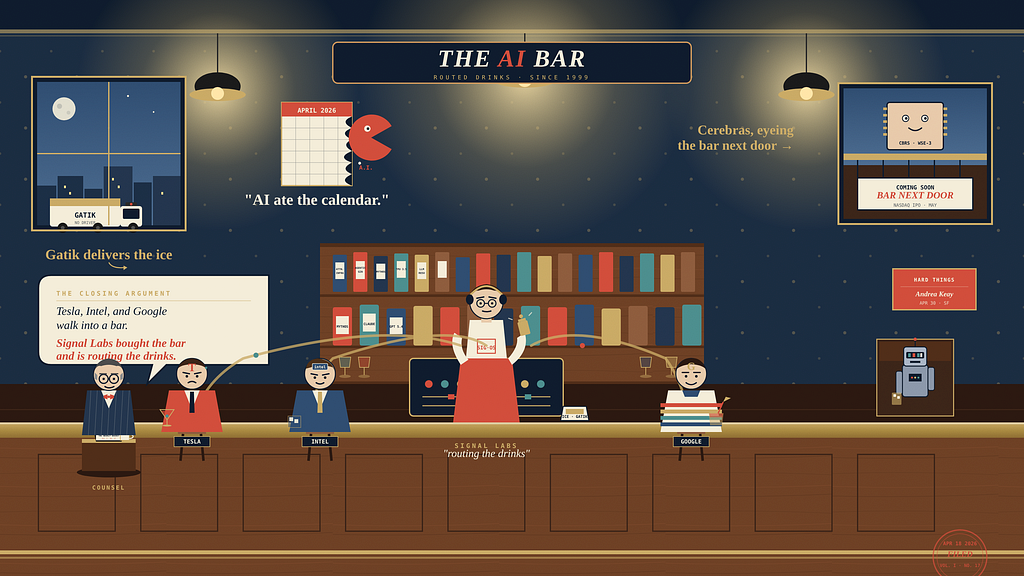
- Last week was about announcing AI infrastructure. This week is about pricing it — in earnings, in a Cerebras as S-1, in a Signal Labs GA release, in a Tesla robo-taxi roadmap. Tesla has to defend its AI valuation. Intel has to prove a turnaround. Google has to turn a platform into an ecosystem. Cerebras has to prove the public markets will finance something other than Nvidia. Gatik has already proved AI can drive the truck. Tesla, Intel, and Google walk into a bar. Signal Labs bought the bar and is routing the drinks. Gatik delivered the ice. Cerebras, naturally, is trying to buy the bar next door.
- Every client conversation this week reduces to the same question: how do we structure the deal to capture the AI upside without the liability cliff? No one has the perfect answer. Anyone claiming they do hasn’t read the footnotes. Until next Saturday.
Standard disclosures: opinions my own, not my firm’s. Not legal advice. No attorney-client relationship is formed by reading this newsletter. Past results do not assure future results. If one were, I’d be significantly worse at getting people to unsubscribe.