Hey there Legal Rebels! 👋
I’m excited to share with you the 84th episode of the LawDroid Manifesto podcast, where I will be continuing to interview key legal innovators to learn how they do what they do. I think you’re going to enjoy this one!
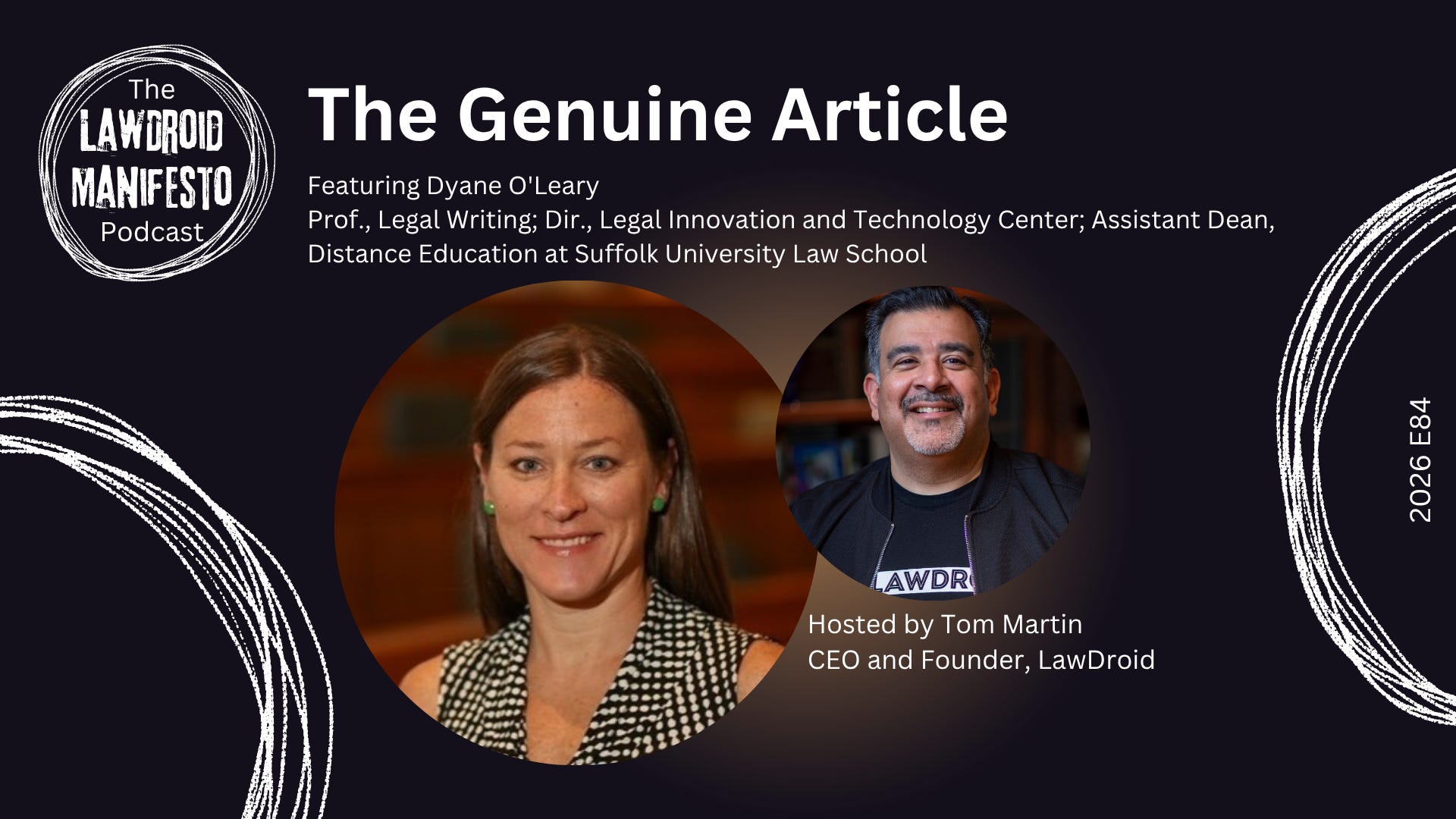
I am very lucky to call Professor Dyane O’Leary a colleague. Dyane is the creator of the Generative AI & the Delivery of Legal Services course. She wears many hats as a Professor of Legal Writing, Director of the Legal Innovation & Technology Concentration, and Assistant Dean for Distance Education at Suffolk University Law School. But, most importantly, she prioritizes authentic, human connections with students — and that is why I have dubbed her “The Genuine Article.”
If you want to understand how law schools are actually teaching AI competence, not just talking about it, you need to listen to this episode. Dyane is at the forefront of building that curriculum at Suffolk University Law School and brings a rare, grounded perspective on where legal education is headed.
Teaching Lawyers to Find Their Voice in the Age of AI
Join me as I interview Dyane O’Leary, Professor of Legal Writing, Director of the Legal Innovation & Technology Concentration, and Assistant Dean for Distance Education at Suffolk University Law School.
In this episode, Dyane walks through how Suffolk built one of the country’s most established legal innovation and technology programs, and how that foundation is now being tested and expanded by generative AI. She shares how she teaches first-year law students to use AI tools responsibly before they’ve developed a professional voice of their own, why she reinstated a closed-book legal writing exam last year, and how the skills-versus-doctrine divide that’s shaped law school curricula for a century is finally starting to blur.
Dyane also opens up about her path into teaching, from a Wilmer Hale associate who kept sneaking back to adjunct teaching, to a federal clerkship that confirmed the pull toward the classroom, to her current role shaping how an entire law school thinks about technology competence. Her stories about staying connected to students as people first, not just names on a roster, make this episode a valuable listen for anyone thinking about how legal education needs to evolve.
The Skinny
Dyane O’Leary, a Suffolk University Law School professor and administrator, joins Tom to talk about how legal education is adapting to generative AI without losing sight of what makes good teaching good. She discusses Suffolk’s decade-old legal innovation and technology concentration, the challenge of teaching AI skills to 1Ls who don’t yet have a professional voice, and why her program brought back a closed legal writing exam to make sure students can still do the work without AI assistance. She also reflects on her own path from Wilmer Hale associate to law professor, the mentors who shaped her along the way, and what continues to make teaching worthwhile after years in the classroom.
Key Takeaways
-
Suffolk’s Legal Innovation and Technology concentration has existed for roughly a decade and has become a defining feature of the school’s identity and national recognition.
-
A central challenge in legal education right now is the “skills-doctrine divide”: AI doesn’t fit neatly into either category, since it’s simultaneously a skill and a source of fast-moving new doctrine (work product privilege, discoverability of prompts, confidentiality).
-
Suffolk brought back a closed-book legal writing exam for all 1Ls in December, part of a broader trend among legal writing programs to ensure students can still perform without AI assistance.
-
Students transitioning from personal AI use to professional legal writing face a unique challenge: they don’t yet have an established “voice” the way experienced practitioners do, making it harder to know when and how to lean on AI tools.
-
Dyane’s 1L orientation exercise, having students ask AI to define “false imprisonment” and compare wildly inconsistent answers, is designed to show students they aren’t yet equipped to evaluate AI output critically.
-
AI’s effect on the legal job market looks uneven: big law summer associate classes haven’t shrunk, public-interest and government roles remain untouched, but small firms (single-digit attorney count) may have less first-year associate work available.
-
New hybrid roles, like legal innovation architect, are emerging that didn’t exist a decade ago, and substantive practice areas tied to AI (regulatory, cybersecurity, employment) are expanding.
-
Dyane emphasizes that technology competence and human connection aren’t opposites. Knowing students’ names and staying present as a mentor matters just as much in an AI-forward classroom.
-
Personal practices like a running whiteboard to-do list, hot yoga, and “walking hours” instead of office hours have helped her manage the workload of teaching, administration, and family life.
Notable Quotes
-
“I do think AI is unique in the sense that it crosses all those things. It’s a skill, but there’s also all sorts of new emerging doctrine because of AI.” Dyane O’Leary [13:10 to 13:27]
-
“If you have your voice, it’s easier to use these tools. We are able perhaps to use these tools in connection with our voice. I worry about the idea that our students, for the most part, are transitioning from personal users to professional, and they don’t have that voice yet.” Dyane O’Leary [31:13 to 32:06]
-
“We embrace technology competence, we are known for it, but we also told our students that it’s our job to prepare you to be managers of these tools, to be able to pass the bar exam, to be able to talk to a judge, to be able to speak with your colleague in an office about a legal issue when you don’t have your ChatGPT screen.” Dyane O’Leary [32:33 to 33:00]
-
“For every skills angle that AI might be taking from a lawyer, I do think it’s true that there is a whole bucket of new substantive practice that is exploding because of AI.” Dyane O’Leary [40:34 to 40:56]
-
“The more we can encourage students to kind of be people instead of just law students, I think that’s a good thing for their career. Certainly is for mine.” Dyane O’Leary [50:19 to 50:42]
Clips
AI is Creating New Legal Careers
I’d Prefer Caution Over Reliance
Find your Legal Voice with AI
Why Teaching Matters More Than Rankings
Dyane’s conversation makes clear that the future of legal education isn’t a binary choice between embracing AI and preserving what makes a good lawyer, good. Suffolk’s approach shows a way to hold both at once, giving students real technical fluency while insisting they can still think, write, and argue without a screen in front of them. From closed-book exams to walking office hours to a whiteboard full of half-formed class ideas, Dyane’s work is a reminder that innovation in legal education is as much about staying human as it is about staying current.
Closing Thoughts
What struck me most in this conversation with Dyane is how she refuses to treat technology competence and genuine mentorship as competing priorities.
So many conversations about AI in legal education get stuck in a false choice: either you’re the tech-forward professor or you’re the one who actually knows your students’ names. Dyane’s answer is that you have to be both, and honestly, that’s the only version of this that will hold up over time.
The way forward is not either / or, it’s AND.
Also, those of us who built our professional judgment before generative AI existed have something to lean on when we use these tools. Our students don’t have that yet, and figuring out how to help them develop a voice alongside the tools, rather than instead of them, might be the single hardest and most important task facing legal education right now.
Thanks for listening, Legal Rebels! Go check out what Dyane and her colleagues are building at Suffolk Law’s Legal Innovation and Technology Center, and I’ll see you in the next episode.
By the way, if you would like to meet other superlative legal innovators in person, and enjoy an exceptional awards gala celebration, don’t miss the Oscars of Legal Innovation: the American Legal Technology Awards, this October 25, 2026, in Boston. Reserve your Early Bird tickets today and save $100.