
AI has become an integral part of our everyday lives, and content created with its help is taking up an ever-growing share of the information we consume. Today, we encounter it almost everywhere: in social media feeds and everyday advertising, in texts, images, videos and songs, and sometimes even in content presented as genuine news.
Not so long ago, AI would give itself away through odd details and the infamous “six fingers” we have all come to recognise. Today, however, the line between what is real and what is AI-generated has become increasingly blurred. Spotting AI-generated content is getting harder and harder and, at times, may be virtually impossible.
This naturally raises a question: are we entitled to know when the content we see, read or hear has been generated or manipulated using AI? And if so, who should disclose this, when, and how?
In the EU, the answer has already moved beyond a purely ethical debate and into the realm of legal regulation. As of 2 August 2026, the transparency requirements laid down in Article 50 of the EU Artificial Intelligence Act (the AI Act) apply. Among other things, they determine when content generated or manipulated using AI must be appropriately marked and when its artificial origin must be disclosed to users.
So, let’s have a closer look at how these rules work.
Two Levels of Transparency: Obligations for AI Providers and Deployers
Article 50 of the AI Act distinguishes between the obligations of providers, meaning those who develop AI systems and place them on the market, and deployers, who use such systems in the course of their professional activities.
Technical Marking: What Providers Need to Do
For providers, the key requirement is technical marking: AI-generated text, image, audio and video content must be marked in a machine-readable format so that it can be detected as artificially generated or manipulated.
In practice, this may involve, among other techniques, digital watermarks, metadata, cryptographic methods for proving the provenance and authenticity of content, logging methods or digital fingerprints. The AI Act does not, however, prescribe a single mandatory method of technical marking. What matters is that the chosen technical solution is effective, interoperable, robust and reliable as far as technically feasible, taking into account the specificities and limitations of different types of content, the costs of implementation and the generally acknowledged state of the art.
That does not mean, however, that everything AI has had a hand in must be marked. The requirement does not apply where AI merely performs an assistive function for standard editing or does not substantially alter the input data or its semantics. For example, correcting grammar and spelling, making minor stylistic edits, translating or formatting text, reducing noise, cropping an image or adjusting its colour would not require such marking.
The line is crossed when AI makes more substantial changes. Summarising or substantially rewriting a text, adding or replacing people or objects in images or videos, significantly altering a person’s appearance, generating audio in a specific person’s voice, or creating a realistic video depicting something that never actually happened would require marking.
Transparency for Users: Deep Fakes and AI-Generated Text
For deployers of AI systems, the focus shifts from technical marking to transparency for the people who encounter the content. They must disclose when content has been artificially generated or manipulated where it constitutes a deep fake, as well as in the case of text published for the purpose of informing the public on matters of public interest.
When Does AI-Generated Content Become a Deep Fake?
Not every AI-generated or manipulated image, audio or video automatically qualifies as a deep fake.
The term refers to content that resembles existing persons, objects, places or events and would falsely appear to a person to be authentic or truthful.
For example, an AI-generated image of a product used in advertising may qualify as a deep fake if it is capable of misleading the audience as to the product’s actual appearance, characteristics or use. By contrast, a real car shown against an AI-generated background would not be considered a deep fake if the advertisement does not mislead the audience about the actual appearance, characteristics or use of the car itself.
There is also a more flexible transparency requirement for deep fakes that form part of an evidently artistic, creative, satirical, fictional or analogous work. The AI-generated or manipulated nature of such content must still be disclosed, but this can be done in an appropriate manner that does not hamper the display or enjoyment of the work.
AI-Generated Text and Matters of Public Interest
When it comes to text published for the purpose of informing the public on matters of public interest, the rules do not apply to just any AI-generated text. Matters of public interest include, among other things, politics and democratic processes, public administration, the administration of justice, the protection of fundamental rights, public security and public health, environmental protection and consumer safety, as well as significant economic, financial, scientific or cultural developments.
For example, disclosure would be required for an AI-generated summary of a newspaper article discussing a local council decision, an article on the effects of different diets on a particular disease where parts of the text have been manipulated using AI, a corporate report containing information for investors, or an AI-generated warning about hazardous weather conditions.
There is, however, an important exception.
Disclosure of the use of AI is not required where the AI-generated or manipulated text has undergone a process of human review or editorial control and a natural or legal person holds editorial responsibility for its publication.
A purely formal check for spelling or grammar is not enough. The text must undergo substantive human review, including verification of the accuracy of the information it contains. Accordingly, separate disclosure would not be required for an AI-generated or manipulated newspaper article that has undergone editorial control, or for content that has been reviewed and approved by the responsible official before publication. By contrast, an AI-generated article published automatically without substantive human review, or content that has merely been given a cursory grammar check, would not benefit from this exception.
The AI Act does not prescribe a single mandatory format for such disclosure. It may, for example, take the form of a clear textual or audio notice. The European Commission has also developed dedicated icons for labelling fully AI-generated and partially AI-modified content. Their use is optional. What matters is that the disclosure is clear and distinguishable to the person encountering the content. Below are the icons developed by the European Commission for labeling AI-generated content.
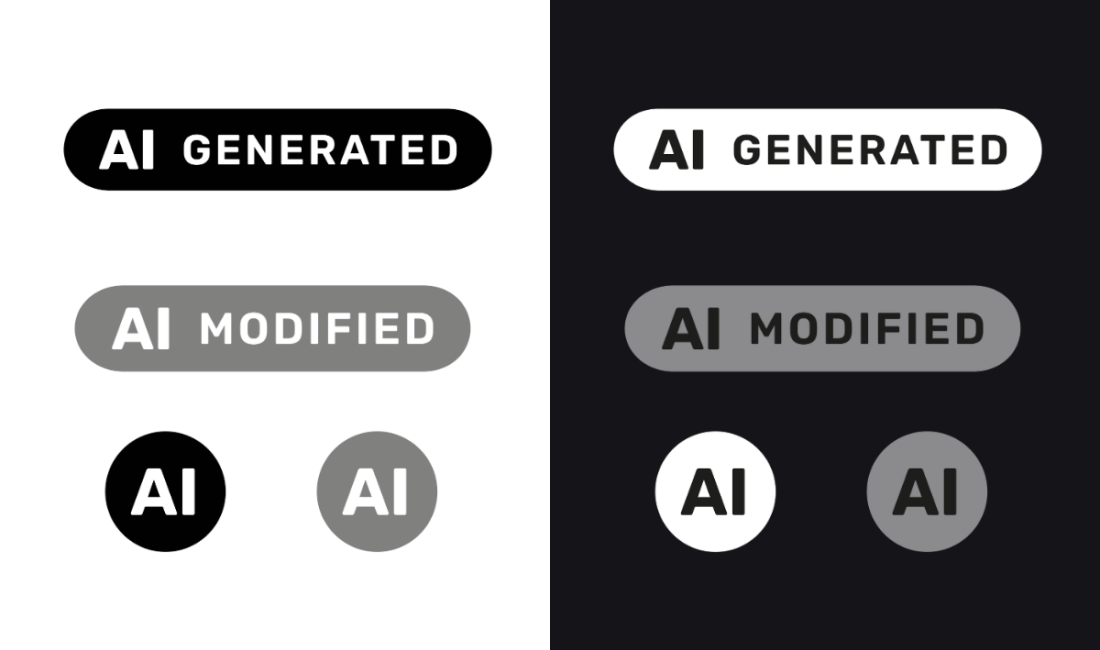
A Special Case: AI in Law Enforcement
Alongside the exceptions discussed above, the AI Act also makes specific provision for the use of AI in the context of law enforcement. Here, the exception is broader, as it applies both to the technical marking of AI-generated content by providers and to the obligation of deployers to disclose that content has been artificially generated or manipulated. These requirements do not apply where the use of AI is authorised by law to detect, prevent, investigate or prosecute criminal offences.
Ex Ante Transparency: When Must AI Use Be Disclosed?
Importantly, where the AI Act requires information about the use of AI to be disclosed, it must be provided in a clear and distinguishable manner, at the latest at the time of their first interaction or exposure to the relevant content.
Drawing the Line…
Ultimately, all these rules come down to a fairly simple idea: the more realistic AI-generated content becomes, and the harder it is to distinguish from human-created content, the more important transparency about its origin becomes.
If people can no longer always recognise the involvement of AI on their own, then, in the circumstances specified by the AI Act, they should at least be made aware of it.
That does not mean, however, that everything touched by AI now needs a “generated by AI” label. What matters is the nature of the content, how substantially AI has altered it, the purpose for which it is made available, and the role played by humans in the process. For businesses, then, using AI effectively is now only part of the equation. Just as important is understanding when its use must be disclosed to users and how that disclosure should be made.
Сообщение AI-Generated Content: Transparency and Labelling Requirements under the EU AI Act появились сначала на Legal IT group.