
On August 13, 2026, the Public Company Accounting Oversight Board issued its latest inspection reports for the six largest public audit firms: BDO USA, P.C., Deloitte & Touche LLP, Ernst & Young LLP, Grant Thornton LLP, KPMG LLP, and PricewaterhouseCoopers LLP. [1]These firms collectively audit the vast majority of corporate issuers. In this post, I focus on the inspection reports of the “Big Four:” Deloitte, Ernst & Young, PricewaterhouseCoopers, and KPMG, which collectively audit issuers comprising about 80 percent of the market capitalization of listed companies.
These Big Four inspection reports are astonishing for the improvements they reflect in the performance of these firms. But which narrative do they support: an industry that has dramatically gotten its act together, or a regulator that has been brought to heel by an aggressively deregulatory SEC? Given the nonpublic nature of the PCAOB’s internal processes, any answer must be speculative. Still, there are clues that ought to pique the curiosity of audit committees of the Big Four firms’ public company clients, as well as congressional oversight committees.
A Bit of Context
Since the advent of the second Trump administration, the PCAOB has been under siege. Eliminating the PCAOB was among the recommendations of the Project 2025 report. The most significant threat to do so, a legislative proposal slipped into the version of the famous “Big Beautiful Bill” that passed the U.S. House of Representatives, was stripped out in the Senate and ultimately was not part of the bill that Congress approved last year. However, a second front was opened by President Trump’s SEC, which replaced all but one of the PCAOB’s board members, slashed the PCAOB’s budget, and required a substantial reduction in PCAOB staff. The reductions in PCAOB resources and personnel are not as sweeping as in other agencies, at least to this point.[2] Nevertheless, the PCAOB reductions, combined with a Board likely in sync with the SEC’s own Trump-era leadership, suggests a new direction, and generally less assertive posture, by the PCAOB. As one major law firm recently put it, “there has never been a better time for firms to successfully challenge PCAOB inspection findings.”[3]
In particular, there is reason to be concerned that the new board may be pushing the PCAOB staff, or the SEC may be pushing the new board, in a direction that might imperil its fundamental mission: its inspection program. In particular, there is reason to suspect that the PCAOB’s inspections program is under pressure to turn a blind eye on the largest audit firms.
The PCAOB is required to inspect registered audit firms that provide audit opinions to issuers at least once every three years (for firms with fewer than 100 audit issuer clients) or annually (for firms with 100 or more such clients). Unique among U.S. regulators with inspection authority, the PCAOB is required by law to issue public reports on the results of each of its inspections of auditors of public companies. Accordingly, the inspection program is by far the largest part of the PCAOB’s operation, employing the vast majority of its staff. The PCAOB issues more than 150 such reports on its website each year, and they are an important bellwether of auditor performance. They provide an irreplaceable measuring stick, both of the performance of individual firms, and of the audit industry as a whole.
Given the significance of the PCAOB inspection program, is it possible that the SEC or the new board is seeking to dilute the findings in inspection reports, at least for the largest and most politically influential firms? If so, will any such relaxation of oversight undermine the pressure to improve performance that has led to substantial improvement in audit performance in the decades since SOX was enacted?
The Significance of These Inspection Reports
Inspections of registered audit firms with 100 or more corporate issuers must be conducted annually, and followed by a public inspection report. In practice, there are six firms that meet the requirement for such annual inspection and public reporting. In recent years the PCAOB has endeavored to make the performance of these six firms more easily comparable by issuing their annual inspection reports simultaneously. The changes in relative performance reflected in PCAOB inspection report results, both year-to-year and between firms, is, apart from audit restatements, one of the few objective measures for assessing the overall performance of audit firms.
- Remarkable Improvement in Audit Performance.
As noted above, the performance of the six annually-inspected firms, and especially the Big Four, in the newly-issued inspection reports seems astonishing These firms have shown steady improvement in their PCAOB inspection results for several years, but the degree of improvement year-to-year from the 2024 inspection cycle to the 2025 inspection cycle is remarkable.
The most widely-used metric for a firm’s performance in a PCAOB inspection is the percentage of audits that the PCAOB inspected that resulted in a “Part I.A” finding (in the PCAOB’s own words, a finding that its inspection identified “deficiencies that were of such significance that we believe the firm, at the time it issued its audit report(s), had not obtained sufficient appropriate audit evidence to support its opinion(s) on the issuer’s financial statements and/or ICFR”). As the chart below illustrates, the percentage of audits of Big Four firms with Part I.A findings has improved steadily in recent years. For example, for the 2022 and 2023 inspection cycles 26 percent of the Big Four audits inspected were found to have Part I.A deficiencies. That percentage declined to 20 percent for 2024 inspections. One would expect the trend to possibly flatten out as it approached zero, but instead it accelerated for 2025 inspections, to only 8 percent. The lowest-performing Big Four firm in the 2025 inspections, KPMG, had a 13 percent deficiency rate, which was lower than any of the Big Four firms had for the 2024 inspection cycle. Most conspicuously, Ernst & Young, which had a 37 per cent Part I.A deficiency rate for the 2023 inspection cycle, saw that rate drop to 28 percent for 2024 inspections, and then all the way down to 5 percent for the most recent inspection cycle.
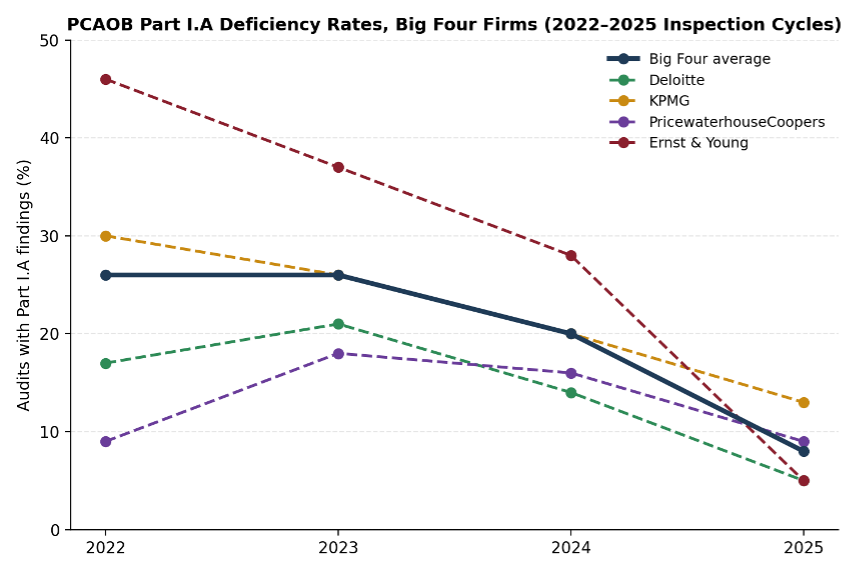
Given the fairly substantial size of the audits tested at each firm (64 audits) these drops are highly unlikely to be an artifact of sample-size randomness. A statistical calculation shows the chance that random variation accounts for Ernst & Young’s improvement is 1 in 6,000,[4] and the chance that the overall Big Four’s improvement from 2024 to 2025 was due to random variation is 1 in 14,000.[5] Something specific—whether a change in audit practice, in inspection methodology, or in regulatory posture—clearly drove this shift.
Is it possible that this impressive drop in Part I.A deficiency findings stems from the firms’ efforts to improve audit quality? If there is some major change in auditors’ techniques, technologies, or staffing models that accounts for this great leap forward, it is to be hoped that the PCAOB has a staff study under way to highlight these changes so that the rest of the audit profession and the PCAOB itself can learn from it. If so, the PCAOB has been strangely silent about it, in stark contrast to the Big Four inspections reports released last year, for which the PCAOB simultaneously released a press release noting the improvement and a staff study analyzing it.[6]
For that and other reasons, I am skeptical. To be clear, a more modest improvement among these firms from the prior year would be plausible. The prior two years showed appreciable improvement by all four firms. If the trend line from 2022 had simply continued on its course the overall deficiency rate for the four firms would have been 17 percent. If the 2022 data are disregarded, the trend line would suggest a 14 percent deficiency rate for 2025. Instead, the 2025 deficiency rate was an improbable 8 percent.
So what else might be going on here? Given everything else that has happened at the SEC and the PCAOB over the last 12-18 months, one has to wonder if the most recent results say more about a regulator growing lax than an industry that has dramatically transformed itself
- Delay in Issuance of the Annual Firm Inspection Reports.
The PCAOB has tried in recent years to close the lag time between its conduct of inspections and issuance of inspection reports. For the annually inspected firms, this effort reached its high water mark last year, when all of the Big Four reports for 2024 inspections (as well as BDO and Grant Thornton) were issued together in March, 2025, months ahead of the normal cycle. For 2026, these inspection reports have come out in August, nearly four months later, a substantial but not catastrophic slippage.
Perhaps some of this delay can be explained by the recent turnover in board members, but that by itself does not appear to be a complete explanation. As reflected in the table below, last year all of the Big Four inspection reports were dated February 26, 2025, and were issued on March 31. This year, two of the Big Four inspection reports, for KPMG and Deloitte, are dated May 21, 2026, suggesting that the board approved those reports for issuance at or around that date. Two others, for PricewaterhouseCoopers and Ernst & Young, are dated June 12, 2026 and July 22, 2026 respectively. If bringing along two new board members[7] were the only reason for the delay in issuing the inspection reports until July 22, it is hard to understand why those novice members would have been ready to approve two of the reports on May 21, one three weeks later, and one nine weeks later.
| Firm | 2025 Report Date (2024 Inspections) | 2026 Report Date (2025 Inspections) | Days After First 2026 Report (May 21) |
| Deloitte | February 26, 2025 | May 21, 2026 | 0 |
| KPMG | February 26, 2025 | May 21, 2026 | 0 |
| PricewaterhouseCoopers | February 26, 2025 | June 12, 2026 | 22 |
| Ernst & Young | February 26, 2025 | July 22, 2026 | 62 |
Note: Last year all four Big Four inspection reports were dated the same day (February 26, 2025) and issued together on March 31, 2025. This year the four reports are dated across a nine-week span, with KPMG and Deloitte first, PricewaterhouseCoopers three weeks later, and Ernst & Young nearly six weeks after that.
Another possible explanation that can be discounted is that the staff’s own processes resulted in delays. There may on occasion be difficult legal or factual issues around some of the proposed inspection findings that required extensive back-and-forth between the staff and the firm, further legal analysis by the PCAOB’s Office of General Counsel, or perhaps consultation with the SEC Office of the Chief Accountant. But it seems unlikely that this would explain the report sequencing here, and it would be surprising if that process would have taken the better part of a year, especially if some technical issue on a small number of comment forms was holding up all of the Big Four inspection reports that were otherwise ready for issuance.
Two other possibilities remain. One is that some or all of the Big Four firms successfully got the board to intervene and strip out audit deficiency findings that the staff had proposed. The second is that one or more of the Big Four firms prevailed on the SEC to overturn audit deficiency findings after the board signed off on them. As discussed below, either of these explanations seems plausible.
- Board intervention to block inspection findings. SOX and PCAOB rules provide a way for an audit firm to challenge the staff’s proposed inspection findings, and it is possible that any or all of the Big Four firms may have done just that. SOX provides that firms receive a draft of their inspection reports before the final report can be issued, and the firms have 30 days to challenge any findings in the draft report to the board. The board can revise the report to make any changes that it deems appropriate. If PricewaterhouseCoopers or Ernst & Young sought board review, that might explain the variation in the dates of the final inspection reports.[8] It is possible that KPMG and Deloitte also made such challenges, but that the board found the issues they raised easier to deal with, while needing more time to work through issues raised by the other two Big Four firms.
- SEC review of Board-approved inspection reports. The final possibility is that PricewaterhouseCoopers or Ernst & Young sought SEC review of some or all of the findings contained in their inspection reports. Under Section 104(g) of SOX, once the board issues a final inspection report, firms have up to 30 days to seek SEC review of any inspection report findings before the report is made public. SEC Rule 140[9] in turn sets out the process for seeking this review, which is wholly discretionary for the SEC. If the SEC accepts the review request, the PCAOB may respond to the firm’s challenge. Rule 140 requires the SEC to review the report findings under an “arbitrary and capricious” standard. This very high standard of review suggests that SEC reversal of a finding would be very unlikely. However, given the perception of the SEC’s hostility toward the PCAOB’s regulatory program,[10] it is possible that a firm might have more of an incentive to challenge PCAOB inspection findings to the SEC, and that the SEC might be more receptive to such a challenge.
While intervention by either the hoard or the SEC seems like the most plausible explanation for the disparity in the dates of these four inspection reports, board intervention seems somewhat more likely. That is because of one detail in the Rule 140 review process. If any of the firms had successfully sought SEC review under Rule 140, one byproduct of that process is that, unless the SEC orders otherwise, the board must issue a redacted version of that inspection report while the SEC review is pending.[11] No such versions appeared on the PCAOB’s website. On prior occasions it appears that the PCAOB has issued redacted versions of Big Four inspection reports while Rule 140 challenges were pending, even keeping the redacted version on its website after the final version was issued.[12] The absence of any such redacted versions for these inspection reports suggests either that there were no Rule 140 appeals, or that the SEC departed from prior practice and ordered the PCAOB not to issue such redacted versions.
Under SOX, everything about the PCAOB’s inspection process, including firm responses to draft inspection reports and the Rule 140 review process is privileged and nonpublic, but if any of these firms successfully got the board or the SEC to reverse multiple inspection findings, that would suggest that their initial inspection reports were not nearly as favorable as the versions that eventually became public. Might that have been because the staff went too far in some of the proposed inspection findings, or might it have been because either the PCAOB board or the SEC have become solicitous of the accounting industry, or at least of its largest and most politically influential members, and put a thumb on the scale to block certain findings even if they were entirely reasonable?
To assume that either the board or the SEC whitewashed inspection findings of any of the Big Four inspection reports requires piling one speculation on top of another about a nonpublic regulatory process. Assuming that the latest Big Four inspection results were entirely attributable to massive improvements in audit approach across all four firms simultaneously seems even more speculative. It may be that there is some more benign explanation for the unusual dating pattern of the Big Four inspection reports for the 2025 inspection cycle. If so, the PCAOB and the SEC might not be able to say even if they wanted to, since provisions of SOX would require them to keep that information confidential except in very limited circumstances.[13]
But while the public may not be able to get to the answer directly, two constituencies of PCAOB inspection reports can find out more. The first are the audit committees of issuer clients of the Big Four firms. It seems fair, and may be necessary in light of fiduciary obligations, for the audit committees of issuer audit clients of the Big Four firms to have questions for their auditor about the inspection findings in their latest PCAOB inspection reports. The PCAOB itself has made clear that nothing in SOX or PCAOB rules prevents the firms from disclosing otherwise nonpublic information about their inspection findings with their clients’ audit committees.[14] Moreover, the listing standards of stock exchanges on which the issuer is listed may require such inquiry.[15]
Questions that audit committees might pose include:
- Are there any differences between Part IA, Part IB, of Part IC findings in your draft inspection report and in the final report as published by the PCAOB?
- If so, what specifically was changed? What is your understanding of why it was changed? Did you seek the change from either the Board or the SEC, and what were your reasons for seeking the change?
- Can you provide the comment forms and firm responses for any inspection findings contained in the draft inspection report that were dropped in the final report?
- Can you provide any letter or filing that your firm made with the PCAOB Board or the SEC challenging any inspection finding, and any response made by the PCAOB?
- The same questions could be asked about nonpublic quality control findings in Part II of the inspection report.
While audit committees could get these answers for their own benefit, there is also a constituency that could get more transparency on the latest Big Four inspection report results on behalf of the public: Congress. While congressional oversight of the PCAOB has not been strong in many years, that may change, either because of a turnover in party control or any significant increase in audit restatements or other market signs of a weakening of audit performance. Such oversight would likely not be constrained by the confidentiality provisions of Section 105(c)(5) of SOX. That limitation does not apply to information that is “presented in connection with a public proceeding.” While there is no case law on whether “public proceeding” in this context refers only to administrative or judicial litigated proceedings, or extends to congressional oversight hearings, the language seems expansive enough, and the argument that Congress wrote that language with the intention of shutting itself out from access to such information seems very slender. In any event, the prospect of responding to a congressional subpoena or giving testimony under oath may prompt the Big Four firms, and perhaps the regulators, to be forthcoming rather than to risk the expense and bad publicity of resisting such disclosure only to create a bad judicial precedent for themselves.
Without presuming to suggest what the scope of such congressional inquiry might be, some questions that might be ripe for exploration include, in addition to the audit committee questions noted above,
- whether any and all former Big Four auditor staff working for the PCAOB or SEC, respectively, recused themselves from involvement in all aspects of their former employer’s inspection reports;[16]
- In the case of the SEC, if there were any Rule 140 review requests, whether the SEC instructed the PCAOB to not publish redacted versions of those firms’ inspection reports, and if so
- The reasons why the SEC gave that instruction, and
- Whether there is any precedent for the SEC to instruct the PCAOB to not issue a redacted version of an inspection report while a Rule 140 review request is pending.
- Any communications between the SEC and the PCAOB relating to a Rule 140 review request by any of these firms.
- Whether any final decision on a Rule 140 review request by any of these firms was reviewed or approved by the Commission, or handled solely by the SEC Chief Accountant on delegated authority.
- In the case of the PCAOB, which Board members participated in any decision to change the findings of a draft inspection report, how each Board member voted on that decision, and any minutes or other written communication indicating the reasons for each Board member’s vote.
- To what does the PCAOB attribute the significant improvement in audit performance by the Big Four audit firms in the 2025 inspections? Was there any meaningful change in the PCAOB’s audit selection process from the 2024 to the 2025 inspection cycles? Does the PCAOB intend to release any type of staff study analyzing and explaining how the Big Four firms boosted their performance so markedly? If not, why not?
Conclusion
The latest Big Four PCAOB inspection results should be viewed with some skepticism. It may well be that the performance of all four firms continued the salutary trend of improved performance that has been tracked in the two prior annual inspection cycles. But the acceleration of that performance as described in the inspection reports for the 2025 inspection cycle seems implausible, and may be a harbinger of a troubling laxity by the current PCAOB or SEC in oversight of the audit function. History has demonstrated that such laxity, over time, leads to significant trouble. And trouble is what may lie ahead.
ENDNOTES
[1] “PCAOB Posts Six Inspection Reports,” available at https://pcaobus.org/news-events/news-releases/news-release-detail/pcaob-posts-six-new-inspection-reports-august-2026.
[2] As reflected in this recent headline, the SEC may be seeking to further reduce PCAOB staffing and resources: “US Audit Regulator Weighs Deep Cuts in Trump Administration Overhaul.” Financial Times, May 14, 2026, available athttps://www.ft.com/content/f5c56c66-2896-4ef1-9a6a-49c59c76f23e?accessToken=zwAAAaBPWkDVkdP1xWxmKJZO8dOaaknFnnbyPg.MEUCIQDEQzGLJWOx (requires subscription).
[3] “Challenging PCAOB Inspection Findings,” July 29, 2026, at 2, available athttps://www.kslaw.com/insights/articles/challenging-pcaob-inspection-findings-%E2%80%93-is-now-the-time-for-a-change-in-approach. (“King & Spalding memo”).
[4] This calculation was performed by Claude, an Anthropic AI model, and checked by me. For brevity’s sake the full calculation is not presented here, but I will send it to interested readers via the email address provided at the end of this article.
[5] As with the calculation above, This was made by Claude and checked by me, and I will send it to interested readers via the email address provided at the end of this article.
[6] See “PCAOB Posts Report Detailing Significant Improvements Across Largest Firms, Alongside Inspection Results In Record Time,” March 31, 2025, available at https://pcaobus.org/news-events/news-releases/news-release-detail/pcaob-posts-report-detailing-significant-improvements-across-largest-firms–alongside-inspection-results-in-record-time and “Spotlight: Staff Update on 2024 Inspection Activities,” (March 2025), available at https://assets.pcaobus.org/pcaob-dev/docs/default-source/documents/staff-update-2024-inspection-activities-spotlight.pdf?sfvrsn=86794c04_2.
[7] These were Board Chair Logothetis and Board member Calabria, who took office in February 2026. Board member Hauptman was sworn in on August 10, 2026, after the Big Four reports were all approved. Board member Botic was held over from the previous board and had previously been director of the inspections program, and Board member Laughton, while sworn in as a board member in February 2026 was before that a senior PCAOB staff member. Botic and Laughton were therefore familiar with the inspections process already.
[8] If Ernst & Young made such a challenge, PCAOB ethics rules may have required Board Chair Logothetis and his Chief of Staff, who are both Ernst & Young alumni, to recuse themselves, although those rules are not explicitly clear on that point. See, e.g., E.C.3(b)(2)-(5), available at https://pcaobus.org/about/rules-rulemaking/rules/ethics_code.
[9] 17 CFR § 202.140 – Interim Commission review of PCAOB inspection reports.
[10] “[T]here is a uniquely favorable climate to challenge findings stemming from the old inspection paradigm.” King & Spalding memo at 2.
[11] Rule 140(c)(5) requires, in part, that “[u]pon expiration of the 30-day period during which the firm may request interim Commission review, the PCAOB shall make publicly available the remainder of the final inspection report … [that is] not the subject of the firm’s review request, unless the Commission otherwise determines that such a result would not be necessary or appropriate.”
[12] See, e.g., https://assets.pcaobus.org/pcaob-dev/docs/default-source/inspections/reports/documents/104-2024-035-kpmg.pdf.
[13] See Section 105(c)(5) of SOX.
[14] Information for Audit Committees About the PCAOB Inspection Process, PCAOB Rel. No. 2012-003 (Aug. 1, 2012) at 10.
[15] For example, audit committees of New York Stock Exchange listed companies must annually obtain and review a report by the auditor describing, among other things, “any material issues raised by … peer review, of the firm, or by any inquiry . . . by governmental or professional authorities, within the preceding five years, respecting one or more independent audits carried out by the firm, and any steps taken to deal with any such issues . . . .”NYSE Listed Company Manual, Section 303.A.07(b)(iii). PCAOB inspection findings, whether or not included in an inspection report, would appear to be reportable to audit committees under this provision.
[16] In addition to the new PCAOB chair and his chief of staff being alumni of Ernst & Young, it should be noted that the current Chief Accountant of the SEC, who has delegated authority to rule on any firm request under SEC Rule 140 to review a finding in a PCAOB inspection report, is also a former Ernst & Young partner. Especially given the fact that Ernst & Young’s 2025 inspection results reflected by far the most precipitous drop in audit deficiency findings, it seems important to confirm that these individuals, and anyone else formerly associated with the firm, recused themselves from any Ernst & Young request for review by either the Board or the SEC. Affirmation that such recusals occurred would help bolster the credibility of both organizations, and an inability to make that affirmation would be very revealing. It is somewhat surprising that neither the PCAOB nor SEC have proactively addressed this. The current lack of clarity about this does not seem helpful to the reputation of either.
George Kramer is a lawyer who served in the PCAOB Office of General Counsel for 12 years. He can be reached at gkramer1220@gmail.com or on social media at https://www.linkedin.com/in/george-kramer-87b50024/.