
Researchers at Stanford University Graduate School of Business and MIT Sloan recently proved what experts have been postulating: AI augments human capabilities. The study, Human + AI in Accounting: Early Evidence from the Field, examined hundreds of thousands of transactions from 79 small and medium-sized companies that used Generative AI (Gen AI) in accounting. Besides improving accounting quality, Gen AI has enabled accountants in these firms to devote more time every week to client support (18-59% increase) and move toward high-value tasks (9% increase).
AI for finance enables this transition, but the capabilities of F&A practitioners must evolve to unlock its potential.
F&A teams must know how to create orchestrated insights, validate AI-generated reports, use algorithms to extract patterns, and leverage AI-generated insights for recommendations and strategy. These teams will need to improve their AI literacy, an understanding of the potential and limitations of the technology, along with prompt engineering skills to interface with AI, and the ability to translate AI outputs into business reality.
The key takeaway for CFOs and CIOs is that workforce transformation must go hand in hand with deploying new technology. This includes upskilling or reskilling to create hybrid roles that bridge the gap between teams—finance, technology, and data science. Equally important is for these leaders to create a vision for the function to ensure training and career roadmaps align with the organization’s aspirations.
Three Models of Human-AI Partnership in F&A
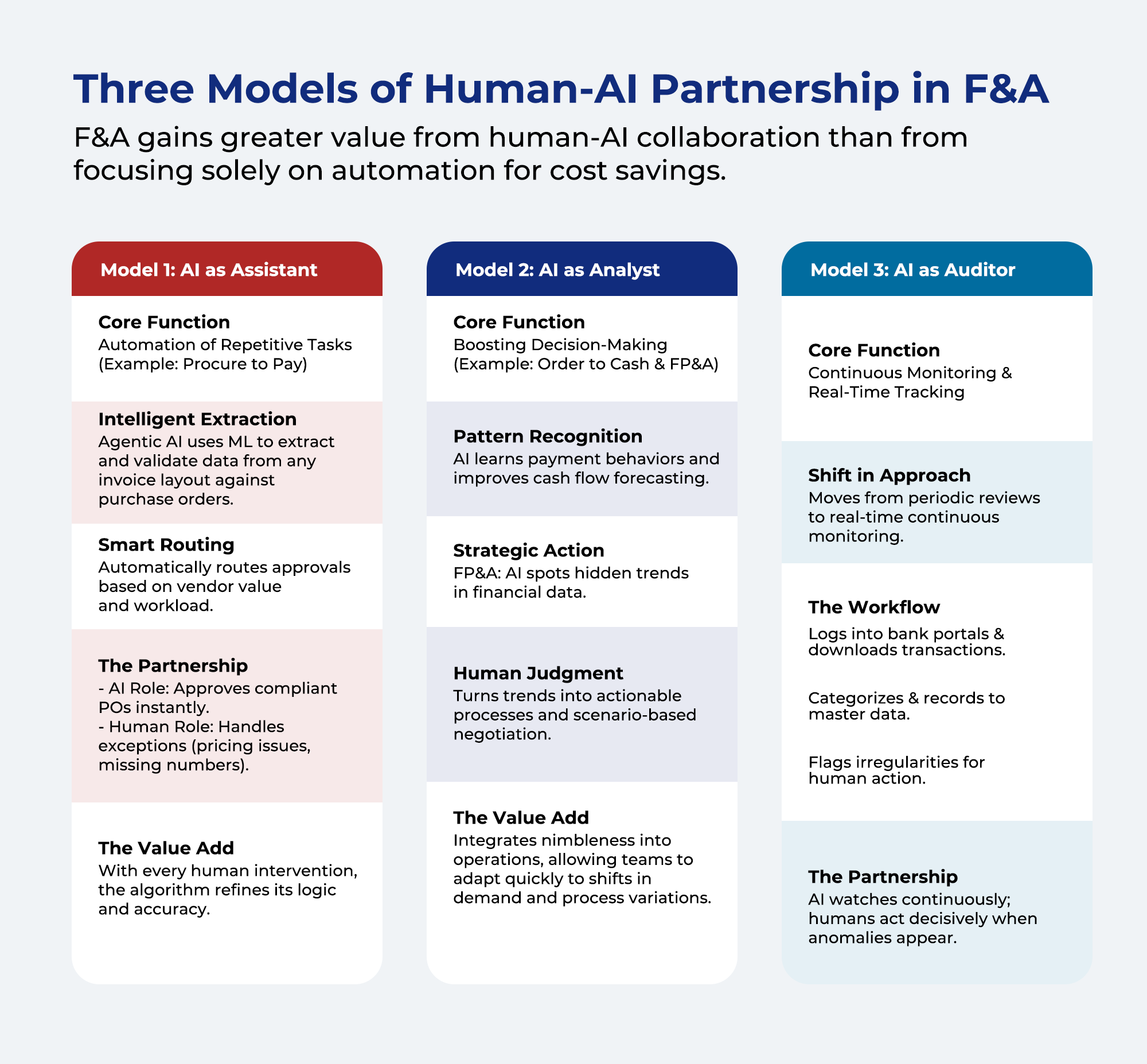
F&A gains greater value from human-AI collaboration than from focusing solely on automation for cost savings. Below are three models of collaboration that define what an AI-human partnership looks like in practice.
AI as Assistant
AI as an assistant automates repetitive tasks. For instance, in Procure-to-Pay (P2P), agentic AI can use Intelligent Document Processing (IDP) and machine learning to extract data from any invoice layout and validate it against a purchase order. It then routes and approves invoices based on vendor value thresholds and the approver’s workload.
The agentic system continues to approve compliant POs and flags exceptions for human intervention. These could be related to pricing issues, missing PO numbers, or incorrect quantities. With every human engagement, the algorithm will refine its accuracy and logic.
AI as Analyst
In this model, humans use technology to boost decision-making. In Order-to-Cash (O2C) management, AI learns patterns in payment behavior, improves cash flow forecasting, and recommends targeted collection tools, while finance teams deliver scenario-based negotiation expertise.
In FP&A, AI spots trends in financial data that human judgment turns into actionable processes. This collaborative approach will integrate nimbleness into O2C operations, enabling finance teams to become more agile, allowing them to adapt to shifts in demand and process variations.
AI as Auditor
AI as an auditor enables continuous monitoring rather than periodic reviews. AI tracks transactions in real time, flags irregularities for human review, and replaces manual reconciliation, journal entries, and data consolidation. A North American healthcare company used AI, RPA, and Power BI to process over 100,000 financial transactions annually across multiple banks and credit card statements.
The intelligent bot logs into banks, downloads new transactions, categorizes them, and records them in master data records. The solution saved the company the equivalent of one full-time employee annually, improved accuracy to nearly 95 percent, and saved $5,000-10,000 per year by reducing rework and penalties.
The Re-imagined F&A Team
AI helps F&A move from transaction processing to insight-driven decision-making. There will be two simultaneous paths for organizations. They can reskill existing employees to work with AI and create hybrid roles that did not exist five years ago.
The reskilling path enables current employees to develop AI capabilities while staying integrated with their workflows. The hybrid roles combine expertise in the AI finance domain with technical skills.
- The Finance Strategist: This role has moved past the traditional FP&A role to become one of a business partner within the organization. They make use of AI-driven insights to model complex scenarios, identify new business growth opportunities, and make recommendations for long-term value creation.
- The Data Translator: This position assesses executive inquiries and transforms them into analytical problem statements for data scientists. After completion, the translator converts technical findings into business recommendations, bridging the gap between the finance team’s questions and the data scientists’ ability to build a model.
- The Governance Guardian: As firms rely more on AI to make financial decisions, this role becomes important to ensure AI is being used responsibly, models are not at risk, and regulation frameworks are adhered to.
In addition to understanding how their new AI methods work, F&A teams will benefit from strategic thinking, business acumen, and effective communication. As routine work gets automated, F&A professionals can leverage these strengths to interpret data, contextualize it, and influence decision-making.
Making the Shift with Training and Change Management
Technology adoption delivers results only when the human element is prioritized. The EY 2025 Work Reimagined Survey shows that organizations integrating talent and technology achieve up to 40% productivity gains, yet just 12% of employees receive sufficient AI training to unlock this value.
Cultural resistance is a key challenge in change management. Finance professionals may be concerned that AI will displace them, instead of augmenting their roles. Employee confidence in AI will grow as they see AI freeing up their time from manual tasks to strategic work. Companies with AI skeptics need to offer early adopter programs so employees can gain experience before the organization fully adopts a tool.
The change management process will require transparency about which jobs will change and what skills will be needed. Building quick wins will generate momentum. Starting with high-value, low-complexity projects can help demonstrate sustainable outcomes within a few weeks.
Recognize teams that succeed in integrating AI into their workflows and share their success across the organization. Organizations that build nimbleness into change management by adjusting training based on team feedback and scaling successful pilots quickly will drive faster adoption and realize value sooner.
The Path Forward: CIO-CFO Partnership
To leverage AI-human collaboration in F&A, the CIO and CFO must partner closely. KPMG research shows that 93% of stakeholders agree that the implementation of AI has improved collaboration between CIOs and CFOs, but their priorities and roles remain distinct.
The CIO is responsible for building the technical foundation that enables seamless collaboration between humans and AI. This includes implementing platforms that explain AI decisions and providing self-service tools that allow accountants to interact with AI without needing technical expertise. The CIO also ensures continuous feedback loops, where human corrections improve AI quality, and embeds AI literacy into onboarding and training by creating safe environments for teams to experiment.
The CFO translates human-AI collaboration into business results. Rather than measuring only hours saved, the CFO focuses on how reallocated time enables better decision-making. Are analysts uncovering new opportunities? Are strategists able to model more scenarios because data preparation is automated? The CFO invests in team development, supporting innovation in AI expertise and allocating time for learning, even during peak periods.
Together, the two executives will co-own at least three dimensions of metrics:
- Quality of adoption: Do teams validate the output of AI, intervene when AI is mistaken, and contribute back to an enhanced model through feedback?
- Time reallocation: Does automating routine tasks allow professionals to focus on more strategic, value-generating work? The Stanford-MIT research shows a 9 percent time savings from data entry to advisory services for clients.
- Effectiveness of collaboration: When humans work alongside AI, do they improve model accuracy for forecasting and decision-making, and strengthen judgment and relationship management?
When CFOs and CIOs align on time and quality metrics, they position finance to harness AI’s analytical power and highlight the human factors that drive effective collaboration and maximize value from financial resources.
At Cogneesol, we help Finance leaders move beyond transactional outsourcing to F&A functions where human expertise and AI work hand in hand. Our ADIS Framework supports this AI and human collaboration by automating repetitive tasks with human oversight for exceptions, generating data-driven insights for strategic advisory, and enabling scalable workflows without complete system overhauls.
The post Building F&A Teams that Amplify Human-AI Collaboration appeared first on Cogneesol Blog.