
Finance leaders deal with two timelines at the same time. A business-focused timeline that runs on daily signals: shifts in pricing and demand, disruptions in supply, and cash movements that do not wait for the calendar. And then there is the month-end timeline, which is the most reliable financial view of performance. This was an acceptable practice when the market moved slowly. However, today, it holds back decision-making and results in missed opportunities.
Real-time record-to-report (R2R) reframes financial reporting as an always-ready capability. Instead of waiting to close the books at month-end, this modern accounting practice maintains a steady close throughout, providing business leaders with actionable financial data at any time, while decisions are still being made.
This article looks at what it takes to move from a month-end sprint to a continuous close, and how real-time access to financial data helps executives protect margins, respond faster to disruption, and manage cash with more confidence.
Why the Traditional Close Has Been Falling Behind
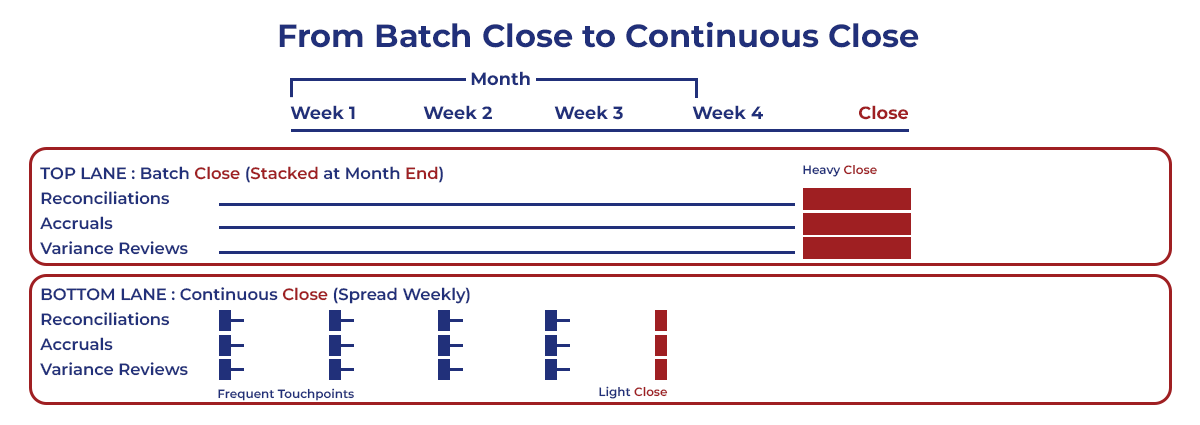
Most record-to-report models still operate like a batch factory. While transactions are recorded throughout the month, critical activities such as reconciliations, accrual validations, intercompany reconciliations, and variance analyses are crowded into the final days.
Recent benchmarks show that finance teams still close the books at very different speeds. Across surveys, the month-end close for many organizations continues to span about five to ten business days.
This batch way of working creates three persistent challenges:
- Delayed decision-making, as issues like margin erosion, cost spikes, or revenue leakage become apparent only after a few weeks
- Compressed control windows, which means rushed reviews, more rework, and last-minute manual fixes
- Workforce strain, with the closing week demanding sustained effort and leaving little room for analysis or business partnering
Continuous close addresses these challenges by shifting work forward and distributing effort evenly throughout the close cycle.
How Continuous Close Redesigns Record-to-Report
Continuous close does not lower rigor but rather changes the timing of close activities that are executed in rolling cadences, so the ledger remains close-ready on most days.
Four operational shifts define real-time record-to-report services:
- Rolling Reconciliations
High-volume accounts such as cash, AP/AR subledgers, payroll, fixed assets, and intercompany are reconciled on a daily or weekly basis. Exceptions are investigated immediately, while the context is still fresh. - Event-based Adjustments
Accruals and reclassifications follow business events instead of being deferred until period cut-offs. This approach reduces both the size and frequency of late-stage journal entries. - Early Variance Insight
Significant deviations from the plan are reviewed mid-month. Leaders can step in with rapid corrective actions proactively and not identify underlying causes only after the period closes. - Embedded Governance
Documentation and approvals are integrated into routine operations, making month-end activities a confirmation step rather than a remedial exercise.
Technology accelerates these shifts. Artificial Intelligence (AI) and Generative AI (Gen AI) strengthen the model without replacing human judgment. For instance, machine learning manages high-volume reconciliations and outlier detection, while Gen AI supports first-pass variance analysis for experts to refine. A MIT–Stanford study found accountants using Gen AI cut the monthly close by 7.5 days while improving report quality and freeing accountants for higher-value work.
Continuous Close in Practice
The value of continuous close becomes clearer in day-to-day situations. Here are two scenarios that demonstrate immediate business outcomes.
Scenario 1: Protecting Margins in Time
A distributor notices freight costs creeping up in week two after a carrier rate change. In a batch close world, reconciliations happen only after month-end, so margin quietly erodes for weeks. With continuous close, rolling reconciliations keep freight accounts updated throughout the month. Finance spots the drift mid-period through early variance insight, sizes the impact, and works with operations to reset routes or surcharges before the damage hardens.
Scenario 2: Avoiding a Liquidity Surprise
A consumer brand runs early-month promotions, sales look strong, but longer payment terms and rich rebates drag collections. In a delayed R2R cycle, treasury feels the cash squeeze only after close and scrambles with short-term borrowing or slowed vendor payments. With continuous close, event-based adjustments ensure receivables aging and rebate accruals update as transactions occur. Treasury sees pressure building early and staggers outflows with intent.
What is Driving Real-time Record-to-Report Adoption
Continuous close has been discussed for over a decade. So why does it matter more now? The business environment changed.
Shorter Operating Cycles
Pricing, procurement, and capacity decisions are now refreshed on rolling horizons rather than in neat monthly cycles. Financial insight must keep pace if it is to support these calls with in-period actionable information.
Rising Working Capital Pressure
A recent European working-capital survey from The Hackett Group estimates that more than €1.3 trillion remains trapped in inefficient inventories, receivables, and payables. Improving cash performance requires fast, in-period visibility into the drivers of DSO, DPO, and inventory turns, not only a strong cash-flow statement at month-end.
Wider Performance Gaps
Organizations that run reconciliations and variance reviews throughout the month free more days for analysis and dialogue. Late closers spend most of the month catching up, widening the distance between finance that informs decisions and finance that explains them.
Building a Continuous Close Roadmap
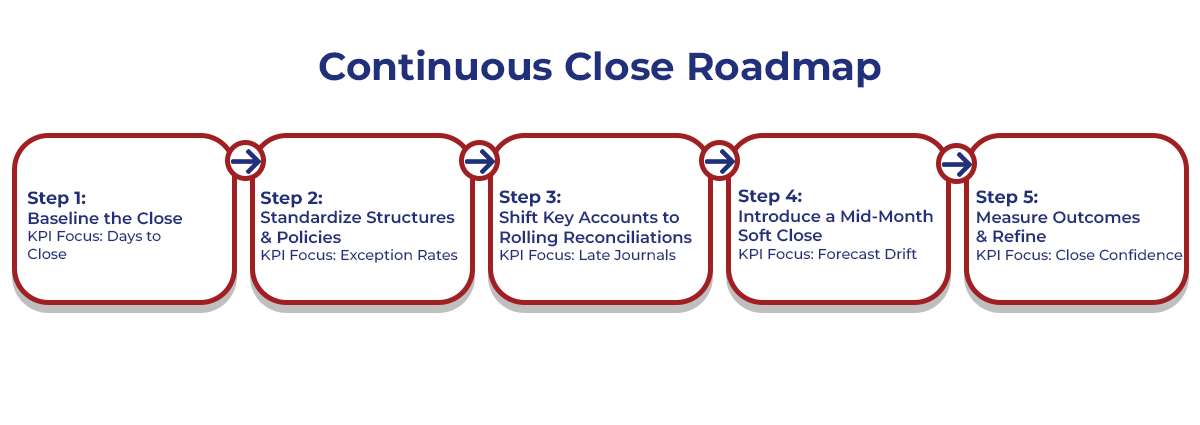
A successful transformation is less about changing systems and more about redesigning the record-to-report operating model. A pragmatic sequence typically includes five steps:
- Establish a Baseline
Mapping the entire close activity to isolate bottlenecks such as intercompany mismatches, high-volume reconciliations, and late journals. - Standardize the Backbone
Creating consistent charts of accounts, journal templates, materiality thresholds, and reconciliation rules across entities to reduce variation. - Shift Key Accounts to Rolling Cadence
Moving priority accounts, such as cash, AR/AP, fixed assets, and intercompany, to daily or weekly reconciliation cycles to spread the workload and improve accuracy. - Add a Mid-month Soft Close
Conducting a controlled mini-close in week two or three to surface data issues upstream early, allowing for correction in time. - Track Meaningful Outcomes
Reviewing close quality, predictability, and recurring problem areas to strengthen the model over time.
Together, this sequence implements the four operational shifts: standardization and rolling cadences enable rolling reconciliations and event-based adjustments, the soft close delivers early variance insight, and outcome tracking sustains embedded governance.
Where Record-to-Report Outsourcing Strengthens the Model
Many companies accelerate steps 2 through 4 of the continuous close roadmap by outsourcing record-to-report functions or utilizing hybrid shared services models. The benefits go beyond efficiency. Expert service providers offer standardized closing schedules across different regions, extensive reconciliation skills, and strict procedures that help avoid last-minute month-end rushes. When service quality is linked to readiness for closing and accuracy during the period, outsourcing becomes a partnership effort that enhances agility as business priorities change.
Cogneesol’s record-to-report solutions are built to support a continuous close, not just a faster month-end. The firm manages end-to-end R2R activities such as general ledger and intercompany accounting, reconciliations, journal posting, fixed asset and fund accounting, and financial reporting, while weaving AI and automation into the flow. Data is captured and classified with minimal manual effort, integrated into a single, reliable view, analyzed in near real time, and continuously monitored for compliance. Finance teams gain accurate, timely numbers and the space to focus on planning, scenarios, and conversations with the business. For example,
From Month-end Close to Always-on Financial Insight
Executives make better decisions when the numbers they rely on are current, consistent, and credible. Real-time record-to-report (R2R) processes and continuous closing keep the ledger prepared throughout the month, lessen the pressure at the end of the period, and provide leaders with up-to-date insights on margins and cash flow while decisions are still being made.
Cogneesol supports enterprises in this transition through end-to-end record-to-report services, operating-model redesign, and record-to-report outsourcing options that sustain continuous readiness at scale. The result is a finance function that is accurate by design and capable of swift, well-governed action throughout the period.
The post The Real-time Record-to-Report Transformation for Continuous Close appeared first on Cogneesol Blog.