
Economic uncertainty and sustained periods of expensive capital are prompting CFOs to look inwards for liquidity rather than pursuing external financing or topline expansion. According to the Hackett Group’s 2025 Working Capital Survey, excess Accounts Receivable (AR) alone accounts for nearly $600 billion in tied-up working capital.
What’s more, the gap between top performers and laggards is a big one: APQC benchmarks show top-performing organizations collect in ~30 days, while bottom-quartile peers take 45+ days to convert receivables into cash. In other words, the Order-to-Cash (O2C) process at 3 in 4 organizations is bloated with inefficiencies.
This drag in working capital is within the CFO’s span of control, as it arises from gaps in how orders, invoices, collections, and payments are executed and synchronized – gaps that can be closed with intelligent automation.
Persistent Cash Drag in Mid-Market O2C Cycles
In mid-market organizations, increased Days Sales Outstanding (DSO) is typically the result of small execution gaps that compound across the O2C process. Inconsistent execution of core processes such as invoice issuance and collections activities, and uneven application of controls progressively inflate DSO, even though individual delays appear manageable.
For instance, weekly credit reviews can delay a routine invoice by a day or two, after which customers’ Accounts Payable (AP) systems may place the invoice on hold because a required customer-specific reference was not validated upfront. Collectors might deprioritize it as it remains technically “current,” and after payment, remittance ambiguity can leave the cash unapplied, adding 10+ days to cash realization.
These delays persist because O2C execution lacks standardization and scale. Orders, credit checks, invoicing, and collections often span email, spreadsheets, customer portals, and bank feeds, causing exceptions. As a result, credit holds, pricing mismatches, missing PO data, tax errors, or fulfillment discrepancies surface only after downstream steps are complete.
These gaps — the result of fragmented workflows, delayed signals, and manual execution — cannot be resolved without first restoring execution discipline.
Cutting DSO, Improving Liquidity: From Automation to Intelligent Automation
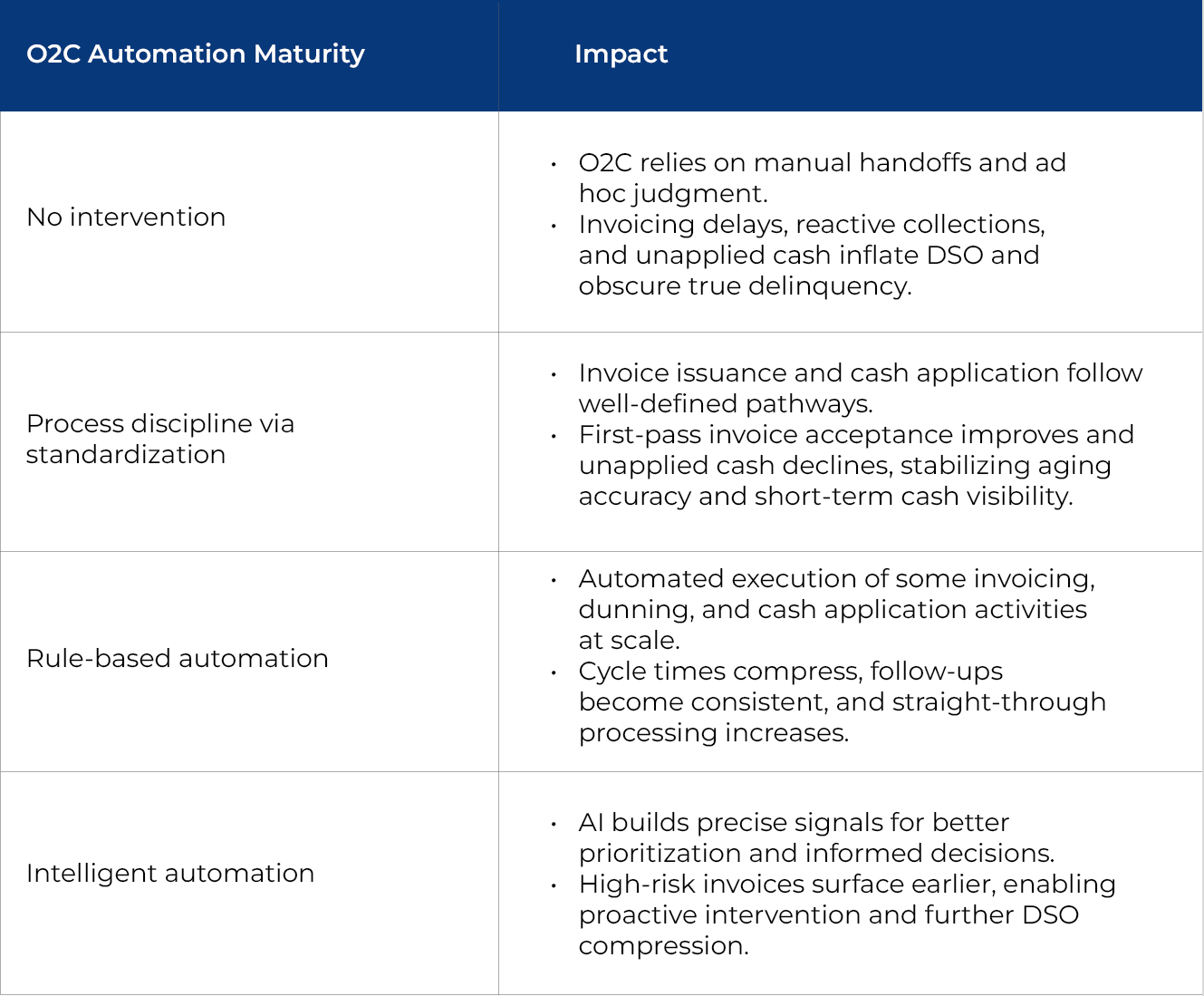
To mitigate cash drag, CFOs of mid-market companies need to look beyond task-level interventions and reimagine the O2C process through a progressive modernization journey. It begins with enforcing discipline and setting up guardrails at the process level, followed by rule-based and workflow-driven automation.
Process discipline, for instance, requires standardization of order validation rules, credit hold criteria, and remittance formats. This ensures O2C processes are executed along consistent and predictable pathways. Once processes are standardized, the F&A function can apply rule-based automation to order release, invoice validation and submission, dunning schedules, and cash application. It sets the stage for straight-through processing for routine transactions.
As transaction volumes grow, data quality improves and execution becomes consistent. That provides a foundation for intelligent automation, which enables better prioritization and decision support. Intelligent automation augments rule-based workflows by analyzing patterns across orders, invoices, collections, and payments. This helps reprioritize work queues, surface emerging risks such as dispute propensity or payment slippage, and recommend targeted actions.
In practice, enforcing process discipline and deploying rule-based automation alone can deliver substantial early gains – cutting DSO by 8–14 days, and improving on-time collections by over 15%. These outcomes illustrate why mid-market organizations should approach O2C modernization as a staged journey.
Stage 1: Build process discipline for consistent execution
Reducing DSO in mid-market organizations begins with addressing execution gaps resulting from non-standard processes at two key points in the O2C process: invoice issuance and cash application.
Customers’ AP systems often hold invoices because billing teams release them without validating customer master data, purchase order references, or pricing alignment with contract terms. The ensuing rework can be avoided by redesigning billing workflows so invoices are issued only when all billing prerequisites are met and verified upfront, ensuring they are ready for first-pass acceptance in customer AP systems.
On the back end, similar gaps arise in cash application, where payments remain unapplied due to inconsistent remittance formats and undefined application priorities. Cash application governance introduces clear standards for acceptable remittance information, defined application hierarchies, and consistent handling of partial payments and deductions.
Such interventions, which are enabled by Cogneesol’s ADIS framework, reduce invoice cycle time by 15–20%, lower downstream disputes, and create a stable execution baseline for adopting rule-based automation.
Stage 2: Scale execution with rule-based automation
Once process discipline is established, execution can be scaled with workflow-driven automation, which applies rules consistently across high-volume O2C activities to reduce manual effort and cycle time. For example, invoices that meet predefined readiness criteria can be quickly released by automating handoffs across multiple enterprise systems. Only invoices with exceptions such as pricing deviations or credit holds are routed through approval workflows, thus reducing the workload on small F&A teams in mid-market companies.
In collections, rule-based segmentation can help group accounts by attributes such as aging, balance thresholds, dispute status, or payment terms. This informs structured dunning schedules, which are guided by standardized collector worklists that contain invoice-level tasks (prioritized by aging and balance thresholds), and embedded account context (such as dispute flags and promised-to-pay dates).
Similarly, in cash application, predefined matching and exception rules enable faster posting of straightforward payments while tagging partial payments and deductions for review.
The adoption of rule-based automation significantly improves collector productivity, shortens billing cycles, and improves on-time collections, while building execution capabilities that support intelligent automation.
Stage 3: Better prioritization and decision support with intelligent automation
The O2C process is ready for intelligent automation when rule-based workflows operate reliably at scale. The key rationale for adopting intelligent automation is to improve prioritization, offer decision support at the point of action, and enhance responsiveness. For this, AI and Machine Learning (ML) analyze patterns across orders, invoices, collections, and payments to surface emerging risks and guide decisions.
For example, collectors can be directed toward invoices showing early signs of payment slippage or dispute likelihood (identified by deviations in payment behavior, disputes, partials, or broken promises), rather than relying solely on aging. Similarly, cash application teams gain visibility into recurring deduction patterns or remittance behaviors that warrant proactive resolution. Such insights allow finance teams to intervene earlier, allocate effort more effectively, and prevent small delays from compounding into delinquency. This further reduces effective DSO, improves cash predictability, and enables CFOs to sustain performance as volumes and complexity increase.
Intelligent automation also powers dashboards that dynamically separate collectible versus disputed AR, and generate reliable short-term cash forecasts. These insights come from an analysis of historical payment behavior, dispute patterns, and cash application trends, and refresh continuously as systems ingest and evaluate new payment and exception data. The CFO now has an accurate, forward-looking view of liquidity. They can manage short-term liquidity by timing payables, reallocating working capital, and focusing collections based on expected cash inflows.
Next Steps: The Right Way to Orchestrate Your O2C Transformation
For mid-market CFOs, the path to lower DSO is clear: take incremental steps to ensure that the foundations for adopting advanced applications are in place. While pilot use cases can deliver localized gains, organizations can expect sustainable value only when improvements hold across transaction volumes, customers, and exception scenarios.
CFOs should therefore anchor O2C modernization in the right sequence: first, enforcing process discipline, then by scaling execution through rule-based automation. At this stage, intelligent automation can offer significant benefits in the form of improved prioritization and decision support.
Cogneesol’s ADIS framework is designed to support this O2C automation maturity journey. It can help finance teams standardize execution, scale automation reliably, and apply intelligence where it delivers the greatest cash impact. Learn how ADIS can help modernize your order-to-cash operations and unlock trapped working capital at scale.
The post The O2C Acceleration Blueprint: How Mid-Market CFOs Can Cut DSO and Strengthen Cash Flow appeared first on Cogneesol Blog.