

At a Glance:
As proposed, the DNA would bring major changes to the EU’s digital infrastructure and telecom framework. In particular, the EC inter alia proposes to introduce the following:
A copper network switch off by 31 December 2035 (earlier in regions where 95% fibre coverage would be achieved, and affordable retail connectivity would be available).
The Single Passport Authorisation: a single EU Member State notification procedure could be used for providing services throughout the EU. Member States would not be allowed to set additional requirements.
EU satellite authorisation: a single EU autorisation for satellite services.
European Table of Allocation of Satellite Frequencies: an announced future framework to provide transparency to satellite operators as to which spectrum to access for specific satellite services.
Radio spectrum rights of unlimited duration and a “use it or share it” general approach to the radio spectrum (with exclusive rights only applied “where necessary and justified”).
The transformation of the Body of European Regulators for Electronic Communications (“BEREC”) Office into an Office for Digital Networks (“ODN”) supporting both BEREC and a new Radio Spectrum Policy Board.
The establishment of an EU numbering plan.
A voluntary conciliation procedure facility for dialogue on technical and commercial arrangements. The facility would be led by national authorities in cooperation with BEREC, which would provide opinions on individual cases.
A shift away from mandatory network fees that had previously been explored.
Strengthened network resilience, preparedness and mandatory testing obligations.
After an extensive period of consultation and preparation, several reports and studies, a slight delay of publication, a leaked draft and much debate, the European Commission has finally adopted its proposal for the EU Digital Networks Act (“DNA”),[1] a landmark regulation set to overhaul the EU’s electronic communications framework.
If adopted, the DNA will replace the European Electronic Communications Code Directive (“EECC”)[2] and consolidate other existing telecoms instruments (namely, the e-Privacy Directive, BEREC Regulation, Radio Spectrum Policy Programme and parts of the Open Internet Regulation) into a single, directly applicable regulation across the EEA.
Is the DNA a revolution or an evolution of the EECC and these related instruments? Some of its changes are significant, while others may not go far enough. Certainly, it is too early to say, because the proposal initiates what is expected to be a lengthy and debated decision-making process: the DNA must now go through the EU’s ordinary legislative procedure before its final adoption, which will see the European Commission, the European Parliament and the EU Council negotiate amendments in trilogue negotiations.
This blog post unpacks the DNA proposal and comments on its key changes based on our extensive experience in communications law which has seen our Firm at the centre of the regulatory changes that have shaped this sector for the last four decades.
Convergence and level playing field
The DNA formally recognises the convergence of traditional telecoms with other digital (cloud, AI and space-based) infrastructures, bringing the latter fully into scope of EU connectivity regulation, but arguably only with regard to some of the DNA provisions.
On the one hand, the DNA does introduce new and extensive requirements for “digital infrastructure” providers, which unambiguously include cloud, AI and space-based providers, with regard to:
- Resilience,
- Security, and
- Interoperability.
This will create significant additional work for digital infrastructure providers to be coordinated and reconciled with their efforts to comply with other EU and national instruments, such as the Network and Information Systems 2 (“NIS2”) Directive[3] and other EU cloud-related legislation, amongst other things.
On the other hand, the DNA appears to have rejected calls (mainly from traditional telecom operators) to extend the entire scope of the EECC to cloud providers, based on technology convergence arguments. Indeed, the DNA does not fundamentally change the EECC definitions of regulated providers who are subject to the DNA’s general authorisation and access regulation regime, which should thus continue to be inapplicable to cloud providers. However, there continues to be residual ambiguity interpreting the existing EECC definitions, particularly where cloud networks are used to transmit electronic communications and the lines are blurring. Therefore, this is one area where additional amendments could provide further clarity.
Transition to Fibre
The DNA is intended to accelerate the migration from copper to full fibre. This marks a move away from a technology neutral approach – the concept of “very high-capacity networks” is now replaced by “gigabit networks” – based on the argument that Fibre-to-the-Premises (“FTTP”) is the most future-proof and energy-efficient technology.
The EECC provisions related to legacy copper migration had limited practical relevance primarily since they were not designed to accelerate migration and did not provide regulators with the tools to do so. The Commission’s 2025 Digital Decade Policy Programme report showed that the gigabit connectivity target measured by FTTP was in 2024 at 69% and it was expected that by 2030 around 90% of premises will be reached by fibre. However, predictions for the full FTTP coverage at the EU level showed that the 100% coverage would be only achieved by 2051 if no further action was taken.
In response, the DNA contains a combination of measures geared at fostering fibre deployment and take-up, including:
- EU-wide copper switch off date by 2030, subject to certain conditions and safeguards
- The conditions to be applied cumulatively are: (a) fibre coverage at 95% and (b) availability of broadband retail offers with comparable prices and quality to copper based offers.
- In addition, Member States should put in place appropriate safeguards for vulnerable consumers prior to the start of the copper switch off.
- Commission’s scrutiny over the copper switch-off process, to ensure consistency.
- More tools for ex ante access regulation, allowing for a targeted use, depending on the market situation, of significant market power (“SMP”) or new symmetric regulation for transition to fibre.
The copper switch‑off requirement is intended to create a structural incentive for fibre rollout by setting a clear regulatory end‑date for copper, by tying shutdowns to fibre availability, and by ensuring harmonized EU‑wide rules that improve investment certainty. However, early commentary shows that access seekers and access givers are ready to battle to win additional amendments to these provisions in defence of their respective positions.
Satellite and spectrum
One of the most ambitious changes – and likely to become the most controversial topic during the trilogue between European Commission, European Parliament and the EU Council – relates to satellite communications and spectrum management.
On satellite communications, the authorisation of satellite spectrum usage and the enforcement of the authorisation conditions are currently implemented by each national administration. In a context of exponential growth of the number of satellite constellations, the Commission’s Impact Assessment that accompanied the DNA proposal argues that the lack of a European approach in satellite spectrum authorisation poses risks to the capacity of Europe to tap into the potential of satellite networks for the provision of ubiquitous and seamless pan-European networks. Moreover, it jeopardises the access of EU operators to key resources and fails to guarantee that all players respect at least international obligations related to avoidance of harmful interference.
In response, the DNA advances EU “strategic autonomy” by introducing EU‑level satellite connectivity authorisations, replacing national‑level procedures, and additional coordination measures to avoid harmful interference. An EU satellite authorisation regime would allow operators guaranteed access to spectrum in all Member States under the same authorisation conditions, providing them with the means to scale up and provide pan-European services, while keeping in check sovereignty aspects. There is a notable precedent here: the EU harmonised framework for mobile satellite services (“MSS”) in the S band, which is also coming up for review in 2027. However, the MSS framework was far from perfect, and its implementation has been fraught with legal proceedings. The EU legislators should therefore be mindful of not repeating the pitfalls and missteps occurred in the implementation of the EU MSS framework.[4]
On spectrum management more generally, the Commission’s analysis showed that spectrum regulation and market factors slowed down investment in high quality mobile connectivity, especially 5G. In response, the DNA introduces unlimited licence duration by default, under certain conditions and safeguards, and with exceptional limited duration of 40 years (double from the existing 20 years’ cap) combined with quasi automatic renewal, and the application of pro-investment auction design. It provides for the possibility to harmonise spectrum authorisation conditions and includes a mandatory spectrum scrutiny of authorisation procedures at EU level. It ensures increased transparency and predictability of the timing of availability of spectrum through roadmaps and ensures that 6G spectrum will be authorised in a shorter period of time from harmonisation and in a more consistent manner.
Moreover, the DNA introduces “use‑it‑or‑share‑it” safeguards to prevent hoarding and encourage a functional secondary spectrum trading market. The difficulty here is navigating the limitations of the general EU principle of subsidiarity and distribution of competences between the EU and the Member States with regard to national scarce resources like spectrum, which can be very valuable.
Numbering resources
Numbering is another scarce national resource that is currently subject to divergent national management rules, just like spectrum. This is out of sync with the emergence of new and innovative pan-European use cases for numbering resources.
In response, the DNA proposes establishing an EU‑wide numbering plan, moving beyond the current system in which numbering resources are managed exclusively at national level.
This pan‑European framework is intended to support cross‑border services and streamline the use of numbers across the single market.
At the same time, the DNA proposal also recognizes the increasing prevalence of fraud in voice and messaging services and introduces harmonized measures to reduce threats such as:
- CLI (caller line identification) spoofing.
- Smishing.
- Vishing.
- Other forms of number‑based fraud.
In this respect, the DNA empowers the Commission to adopt further measures in the future to strengthen protections against fraud in a harmonized manner. However, this may not come soon enough, as Member States are currently adopting, or have already adopted, their own measures to prevent fraudulent use of numbers, thus creating a patchwork of complex regulations across the EU that risks having a chilling effect on innovation. This too could be an area where additional amendments could help achieve greater harmonization.
Single Passport for market access and reporting requirements
We have long advocated for our clients in favour of a single passport authorisation regime, as well as a reduction and simplification of the EECC reporting requirements, as a way to remove the artificial regulatory barriers that threatened a single EU market for electronic communications.[5] It is therefore pleasing to see that all our key arguments have been taken onboard by the DNA:
- One Notification for EU‑Wide Operation: Under the DNA, providers of electronic communications networks or services would only need to submit a single notification to one national regulatory authority, which then grants the right to operate in all EU Member States listed in the notification.
- Eliminates 30 EEA Separate National Procedures: The single passport regime replaces the current fragmented regime under the EECC, where companies must deal with 30 different national notification systems across the EEA and a patchwork of divergent regulatory conditions.
- Harmonised Notification Template and Regular Reporting: BEREC will issue a harmonised EU‑wide notification and regular reporting templates, and Member States are explicitly prohibited from imposing additional or separate notification and regular reporting requirements.
- Central EU Oversight via the Office for Digital Networks (“ODN”): Notifications will be managed in a central EU database maintained by the new ODN, replacing the BEREC Office.
In terms of scope, the single passport regime remains broadly the same as under the EECC, whereby number‑independent interpersonal communication services do not require any prior notification or registration. However, even with the single passport proposal, there remain certain areas that risk opening the back door for further fragmentation, including for example:
- Admin charges.
- National reporting rather through a central database.
- Moreover, providers must continue complying with certain national enforcement mechanisms and conditions, including cybersecurity obligations.
Here the role of the ODN could be strengthened from mere coordination to more active implementation. However, this too is likely to be controversial with the Member States and their national competent authorities which are unlikely to give up their powers easily.
Moreover, even if the single passport regime survives the trilogue, it is unlikely to come into force for another couple of years. In the meantime, our one-stop shop EECC compliance solution provides a de facto single passport tool to mitigate the business risks and costs arising from the fragmentation of the current EECC authorisation and regular reporting regimes, as well as covering the Article 3(4) NIS2 registrations for publicly available electronic communications services in all the Member States where a registration is required.[6]
Minimum contract terms
The EECC transposition has failed to recognize that business customers have greater bargaining power than consumers and that business-to-business (“B2B”) relationships are often bespoke and heavily negotiated rather than based on standard contracts. The unfortunate result of this failure is that many national regulatory authorities apply the same standard of compliance to B2B and consumer contracts alike, which is not only disproportionate but also plainly impractical.
The EU Digital Networks Act proposal introduces measures aimed at reducing administrative burdens and simplifying contractual relationships for B2B interactions in the connectivity sector, again in perfect unison with the advocacy and evidence that we have provided in response to the DNA Call for Evidence. This simplification will hopefully eventually remove unnecessary procedural requirements and make it easier for connectivity providers to structure commercial agreements. In practice, under the DNA if adopted, contracts between connectivity providers and business users will be structured with greater flexibility, as fewer prescriptive administrative conditions apply. Providers will be able to adapt contractual terms more rapidly to technological developments, new service models, or cross‑border operations. The streamlined framework is intended to reduce transaction costs and negotiation friction for business users purchasing network services.
Having said that, there remains additional important tweaks that may usefully be made to the DNA relevant provisions during the trilogue, to ensure that the right balance is struck between those obligations applying to contracts with “end users” – encompassing also business customers – and those applying to contracts with “consumers”; and to further remove unnecessary and anachronistic minimum contract provisions applicable to digital app based interactions with consumers and number-independent interpersonal communications services.
Net neutrality and voluntary conciliation facility
The DNA maintains core EU net neutrality principles but requires BEREC and the Commission to work together on new guidelines for its application. This change could help replace the existing BEREC net neutrality guidance, which is arguably too strict with regard to certain use cases (such as Wi-Fi on transportation systems) if it is compared with the more pragmatic approach adopted in the UK Ofcom’s revised net neutrality guidance.
But the main highlight of the DNA is that it formally abandons previously explored mandatory contribution regimes (“network fees”) for large platforms. Instead, it introduces a voluntary conciliation mechanism to resolve disputes over IP‑level interconnection and traffic management. Industry reactions indicate dissatisfaction on both sides – telecom operators see it as insufficient, while tech firms express concern it could re‑emerge as a de‑facto fee pathway. In reality, there could be merit in having this sort of dispute resolved through the intervention of specialized regulatory bodies rather than national courts which sometimes may struggle with the technical nature of these disputes – for example, with regard to the distinction between transit (for a fee) and peering (essentially free). This topic will no doubt be the subject of heavy lobbying on all sides during the trilogue.
Competition law
The intersection between EU sector-specific rules and competition law in the communications sector is not new, with EU case law clearly stating that the two rules are complementary with each other. This is true under the EECC, and it holds even truer under the DNA.
First, the DNA reinforces a long-established mantra of EU law that it is necessary to reduce ex ante sector-specific rules in the future as competition in the markets develops and, ultimately, to ensure that electronic communications are governed only by competition law. That was the aim since the first regulatory framework for the electronic communications network and services was adopted in 2009. However, the current framework has resulted in national fragmentation and has not achieved the completion of the single market, and therefore more consistency in ante regulatory obligations is needed. Considering that the markets for electronic communications have shown strong competitive dynamics in recent years, it is essential that ex ante regulatory obligations are imposed only where there is a market failure on the markets concerned, without prejudice to competition law.[7]
Second, the DNA encourages the sharing of spectrum and of passive infrastructure, as well as cooperation among market players in the broader connectivity ecosystem (including through the voluntary conciliation facility), only subject to competition law.
Third, the SMP regime (market definition, dominance and remedies) as well as the assessment of competition for the design of spectrum allocations continue to be firmly anchored to well-established principles of competition law.
Therefore, competition law provides an essential key to be able to understand the DNA and will guide its implementation once adopted.
Resilience
Finally, the DNA proposal enhances network resilience and emergency communications. For example, for emergency and public warning services (including 112):
- Existing EECC obligations are retained and clarified.
- Operators will face strengthened network resilience, preparedness, and mandatory testing obligations before significant network changes.
- Clearer guarantees for transnational emergency communications and the ability for PSAPs to call back end‑users.
This reflects rising concerns about large‑scale disruptions across the EU and geopolitical tensions. The DNA also emphasizes the need to address ICT supply chain risks, particularly for 5G, subsea cables, and “critical network segments”.
Next steps
The following chart provides an indicative timeline for the negotiation and adoption of the DNA.
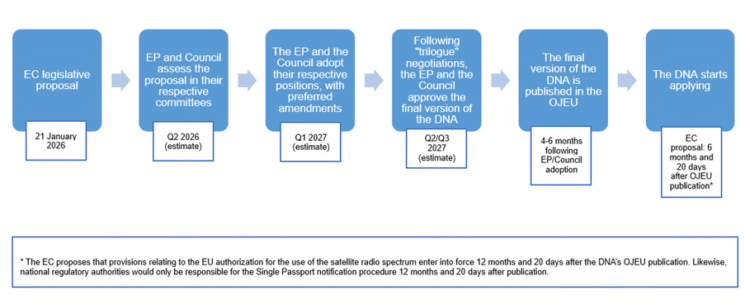
Over the course of this legislative journey, stakeholders will have an opportunity to advocate before the European Commission, the European Parliament and the EU Council, either directly or through the Member States’ delegations, hopefully to improve the DNA’s final text. But once the DNA eventually enters into force, that will not mean the end of the road. Indeed, the proposal foresees circa 40 implementation measures that will have to be adopted as part of the implementation of the DNA. Whether the DNA marks the start of a revolution or an evolution, the journey has just started and whatever change will be introduced will shape the future of the digital infrastructure sector in Europe for the next decades to come.
[1] Available at: Proposal for a Regulation for the Digital Networks Act (DNA) | Shaping Europe’s digital future
[2] Available at: EUR-Lex – 02018L1972-20241018 – EN – EUR-Lex. Our EECC handbook is available at: EU Electronic Communications Code Handbook: : Francesco Liberatore: Bloomsbury Professional – Bloomsbury Professional; and our tracker on the EECC transposition is available at: European Electronic Communications Code – Transposition Status | Communications | Regulation, Risk & Compliance | Our expertise | Squire Patton Boggs.
[3] Available here: EUR-Lex – 02022L2555-20221227 – EN – European Union.
[4] More information on the MSS framework evaluation is available at: Commission requests input from stakeholders on the use of spectrum bands for mobile satellite systems | Shaping Europe’s digital future
[5] See our submission in response to the DNA Call for Evidence, available at: Feedback from: Squire Patton Boggs on behalf of Twilio, Vonage and Zoom.
[6] More information is available at: document
[7] For example, the DNA continues to regulate the rates for the termination of voice calls across the EU as if this was an inherent monopoly. Yet, the DNA does not extend the same logic to SMS termination, contrary to Ofcom’s recent investigation into A2P SMS Termination Rates that was ultimately resolved through voluntary commitments by the mobile network operators. Perhaps, this might be a potential area of reflection for the trilogue stage.