
I’ve written previously about conceptual shortcomings in relying on generative artificial intelligence to mark changes in the other side’s draft, commonly known as “redlining” (see this blog post and this blog post). Now, let’s look at a more basic problem: erratic drafting choices. This post is about one example of that. Recently the contract-lifecycle-management vendor
5 Trends to Watch: 2024 Venture Capital

The Golden Turkeys: 2.0
Hello, folks. I’m back. From now on, you can follow my musings on that which annoys, amuses and confounds me here in CrunchedEverything. I look forward to continuing to engage with my readership. Please don’t be shy about telling me that I am ill-informed analytically weak, or just plain silly.
In any event, I’m starting
Best Antitrust Practices for Exchanging Competitive Information via Third Parties
Authors: Steve Cernak & Molly Donovan
There is no guaranteed safety zone for exchanging competitively sensitive information amongst competitors. Practices once deemed relatively safe—like subscribing to a third-party data services provider to manage the exchange—now carry increased risks. This is mostly because machine learning and AI have made it possible to predict a specific competitor’s
Top IP Developments of 2023
2023 was a big year for U.S. intellectual property law. Major developments occurred in every area. Here are the highlights.
Copyright
Fair Use
Andy Warhol Foundation for the Visual Arts, Inc. v. Goldsmith et al.
I’ve written about this case before here and here. The Supreme Court issued a ruling in the case in
Ten Things: Best Blogs (and Other Media) for In-House Lawyers (2023 Edition)
Hello everyone and season’s greetings from the penthouse of the “Ten Things” world headquarters in Dallas, Texas![1] I will start this post by wishing everyone a fantastic holiday season and all the best for 2024. As most of you know, 2024 is year 10 of the “Ten Things” blog and it is also
AI Regulation: The Next Frontier
As the federal government continues to wrestle with the complex issue of regulating Artificial Intelligence (AI) in the wake of the release of President Biden’s Executive Order, states have already proposed or enacted AI regulation, and even more will attempt to tackle the issue in 2024. Two recent developments in AI regulation from California
Press Release: Atlanta Wins USPTO Southeast Regional Office: A Leap in Innovation and Growth
Press Release: Atlanta Wins USPTO Southeast Regional Office: A Leap in Innovation and Growth by Jaime Chandra
Press Release: Atlanta Wins USPTO Southeast Regional Office: A Leap in Innovation and Growth
NEWS PROVIDED BYFounders Legal®December 14, 2023, 08:10 GMTVIEW OUR BLOG POST
Atlanta Celebrates: USPTO’s New Southeast Regional Office LocationUSPTO’s selection of Atlanta for
The Federal Trade Commission Weighs In on AI and Copyright
The Federal Trade Commission (FTC) recently submitted comments to the US Copyright Office as part of the Office’s notice of inquiry examining copyright issues related to artificial intelligence.
The agency’s comments largely focused on two areas: potential threats to competition from AI, and copyright.
Competition: The FTC cautioned that “the rapid development and deployment of
Generative-AI as Unfair Trade Practice
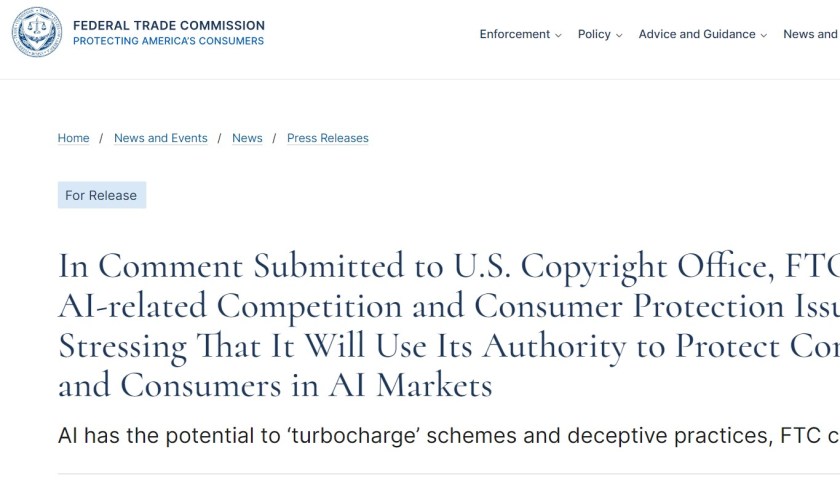
While Congress and the courts are grappling with the copyright issues that AI has generated, the federal government’s primary consumer watchdog has made a rare entry into the the realm of copyright law. The Federal Trade Commission (FTC) has filed a Comment with the U.S. Copyright Office suggesting that generative-AI could