From Nov. 3 through Nov. 5, the Windy City welcomed the ANA Masters of Advertising Law Conference. While the conference focused on all things advertising and marketing, one concept seemed to dominate nearly every single panel – AI. Nearly every presentation had some mention of the ways those two letters have changed the game over
Intellectual Property
Dr. Thaler is Right, in Part
When Dr. Stephen Thaler asked the U.S. Supreme Court to reconsider the human authorship requirement for copyright protection last month, many observers dismissed the effort. Thaler’s claim—that his generative AI system should be recognized as the author of its own outputs—has been consistently rejected by courts and the Copyright Office. On its face, Dr. Thaler’s petition…
UK High Court Issues Landmark Ruling in Getty Images v. Stability AI, with Narrow Trademark Infringement Win for Getty; Claim of Secondary Copyright Infringement Fails
On November 4, 2025, the UK High Court handed down judgment in Getty Images v. Stability AI,[1] a case emphasized for its significance to content creators and the AI industry and “the balance to be struck between the two warring factions”.[2] Despite significant public interest in the lawsuit, the issues that remained before…
Update: Desjardins Decision Made Precedential
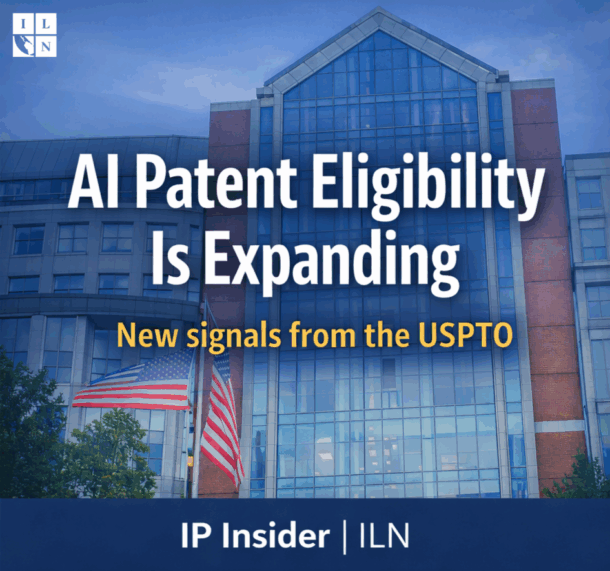
When we first covered Ex parte Desjardins, we noted that the decision, which was issued just days after Director John Squires took office, could mark the beginning of a new era for AI and software patent eligibility at the USPTO. That prediction now appears well-founded. On November 4, 2025, Director Squires designated the Desjardins…
Memory and Compute in Everyday Practice
For years, I kept too much in my head: deadlines, facts, half-finished ideas. It slowed my thinking. Recently I started treating project management as a drive and AI as a processor. The split is simple and it is starting to work.
The drive is where the work lives when I am not doing it. For…
USPTO Introduces AI-Assisted Prior Art Search: Key Details for Applicants
The United States Patent and Trademark Office (USPTO) introduced the Automated Search Pilot Program, designed to give applicants early access to AI-generated prior art searches before substantive examination. Using an internal AI tool, the program identifies and ranks relevant prior art from U.S. and foreign patent databases, helping applicants anticipate potential issues and improve claim…
USPTO Director Intends to Embrace AI on Many Levels

According to recent coverage, new U.S. Patent and Trademark Office (“USPTO”) Director John A. Squires has signaled a new approach that leaves room for more AI-based inventions while also exploring AI as a tool for attempting to improve examination and chip away at the Office’s backlog.
His remarks align with the August 4, 2025 §101…
AI Counterfeiting Risks for Online Sellers on TikTok Shop
TikTok Shop has become the fastest-growing channel for online product discovery. It drives visibility and sales through short-form content, influencer amplification, and algorithmic targeting. But the same mechanics that accelerate growth also expose sellers to AI counterfeiting and gray market products. Fraudulent operators track viral listings, replicate them with slight variations, and intercept traffic before…
Privacy Tip #465 – Privacy Risks Associated with AI
The use of AI tools is revolutionizing our society. The efficiency it presents is like nothing we have ever experienced. That said, there are risks worth considering.
“AI poses risks including job loss, deepfakes, biased algorithms, privacy violations, weapons automation and social manipulation. Some experts and leaders are calling for stronger regulation and ethical…
Italy Adopts the First National AI Law in Europe Complementing the EU AI Act
On 10 October 2025, Law No. 132/2025 (the “Italian AI Law”) entered into force, making Italy the first EU Member State to introduce a dedicated and comprehensive national framework for artificial intelligence (“AI”). The law references the AI Act (Regulation (EU) 2024/1689) and grants the government broad powers to implement its principles and establish detailed operational rules.…