
On December 18, 2025, President Trump signed the 2026 National Defense Authorization Act (“NDAA”), a sweeping defense spending bill that brings a number of changes to the U.S. outbound investment security program, U.S. economic sanctions, and biotechnology restrictions relating to federal procurement. First, the NDAA includes the Comprehensive Outbound Investment National Security (“COINS”) Act, which provides
President Trump Announces Section 232 Tariffs on Semiconductors and their Derivative Products

On January 14, 2025, President Trump signed a proclamation entitled “Adjusting Imports of Semiconductors, Semiconductor Manufacturing Equipment, and Their Derivative Products into the United States.” The proclamation imposes a 25% tariff under Section 232 on certain advanced computing chips that meet the technical specifications detailed in Annex I of the proclamation. The measure
United States and Taiwan Sign Agreement on Trade & Investment
On January 15, 2026, the United States and Taiwan agreed to a trade deal to establish “a strategic economic partnership … to decisively strengthen U.S. domestic semiconductor supply chains and secure America’s technological and industrial leadership.” While the text and full terms of the trade deal were not released, the Department of Commerce released a fact
Covington’s Guide to Ballot Measures
More than one billion dollars were spent in 2024 elections supporting or opposing state and local ballot measures. With high-profile and contentious issues expected to be on the ballot, such as congressional redistricting, AI regulation, minimum wage increases, and more, that number promises to be even larger in 2026. As state legislatures become more polarized
House Passes Remote Access Security Act to Limit Adversaries’ Remote Access to Critical Technology
On January 12, 2026, the U.S. House of Representatives overwhelming passed (369-22) the Remote Access Security Act, modernizing U.S. export controls to address foreign adversaries’ remote access to controlled technologies through cloud computing services.
Currently, the U.S. Department of Commerce’s Bureau of Industry and Security (BIS) does not consider the provision of cloud computing
Germany: What to expect in 2026
In 2026, new legislation will be introduced into German employment law bringing significant changes for Human Resources Managers to be aware of.
New legislation coming into force
Social insurance calculation factors
The factors for calculating the levels in the social insurance system were updated on 1 January 2026. The updated rates and limits can be
A New Milestone in China’s Rule-Based Opening-Up and Trade-Related IP Governance-A Brief Analysis on 2025 Revision of China’s Foreign Trade Law
I. Introduction
On December 27, 2025, the Standing Committee of the National People’s Congress of the People’s Republic of China promulgated the newly revised Foreign Trade Law, which will take effect on March 1, 2026 (the “2025 FTL”). This legislative act marks a pivotal moment in China’s legal framework governing its economic interactions with the
AI Patent Outlook for 2026

After years of resistance from the United States Patent and Trademark Office (USPTO) toward AI patent applications, the patent outlook for AI-related inventions in 2026 appears to be promising thanks to recent changes at the USPTO under Director John A. Squires.
On Sept. 22, 2025, the USPTO swore in Squires as its 60th director. Since
International Trade & Supply Chain Law: Download Our 2025 Year in Review & 2026 Outlook
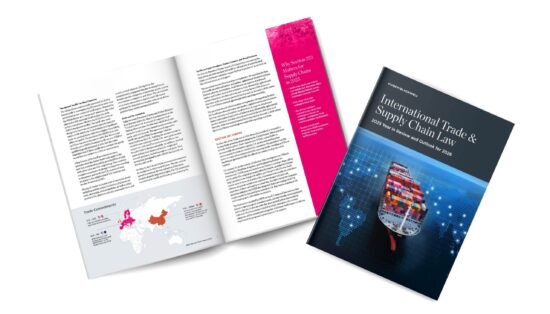
2025 marked a turning point for international trade, with sweeping tariffs, regulatory shifts, and supply chain upheaval reshaping the global business landscape.
Husch Blackwell’s 7th annual report unpacks the year’s most consequential developments and offers practical guidance for importers, exporters, manufacturers, and logistics providers navigating a rapidly changing environment.
The report provides actionable insights on:
- How
National Commission calls for evidence on the regulation of AI in healthcare
The following piece was also published here on 1 Crown Office Row’s Quarterly Medical Law Review.

AI is set to transform and disrupt the way in which healthcare is delivered. The Government’s 10-year health plan for England commits the NHS to becoming “the most AI-enabled healthcare system in the world”, supported by the delivery of