
Reading Time: 7 minutes
There are times when you know you need help and you take the step to ask for it. We were selling a house in Canada and moving to the United States. There are tax consequences and they were complicated because now we had 2 national tax regimes to deal with: capital gains, residency, the works. Although we were selling this year and might have to report in next year’s taxes, we had a filing deadline for a certificate within 10 days of the sale. It was a deadline that started to weigh on my mind. Like so many people with a legal need, I called some professionals to try to resolve it in time and was unable to find someone to help me.
It didn’t help that we had never used an accountant in our time there. An existing relationship would have been helpful. We didn’t know any accountants or have a referral network for one. To be frank. we were trying to complete a single form as we were leaving the country and I didn’t think we were very promising clients. It also was poor timing as we were going to be selling in the spring and that is tax season north of the border just as it is in the United States.
One firm told me that, that my timing was terrible. This was because they had misread my email describing a sale in the current year but not needing help with taxes for this year. Two more firms never responded. A third one took my information—I was phoning them, not using email, which will tell those of you who know me how desperate I was—and passed me to someone who then confirmed that they weren’t taking on any new clients.
Meanwhile, the time is ticking by and the sale is looming. This is where my stubbornness started to kick in. First of all, it’s just a form and I should be able to figure out what it says. Even without a higher education and a law degree, government forms should be designed for any citizen to complete, right? But reality was also kicking in: our lawyer had been clear that they didn’t do this form for us, that we’d need an accountant. In lieu of an accountant, I was on my own.
Legal Issues Without Courts
I’ve written about this in relation to leases I’ve helped my kids with but so much of the law is happening outside of courts. This is without even recognizing the very small number of cases that go to trial in either civil or criminal settings. When you’ve got plea agreements at nearly 90% and only 2% of criminal cases going to trial in the Federal courts and only 0.5% of civil cases filed in a Federal court reaching trial, it’s enough to wonder why so much of legal media and popular culture views the lawyer as a courtroom beast.
I am fortunate to be able to approach these problems on two levels. One is the basic “I need information to complete this obligation” and the other is “what skills can I deploy to accomplish this and what skills am I missing.” As someone who does not practice law or care much for tax codes, my first stop was to seek professional help. When that failed, I had to start where everyone does: the internet.
Canada Revenue has a pretty great website (although why are they promoting Adobe’s PDF reader?) and I think the Internal Revenue Service’s is also pretty good . I am not sure if it is because they recognize the universal access need they are trying to serve. Sure, the tax codes are written in ways that seem purposefully confusing but at least the websites are navigable. I have a 10-year old post about Citizenship and Immigration Canada forms that are unprintable via the web (and that Canadian lawyers still visit regularly to learn the hack) because they’re meant to be directed, step-by-step for the applicant. Its longevity is funny to me because CIC people have visited the page too!
As a law librarian, the thing that struck me most that, while the forms were easy to find for my problem, the explanations for how they worked were not. Once I had completed the demographics, I started to need specialized knowledge that an accountant or a tax lawyer would know immediately. I even remembered some of the terms from Federal Taxation, a class I did poorly in despite having a great prof.
I think this is common and law librarians do it ourselves: we start with a topic and soon we are adding in every potential use case or alternative. Libguides and other documents grow like kudzu, spreading to the perimeter and then across it in an attempt to be helpful. Or, in the case of government forms, to try to have “one stop shopping” with a form for everyone who needs it. Of the more than 40 checkboxes on my form indicating the documents I might need, only 3 applied. All of the property sales involving leases and business assets, trust and partnerships, none of them were applicable. There was a second entire page of tax treaty exemptions with another 40+ options. To a professional, the answers would have been obvious (if you haven’t read Duncan Watts “Everything is Obvious (When You Know the Answer)”, I highly recommend it).
I mean, I get it. A legislature has legislated and an agency has to implement. Sometimes you have to throw everything into the meat grinder to make the particular sausage. But it can feel overwhelming when you see so many choices you are not making, worried you may be missing something.
I plugged away. Again, with the perspective of a law school graduate, I could tell which were the form fields that were critical and which a misinterpretation might not hurt me. In this case, it was the ones involving money:
- adjusted cost base (and how to calculate it)
- capital gains exemptions (and how to calculate them)
If you were to search either of those on the open web, you would get a ton of definitions. Many of them use other tax-related terms, so you then have to search again to try to pull them all together. It would have been hugely helpful if the form had (a) explained something like adjusted cost base or (b) had hyperlinked to a glossary or schedule to explain things like capital gains exemption amounts.
We make fun of the conspiracy red-wool-connecting-images-on-a-pinboard but legal research around government forms often feels like that to me. You start with a single simple-looking document but, to fill out each box, you may need one or more levels of additional knowledge. When I think about the place artificial intelligence will take in the access to legal information, it is in this stitching together of definitional information. Information we may not think of as being legal information because, while it comes from legislation or administrative rules, it is also a term of art in another knowledge domain outside of the law.
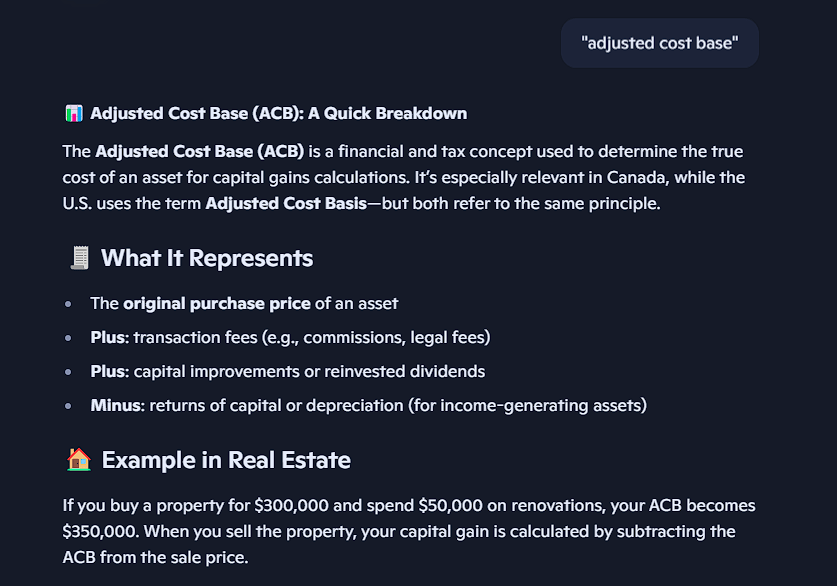
I made my best guesses and then I sat on the form for a day or two. Perhaps because I do a lot of project management in my day job, I had considered the time I would need to be finished and comply with the time requirements for filing. Given the lack of professional help, I had cut bait on that approach early enough that I didn’t feel too rushed.
Push Send
There was a holiday in Canada and the postal service was threatening a strike, so I moved up my deadline to mail the form. After worrying at it and revisiting what I felt the calculations should be, we each signed a copy and sent it off to Canada Revenue. Now we waited.
One of the benefits of being able to walk into a building to submit a document or complete a process is that you are often aware of whether you were successful or not. I went into the Illinois DMV with a set of documents and they rejected one. Fortunately I had a backup and was able to still move forward with that key tool of American society, the driver’s license, but I could just easily have had to come back later with the document I was missing.
When you mail in a form, you have no idea. You can guess when it will arrive, assuming you didn’t get that last step of the information gathering process wrong and misaddress it. When we first got to Canada, I sent a document to the wrong location, getting it back weeks later with an indication of where it should go.
We started to get a sense that something was happening. Our lawyer had said it could take six to nine months, so we were not really looking for anything except an immediate return for lack of a complete form or something. But then we found our access to Canada Revenue’s tax portal had been revoked. That was a bit of a worry but repeated attempts to speak to a person went unanswered—”we are currently experiencing a high call volume” seems to be the universal answer to not having enough people to answer the phones, because the call volume would go down with more people—so we just hung tight.
In this liminal space, it was not always clear why something was happening. We had left Canada so we were no longer residents. A change in our Canada Revenue access might reflect that. Or it could be something else, since our bank also has to recognize us as non-residents and so CRA’s use of bank credentials might no longer work the same way for authentication. Or perhaps, like U.S. States and Canadian provincial websites do, we were geo-blocked from some resources for trying to access from outside the jurisdiction. (I just heard of a Canadian blocked from accessing a North Carolina website. This is dumb and the people who are likely to be harmful are not being stopped by this approach; c’est un doddle).
Then two brown envelopes appeared in the mail. They contained a letter that explained what we should do next but not what the outcome was. I pored over the very simple form response to try to figure out. In the end, I convinced myself that, in fact, we had achieved the outcome we wanted. We had our Certificate of Compliance as a non-resident for a sale of a property in Canada. We could send it to our lawyer, who could forward it to the purchaser so they can inform Canada Revenue there is no tax due on the sale. We got it done in time so no financial penalty for us.
As great as this outcome is, it still feels like there should be a better way for all of these unshepherded legal issues. My perspective is obviously skewed because I am not entirely sure what expertise I have that other self-represented people have, but I expect it’s substantially more confidence around learning and applying legal or regulatory terms. I think it they could be improved with simpler, clearer one-issue forms. We have the ability to directed inquiries via forms-based tools and that question-and-answer approach makes more sense to me, spitting out a completed form at the end. “Adjusted cost base” may not be legalese but it’s only plain English to people who know the term of art. Once a form hits the system, since they are gathering email addresses and phone numbers, those methods of contact should be used to (a) provide updates or (b) allow someone to create an online profile or access a process timeline to help them understand what is going on.
I was fortunate to have a lawyer to ask about the timing, which lowered my expectations around responsiveness. And some agencies are good at this. US Customs and Immigration had all sorts of information on the processing of my green card application and when to expect the next step. Even our payables department tells us the recency of the invoices they’re working on (7 weeks ago). But there are two knowability areas: knowing what you have submitted is correct and knowing when what you have submitted will be processed. I think there is a lot of improvement to be made, particularly in the latter area.
There is now plenty of time to find a local accountant to help us navigate the U.S. taxes for next year. Capital gains but, because the U.S. requires you to file taxes even if you file taxes in another country, working through any foreign exemptions. I am not confident that I’m able to do this competently myself. That’s an issue for another day though and, with this success, I’m a bit more confident that I can figure out the next step if I have to.