
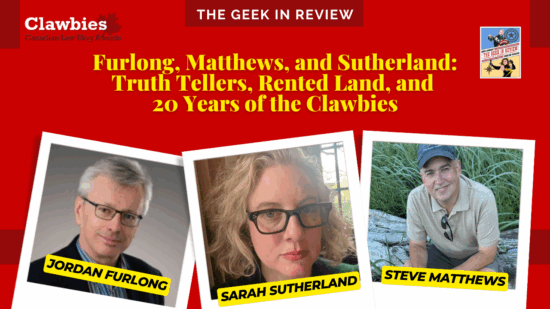
This week on The Geek in Review, we bring together a trio of Canadian legends from the legal web to celebrate the 20th anniversary of the Canadian Law Blog Awards, better known as the Clawbies. Steve Matthews of STEM Legal and Slaw.ca, Sarah Sutherland of Parallax Information Consulting and former president and CEO of CanLII, and legal market analyst and Substack author, Jordan Furlong join us to talk about how legal publishing has changed over two decades and where it heads next. Along the way, we share a little host pride, since 3 Geeks and a Law Blog picked up a Friend of the North Clawbies back in 2011. Canada remembers, even if the trophy cabinet looks a little full on our side of the border.
We start with Steve’s long-running mantra: do not build your professional home on rented land. For years he pushed lawyers toward blogs and owned domains, warning that social platforms could change rules overnight or simply fall apart. That warning came into sharp focus as Twitter morphed into X and law Twitter scattered toward BlueSky, Mastodon, Threads and other venues. Jordan talks about deleting years of tweets rather than leaving a personal archive tied to a platform he no longer trusts, then describes how his own publishing shifted from long-form blogging at Law21 to a Substack newsletter model that feels more like a curated living room of engaged readers than a noisy town square.
From there, Sarah introduces one of our favorite phrases in the episode, “law’s eternal September,” where a constant wave of new technology, including generative AI, keeps the justice system and the information world in permanent transition. We explore how legal publishers now balance automation and human judgment, with AI helping on classification, annotations, and summaries, while editors and authors still play a central role in verification and context. We share our own experience with AI-assisted prep for the show, and how a human guest had to correct outdated biographical details. That leads to a broader point about the need for trusted, non-AI sources that give researchers, lawyers, and readers a place to check facts and assumptions before sharing work with clients or the public.
Jordan, Steve, and Sarah then turn to the Clawbies themselves and the theme they have set for the upcoming awards year: “the year of the truth teller.” In an era of disinformation, sloppy AI content, and reputation-damaging LinkedIn posts, lawyers and legal professionals gain real value by standing out as accurate, consistent voices who care about community as much as client work. Steve explains how the Clawbies now cover blogs, newsletters, podcasts, Tik Toks, and other formats, while still focusing on authenticity and public legal education. We also learn about the “humble Canadian rule,” where nominators highlight one to three other voices, while the organizers quietly take a closer look at the nominator’s own work in the background. The mission stays the same: surface new voices, new formats, and generous contributors who strengthen public conversation.
We close with a look ahead. Steve predicts more structured, list-driven use of newer platforms like BlueSky for targeted conversations, while Sarah points to growing centralization as giants such as Thomson Reuters, LexisNexis, and Clio blend publishing and practice software. Jordan sees a fractured present, with silos and distrust, but also anticipates a future pull toward recombination, where readers gravitate to sources and bundles that feel trustworthy again. Through it all, the three guests encourage anyone interested in writing, podcasting, or other media to choose a format that fits personal strengths, commit to thoughtful output, and focus on truth-telling over pure marketing.
For listeners who want to follow along, Sarah is active on LinkedIn and BlueSky, Jordan anchors his work on Substack, and Steve runs both Slaw.ca and the Clawbies at clawbies.ca, where nominations open December 1 and winners appear on December 31.
Listen on mobile platforms: Apple Podcasts | Spotify | YouTube
[Special Thanks to Legal Technology Hub for their sponsoring this episode.]
Email: geekinreviewpodcast@gmail.com
Music: Jerry David DeCicca
Transcript:
Marlene Gebauer (00:00)
Hi, I’m Marlene Gebauer from the Geek in Review and I’m here with Nikki Shaver from Legal Technology Hub. And Nikki’s going to give us a recap of the amazing TLTF Summit. So Nikki, please tell us your thoughts.
Nikki Shaver (00:14)
Hi Marlene, hi everyone, so nice to be here. Well Marlene, you were there as well, so you could jump in and help me with this recap. For people who don’t go to TLTF, I really do think it’s one of those events that elicits FOMO because it brings together such an amazing group of people. And really what’s special about it is it cuts out all of the sales and marketing that you get in a lot of other conferences that do make those conferences worthwhile.
But for a different level of conversation, TLTF is quite special because almost every conversation you have with somebody is highly worthwhile from a collaboration perspective, a partnership perspective. People are just on the same mind, mind length. They are kind of thinking along the same lines. I think it allows people to open up and really ⁓ be vulnerable to conversations that they might not be otherwise.
This year it was held in Austin, Texas at a lovely golf resort. And one of the other things that was special is we had the entire resort booked out. So it was like being in a legal tech bubble for two whole days, which was pretty unique. Some of the things to come out of it, ⁓ other than the serendipitous conversations that happen all over the place, there are some really interesting conversations about ⁓ kind of new platforms of legal technology and
where that might take us in terms of the legal services of the future, ⁓ whether technology within legal is going to move beyond what it currently does into actually taking a share of the legal services market, which obviously from a regulatory perspective is challenging at the moment, but a really interesting conversation to have. Also a conversation I was involved in actually about interoperability and the importance for
startups, also for incumbents to ensure that they’re speaking to one another, that context and data is more important than other and being able to connect data across systems is really, really critical. ⁓ For me, I also was in the startup room and saw the growth stage for a number of the presentations and pitches that happened. Some really interesting startups emerging that showcase their
technologies and one I thought was interesting was also seeing Winston Weinberg on stage from Harvey talking about three things that are really important for legal tech now and into the future, one being control, ensuring security from an ethical walls perspective and a permissioning perspective for the technology that you use, second being context again, so that ability for technology systems
to really tap into the key data sources that the system requires in order to deliver the best possible output and three being collaboration, which is really a theme that we’ve heard a lot about lately. So a lot of really interesting discussions to emerge out of that, which I think will give rise to all kinds of ongoing content and debate in the industry. Just a reminder to everyone that on Legal Tech Hub, we do indeed also have
an events calendar if you go to our homepage, LegalTechnologyHub.com. There’s a drop down under events that will take you to our full events calendar, not just of our events, but all of the legal technology events across the world. So if you want to find your next event to attend, feel free to drop by Legal Tech Hub and find out what’s coming up. Thanks Marlene.
Marlene Gebauer (03:54)
Thank you, Nikki.
Marlene Gebauer (04:01)
Welcome to The Geek in Review, the podcast focused on innovative and creative ideas in the legal industry. I’m Marlene Gabauer.
Greg Lambert (04:08)
And I’m Greg Lambert. And Marlene, this week, I’m really excited because we’re going to be hosting a bit of a summit meeting for the Canadian legal publishing world here. We have the US and our potential 51st state, right?
Marlene Gebauer (04:18)
It’s an international episode.
Yeah.
Jordan Furlong (04:25)
No, ⁓
Steve Matthews (04:26)
boy.
Greg Lambert (04:27)
No, no, no.
Marlene Gebauer (04:31)
Ha ha ha.
Greg Lambert (04:31)
Well, we have ⁓ three guests on. One who’s been on before, but two I can’t believe we haven’t had on before. ⁓ And, you know, they don’t just observe the legal media landscape to actually really essentially help build the infrastructure that it runs on.
Marlene Gebauer (04:37)
Right?
Yeah. So we have Sarah Sutherland founder at.
Greg Lambert (04:52)
No, no,
no. Go up.
Just right here.
Marlene Gebauer (04:57)
you’re going to do it later. I’m sorry. Okay. Nevermind. now you lost me. Okay. That’s right. We’re joined by the team behind the Canadian law blog awards, better known as the CLAWBIES, which are headed into their 20th year. But beyond the awards, these three represent the architects of the modern legal web, the builder, the data steward, and the strategist.
Greg Lambert (05:00)
That’s right.
And I have to say, just for the record and a little bit of bragging, three geeks in a law blog, one, CLAWBIES, the friend of the North category, gosh, 14 years ago in 2011. ⁓
Marlene Gebauer (05:28)
Ha ha ha.
Steve Matthews (05:29)
very early
on.
Greg Lambert (05:30)
So
first we have Steve Matthews. Steve is the founder of STEM Legal and the publisher of SLAW.ca, which is effectively the New York Times of the Canadian Legal Web, and I’ve been following for decades. Steve has spent 20 years telling lawyers to own their content rather than renting the space on social media.
Marlene Gebauer (05:54)
next to Sarah Sutherland founder at parallax information consulting and the president, former president and CEO of CanLII and author of the book, legal data and information in practice.
Sarah brings the rigorous data perspective, helping us understand not just what lawyers are saying, but how legal information is actually structured and consumed in an era of AI.
Greg Lambert (06:15)
And last but not least, rounding out the trio is Jordan Furlong. ⁓ Jordan is a legal market analyst and forecaster who many of our listeners know from Law 21. Jordan has made a significant shift from the traditional blogging to Substack, leading a migration toward deeper subscription-based legal commentary. So Sarah, Steve, Jordan, glad to have all three of you here on The Geek in Review.
Marlene Gebauer (06:41)
Welcome.
Steve Matthews (06:41)
Thank
you very much for having us.
Sarah (06:42)
Thank
you.
Jordan Furlong (06:43)
Thank
you, it’s a pleasure to be here.
Greg Lambert (06:45)
All right, so Steve, I want to start off with you. For a number of years at STEM Legal, your mantra has been on that, you know, don’t build your home on rented land. And so you’ve warned lawyers that, you know, social media platforms could change, you know, the rules could, you know, they could change those rules or it could, the platform could disappear. They could switch from Twitter to X.
You know, all of these things. you know, you were saying we need to make sure that we have our own blogs. And so now that we’ve seen the likes of X causing the law Twitter community to essentially collapse and migrate to some other platforms, including Blue Sky, which is this decentralized platform. have to ask, do you feel some sense of vindication?
⁓ on warning everyone not to do this.
Steve Matthews (07:39)
I am totally
vindicated. Yeah, maybe I’m totally vindicated. don’t know. Actually, I kind of got mixed reactions. know, I still think lawyers should own the substantive publishing. And blue sky is probably a little more of that ephemeral conversational element of publishing. But yeah, the handle owning domain connection is obviously a positive direction for firms and for legal organs.
organizations in general just to own what they those conversations that they’re having because like I mean and I say it’s I kind of got mixed reaction because it’s kind of sad that we lost what Twitter what what law Twitter was I mean as a web as a legal web guy I’ve been pulling links and badges off of firm websites and legal organizations probably for a year and half now you know so you know you know from firms associations
Greg Lambert (08:29)
⁓
Steve Matthews (08:33)
legal organizations voltage. Nobody wants anything to do with it right now. So there’s definitely like this mass exodus. And one of two things is kind of happening in the fall out there. know, either, you know, these accounts are converting over to something like Blue Sky or they’re, ⁓ you know, maybe mastodon or threads. There’s a little bit of short form movement over there as well. But, you know, the other kind of more concerning point is that for firms who have invested and actually built an audience,
and connected there with people. Some of those firms are actually just removing the icons, shutting the accounts, and they’re done. So some of those conversations are finished. So, you know, is there value in or how valuable are those ephemeral conversations? I think in 100 years, they’re not at all. But right now, you know, we’ve all in this room here have a connection to legal knowledge management over the years and organizational history. We
kind of want to capture where we’ve been. So yeah, I think some of those firms have lost a little bit and the open web is kind of a big part of that.
Greg Lambert (09:34)
Yeah, Steve, just to follow up a little bit on that. You know, when it was still Twitter, but it was making its way to X, you could kind of feel that momentum of change that people were not happy with what the platform was becoming. And we used to say, well, if you could weed your garden so that, you know, you’re only dealing with the people that, you know, that you want to deal with.
Do you think that was an option or did it just become so poison that everyone just felt like it was better to make a clean break?
Steve Matthews (10:04)
Unless,
I mean, I think that we all honestly with ourselves, you know, we tried. There is a tab exclusively for people who you follow. So you can weed the garden as much as you want. But the default tab, of course, is what the algorithm wanted you to see. And the algorithm shifted. The algorithm shifted you to things that you had no, in some cases had no interest in seeing whatsoever ever. So.
Jordan Furlong (10:29)
Yeah.
Steve Matthews (10:31)
It became a hostile environment for lot of organizations. And they also, you don’t want to have your business presence connected with some of the stuff that’s on Twitter these days. like you’re just going to disconnect your business altogether. That’s just the prudent decision.
Greg Lambert (10:48)
Just just a quick around the horn Did anyone completely give it up or do you still have your Twitter handle? You’re just not using it Jordan
Jordan Furlong (10:58)
For myself, I hung on as long as I could. really did. My mantra to myself was, I was here before Elon and I’ll be here after he’s gone. That was my fervent hope. But I think after the 2020 election, sorry, 2024 election, when it became clear that Elon was going to play a part in the White House and that X was going to be part of whatever swath of destruction they were going to undertake there, it’s like, no, I just can’t. I don’t want…
Greg Lambert (11:05)
Thank
Marlene Gebauer (11:06)
Hahaha
⁓
Jordan Furlong (11:26)
Because I had a lot of data there. had years and years worth of tweets and conversations and so forth. And I just thought, no, I’m not giving you that. So I basically burned it. I deleted the whole thing, moved over to Blue Sky, dropped, I don’t know, like I had something like 16,000 followers. I’ve gotten maybe a couple of thousand now at Blue Sky, but
Steve Matthews (11:45)
Jordan,
you ported your presence off of Twitter and you got a service to bring it over to Blue Sky. That seemed like a smart move at the time. I did not. I got lazy and said, shift, I’m moving to the new platform. Here’s a link to the new platform. You are all I’m done.
Jordan Furlong (11:52)
Yeah!
Greg Lambert (11:58)
Let’s start all over. ⁓
Jordan Furlong (12:01)
Yeah,
well, know, and it’s funny, right, because I did port over all the old tweets and but, know, and the weirdest thing is every so often, like just this morning, I get a little notification, someone has liked your blue sky, the blue whatever they’re calling it there. And it was something I put it back in like 2013. Right. And the person doing it and I clicked through to their account and said, no, I don’t want you following me. ⁓ So ⁓ so it’s
Marlene Gebauer (12:24)
Yeah.
Steve Matthews (12:24)
hahahaha
Jordan Furlong (12:27)
It’s one of those, you know, you’re right, there was real attraction to it saying I don’t want to lose all of that. But you know what it’s kind of like? It’s like when you open up that box of photos you’ve been keeping for years and years in the basement and you look at it it’s like, not really. You know, I don’t really need it as much as I thought I did.
Greg Lambert (12:40)
Yeah, yeah.
Yeah, but I just keep mine to keep the Adam Lambert fans, the glamberts from from having it. I check in every once in while just to sign on so that I’m there and they don’t they don’t deactivate it. Sarah Sarah, do you still have yours? ⁓ Well.
Sarah (12:57)
I deleted it.
Marlene Gebauer (13:00)
I still have
mine, just for weather calamities. So it’s like if something happens, like that seems to still be the fastest place that people will talk.
Jordan Furlong (13:04)
Mm.
Greg Lambert (13:05)
you
Jordan Furlong (13:10)
That’s interesting, yeah.
Marlene Gebauer (13:12)
So, you know, Jordan, mean, you’ve just been talking about like you had been, you know, a central voice in this sort of online town square for a long time, but you’ve recently written about the migration of intellect from these public feeds to the inbox via sub stack. ⁓ why did you make that shift? You know, is the era of the blog or, you know, tweets or blues or whatever.
And as a public conversation is that over, you know, replaced more by, you know, the intimacy of a newsletter. We go in old school again.
Jordan Furlong (13:44)
You know, going to old school,
Greg Lambert (13:46)
Yeah.
Jordan Furlong (13:47)
everything old is new again. I kind
of think it might be. I think there’s probably three reasons why I shifted over. just by way of background. So I began blogging in January 2008. And I was not the first by any means. There was many folks there still that would have been around for ages. know, Greg, we were talking earlier, I was digging through some of the old archives in this area and I found
Dennis Kennedy’s first blog awards, well that was 2004. So even back then there was enough of a legal blogging ecosystem, you could have awards, right? Which was, you know, really cool. So, but, and so I began in 2008, took a hiatus around 2015, but I really blogged continuously till 2023. But what I found was I really tapered off near the end. And I thought I need to kind of revitalize this. I think
Greg Lambert (14:15)
Wow.
Jordan Furlong (14:40)
I moved to newsletters for three reasons. One was that I really wanted to get back to the, it sounds weird to say, but back to the pressure of expectations of, know, and so forth. I ran a legal magazine for 10 years and you learn to take deadlines seriously, right? People expect something from you at a certain time. You know, I said to my, the person who replaced me, I said, you know what? The word periodical includes periodic because they expect it on time.
Greg Lambert (14:50)
Yeah.
Jordan Furlong (15:07)
So, and I kind of wanted, I kind of lost that discipline a little bit and I sort of thought if I’ve got people who are expecting to hear from me on a regular basis, that will motivate me to be more consistent and that has proved to be the case. I think a second part of it and this kind of goes to your question around like the town square. think blogging really is like the town square in a lot of ways, but you’re also kind of just standing on a corner shouting.
you know, and try to get people’s, it’s open broadcast to anybody. And I was looking for something, I mean, you said more intimate, I think that’s correct. I was looking for the people who were actually interested in the same stuff I was. And I wanted to have a kind of a, I talked to law students a fair bit and I say, you know what, when you get out there into the profession, you got to find your people because they’re out there. The people who are right for you, the communities that are right for you are out there. You got to go find them.
And it’s kind of the same thing for me on the writing. There was stuff that I cared about and wanted to find people who also cared about that. so that was a factor. And a third one, more distant for me, it was a consideration at least, Substack in particular, where I wound up, also gave you the monetization option. If you wanted to, you could charge a subscription annually or monthly or quarterly, whatever you want to do it for your work.
And I didn’t think I would, and in the end I haven’t. What I do there is still free, basically because I’m interested in getting the ideas out there and it leads to work being hired to speak or whatever. But I think for a lot of people, that’s an attractive option as well. So to go back to the original question you asked five minutes ago, I fear maybe it is. I fear blogging may have been a moment in time.
And I think, Steve, you mentioned like the open web, right? That was a wonderful place and a wonderful time. But it’s like a lot of things over the last five, 10 years. I think we’ve kind of lost that. I suspect as a result, we’ve gone into these, you know, these instead of we’re not in the town square, we’re kind of in our living room with, you know, 200 of our closest friends and having conversations in there.
Greg Lambert (17:10)
Yeah, I always put my finger back on March 2012 when Google shut down Google reader as the the end of the open web where They decided you could no longer decide what it is. You wanted to read the algorithm was going to decide what you wanted to read so and and actually I want to I want to kind of pitch something that that Steve has said against What you’re doing now Jordan and that is
Steve Matthews (17:26)
Yeah.
Jordan Furlong (17:26)
Yeah,
exactly.
Greg Lambert (17:34)
Are you now building on rented land? Are you also subject to sub-stackets bought by a billionaire who decides to turn it into a political platform or are back to step one of finding something else again?
Jordan Furlong (17:42)
Mm-hmm.
I might very well be. mean, the advantage of having everything written down is that it’s easy to download and to hold on to. And the difference between…
Greg Lambert (17:57)
And you’ve had experience
at migrating it off from one platform to the other, so you could do it again.
Jordan Furlong (18:02)
Yeah, exactly. but,
Marlene Gebauer (18:03)
Hehehe.
Jordan Furlong (18:04)
but the difference as well as like Twitter and Steve, talk about the, you know, the, the ephemeral nature of it. Twitter really was just kind of like, Ooh, thought thought observation link, et cetera. But the stuff I’m doing on my newsletter, stuff I did to the blog, that was more, you know, short, medium, long form writing. And that’s something that, you know, it’s, it is easier. That has, I think a bit more longer term value that I can, I can pull down, but in the end it’s,
I don’t think there’s any right answer as to is it better to have your own site, know, yourname.com and you’re putting yourself up there or someplace on Substack. There’s pros and cons to it. Substack for me and the same is true of any other newsletter platform, I think. It handles all of the work for you, right? All you have to do is you write, you press a button and everything is taken care of. And boy, do I appreciate that at my age that I don’t have to go and learn something new.
Greg Lambert (18:49)
Yeah.
Marlene Gebauer (18:58)
I’m
wondering, is there also consideration that on Substack you’re somewhat out of the fray as opposed to a Twitter format where you feel like you have to keep responding, keep responding, keep responding.
Steve Matthews (19:08)
you
Jordan Furlong (19:12)
Yeah, I think for sure. Because you can have comments, obviously, on Substack posts. And I have some good conversations there. the thing of it is that we talk about that heyday of law Twitter. it was really good. It’s not to say that can’t come again at some point if there is something along those lines that surfaces. I just think we’re in such a fractious, fragmented time right now.
that it just makes it difficult. I everybody is kind of looking for shelter in a storm and I suspect that’s why we’re in this siloed period. Well, who knows if it’ll last longer, but that’s I think where we’re at right now.
Greg Lambert (19:42)
Yeah.
Steve Matthews (19:50)
I would say what Jordan’s doing on Substack is probably a lot closer to what we were doing early day blogging any event because that mid middle range discourse writing is certainly being captured. There’s a little more relationship connections between substackers I would guess and there would be what you would find on Twitter or even Blue Sky. So it is a little more conversational but a little more substantive and you have a little more choice in who you’re connecting with and.
and what you’re reading. you know, there’s certainly an argument there. I mean, if we’re talking about where blogging is going, really, what it is is self-publishing and controlling your self-publishing in no matter what platform you use. Even if you use a hosted blog or you decide to self-publish on a WordPress website and own all of the pieces, you’re still at the whim of somebody along the way.
Jordan Furlong (20:41)
Mm-hmm.
Steve Matthews (20:42)
So
Greg Lambert (20:42)
Yeah.
Steve Matthews (20:42)
the choice is, do you have the best you can control over the content that you’re publishing? Can you barter it? Can you do something with it, republish? Can you take it to a magazine in your industry and say, hey, I’ve got a great piece that I wrote, or you can submit original material and then republish back on your blog afterwards? Having a self-publishing presence, whether you call it a blog or not, really doesn’t matter.
Like at the end of the day, you just need to have a little bit control of who you are online.
Jordan Furlong (21:09)
Yeah.
Greg Lambert (21:13)
Yeah, it is nice though to push a button and then also to get paid. All right, well, Sarah, let’s let’s bring you back into the conversation here. And we are now almost 20 minutes into into the conversation. And we’re just now going to talk about AI. So.
Jordan Furlong (21:19)
It’s it’s perfect. Exactly. It’s 21st century dream job. Yeah. ⁓
Marlene Gebauer (21:19)
Push a button, get paid. Push a button, get paid. Yeah.
Steve Matthews (21:21)
It happened.
Greg Lambert (21:40)
waited this long. ⁓ So, you coined a phrase that I really liked, and that was laws eternal September, where you argued that a constant influx of new technologies, and the most recent being obviously generative AI, prevents the legal system from ever really settling into kind of the stable equilibrium.
Marlene Gebauer (21:40)
Well done.
Jordan Furlong (21:41)
Yeah.
Greg Lambert (22:03)
I think as a law librarian, I feel like we also do the same thing. We’re never in a stable equilibrium. So let me ask, in a world where generative AI can literally generate infinite, plausible sounding text, legal text, does the role of illegal publishers shift from creation to verification now? What’s our role now?
Sarah (22:31)
I think the publishers will continue to have both those roles and they have, you know, it’s not really a new thing though, the balance might shift. So publishers will definitely continue to work on content creation. This could be including automated content, which isn’t really new. You know, there’s certainly been things like automated classification or automated
⁓ development of annotated codes or statutes by pulling in snippets of citing documents. These things have been around for many years and they will continue to be so large language models have kind of further facilitated this and you know, we’re going to have things like more automated summaries. Like I would like to kind of carve out space for
Greg Lambert (23:17)
Yeah.
Sarah (23:20)
human writers and editors because I think that that’s the human beings bring essential judgment and elements. But, you know, in some cases, some products which used to be very labor intensive don’t have to be anymore. And maybe, you know, and maybe they’re a little bit lower stakes in terms of what they’re being used for. You know, there’s
there’s always been errors in classification, whether you have human beings doing that work, you have highly trained people, or if you have an automated system. Is it the end of the world if you don’t get every single case or if a case is miscategorized? And maybe in that case, having a conversation where you can just report issues to the publisher and they can use it to train their system better, maybe that’s enough.
But I think that the work of verification will also continue. But the work of human authors also needs to be verified. ⁓ Both these tasks are central.
Marlene Gebauer (24:14)
I think it’s critical.
Jordan Furlong (24:15)
But know, the business of doing offers also needs to be verified. It’s, it’s, uh, know, I think I
Greg Lambert (24:17)
Yeah, well, I can give you a good example
Jordan Furlong (24:21)
did
Greg Lambert (24:21)
here of what we’re working on right now, and that is, you know, I obviously lean on AI to help me prep for these interviews. luckily, I had an editor come in, that being Sarah, come in and point out, hey, I no longer work at this place. I now work over here. It’s like, oops.
Jordan Furlong (24:21)
example here before working on it now, and it’s, you know, I obviously, uh, we need to make that a whole new prep for these interviews. And, know, luckily I have a few, have a few comments about that being said. I mean, and it’s probably not good, you know, a lot of her work in this place. I can work over here. It’s not close.
Greg Lambert (24:43)
So yeah,
definitely, know, and so it’s not just hallucinations, it’s, you know, out of date information. It’s kind of the same things that we run into as humans, but at a speed that is just, you know, just amazing. So, you know.
Jordan Furlong (24:45)
Yeah.
Marlene Gebauer (24:57)
Well,
we have to have a non-AI source to check AI and it’s just critical that you have humans sort of doing that. mean, we’re asking people to double check their work that’s done there. So they have to have someplace that’s not that to go to.
Jordan Furlong (25:16)
Yeah.
Greg Lambert (25:16)
Yes, so I’ll just keep sending my scripts to Sarah and let her
Sarah (25:20)
My regular guest spot.
I think that the, know, what we’re talking about with blogging though, is that blogging was a big initiative that helped us all kind of escape some of that verification role that the publishers had that restricted access to certain people. And you could take responsibility for your own self.
Jordan Furlong (25:36)
So if you’re an activist and you’re a people and you can take responsibility for your own
self, I think the liability to write to someone who is the finalist.
Sarah (25:41)
Um, I think of my ability to, to write to Simon Fodden, who was the, founder of SLAW and the
original editor and asked to be a columnist in 2013. And that that has been a huge benefit to my career. You know, whether everybody wants to build their career by writing it is kind of a different matter. If you don’t like it, it’s a lot of work for some, like content creation is a lot of work for something. If you don’t.
kind of enjoy it. you know, I’ve been writing, I’m going to say a number of columns that approaches but does not reach six since 2013. And, you know, the dynamics of authority and approval, the publisher’s drive will continue to be important. But the balance is going to change.
Greg Lambert (26:20)
you
Yeah.
Jordan Furlong (26:29)
You
know, Sarah, I just want to say that’s a really great point about how, and I actually kind of forgotten this, when we all began blogging, it was actually so liberating because you didn’t need to be able to, I mean, again, like I said, I ran a legal magazine for about 10 years and we would constantly get submissions from lawyers saying, I want to write this, I want to write that, which of course they would, right? Because they want to get published. But there were so few vehicles and so few distribution points for information.
And then blogging came along and now we’ve got hundreds, we’ve got thousands of them. And you know, some of them are bad, obviously, but some of them turned out to be exceptional. it was a real, it was a lowering, if not a demolishing in a lot of ways of the barriers that the publishing industry generally had created. And I think on balance, and God knows we see enough evidence out there on the con side.
But on balance, think it was a huge pro. I think it was a great thing to have happen.
Marlene Gebauer (27:23)
so Jordan, mentioned in your email to us that you, Steve and Sarah characterized 2026 and the upcoming clobbies as the year of the truth teller. ⁓ what does that mean practically for a lawyer trying to build a, what do you mean by Somebody trying to build a brand. What does that mean?
Jordan Furlong (27:34)
yes, yeah.
Greg Lambert (27:38)
What do mean by that, Jordan?
Jordan Furlong (27:40)
Yeah, exactly. Well, so, yeah, well,
Greg Lambert (27:43)
Hahaha
Jordan Furlong (27:44)
yeah, so I wrote that around this time last year when we were all still kind of dealing with the ramifications of the election results in the United States. And it wasn’t the happiest time. And I had a lot of concern and I, know, some of that I think has turned out to be fairly justified.
that we were going to, among other things, experience a real wave of disinformation, misinformation, and not just for purely political purposes, but we could already see what that AI was not, as we’ve been talking about, is not as reliable as you would like it to be. And I really thought there’s a dual role here for lawyers in terms of
intentionally framing yourself as someone as a reliable, steadfast source of accuracy, of truth. We hear a lot about, and we’ve all come across this, clients especially, people talk about, I want to get more transparency into your billing. I want to get transparency into what you’re doing. And transparency is just another way of saying, I want you to be straight with me. Just tell me what’s going on. And I think that
There’s a very strong societal role for lawyers as truth tellers right now. mean, it’s not exclusive to us, of course. Anybody can do it. But I think it’s incumbent upon us. there’s an extra responsibility, obligation, opportunity that we have to be able to stand up to, as I’ve written elsewhere, to be citizen lawyers. And what does a citizen do? A citizen stands up for their community. And they stand up for what’s right.
And those are phrases that a lot of people in this profession like to roll their eyes at, that’s one of the reasons I got involved. think most of us got involved in the law. So I think that is important in and of itself. But in terms of promoting your practice or standing out, look, I mean, I think the days when we published for marketing, think that’s, it’s not that it’s not still accurate, but
It’s just so difficult as you know, Steve, can testify to this. It’s so difficult to get to project a signal through all the noise and the volume out there. what you your latest analysis of this case or of this bill. Okay, that’s great. But there’s 150 other ones out there at the same time and AI wrote 100 of them. So ⁓ if you want to really stand out,
Steve Matthews (30:09)
Hahaha
Jordan Furlong (30:13)
I think you stand out for the things that people are going to want to hire lawyers for, which is you are trustworthy, you are well informed, you are concerned for your community, you are interested in letting people, giving people the best information they can to make the best decisions they can, you are acting in your client’s best interest and the community’s best interests and so forth. you know, AI is going to do a lot of the legal work in future. It’s going to, you know,
answer legal questions and it’s going to create legal documents and instruments and so forth. There’s a lot of the task performance that lawyers have traditionally done is going to shift over to the machine. So what is left for us is going to be that the personal relationship based higher level. Again, I said I was talking to law students. I finished off one presentation the other day saying in the future, what you know as a lawyer and what you can do as a lawyer.
aren’t going to be as important as who you are as a person, as a citizen, as a lawyer. That’s where people are going to find the most value in you and that’s what’s going to generate the best, most satisfying, fulfilling relationships.
Steve Matthews (31:25)
I’d
say we also have to recognize that there’s an ebb and flow here and that we look at all what’s going on on internet circles of disinformation. lawyers have a role just like doctors. see a lot of people in the medical profession who are suddenly, with respect to vaccines, are coming out and saying, well, here’s what the studies actually say and I’m going to walk you through it point by point. All of a sudden, authority has some value.
Jordan Furlong (31:47)
Mm-hmm.
Steve Matthews (31:52)
And so when we talk about truth tellers and blogging, what we’re talking about is lawyers who are relying on their expertise, their knowledge in the domain, and showcasing that. And not only does that showcase well for them, for general input into societal conversations, but it also reflects back on their practice at the end of the day. So lawyers have a role in public conversation, as you just said.
It’s really critical. mean, that’s what we want to recognize when we’re out there hunting for new blogs or new content pieces. Who’s out there really connecting with audiences? Who’s out there doing public legal education from a blogging platform or for a podcast platform or what have you? Who’s out there really educating people and bringing authority back into the conversation?
Jordan Furlong (32:40)
Steve, I just want to jump on that because I could not agree more and it really links back to something Sarah was talking about in terms of, you know, the ability to multiply and maybe democratize the opportunity to provide accurate information because you’re absolutely right. That is an obligate, like for a doctor or a medical professional or anybody in healthcare, to be able to go out there and say these things is essential.
because you look at the website right now of the Center for Disease Control, which is basically saying, you can vaccinate your child against various diseases if you feel like it, no biggie, right? and it’s because like a few years ago, we were like, oh, disinformation, that’s some dude in a basement in Moscow, filtering stuff onto the internet. No, it’s the actual government doing this stuff. So I come back to…
It’s not just essential, it’s urgent. This is a role we’ve got to play as, you know, if we’re going to justify our positions as professionals in our society, we got to step up on this one in particular.
Greg Lambert (33:41)
Yeah, Sarah, Sarah, I’m curious when you talk to people that either you think would make good writers or are coming to you saying that, you know, they think that they’re good writers and need a need a platform. I mean, how how do you approach it now? Because, you know, in 2008, it was easy, you know, hey, go on bloggers, you know, get a free thing. you know, in 2017, it was, you know, go on anchor and get a free podcast.
Jordan Furlong (34:10)
Thank
Greg Lambert (34:11)
If this sounds
like very specific, that’s because that’s what I did. But in 2026, what advice do you give people that want to kind of enter the four right now?
Sarah (34:24)
I kind of advise to really think about whether it’s something you want to do because, know, like sometimes people just have a particular thing they want to say. in that case, you know, submit it to an online magazine, submit it to another publication, know, SLAW takes guest posts. You can do something like this and get out your singular thing. And I think that that’s a really great thing to do.
If people just want to do it as a way to develop influence without actually liking the process of writing, I kind of, I suggest that maybe they might like to try something else just because a lot of work before, well, it’s a lot of work before you get anywhere. And if you don’t enjoy it, it’s not necessarily the greatest return on your investment of time.
Greg Lambert (35:02)
Have you thought about buying a dog?
Marlene Gebauer (35:04)
Very politely.
Jordan Furlong (35:04)
Yeah.
Yeah. Yeah.
Sarah (35:19)
I, I personally, have a preference that if you’re not going to put in the full investment to really build an audience in, a really kind of dedicated way to, go with a different, like someone else’s platform, I find a blog, when I’ve had one in the past felt like a horrible, horrible hamster wheel that I couldn’t get off.
Jordan Furlong (35:40)
Thank
you.
Sarah (35:41)
And I am so relieved that I only have to come up with
up to six posts per year because I just don’t want to write that much. I don’t enjoy it. And so SLAW has been a great option for me.
Greg Lambert (35:47)
Yeah.
Wow.
Steve Matthews (35:53)
We are essentially all the lazy writers.
Greg Lambert (35:52)
Awesome.
Jordan Furlong (35:52)
Well, and Sarah,
But know, but sorry, I think you make a really good point too, because it’s also question of what’s going to make sense for the person themselves. So for some people, writing is a chore. It is, my God, I got to write something else. Whereas, you know, put them on a podcast, let them talk. They’re fine, right? Or do if it’s like, you know, I want to say something in person for 90 seconds. Well, there’s a thing here called TikTok and it’s perfect for you. So right. And Steve, that’s kind of why we made the decision a few years back to expand.
the clobbies to go past blogs and written work. Generally, we were like multimedia. Listen, we don’t really care. You want to do the, you know, the the the cliche of the interpretive dance to communicate your point. You go right ahead. If you’ve got an audience and you’re making an impact. Yeah, we’ll cover that. We’ll reward that. So it really is find the right match for you to tell your story. But you need to have a story to tell. If you don’t have a story to tell, it’s absolutely a hamster wheel for sure.
Greg Lambert (36:49)
Yeah, Steve, that leads perfectly. so the clobbies in 2026, what is it that you’re looking for? What’s kind of the spectrum of publications or output that qualifies now for a clobby?
Steve Matthews (37:00)
you
Right. I mean, what Jordan said is kind of a big part of it. We’re looking for quality voices and we really don’t care how you put it out there. Last year, I think we had a couple of TikToks on our awards. I think we’ve, but we’re looking and we went through Blue Sky and we started looking for people who doing something different. We found a lawyer who was doing deep dives into a particular type of case law and
Jordan Furlong (37:18)
Mm-hmm. Yeah.
Steve Matthews (37:31)
annotating the decisions as they came off a court of appeal. We’re looking for people who are just looking for a different voice and different take. And we see our job really as diggers of new people, new content. If you read the clobbies year over year, you would notice that we’re not picking the same people all the time. Rarely have we given an award twice. We try to dig.
Greg Lambert (37:53)
I know we only want it
once, never again.
Steve Matthews (37:56)
Well, we
Marlene Gebauer (37:56)
What’s
up with that?
Steve Matthews (38:00)
do have a little freedom with the award categories. We kind of realign them every year and we hand them out pretty freely. you know, private email in the background to Jordan and all of a sudden you got a Clawby Award. Yeah, exactly. ⁓ Yeah, no, no, I think we’re just kind of digging for those good voices and those people that we want to, you know.
Greg Lambert (38:03)
Thank
Jordan Furlong (38:12)
That’s right.
Greg Lambert (38:13)
You can’t have
Sarah (38:13)
Hahaha!
Greg Lambert (38:13)
that.
Marlene Gebauer (38:14)
Okay.
Wink, wink, got it.
Jordan Furlong (38:17)
Yeah.
Greg Lambert (38:17)
Thank
Steve Matthews (38:24)
If you’re doing something authentic, you know, we talked a lot about AI Jordan and Sarah and I had a great conversation about how the tool is almost recognizable. It kind of it dances when you’re in your head when you’re reading an AI based post and it’s very recognizable. digging people who dig down into their internal dialogue and let it and express it, it becomes very obvious when we’re reading or, ⁓
Greg Lambert (38:38)
Yeah.
Jordan Furlong (38:47)
Yeah.
Steve Matthews (38:48)
if we’re listening or what have you watching the video, these types of things really become evident.
Jordan Furlong (38:54)
And know, Steve, especially the fact that we’re Canadian, right? I mean, we’ve got a market, a fraction the size of the US, especially when it comes to lawyers and legal professionals. mean, the ABA for about, what, 10, 12 years had its blog 100, you know? And it wasn’t hard for them to fill it. They had lots and lots of space and opportunities. So by the way, Greg, this is why, we have never had a repeat winner in the Friend of the North category, because there’s just so many of you down there. And you know, and they’re all really good.
Steve Matthews (39:08)
Yeah.
Hahaha!
Greg Lambert (39:19)
Yeah,
Marlene Gebauer (39:20)
Heh.
Greg Lambert (39:20)
we’re
emerald friends.
Jordan Furlong (39:22)
But
it also makes it more possible to do exactly what Steve says, is to encourage those new voices. I don’t want speak for Steve and Sarah, but for me one of most rewarding aspects and one of the most rewarding categories is new voices, the new blog, the new this, the new whatever. Someone who probably wasn’t even in law school when the the clobby started. Maybe they were in kindergarten, I don’t know.
But they’re out there and they’re saying, at all of the, look at the track record, look at the people who’ve come before me. I can do that too. And I think a big part of what we want to do is just to encourage people, yeah, you actually, if you really want to, you actually can and you should.
Greg Lambert (40:01)
Yeah, Steve, just to make you feel older, the people that were born in 2004 are now entering law school. So just…
Steve Matthews (40:11)
Hahaha
Jordan Furlong (40:11)
Ooh,
thank you. Yeah, that’ll do it. Mission accomplished.
Steve Matthews (40:14)
Yeah.
Marlene Gebauer (40:14)
Yes. I want to keep going on this,
on this international theme, cause I understand that the clobbies are going to become more, sorry, the clobbies are going to become more international this year. so tell us, you know, tell us about that, like it, cause the clobbies kind of have a very unique culture to them. You know, they’re, very collaborative and you know, how are you going to kind of export that to, you know, a more international legal tech scene?
without losing what makes the award special.
Also, I want to know what the humble Canadian rule is.
Steve Matthews (40:45)
⁓
Greg Lambert (40:45)
Laughter
Jordan Furlong (40:46)
You
Steve Matthews (40:47)
I can explain the humble Canadian rule. ⁓ That is our way to avoid self-promotion. So we ask anybody who’s nominating in the process to give us between one and three blogs. Tell me what you’re reading or what you’re watching, what’s inspired you and had a connection to your practice. And in turn, we will secretly wink, wink, nudge, nudge, have a look at what you’re writing and you’re publishing and we will quietly
give that consideration for an award too. In fact, if you obey that little rule strictly, I think we normally give the nominator quite a rigorous look before we start choosing award categories.
Greg Lambert (41:25)
All right, I’m drafting that email now. ⁓
Jordan Furlong (41:25)
Yeah.
Marlene Gebauer (41:27)
I was going to say we’re writing this down right now.
Steve Matthews (41:28)
⁓ ha ha!
Jordan Furlong (41:31)
And I think from the international side, mean, part of it too is this is the 20th anniversary, right? It’s a pretty big deal in a lot of ways. And you know, the clobbies really, I mean, we’re kind of the last survivor, aren’t we, Steve, right? In a lot of ways, right? Because the bloggies, Dennis doesn’t do the bloggies anymore, and the blog 100 long since, you know, ⁓ it passes mortal coil.
Steve Matthews (41:45)
Hahaha
Right. And I mean,
that’s obviously why we expanded our look into all these different platforms, because the concept of a lawyer voice or a legal librarian’s voice in online hasn’t changed. We’ve got some consistency in who we’re looking at year over year.
Jordan Furlong (41:57)
Yeah.
Steve Matthews (42:11)
how they’re expressing themselves, of course that’s going to change. People don’t want to do the same thing. Three Geeks and a Law Blog was originally all text. So here we are having a nice video conversation, you know, and so people want to expand their professional presence. So yeah, we’re going to always have a deeper look. And how do we maintain that? I think we just keep kind of doing what we’re doing. We try to look for people who are doing an altruistic.
publication that is connecting with an audience. doesn’t have to be exciting. It can be, you know, ethics or it could be something that is perhaps not considered an exciting conversation. But if the conversation is connecting with an audience, we can see that. And that’s what we’re trying to shine a light on, those people who are, you know, out there doing the good work.
and putting their time in and you know they should be rewarded and either have their audience expanded or just the fact that we want to give them a pat on the back.
Greg Lambert (43:08)
All right. Any TikTok nominees this year? I’m sure, right?
Steve Matthews (43:14)
We
Jordan Furlong (43:14)
Probably.
Steve Matthews (43:15)
may have to dig and do a couple of searches, but yeah.
Greg Lambert (43:17)
Yeah, okay.
Yeah, once we stop recording, I can show you my TikTok dance. So. All right, well, before we wrap up and go to our crystal ball question, it would be a shame to have the brain power that we have with the three of you and how you guys keep up with the market. So.
Steve Matthews (43:23)
Excellent!
Jordan Furlong (43:24)
Alright,
Marlene Gebauer (43:24)
Ha
Jordan Furlong (43:25)
bonus!
Greg Lambert (43:42)
What are some of your go-to resources that kind of help you stay up to date with the things that you’re interested in? Steve, I’m going to start with you if you don’t mind.
Steve Matthews (43:53)
Well, mean, my role in SLAW basically means that I’m reading 60 columns every month to see who’s doing what. ⁓ Yeah, I’m just getting emails in my inbox. And plus, they tasked me with things to assemble their columns with in photos and stuff. no, yeah, there is a one-off connection of just having those submissions come in and people who are experts in their field telling me, you know, what the
Greg Lambert (44:02)
So you just set it up where they just feed you the information. That’s very convenient.
Jordan Furlong (44:11)
or walking RSS feet.
Steve Matthews (44:21)
the trends are in the legal industry. So that helps me an awful lot. I would say sub stack is probably I get, I read a lot of sub stacks and while my, we talked about Google reader the other day, my Google reader has not been active in over a decade. And that’s a shame because I really miss, even if I was able to go through maybe 120 feeds in a matter of an hour.
And ⁓ at least if I’m capturing headlines, I may not read everything, but I knew a lot of what people were writing during that period. It’s really a shame that’s been lost.
Greg Lambert (44:55)
Yeah, I agree. Sarah, what about you?
Sarah (44:59)
I still have Feedly, so I technically do have the RSS feeds. I can get my news old school. But a lot of what I do is I’m more interested in the pure technology side, especially in the data analytics. I’m more interested in that more abstract side of the legal industry. And so I actually started a PhD this year.
Greg Lambert (45:01)
All right, nice.
Jordan Furlong (45:01)
Wow
Marlene Gebauer (45:21)
Yay, congratulations.
Sarah (45:22)
I look
at the academic literature and so I tend to look at information about legal computing and honestly none of the things that are happening right now are at all surprising if anybody’s been paying attention to where research has been going over the last several years. And so it is a little bit of a crystal ball if you want to look at what people are researching and what will be commercialized.
Greg Lambert (45:41)
Well, hold that because we’re going to ask you that question
in a minute. And Jordan, how about you? Besides your substack, how else do you keep up with what’s going on?
Steve Matthews (45:45)
my
Marlene Gebauer (45:45)
Mm-hmm, mm-hmm, mm-hmm.
Jordan Furlong (45:47)
Yeah.
Well,
well, it’s funny, actually, because it’s kind of a theme emerging here because for me, there’s like the legal and the non-legal. And the non-legal for me is like, so I need to keep up with AI because that’s just so much happening there. But I’ve also like there’s a geopolitical split, a lot of the stuff that I write and stuff that’s taking place outside of the borders of both our countries. So I subscribe to a number of sub stacks. I’ve got subscriptions to
magazines like or newspapers like the Atlantic and the Financial Times and and and so forth. So so I’ve got a lot of stuff coming in from outside the law, which is really important because it’s really easy to get kind of, you know, into the bubble. But for the legal stuff, and it’s funny that this platform has not come up yet in our conversation, but LinkedIn actually has turned out to be a really useful source for me, because there are people that people who’s
stuff always comes up on a regular basis in my LinkedIn feed and it’s like, excellent. get, know, like someone like Cat Moon or someone like Nicky Shaver or someone like, and I’m gonna think of all the names and you know, Tom Martin, people that I, people I’m sure if they give me in a moment, I could get 20 names, but right in the moment I’m gonna freeze up and Greg Lambert, exactly, exactly. This is the leaders in, but yeah, I mean.
Greg Lambert (47:01)
Greg Lambert, Marlene Gay-Boward. ⁓
Marlene Gebauer (47:03)
more than gave our
Jordan Furlong (47:08)
And the weird thing is, LinkedIn, that’s kind of where lot of these conversations have migrated. I have great conversations back and forth on LinkedIn, even though it is absolutely not optimized for that at all. It’s like, you know, it’s not fit for purpose, but that’s people are using it for. So actually I find the more I can curate my LinkedIn ⁓ feed, which is really hard to do because again, it’s not optimized for that.
Greg Lambert (47:19)
no.
Jordan Furlong (47:32)
That’s where I’m finding a lot of, not just really breaking news and developments, but a lot of great insights as well.
Marlene Gebauer (47:38)
Well, now it’s time for the crystal ball questions. So I’m going to ask each of you to look into your crystal ball, you know, for, you know, the end of 2025, you know, maybe in the next year or so, you know, where is sort of legal, you know, publishing going? you know, where do you think it’s going to end up? Steve, I’ll start with you.
Steve Matthews (47:57)
boy. I think we’re going to transition into a period where the social conversations are going to…
change, like they’re going to slow, they’re going to have to be a little more in depth than what they are currently. A lot of it’s kind of, again, without shining a light back on yourself, that self-promotional concept, I think you’ll have to see a lot more of the conversations move to an era where ⁓ they’re rounding up and gathering the discussions of others and connecting them. If we don’t see more conversation, the platforms just aren’t going to survive.
One of the, we were just talking about methods of management. One of the things that I’m doing right from the get-go on Blue Sky that I should have done years ago on Twitter is manage my conversations and my watch lists. And so I’m using the list functionality to, I don’t even have to subscribe or follow people. I can just simply add them to a list and I can watch some very niche topics that way.
and see what’s going on just by identifying 25 experts, putting them into a designated list and tracking ⁓ what’s going on in that particular community. And I think the more time I invest in something like that, the more value I’m gonna get at the end of the day.
Marlene Gebauer (49:08)
Sarah.
Sarah (49:09)
think that we’re going to have this kind of continued pressure of centralization through, you know, we have these kind of growth of these enormous legal publishers slash software companies. And so we have, you know, Thompson and LexisNexis and now we have Clio, which is just, and I’ll be very interested because it seems to me that Thompson and LexisNexis have been wanting to move into the
you know, the practice management or the practice software space for over a decade. Cleo has already really kind of perfected that angle. And so I will, and they’re, they’re moving into publishing. And so I’m curious how that will go. But I think that there’s also going to continue to be a desire for more authentic voices. There’s, you know, you know, I’ve, I’ve been so frustrated with
Jordan Furlong (49:37)
management and the practice software space.
Greg Lambert (49:40)
Everybody’s moving into that.
Marlene Gebauer (49:41)
Mm-hmm,
Sarah (50:00)
LinkedIn, we were just talking about it in the last week because it’s so garbagey now. Like, it’s not, it’s really not improving your, your reputation or your credibility. If you’re putting out content that’s ostensibly yours, but is kind of junky. And you know, when you start writing, your writing is not going to be the best and I don’t
Jordan Furlong (50:05)
It’s so garbagey now. It’s really not improving your reputation or your credibility. It’s not for getting out content that’s essentially yours, but it’s kind of junky. And you when you start writing your writing drafts, you survive. I
Sarah (50:28)
I don’t think that that’s necessarily a terrible thing. Everybody learns and
Jordan Furlong (50:28)
don’t think that that’s necessarily a terrible thing. Everybody’s early life.
Sarah (50:33)
goes somewhere, but not being careful about what you’re putting out and putting out this stuff that’s just not up to a kind of community standard, I think is gonna be a risk for people. And I think it’s a mistake to assume that something like Substack can’t be a vehicle for re-centralization. I haven’t used it, but I have heard that it’s a lot less.
easy to migrate away from than other newsletter platforms like Mailchimp or whatever systems people have been using. Blogging is very distributed and ⁓ I don’t know, it’ll be very interesting. There’s a lot of people who are trying to build their own little turf and get everybody to play and make their money there.
Jordan Furlong (51:04)
And I think I understand there’s a lot of people who are trying to go down with the…
Greg Lambert (51:13)
I’m just going to vibe code my own platform now.
Marlene Gebauer (51:18)
All right, Jordan, bring us home.
Jordan Furlong (51:18)
Yeah, yeah, and I think I’m in broad agreement with both Steve and Sarah on that. I mentioned earlier that, you know, it’s a fragmented, fractionalized ⁓ landscape out there because it’s a fragmented world in a lot of ways. And we’re all kind of like getting broken down into our own little silos and so forth. And what I can see happening
A few years down the road, we’ve got a lot of bad stuff to get through yet, but a few years down the road, I think there is going to be a coalescing, an unfragmentation and a recoalescing where people are going, this desire for clarity and reliability and accuracy is going to become palpable. And people will say, you know, we want to get back to a time where we could look at something and feel we were getting the straight goods. mean, you know, at the start,
Greg, you you referred to like the New York Times of law publishing. And 10 years ago, five years ago, that was a huge compliment. today it’s like, I don’t know. that, oh, no, no, for sure, for sure. But, you know, but like all, like so many of the old institutions just don’t have the same.
Marlene Gebauer (52:17)
Maybe.
Steve Matthews (52:20)
Take it as a compliment,
set it out.
Greg Lambert (52:21)
There you go.
Jordan Furlong (52:29)
oomph to them that they used to. I think, but people are looking for that. It used to be like if you saw it in this location from this source, you could trust it. And it’s not asking too much, I don’t think, for there to be a source like that. And right now I think we’re at the nadir, right? When again, you literally can’t trust what the government’s telling you on its official websites. Yeah, this is about as bad as it gets. But to Sarah’s point,
I can absolutely see something recoalescing on a place like Substack where you might have 10 different experts all in their areas and you go to them and say, hey, you know what 10 experts all put together equals a new service. you can kind of, if you could find ways, can we bundle them together? Cause that’s all newspapers or magazines have ever been, right? The bundling of disparate sources and disparate benefits and values and saying, can build a truly large
and diverse and diversified audience this way. think that it’s gonna, I understand why we have gotten so fractionalized down to the last item, but I think we absolutely need, I don’t think the demand has materialized yet, but we need that sense of recombination back to a community, back to a sense of us, not just a whole bunch of individual me’s. And I think that that’s one way in which that might be manifested a few years down the road.
Greg Lambert (53:52)
All right, well, Sarah Sutherland, Steve Matthews and Jordan Furlong, thank you very much for coming on, having this panel discussion with us today. This has been great.
Steve Matthews (54:03)
Thank you for having us.
Jordan Furlong (54:03)
Thank you.
Sarah (54:03)
Thank
you both.
Marlene Gebauer (54:05)
And thanks to all of you, our listeners for taking the time to listen to the Geek in Review podcast. If you enjoy the show, please share it with a colleague. We’d love to hear from you on LinkedIn and I guess we should say blue sky and tick tock too.
Greg Lambert (54:21)
Sarah, Steve and Jordan and Sarah, I’ll start with you. For listeners who want to learn more about the Clawbys or follow you or your work, Sarah, where’s the best place for them to go?
Sarah (54:33)
I’m on LinkedIn. I’m pretty active there. I’m also on Blue Sky at Parallax Info and I’m generally around online. So please feel free to check me out.
Greg Lambert (54:45)
and Jordan.
Jordan Furlong (54:47)
Substack, honestly, it’s kind of headquartered to me these days. anything, you know, I have various other little places you can find me, but start with Substack. You’ll figure out pretty quickly if I’m worth listening to after a few minutes there.
Steve Matthews (54:56)
Yeah.
Greg Lambert (55:00)
And see, tell us about the Clawbys first and then where to learn more about it.
Steve Matthews (55:04)
Okay, well, first of all, the clobbies.ca, C-L-A-W-B-I-E-S, and we’re going to make two announcements. One on December 1st, we open up our nomination period. We get 15 days worth of people writing on various social media. We track the clobbies2025 hashtag on both LinkedIn and on Blue Sky. And then we will go quiet around December 15th.
And then we announce the winners on December 31st.
Jordan Furlong (55:34)
You know, Steve came up with a Steve
had a great tagline years ago, which we use every year. He says, we may not be the best of wards out there, but we’re definitely the last.
Steve Matthews (55:42)
The last.
Greg Lambert (55:43)
Awesome.
Marlene Gebauer (55:43)
Hahaha.
Steve Matthews (55:45)
And you can find me on slaw.ca and also on Blue Sky.
Marlene Gebauer (55:45)
and work.
And as always, the music you hear is from Jerry David DeCicca Thank you, Jerry.
Greg Lambert (55:54)
All right, thanks Jerry. Bye everyone.
Marlene Gebauer (55:56)
Bye bye.
Steve Matthews (55:57)
Bye bye.