
Reading Time: 5 minutes
Another year, another change in legal information. The AALL Committee on Relations with Information Vendors (CRIV) did a nice write up of American Lawyer Media’s strategic changes. It is not the first legal publisher to (a) center its content exclusively on its own platform nor (b) to create all-or-nothing content pricing. As I look at legal information, especially having now taught a class on legal writing, it seems as though legal publishing strategy relies on a “must have” mindset in the research. If that mindset does not exist, then the strategy falls apart.
Fundamentally, a lawyer or someone representing themselves only needs primary law, which is often freely available. We tend not to cite secondary sources unless they’re all that we have—or, in the case of the U.S. government’s attempt to deploy military forces in cities and the U.S. Supreme Court’s need to define “regular forces”, where the law’s meaning isn’t clear—because commentary on the law is small beer compared to court decisions and legislation.
Information Platforms Are Often Fungible
Secondary sources are an accelerant for understanding an area of law but are not required for competent legal research. They can bridge a knowledge gap, especially for people without a legal background, but are primarily containers of potential information, like potential energy. I suppose someone has read Moore’s Federal Practice thirty-five volumes cover to cover but I expect it is used more selectively, especially by practitioners. Non-governmental legal publications are a tool for efficiency, accessed narrowly and at need, not a requirement of competent legal practice.
I see this as similar to the need in the United Kingdom for a license to watch TV. This is mandatory for certain forms of information access and the proceeds go to fund, among other things, public broadcasting. It excludes things like Netflix and YouTube. The number of licenses issued peaked in 2018 and has declined ever since. When you have no choice, you get the license. When there are alternatives (without even resorting to pirated media), the cost is now optional and can account for both people who want choice but also people who want to opt out.
We have already seen this sort of thing with media paywalls. They go up, they come down, they are adapted to something in between. When I lived in Little Rock or Dallas or Chicago and wanted the local news, I’d subscribe to the paper. It was the only method to read most of that information.
What became apparent, though, especially more recently, is how much information even in those days was syndicated. I’d read the Shreveport Times and there would be articles from the New York Times or Associated Press syndicated (and perhaps delayed) for local readers. Now I can find AP content all over the web. Even hard paywalls like the Wall Street Journal can be avoided as easily as copying the headline from the WSJ web site and doing a search for “[headline] site:msn.com” to find the syndicated copy of the full article on MSN.com. This isn’t fool proof but it’s always an option.
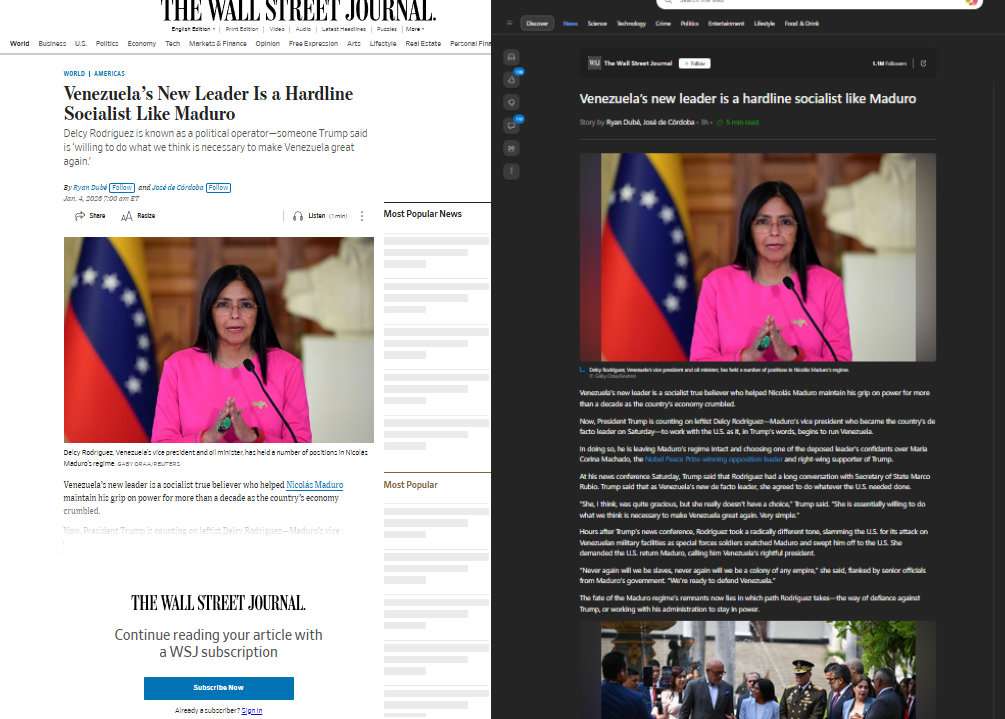
Let’s take the Maduro rendition story, though. There might have been a reason for me to read this specific reportage of what is ongoing in Venezuela: perhaps it quoted a specific named source, for example. But it is hardly the only source of information for this event. Access to information has a specificity challenge but in many cases, an important enough event will be widely reported, whether in the world or within just the legal profession.
Paywalls are porous, sometimes on purpose, but they have a drag on information access. When I saw Oxford University Press move to a “Subscribe to Open” model—which is essentially “libraries pay for everyone else’s access”, which doesn’t seem too different from the old print days but not equitable—it seemed to represent this awareness that they need to grow access but without entirely dropping the subscription model. When libraries themselves are struggling with funding, I am not supportive of them having to subsidize commercial publishers’ attempts at audience growth. Find a better business model or close up shop.
The Min Maxing of the Legal Profession
There is a perception that legal publishers have created that people with legal issues get more benefit by paying for legal information than if they had not paid for it. It’s no different from subscribing to a streaming service because of FOMO. You don’t literally need the streaming media but you value the benefit and are willing to pay for that feeling or sense of enjoyment or whatever.
A part of the legal profession has accepted that there is value experienced by purchasing legal information access. Normally, the value is money: saved time that can be allocated to new income from clients, information advantages that lead to new or refreshed client billings, and so on.
There is a novelty in the reluctance for legal professionals to be selective in their choices of information platforms, with a weird assumption that more than one legal information platform may be necessary for competent legal research. While law libraries have tended to move away from just-in-case collection management, the legal profession has mostly embraced just-in-case legal database access.
It reminds me of min maxing or powergaming. As a law library director, I do not see how a purchaser of legal information can find a causal connection between access to a database or media platform and enhanced revenue. This is particularly keen as we are deluged with artificial intelligence solutions that have a primary selling point of making lawyers more efficient (able to bill more hours to more clients and generate more revenue).
Yet these tools and platforms are licensed for what is intended to be a competitive edge. A lawyer who uses X platform will generate more revenue (directly or indirectly as time) than a competing lawyer. Putting aside that the use of AI creates substantially greater professional ethics risks than existing legal research tools, one has to wonder what sort of edge we’re talking about. I would doubt anyone who makes this assertion of advantage without some measurement that underlies it.
When legal publishers retreat into all-or-nothing licenses—whether content that can no longer be partitioned or whether a license has to cover 100% of an organization’s personnel, regardless of use—they seem to be appealing to this sense of optimization. As their home page shows, 190 of the AmLaw 200 subscribe: what are those other 10 doing!? How can they function? (trade secret: they get their librarians to use discussion lists to source out-of-scope content?)
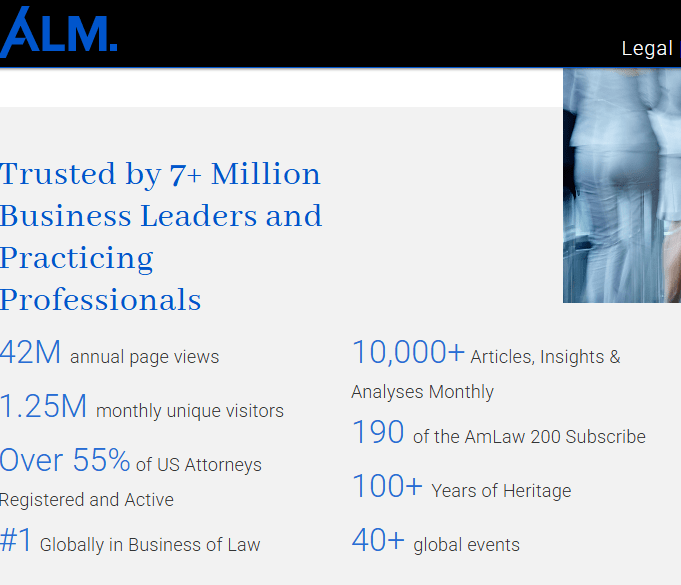
I’m using an ALM page above but it’s not about them. Or about Bloomberg Law and their approach to firmwide pricing models. In fact, the publisher that comes to mind was the poorly if aptly named Maritime Law Book.
They published judicial opinions in Canada and were a well-regarded publisher. For awhile, my law library had a relationship with them, providing access to their online cases (stripped of editorial enhancements) through our Primo discovery layer in addition to our cataloged collection. As this post describes, they shut down in 2016, their print-centric focus never really being able to pivot to compete in the Canadian market, especially as CanLII improved and created pressure on all online primary law sources.
The reality with Maritime is that what they sold was fungible. People could get a comparable version of it in a variety of ways, including free sources. There was no optimization benefit. There was no must-have, need-to-license compulsion. I am always a bit sad when businesses fail but when your content is not unique, you need to have other ways to attract customers.
Secondary legal content is on a spectrum. Treatises and texts may be more sticky, although I think that there remains a lot of collection development in law libraries based on prestige of having a book on a shelf, as opposed to a book being used. I have been glad to hear of colleagues cutting back to a handful of print titles, if only because it shows a more open-eyed understanding of need v. value.
Regionalism is another challenge. A number of legal publishers have deep state-specific collections (Rutter, O’Connor’s, and so on) but those are geared towards large markets. The product exists because it can sell, not because it’s necessary. News media is particularly susceptible to this challenge. Legal news media may be valuable to local audiences when it covers the ins and outs of the metro bar—and provide lawyers with the ability to min max against fellow lawyers—but it is, for the most part, either irrelevant to the profession as a whole or is covered by more than one outlet. National stories will be covered in the national legal media, sometimes in the mainstream media, if they are important enough.
When a publisher isolates to their own platform, they are making a gamble that their specific audience—like the subscribers to “subscribe to Open” products—will provide enough support that the free riders will not matter or, ideally, will convert into subscribers. But I just don’t see the strategic outcome working out the same, especially in niche publishing markets like that for the legal profession. There is little to no need-to-have secondary legal titles that are not reproduced or accessible in other ways. Once you’ve exhausted the min maxers—and I find it hard to believe they are a substantial part of the market—I’m not sure where the growth is.
Publishers tinker with their access methods. Or they pivot. Or they stop publishing, entirely or in a specific information vertical. I will be curious to watch as these publisher strategies play out and adapt over time.