
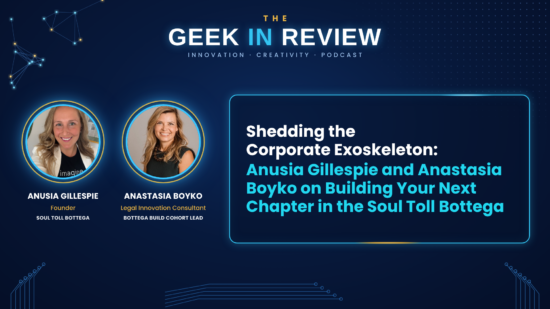
This week, Greg Lambert and Marlene Gebauer welcome back two friends of the show. Anusia Gillespie joined The Geek in Review a few months ago to talk about creative identity and her novel, Soul Toll. Anastasia Boyko, who hosts PLI’s How to Navigate Law School podcast, appeared earlier to talk about the post-pyramid law firm and advisor mode. The two now work together inside the Soul Toll Bottega. Their partnership started over coffee on the water in Marblehead. Gillespie had published the novel while she still held a full-time job, with a byline aimed at anyone who has wondered if success is enough, and she says she put it out as a signal to find people for her next chapter. Boyko picked up that signal. Gillespie thought the coffee was a fun catch-up between two people with similar backgrounds until Boyko said, on the way out, “So we’re going to do this together.”
Gillespie describes the Bottega as a virtual community of practice, and members tend to arrive on one of two tracks. Some know they want a next chapter and can’t yet say what it looks like. Others have a creative project in mind (a book, a podcast, a YouTube series) and the people around them keep pointing out that they have never done that before. The community runs guest workshops, including a recent one on how to write like a human when so much of what people read comes from AI. The deeper program is called Build. It runs eight weeks, one hour a week, with no homework, in peer-facilitated groups, and it ends with a demo day where each person shares what they made. Boyko leads the fall cohort, which had finished week five at the time of recording, and two more cohorts open in January after MLK Day. She told Gillespie she wanted to be a transformation guide, which fits someone who has made a dozen career pivots and says her parents can’t keep track of them.
Greg asks Boyko what keeps lawyers from seeing the commercial value of their skills outside a court, a firm, or a legal department. She says law school and practice socialize lawyers into one path and leave them asking who would hire a lawyer. Her advice is to set the legal label aside and describe the daily work: solving problems, thinking critically, persuading, and managing multiple stakeholders in high-demand environments. She told Yale law students the same thing when she worked there. Gillespie adds a story from the summer Build program, where she led a three-to-five minute guided visualization and asked people to dream. Several participants told her afterward that they could not remember the last time anyone had asked. She also walks the hosts through a chart of the emotional journey of creating anything great, which starts with “this is a great idea,” drops into what she calls the dark swamp of despair, and climbs back out for the people who keep going.
Greg brings up a conference session where a speaker praised the apprenticeship model they came up through, and he recalls telling the audience from the stage that he didn’t remember it being that great. Gillespie says young lawyers want someone to sit down and walk through their work, and what they often get is a short email that says “do it again.” She describes the Bottega as a place for deep and hard work by ambitious people who want that feedback, and she passes along a managing partner’s line that you can’t learn to make a soufflé by watching a video. Boyko says judgment grows when people see how others look at problems, and that law practice felt lonely to her because nobody explained the rules. The Build groups have their own rules. Nobody is there to fix anyone or give advice, and everything said stays in the group. Her phrase for the balance is that “challenge is only as valuable as the support that meets it.” Gillespie has one more rule, which she states in the orientation video: hard sell inside the Bottega and she will kick you out.
The conversation closes with the advisory economy. Boyko says professionals used to need a company’s brand to get their expertise in front of buyers, and now they can do it through portfolio careers, fractional roles, consulting, or resources they create themselves. She points to Ginny Johnson’s Bloomberg Law article on portfolio careers and the advisory economy. Gillespie says she is starting to see staying with one company as the riskier option. Greg tells the story of a first-year associate who reminded him he was seven years old during the 2008 downturn, at which point Greg got up and left the room. For the look-back question, Gillespie says the economics of independence have changed. Ten years ago she was making flyers in Word and someone kindly told her they looked like beginner work, and AI has removed that obstacle. For the crystal ball question, Boyko says people will need to put their expertise out ahead of the logo, and that nobody cares about her Yale Law degree if she has nothing valuable to share. Gillespie’s answer is trust. She talks about shedding her “corporate exoskeleton,” the hustle habits that earned her success in her old career, in order to build this business. She also points out that plenty of Bottega members love their jobs and plan to stay in them, and use the community as time for the deep thinking their workday leaves out. Listeners can find the Bottega at soul-toll.com, and the two post a ten-minute weekly video on YouTube under the name The A-Team Manifests.
Listen on mobile platforms: Apple Podcasts | Spotify | YouTube | Substack
Email: geekinreviewpodcast@gmail.com
Music: Jerry David DeCicca
Transcript
Marlene Gebauer (00:06)
Welcome to the Geek in Review, the podcast focused on innovative and creative ideas in the legal industry. I’m Marlene Gebauer.
Greg Lambert (00:12)
And I’m Greg Lambert.
Marlene Gebauer (00:15)
And this week we’re joined by Anusia Gillespie, founder of Soul Toll and Soul Toll Bottega, and Anastasia Boyko, legal innovation consultant, host of the Practising Law Institute podcast, How to Navigate Law School, and a leader of the fall 2026 Soul Toll Bottega Build Cohort.
Greg Lambert (00:32)
And both our guests are are really good friends of of the pod as well and have been on the show before. Anusia was on a few months ago to talk about the creativity or the creative identity and her novel Soul Toll. And Anastasia was here to discuss the post-pyramid law firm in advisor mode. So now they have teamed up, which makes me really excited, inside the new Soul Toll Bottega.
Turning ideas about creative reinvention, transferable skills, and legal futures into an active cohort programming, helping professionals build their next chapter.
Marlene Gebauer (01:09)
We are gonna hear some very creative ideas. This is one not to miss.
Greg Lambert (01:12)
I’m excited.
Marlene Gebauer (01:13)
So Anusia and Anastasia, welcome to the Geek in Review.
Anastasia Boyko (01:17)
Thanks for having us.
Anusia Gillespie (01:18)
Yeah, thank you.
Marlene Gebauer (01:20)
So let’s let’s start like with the collaboration. you know, what did each of you see in each other’s work that convinced you that, you know, the collaboration needed to happen now?
Anastasia Boyko (01:31)
Yeah, I mean, I started following Anusia’s work when Soul Toll came out and I thought, this is different. This is not like something that a lawyer would talk about. And it very much resonated for me because I feel like along my own journey, which I’ve described as Goldilocks-ing through my career, I’ve tried to move toward a more authentic, soul-led professional life. And so it was it was really interesting to find someone who was similarly a lawyer, someone who had worked in innovation, do something that was very
heart and soul-led. And so I had followed along and and then I was gonna be on the East Coast and I knew that Anusia lived in Marblehead and I asked like why don’t we get coffee while I’m out there? And so we sat on the water and we talked and it was history after.
Anusia Gillespie (02:20)
Yeah, and for me, and thank you for the question, it’s such a nice reflection. I had put out my book and it was this kind of scary thing to do while still in a full-time role, ’cause the byline was for anyone who’s ever wondered if success is enough, like read between the lines.
Anastasia Boyko (02:35)
Yeah.
Marlene Gebauer (02:35)
Ha ha ha
Anusia Gillespie (02:36)
and
but I but I did it to put out signal because I knew that I needed more people than myself to do whatever my next chapter was going to be and how that was going to unfold. And I’m so happy I did because that resonated with Anastasia. And when she came to Marblehead, I had no idea
that we were going to do this together. For me, it was very much, this will be fun. We both have interesting backgrounds that are similar to each other. And then as we were leaving, this still hadn’t occurred to me, and Anastasia said, So we’re going to do this together.
We’re going to do this together. I got now I understand why you’re here. And I
Anastasia Boyko (03:18)
Yeah.
Greg Lambert (03:19)
Yeah.
Anusia Gillespie (03:19)
loved that so much because she held space for me to kind of come to it on my own, but then told me at the same time. And I I I loved that combination. And frankly, at first I was a little curious about it because we have such similar backgrounds and skill sets. I was like, is this going to work? Because we’re bringing a lot of the same to the table.
But then as we got into it, we are and we’re and we’re not. We bring similar histories, but how those unfold and express and how we work together are so complementary. So just so happy to be here with you, Anastasia and Greg and Marlene in coming back to it all.
Greg Lambert (03:56)
Before we dive too deep into it, do you Anusia, do you mind just kinda giving us a broad overview of what the Bottega is, what the what the plans are, and then Anastasia maybe a little bit about what the the cohort is going to be coming up.
Anusia Gillespie (04:16)
So the Soul Toll Bottega is our virtual home hub community. And people are bringing their whole selves there. And we keep getting that feedback that this is the place I can bring my whole self. There’s a lot of other places in my life where I can bring a piece here and a piece here, but not my whole self. And what people are wanting in coming
fall on two tracks. One is I have a next chapter, but I don’t know what that looks like yet. And I need someone to help me figure that out and accelerate myself into it. Otherwise I’m just going to stay stuck. And the other is I have a creative
calling, idea, expression. It could be a book, a podcast, a YouTube series, and people are at the beginning and don’t know. And what we’ve created is a community of practice. So that people who are in one realm and want to either start a new life chapter or a creative work and the people in their existing space don’t understand that or aren’t the right people to help them with that. This community of practice is like, yeah, of course, let’s let’s do that.
And then helps them along versus maybe some of the questions that happen in your kind of friends and family network of well, you’ve never done that before kind of thing.
Greg Lambert (05:28)
Okay.
Anusia Gillespie (05:29)
So it’s the place to bring the idea, bring the pull and see where it goes. And that’s the
Bottega as a whole concept. Within that, we have, I guess I think of that as horizontally, and then we have vertical programming. There’s a lot of programming in the Bottega itself. We have guest speakers coming in and doing workshops. We had a fantastic speaker last week who was teaching us how to write like humans because there’s, you
Greg Lambert (05:55)
Right.
Marlene Gebauer (05:55)
Ha ha ha ha.
Anusia Gillespie (05:56)
know, so much AI writing. But then also as professionals, yeah, we
Greg Lambert (05:58)
It’s pretty relevant right now.
Marlene Gebauer (05:59)
Thank goodness. Thank goodness.
Anusia Gillespie (06:01)
We’ve communicated
in very polished speak and almost forgot how to write and connect with humans, so relevant for everyone really. But I digress. So we have a lot of programming and resources in there and then what I would call kind of the deeper vertical programming like Build.
Anastasia Boyko (06:21)
Yeah, so when Anusia and I were talking in Marblehead, she asked me what I wanted to do. And for me, it was almost immediate, right? Like I want to be a transformation guide. And that came from the fact that I’ve had a dozen career pivots and I’m always reinventing to the pace where my parents can’t keep track. And people are always asking you what you’re doing next. But it’s the thing that I’m good at. I’m good at figuring out what the next thing is for me. And so I thought like that should be the thing that I help people with.
Particularly because so much is changing all around us societally and AI is shifting the way that we do work. And that made us realize, well, why don’t we do a second Build? So Anusia had launched Build as a program during the summer. And I wanted to focus our October Build on people who had another chapter in mind. And it could be like, I don’t know what it is, but I know that this, whatever I’m in right now, doesn’t fit, and I need to figure out what’s next, or someone who wants to
build a new business and they’re trying to figure out how to put it together. Or someone who’s trying to just outline how they want to move forward in a more expansive way. So it’s just that feeling of wherever I am right now doesn’t work. Let me figure out what it looks like together next. And it’s very different doing this work in peer-facilitated groups. And so I’ve done a lot of self-development over 20 years.
But it’s very different when I’ve been in peer-facilitated groups because everyone’s up to the same kind of transformation work or transition work, even if they’re going toward different goals. And to be able to hold that space, which we do over eight weeks, no homework for an hour every single week, has been amazing to watch. So we just finished week five. And it is a drastic difference between where we were on week one, where folks had some idea of what they wanted to use this for,
to where they’re blossoming and figuring out so many additional rich layers to the life that they want to build and what that initial piece meant at the beginning. And so we had a lot of people who were excited about Build in October who just couldn’t make the timing work. And so we have two more cohorts opening up in January after MLK Day. So right after everyone’s had some time to reflect on what they want to be doing during the holidays and after New Year’s resolutions. And we’re really excited about that.
Greg Lambert (08:38)
Yeah. Now Anastasia, you when you were on before you were talking about advisor mode and and now I think you just used the phrase was it transition mode?
I think before you were looking at advising more on an enterprise level and now you’re looking at more almost on an individual level. You’re doing it in groups, but it’s really aimed toward the the individual. How are you able to adjust what you learned in in the enterprise mode to this more small group in in individual mode?
Anastasia Boyko (09:08)
Yeah, I mean, I’ve been doing transformation within organizations for two decades, right? Like I look at my work as more embedded consultant than full-time employee. And so I’ve been pulled into so many different projects where there’s an abstract idea about what we’re moving toward, or there’s a shift in the market, and we need somebody to help us figure out what that looks like. And I was doing that work in parallel with my own self-development work as I was transitioning through all of the different chapters that I moved through. And I find that
we can use some of the same principles, but I’ve actually worked from the inside out when I’m doing transformation inside of an organization. So I can look at the meta level of what we’re doing systemically and see the different obstacles. But a lot of transformation work in an organization is what individuals are in place and in the way that this isn’t happening. We know this, right? We see this all across legal tech. Everyone’s now realizing, we gotta get the individuals
to go along because we can buy this very expensive technology, but if we don’t change minds and hearts of the individuals within influential positions, none of this works. And so for me, it’s transitioning more into that. And also, I just I saw a bigger opportunity. I think a lot of smart overachievers are having this moment. And maybe it’s midlife, maybe it’s just what’s happening on the societal and economic stage. People are asking, like, what more is there?
Greg Lambert (10:30)
Yeah.
Anastasia Boyko (10:30)
Where
can I express myself? Like what what additional chapters do I want? And I think part of that is these transitions that are happening, not to get too woo-woo with people, but I’m very woo-woo, so I fully admit it. But we’re going through a lot of transitions as far as like the the Fourth Turning has sort of ended in this crisis cycle that we had for the last 25 to 30 years, and we’re coming into more of an awakening cycle. And that’s from the lens of someone, a historian who studied all the different cycles that human evolution goes through over the last few hundred
years. And so there’s a bit of an awakening happening in people. Like there’s a different way to do this. We’re seeing it with AI and all the systems that we used to believe in. And so that to me is far more interesting. It’s like how do I change individuals from the mind and heart perspective? So then then they can help shift a more transformational chapter within the systemic enterprise level.
Anusia Gillespie (11:22)
Just add that I think the enterprise versus individual is a distinction without a difference. Enterprises are all
Greg Lambert (11:29)
Right.
Anusia Gillespie (11:29)
consisting of individuals, so
Greg Lambert (11:32)
Yeah, but do you think people think of it that way? ‘Cause I I yeah. I I
Anastasia Boyko (11:35)
No.
Greg Lambert (11:37)
I think
Marlene Gebauer (11:37)
Yeah.
Greg Lambert (11:37)
it’s something you have to consciously think about is that yes, it’s enter enterprise is how we’re we’re presenting this, but it’s affecting the individual. So yeah.
Marlene Gebauer (11:49)
So first I have to say that that I think what you guys are doing is is fabulous and very important because you know, making this transformation I think is is scary for a lot of people that are already kind of in a you know safe environment, but you know, maybe like not a hundred percent happy with what they’re doing. And you know, many times, you know, people will say, you know, yeah, I know I wish you I wish I could start a restaurant or I wish I could, you know, run a pottery studio and you know, people
people talk about it and they reflect on it, I think it would be great, but they don’t actually either know how or, you know, too frightened to take those steps. So
you know, is in terms of the program, Anusia, how do you prevent sort of this this kind of reflection, you know, kind of sensory world building and really have people get out of their comfort zone and and actually, you know, get to the point where they have the tools and capabilities to sort of make that change?
Anusia Gillespie (12:47)
Thank you for seeing what we’re doing and for the question. We have to imagine possibilities. We’re so stuck in very small thinking that that is a practice of its own because how can we go for it if we can’t even imagine it, sense it, see it? Yes.
Marlene Gebauer (13:04)
Small and safe thinking, you know.
Anastasia Boyko (13:05)
Yeah.
Anusia Gillespie (13:07)
And as I thought about this question, I thought about how much
space is taken away in current corporate environments for deep thinking, for strategic work, for going to the whiteboard, away from the computer, and translating this question a bit of how do we not get stuck and spend too much time in world building and reflection away from doing the thing?
In how do we not get stuck in being at the whiteboard and strategizing instead of pressing AI and hitting send? Like you need both. And so
We create space for the imagination, but then also the Bottega is a place to experiment with your beta participants. So you don’t have to just go to your friends and family. It’s the community of practice where you share the little pieces as you start to build them. Actually, that’s the capstone of the Build program is demo day, where wherever you end up with whatever you’re bringing, you’re going to share it and you’re going to hold yourself accountable
and take steps towards it. And I think another part of the process is showing people where they are. A big thesis for the Bottega is everyone’s coming together, because it could sound different. It could sound like these people are figuring out their life and these people want to write a book. But actually, the thread that binds is the emotional journey of creating anything great, which is not my framework. But I’ll send it to you, Greg, if if and Marlene, if you haven’t seen it. But
it starts out with, and and anyone in innovation, anyone who has built something, is a builder, has experienced this. And it starts with, this is a great idea and all the energy of that idea. And then it comes down, it’s like, this is still fun.
And then it comes down a little more and it’s like, shit, I don’t know what I’m doing. And
Greg Lambert (14:49)
Ha ha ha.
Anusia Gillespie (14:50)
then you go start to get into the dark swamp of despair where it’s like all expletives, unless you cross over the bridge and it says like belief, humor, family, which I would add people, process, tech gets you across the bridge to the other side where you have something meaningful. And then you start coming back up, and there’s a spot where I stop a lot where it’s like, quick, let’s say we learn something and call it a day.
This feels hard, but I do feel like I learned something. But if you keep going, you get to the point where you’ve created something great. It’s something that you are most proud of.
And that’s the work that people are bringing in. And that work requires the fluctuation between world building and possibility and getting unstuck out of our our own thinking to then making a meaningful step forward and sharing it and co-creating in community with people who are going to pull you forward.
Anastasia Boyko (15:47)
Yeah. And I’ll add, I think Marlene, when you were saying, you know, I have I have these ideas out there. I think oftentimes when we’re in a corporate space and we’re trying to reach for something that gives us joy, we’re thinking of things we’ve seen other people do or things that we find interesting. And I find it to be almost like you’re throwing darts just out because you need somewhere to direct your
heart and creative energy. And I was guilty of that for many of the years as I navigated my career. And the big game changer is once I started operating from within, right? Like once I started operating from what lights me up and what I, the kinds of work I like doing, what does that feel like, right? So like being in startups, legal tech startups, really excited me because it was innovative and I had a lot of freedom and I could try out a lot of different ideas, right? The feeling is what led my joy at work.
Right. And the expansiveness. And so what I’ve been noticing with our Build cohort now, it’s like w we went from direction to self, right? It comes back to self and understanding how to center yourself in those big future dreams. And that can still be in your own job, right? But getting an understanding of what it is that you enjoy, why you enjoy it, a sense of being that you want to have throughout your work.
is the differentiator between just moving along and trying different things and hoping this’ll stick and being really intentional and deliberate around the way that you navigate your life and career path.
Greg Lambert (17:20)
Now, Anastasia, I know that the Bottega isn’t isn’t limited to look the legal profession. It’s it’s got a w it cast a wide net on on what what type of people could could come in and benefit from this. But I wanna I wanna since this is a legal legal tech or legal podcast, get your opinion on, you know, how what what do you think is one of the biggest barriers that prevents
lawyers or legal professionals from recognizing that the capabilities that they’ve honed in their in their career have real commercial value that’s that that’s outside the the traditional scope of, you know, I’ll go work for a a a court, a law firm or or a company doing the legal work. How how do you get them to kind of see beyond their own set limitations?
Anastasia Boyko (18:09)
Man, that’s a that’s a three hour session. So
Greg Lambert (18:11)
Yeah.
Anastasia Boyko (18:12)
you know, for me, this work began
Marlene Gebauer (18:12)
He’s
Anastasia Boyko (18:13)
when I was trying to explain to law students at Yale that there’s so many different paths available. And that’s just work I discovered over 15 years of my career. And we we tend to make people conform and lock them into one way of thinking through law school and then through practice, right? And I think some of it is just psychological warfare
to keep us stuck where we are, where it’s like this is the only thing that you can do. And you know, you’re a lawyer, who’s gonna hire a lawyer? Versus take a step back, think about your skills. Like think about the things that you’re really, really good at, and where could you transfer them based on a sector or industry that you like, instead of thinking one to one or who will have me or this is all I have to give. I think so much of legal is self-deprecating
and minimizing when like being a lawyer is a superpower. Like you learn amazing problem-solving skills, critical thinking skills, persuasive communication, like multiple stakeholders, high-demand environments, like these are very, very valuable skills. And we tend to narrow them and put them where we’ve seen them operate. And you have to take a step back and think: like, how would I describe
my career to somebody else? How would I describe the skills that I have to someone else? If I could just put the legal label to the side, what do I do day in and day out? What kind of problems do I solve? Where are the challenges that that I overcome day to day? And I think it’s partially just the way that we socialize lawyers through law school and through practice to make them think that they’re less than or they’re only a lawyer, when they do some pretty incredible things in the way that they help their clients. We just don’t
socialize them to think about it.
Greg Lambert (19:58)
Marlene, I didn’t realize how great I was until An Anastasia just made me look at myself like that. Thank you.
Marlene Gebauer (20:03)
That’s right. See, you’re amazing. You’re amazing.
Anusia Gillespie (20:06)
Mm-hmm.
Anastasia Boyko (20:07)
Great. Yeah.
Marlene Gebauer (20:07)
So you’re midway through the fall Build cohort. You know, what foundational assumptions about this professional transformation has the live group already challenged or disproven if they have?
Anastasia Boyko (20:21)
I have to think about that. I’m actually gonna give it to Anusia to reflect on what she had in the summer. What am I learning?
Marlene Gebauer (20:25)
What I mean, what are you learning from them that that you hadn’t thought of before?
Anastasia Boyko (20:29)
Well, I’m learning that it takes a lot of work to find yourself. And we don’t give a lot of space in our current societal environment and our corporate environment to actually sit with yourself and ask yourself what you want to do.
So much of what we do is we get people to achieve, achieve, achieve, right? Like you’re working toward a certain college degree, you’re working toward a certain professional degree, you’re working toward a certain job, right? And you’re
Marlene Gebauer (20:54)
Milestone, milestone, milestone, milestone. Mm-hmm.
Anastasia Boyko (20:57)
doing this and you’re like, all right, I gotta check the box, I
Greg Lambert (20:57)
Yeah, it’s like
Anastasia Boyko (20:59)
gotta check the box, I gotta check the box. And then you get to midlife and you’re like, well, do I like this? Do I want to do this? And it happens, I mean, we we have folks across generations who are realizing how much of themselves
they’ve given to others and haven’t asked themselves what they want. And I think this is very common in professional sectors in high demand careers and with overachievers. We put other people first and we don’t realize how much of ourselves we’re leaving on the table and how much of our lives we haven’t yet lived because there’s this fiction in our head about status and money and how we’re moving towards something and self-importance.
versus what does my heart actually want? And it might be something different than what I’ve spent my career building toward. And that’s wild, right? That’s a wild realization to have when you’ve already spent so long building a career. And for me, it started happening after I left law practice, but it just happened in more and more chapters after. And now I’m seeing the same, same with this cohort across, across age groups.
Marlene Gebauer (22:11)
It’s just a common issue. It’s a common it’s a common thing that that we all share.
Anusia Gillespie (22:17)
I would add from the summer Build program, kind of a profound experience for me was I lead an imagination practice that’s like a guided visualization, three to five minutes, not long, but to get people into a more expansive mindset to bring into the session and not every session, but select, and there was one
And it really asked people to dream. And after it, people reflected on it. And there were many people who said, Thank you so much. No one has asked me about my dream in so long. I cannot remember the last time someone asked me. I’m out here serving everyone else, but no one has asked me.
Greg Lambert (22:58)
Mm-hmm.
Anusia Gillespie (22:58)
And that was really incredible to see that open. And
I would say the other piece from the summer program was
While they’re reflecting on their thinking and their imagination, and thank you for asking me, they’re also stuck in thought patterns and overthinking and overanalyzing. And so it’s this contrast of overthinking and overanalyzing in one pattern, but not bursting out into the big dream space. And then how do we bring that and ground that together into a tangible piece moving forward? And we had people from the program say,
they got so far they couldn’t even have imagined at the beginning and there’s a certain energy and striving together and so there really is something that happens in the sharing and energy of the group when people are bringing their whole selves to this space where they they really want something and are willing to do that work together.
Greg Lambert (23:58)
Anusia, I was I was sitting in in a at a conference a week ago with a a global group that that had gathered. And as I was sitting in the audience, I was listening to someone talk about how great the apprenticeship was when they were coming up through the ranks. And then when I got up on on stage to to to run a panel, I took that opportunity to go
I don’t know what industry you were in,
Anastasia Boyko (24:24)
Ha ha
Greg Lambert (24:25)
but from what I remember it wasn’t that great and
Marlene Gebauer (24:25)
It’s like was it that great? I don’t remember that.
Greg Lambert (24:30)
and it’s not that great now. So wanted to kind of think about, you know, given the traditional apprenticeship in law firms, you know, how does your approach of this kind of horizontal peer Bottega deliver the the you know, the the right
type of critique and d develop the the judgment that that professionals are are currently missing. How how do you kinda compare that to what the the current apprenticeship model does?
Anusia Gillespie (25:02)
Yeah, I mean as an analogy, because we’re not developing lawyers to to do law in the Bottega, just to clarify, as an analogy, it’s the space for deep thinking, critical work, problem solving, building, translation, figuring out how to communicate to your new space, being pulled forward into an up-leveling into another
place of growth. And so I think all of those different practices, people, process, tech is in the Bottega too. Like we’re bringing all of those pieces together to develop people and and to be clear, this is not a soft space. This is a place for
deep and hard work. This is a place for ambitious and driven people who are going to be open to feedback because they want it because they know they will grow. And I think that’s where the analogy is too. Like, how many young lawyers are craving feedback, are craving someone to sit down with them and really spend the time walking through their work and telling them, you know, where it’s working and where it’s not, versus a short email that’s like, do it again.
Greg Lambert (26:10)
Yeah.
Anusia Gillespie (26:10)
So I think we’re
bringing that rigor and that attention and thoughtful resources because we’re building from scratch. So we have that opportunity to build and design in the right way for activation, for meeting people where they are while pulling them into something that’s growth. Whereas in law, unfortunately right now we are
accelerated into AI and systems that don’t allow for that apprenticeship model anymore and people are not getting the reps in and the managing partner of Seyfarth, I’m forgetting her name right now, but I was on a podcast with her and she said you can’t learn how to make a soufflé by watching a video. And I was in e-learning at the time, so I didn’t love hearing that, but I understood her point. Yeah, I was like
Greg Lambert (26:53)
That’s
Marlene Gebauer (26:55)
Not wrong.
Anusia Gillespie (26:57)
Well, you can’t say it now, but yeah, you’re not wrong at all.
Anastasia Boyko (26:59)
Yeah.
Anusia Gillespie (27:01)
And that’s the problem, you know, you can’t outsource that work.
Anastasia Boyko (27:05)
Yeah, and I’ll add so much of judgment development is understanding how other people look at the world and solve problems. And I found that in legal, so much of our work is very lonely in the way that we have to process the work that we’re doing. And then you’re getting top-down feedback, as Anusia mentioned, oftentimes not not useful feedback. And you’re trying to figure it out on your own. Like I felt very lonely in law practice because nobody explained to me the rules I was supposed to know.
And there were minefields everywhere. And what I like about the way that we’re approaching this is it feels very psychologically safe from Imagination Hour to to Build is you’re with other smart, thoughtful people and you’re holding space for each other and you’re learning about how other people feel, and you’re learning about how other people reflect what you’re putting out into the world. And it takes time to build that psychological safety, but I think there are very few spaces that lawyers have across their careers
where they can be in an environment like that and learn how other people approach challenges and problems. And from all the research, like that’s it’s a great way to begin to cultivate better judgment is to understand other people’s perspectives.
Greg Lambert (28:15)
Yeah. Well I think I’m gonna I’m gonna jump in and and ask this next question a little bit out of order because I th I think you cued it up pretty well. So y
Anusia, you talked about the fact that the this is not necessarily a a soft area where you just sit sit down and absorb and and you know g figure it all out by osmosis that there’s actually hard work that that needs to be done. So how is it that you you you structure an environment so that
it remains safe for people to to have these vulnerable experimentations without making them so safe that they don’t don’t necessarily experience the reality of what it takes to get that hard feedback and and what you do with it. So how do you how do you balance that?
Anusia Gillespie (29:05)
Art, and Anastasia
Greg Lambert (29:07)
That’s
Anusia Gillespie (29:08)
and I show up every day doing it. So by modeling what this place is, and what you get here and what you do here. And then other people say, okay.
I can do that too. Okay. And the one-on-one conversations at the start too, before I always I call it the snowball. Like as the snowball forms and then it starts growing and growing and growing, it’s so important to create that culture at the beginning in the snowball. And so that’s where we’re really intentional to show up in that way so that other people can too.
Marlene Gebauer (29:45)
Yeah, that that
Anastasia Boyko (29:45)
Yeah.
Marlene Gebauer (29:46)
safe that safe space is is so important, I think, for people who are sort of, you know, embarking on this journey. But, you know, at the same time you wanna be realistic with them
Greg Lambert (29:56)
Yeah.
Marlene Gebauer (29:56)
about where they’re you know, whether they’re heading in the right direction or not or they’re approaching it the right way, but with sensitivity.
Anastasia Boyko (30:03)
Yeah, and we have rules around it, right? It’s like we in in Build, like we we don’t
Marlene Gebauer (30:06)
That’s good, yeah.
Anastasia Boyko (30:07)
we’re not here to fix anyone, we’re not here to give advice, and everything stays there. And so I think people can slowly over time begin to put their guard down and people share, and then somebody else feels more comfortable sharing, right? And my goal is to get them to their objective. And so I’m gonna ask hard underneath questions in a loving and kind way.
Greg Lambert (30:28)
Okay.
Anastasia Boyko (30:28)
But
I genuinely believe like challenge is only as valuable as the support that meets it. And oftentimes we’re in environments where we have too much challenge and no support, or too much support and no challenge. And so we’re trying to get those things together on something as important as someone’s life, right? Like this is like this is big subject matter to figure out what you want from your big beautiful life and what’s standing in the way. And can your cohort and can your facilitator help you get there? And a lot of that is creating
safety and support and then you start doing a little push.
Anusia Gillespie (31:02)
And and the rules, it’s a good point. We have community guidelines as well. And my one of my big ones, because eventually the vision is for the Bottega to be the workshop where you’re figuring it out, but then hey, maybe I’ve productized my expertise into a program that I want to workshop within the Bottega. And hey, I’ve figured out now that I can sell this one to many at scale. And hey, that’s gonna make me some money. And I’d like to sell that within the Bottega.
It is now a marketplace where people who workshopped all of that in the Bottega are now able to sell it internally as well. Coming back to the community guidelines. However, my number one, and I say it in my orientation video as well, if you hard sell in the Bottega, I will kick you out. So there’s that kind of safety as
Anastasia Boyko (31:48)
Yeah.
Anusia Gillespie (31:49)
well.
Marlene Gebauer (31:52)
So when you talk about preparing professionals for the advisory economy, and maybe you can explain what that means a little bit, like what concrete capabilities separate, you know, a genuine, sustainable advisor from someone who’s simply kind of experiencing, you know, dislocation?
Anusia Gillespie (32:13)
Take that, Anastasia.
Anastasia Boyko (32:15)
I I think part of it is mindset. Because I do think for a long time we looked at people in different stages of their career as less than. And we’re in a different environment now where because of the channels that exist, you can get your expertise out to a lot of different people and you can build a life around that, right? Many of us are seasoned professionals, right? We’ve had lots and lots of experience. And it used to be that you had to
align yourself with a brand or a company to be able to get that expertise out. And now we’re just not in the same economic field. And people are able to sell pieces of that advice out there, right? Ginny Johnson had a beautiful article in Bloomberg Law about this, whether it’s a portfolio career and you have many clients and many different ways of getting your expertise out. Maybe you’re a fractional person, right? Maybe you’re consulting, maybe you’re actually creating a resource that other people consume.
There are so many ways to have that kind of autonomy di distanced from or disconnected from a brand. And we’re seeing it all over the place where you have smart professionals who are coming out and selling their expertise as the owners of it versus selling to one company and staying with that company and not having any any other options to be able to monetize it.
Anusia Gillespie (33:35)
It’s starting to become the riskier option to stay with one company is what I’m seeing. And a less risky option to
Marlene Gebauer (33:43)
Isn’t that interesting?
Anusia Gillespie (33:45)
Yes, why do you say that?
Anastasia Boyko (33:47)
Ha ha ha.
Marlene Gebauer (33:48)
Well, it’s like traditionally that has sort of been the safer route, you know, stay with, you know, a a large organization and or move
to different large organizations and that was sort of the safer way of doing things. And now what I’m hearing is, you know, maybe doing fractional is is is actually safer because it gets you more different types of experiences quicker and you can decide sort of what path you want to to follow rather rather than you know finding that out years later.
Anusia Gillespie (34:20)
Yeah. And what I what I heard from Ginny too was also all of the networking that happens with all of that versus within one company and then just going and networking at a conference. It’s just part of the near every day. And then that’s just opening so many opportunities because we’re not 20 years old anymore, you know, like we’re we’re at the point where we can really get some things done and be a really good mover and shaker in that way. And so the opportunities, the flywheel begins, is what I heard from her in the
Yeah.
Anastasia Boyko (34:48)
You also add, I mean, anyone who’s lived through the financial crisis realize that that traditional job security isn’t a thing. Markets go through cycles. Everything that we’re watching now economically, right? You have a lot of restructurings, you have a lot of reductions in force, you have companies that are very successful and making a lot of revenue who are still laying people off. We’re seeing this through AI and AI investments and how people pay for those by reductions in force.
And if you’re paying any attention to the economy and the world of work, you realize that it’s not a very stable place, including in law, right? Like I’ve been saying this for several years now, with AI, like law firms need to be paying attention to what’s happening in the headwinds. And I think we’re gonna see more and more law firms caught in that web of not having planned ahead, not having restructured ahead for what’s what’s happening, right? And
a lot of a lot of firms are gonna face struggles like we’ve seen in the news, and it’s gonna just get it’s gonna snowball, sadly.
Greg Lambert (35:47)
Yeah. You wanna wanna hear something sad? I w I was talking to one of the first year associates about the turn the economic turndown in 2008, 2009 and they were like, I was seven when that
Anusia Gillespie (35:59)
What’s that?
Greg Lambert (36:04)
I I
Anastasia Boyko (36:04)
Yeah.
Greg Lambert (36:04)
got I got up and left the room, so yeah.
Marlene Gebauer (36:06)
Ha ha ha.
Anastasia Boyko (36:06)
Yeah. This, right? Either we were impacted by it or we
saw friends
Marlene Gebauer (36:09)
Yeah.
Anastasia Boyko (36:10)
impacted by it. And so we know like we have muscle memory in our souls
Greg Lambert (36:14)
Yes.
Anastasia Boyko (36:15)
around around that disruption. And I think we’re seeing a lot of the same thing now. And so what I love about what we’re doing is we’re trying to help people create optionality. And you may not leave right now. You may actually like what you’re doing. You may restructure your relationship, at least your at least your mental relationship with your work and still stay where you are and pursue some other things.
But you owe it to yourself to get ready for what’s happening on the stage so that whatever disruption happens for your career or the people around you or your industry, that you’ve got some planning done ahead of time and you know where you can go and or at least you know your expertise and you know how to monetize that in case anything changes.
Marlene Gebauer (36:57)
So important, so important. We’re gonna have our look back question now. So for for both of you, you know, what is true today about professional reinvention that wasn’t true one year ago that you’d wanna share with the audience?
Anusia Gillespie (37:15)
The economics of independence have changed and AI is very much a part of that story in
reducing the moat, the barriers, all of it, to start a business and look professional. I don’t have to. I I jumped 10 years ago and I was making flyers and Word documents and someone nicely told me this this this was very beginner, not acceptable way to try and get business, which was fair. And
That’s not an obstacle anymore. You can put your expertise and package your expertise in a really professional way really quickly and get it in front of people and start the conversation and have it keep moving. So my thing is the economics of independence have changed and anyone can start a business and jump into the new economy now.
Anastasia Boyko (38:06)
I will say awakening is in the water. I think people are beginning to open up their eyes and just see how big the shift is societally, economically, and politically. And it’s a different environment when you’re heads down working in something.
And then when you’re up and sort of paying attention, like something’s off, right? Something’s off in the water, something’s happening, something new is coming. And I think a lot of people are feeling it. And technology has allowed us to share that sentiment across social media. And we’re picking it up all over the place. So I think that awakening is spreading like wildfire. And a lot of what I’m hoping we get to do is help figure out what’s next.
for people, like knowing that something’s here and there’s a little bit of rattling. how do I get ready? How do I prepare? How do I get myself in the game of what the next ten to twenty years look like for me?
Greg Lambert (38:59)
All right, Anastasia, that’s that’s the perfect lead-in now for our crystal ball question, so I’ll let you continue. in in the next few years, what it what do you think the change and challenge is that we need to be prepared for in in kind of helping build our careers and and deliver experience?
Anastasia Boyko (39:21)
I think the challenge is learning how to put your expertise out there ahead of the logo. The logo is no longer going to speak for you. People want to hear what you know and what you’ve experienced and learn you. I mean, I think that conversation I had with Anusia around like the fact that people are going to buy directly from you because of your expertise, not because I have a Yale Law degree. Like no one cares that I have a Yale Law degree or that I was at these big firms or I’ve worked for these companies. Do I have anything valuable to share with them?
Because I think the economy’s going to change as to who is gonna buy one-to-one in a consumer market on advisory and advice and moving forward versus going to a specific logo that has had a reputation of doing XYZ. And I don’t think we’re at all prepared for that, right? We’re really prepared to sit in an organization and do our job and give our advice. We’re not prepared for what is my unique perspective
that I think people will pay for and then how do I put that out in the world and how do they buy it?
Greg Lambert (40:22)
Mm. And and Anusia, what what does your crystal ball tell you?
Anusia Gillespie (40:26)
I would just add on to that as you asked that question. The first thing that came to mind was trust. And
What I mean by that is I’ve I’ve talked about shedding my corporate exoskeleton as a practice that I had to do to be the person I needed to be to create this business and community. And that meant letting go of a lot of learned behaviors, a lot of learned ways of showing up, of hustle culture, of all of these things that got me success and to where I was wasn’t going to work
in this space. And so if people are preparing,
they need to remember and learn how to trust themselves. And that comes back to what Anastasia was talking about earlier from the inside, not from looking around on the outside. And that’s that’s the trust that is required to start shedding away those layers and the corporate exoskeleton if you are going to move into places of the new economy. I I do want to share too that not everyone
in the Bottega is is looking to come into the new economy. Like other people are there very much entrenched in their jobs, love their jobs and want to stay there, but also want to make time for themselves and they haven’t and they don’t have a place to do that.
And so this is the place that they’re coming to do that as a complement to what they have in their careers and as a place really for deep thinking that their careers aren’t allowing and bringing that creativity, especially in the innovation space, back into their work. So there are many ways to engage in this space. And if we’re looking forward in the crystal ball, I think engaging in this space helps with that trust and intuition and coming back to self.
Greg Lambert (42:11)
Anusia Gillespie and Anastasia Boyko, my friends, thank you very much for taking the time to to talk to us today. It was great catching up.
Anastasia Boyko (42:20)
Thanks for having us.
Marlene Gebauer (42:22)
And thanks to everyone for listening. If you enjoyed the show, please share it with a colleague. We’d love to hear from you on LinkedIn and Substack.
Greg Lambert (42:31)
And Anusia and Anastasia, where’s the best place for listeners to go to learn more about your work and to learn more about the Soul Toll Bottega?
Anusia Gillespie (42:40)
Soul-toll.com. And we also, if people want to follow along this big experiment on YouTube, we have the A-Team Manifests where we are putting a 10-minute video up every week where we are reflecting on the past week and looking towards the next week so people can join in the journey of this experiment.
Greg Lambert (42:59)
Awesome.
Marlene Gebauer (43:01)
Very cool. And as always, the music you hear is from Jerry David DeCicca. Thank you, Jerry, and bye, everybody.