
Can AI summarize legal documents?
The short answer is yes: Among AI’s best use cases in law is summarizing legal documents. It isn’t, however, foolproof, and its performance depends largely on the chosen tool. Any tool’s capabilities and limitations are best understood by viewing legal AI summarization as a spectrum:
- Generic AI summarization: Produces summaries without meaningful understanding of legal context or terminology.
- Law-tuned summarization: Utilizing legal language and document structures, improving accuracy for motions, contracts, pleadings, and case law.
- Matter-aware summarization: Integrates summaries within the specific matter’s context, including deadlines, tasks, and workflows—providing actionable insights.
Matter-aware summarization is the most sophisticated option, offering lawyers the greatest value. Even so, AI-generated summaries can have limitations. While AI can experience “hallucinations,” (seen more often with generic AI tools such as ChatGPT), a common risk with any AI tool is the omission of exceptions, conditional clauses, or defined-term dependencies. As a result, a summary might sound correct yet still be legally incomplete and unreliable. Human review remains necessary no matter which AI tool you use to summarize your documents.
A way to mitigate this risk: The tool provides ground truth (e.g., non-hallucinated text from cases, statutes, regulations, contracts).
In summary, legal document summarization technology is common, but the tool is only as powerful as its application—and access to matter context (e.g., client correspondence and documents) and legal ground truth (e.g., yesterday’s case, statute, regulation). AI summarization reaches its full potential when embedded within the legal matter itself, turning summaries into tools for decision-making and well-informed action.
What makes an AI legal summarizer ‘matter-aware’?
Matter-aware AI links summaries to the specific legal matter, including client information, jurisdiction, prior filings, and deadlines. This allows summaries to be actionable, connect to workflows, track obligations, and integrate with billing.
Best AI legal document summarizer tools (2026)
What should lawyers look for in an AI legal document summarizer tool? An AI tool’s effectiveness depends on several factors, including accuracy, speed, context awareness, data security, and workflow integration.
1. Clio Work (legal-specific AI summarization)



In 2026, Clio Work stands out as the industry leader. Designed specifically for legal practice, Clio Work is matter-aware. This distinction is key as it enables the tool to:
- Operate within the matter file: Retain client details, deadlines, prior filings, and jurisdiction-specific information.
- Produce actionable insights: Identify key obligations, risks, exceptions, and time‑sensitive requirements.
- Integrate with workflows: Translate summaries into follow‑ups, deadlines, and work items.
- Ensure secure, compliant data handling: Meet law firm privacy and confidentiality standards.
Clio Work example workflow: from summary to action
To fully appreciate the value of matter-aware AI, consider how Clio handles the lifecycle of a large legal document:
- Client intake and document creation: Client questionnaires collect key client information, which is automatically populated into the draft document.
- Document resides within the matter: The AI has full context, including client details, jurisdiction, prior filings, and relevant deadlines.
- AI generates a structured summary: Key obligations, exceptions, risks, and clauses are identified and organized.
- Lawyer reviews and validates: Counsel confirms accuracy and verifies important clauses.
- Deadlines and risks are highlighted: Critical dates and requirements are surfaced.
- Tasks and follow-ups are created: Action items flow directly into the firm’s workflow.
- Time is recorded: Activity is captured for billing, reporting, or compliance purposes.
- Summary is preserved in the file: The summary becomes part of the record.
While manual contract review often requires hours of careful reading, AI-assisted analysis can produce a first-pass summary in minutes, shifting lawyer time toward targeted verification rather than line-by-line review.
The true benefits of AI summarization are realized only when the summary is connected to the matter itself. This is how summaries become actionable, deadlines and risks get surfaced automatically, and follow-ups are generated.
Systems like Clio Work embed summarization directly within the case file. Rather than producing isolated documents, they retain client context, jurisdictional details, prior filings, and key dates. This, in turn, enables task creation, risk tracking, and billing integration. In other words, AI summaries within a matter-based system are both faster and operational, helping firms move from insight to action while avoiding the “AI slop” (isn’t just X, it’s Y) often produced by generic tools.
Is AI legal document summarization accurate?
Depending on the tool, AI summaries can be highly accurate. But they can still miss critical details such as exceptions, conditional clauses, or defined-term dependencies. Human review ensures that summaries are legally complete and reliable.
2. ChatGPT



ChatGPT can summarize legal texts such as contracts, pleadings, and case law at a basic level. Some lawyers use it to generate high-level summaries or quickly understand document structure.
But ChatGPT has significant limitations when used for legal document summarization:
- Not matter-aware: Summaries aren’t connected to client context, deadlines, or case workflows.
- Limited legal context: The system may not understand nuances of a jurisdiction (e.g., California, Worker’s Compensation Court, FDA), or firm-specific practices.
- Potential privacy concerns: Entering confidential client information into public AI tools may raise ethical or regulatory issues. Some jurisdictions are already exploring restrictions on entering sensitive legal data into public AI systems. The California Senate recently passed SB 574, legislation that would restrict lawyers from putting confidential or nonpublic information into public AI systems.
- Risk of missed details: Exceptions, conditional clauses, and defined-term dependencies may be overlooked.
For these reasons, ChatGPT’s best use might be for high-level summaries, brainstorming, or initial research, rather than final document review or critical legal decision-making.
3. Claude



Claude is another general AI model that can summarize complex text, including lengthy legal documents.
But Claude shares many of the other generic AI tools’ same limitations:
- No connection to legal matters: Summaries exist outside the firm’s case files and workflows.
- No legal-specific training: The system isn’t designed specifically for legal reasoning or practice management.
- Not designed for sensitive legal documents: Summaries may not meet typical law firm security or privacy standards. Entering sensitive firm or client data (even unintentionally) might expose you to serious ethical and professional risk.
- May miss critical details: Exceptions, conditional clauses, and defined‑term dependencies can be overlooked. Does this legal document violate yesterday’s case?
Claude can be useful for early-stage document understanding, but lawyers should still review the source material carefully before relying on any AI-generated summary.
Generic AI tools are best suited for high‑level summaries or initial research, rather than for final draft review or critical decisions.
Can ChatGPT summarize legal documents?
Yes, ChatGPT and other AI tools can broadly summarize contracts, pleadings, case law, and other legal documents. But their accuracy depends on the specific tool, the prompts provided, and whether the tool is matter aware (i.e., able to understand legal context) and aware of the law (e.g., cases, statutes, regulations).
Choosing the right AI legal document summarization tool for your firm
With the market’s various solutions, choosing an AI legal document summarization tool requires careful consideration. To find a solution that meets your firm’s needs, focus on the following key criteria:
1. Generic vs. legal-specific vs. matter-aware
Not all AI summarization tools are equally effective. Generic AI tools, such as ChatGPT and Claude, produce basic text summaries that can overlook important legal nuances. Legal-specific tools improve accuracy for contracts, pleadings, and statutes.
Matter-aware tools, such as Clio Work, link summaries directly to the specific matter, making insights actionable within workflows. The same matter-aware tools connect directly to your practice management system, reducing constant context switching between tools.
2. Security and compliance requirements
Law firms handle sensitive client information, so any AI solution must meet your firm’s security standards. Look for tools with strong data encryption, strict access controls, and clear policies on data retention and usage. Compliance with privacy regulations and attorneys’ ethical rules should be a baseline requirement.
3. Workflow integration depth
An AI document summarization tool should fit seamlessly into your existing systems. By connecting to your practice management platform, including documents, tasks, billing, and matter records, summaries become part of your operational workflows.
4. Summary reliability features
Above all, legal summaries must be reliable. When evaluating AI tools, look for features that enhance accuracy, such as clause-level checks, defined-term awareness, revision history, and alerts for uncertainty or potential omissions. Does the system point you to ground truth text (e.g., non-hallucinated text from cases, statutes, regulations, or your contract).
Practice the future of law today
With Clio Work, you go beyond generic chatbots and use AI that understands the context of your matters and delivers precise, cited legal research, analysis, and drafting that moves your cases forward.


ROI of AI legal document summarization
If you’re not sure whether using an AI summarization tool is worth the investment, consider the return in time, efficiency, and accuracy.
- Time saved per document: Manually reviewing contracts, pleadings, and case law is time-consuming. AI summarization streamlines the process, letting lawyers focus on analysis, strategy, and higher-value work.
- Impact on matter throughput: Fast, accurate summaries keep matters moving through workflows efficiently. Lawyers can handle more cases without increasing headcount.
- Reduced review fatigue: Long legal documents are mentally draining and invite error. AI can reduce the cognitive load and the potential for errors by highlighting key legal obligations, exceptions, and risks.
- Cost vs. value: While AI tools come at a cost, the return comes from more efficiency, fewer mistakes, faster matter resolution, and better client service. Matter-aware summarization, embedded in platforms such as Clio Work, amplifies these benefits by connecting summaries directly to tasks and deadlines.
Types of AI legal summaries lawyers use in practice
Lawyers use different types of AI-generated summaries for different tasks. These are the most common.
Executive summary
Provides a high-level overview of the document’s purpose, key terms, and major takeaways. Used for quick orientation when reviewing new matters or briefing clients.
Example: A one-page overview of a commercial lease outlining parties, term length, payment structure, and major obligations.
Clause summary
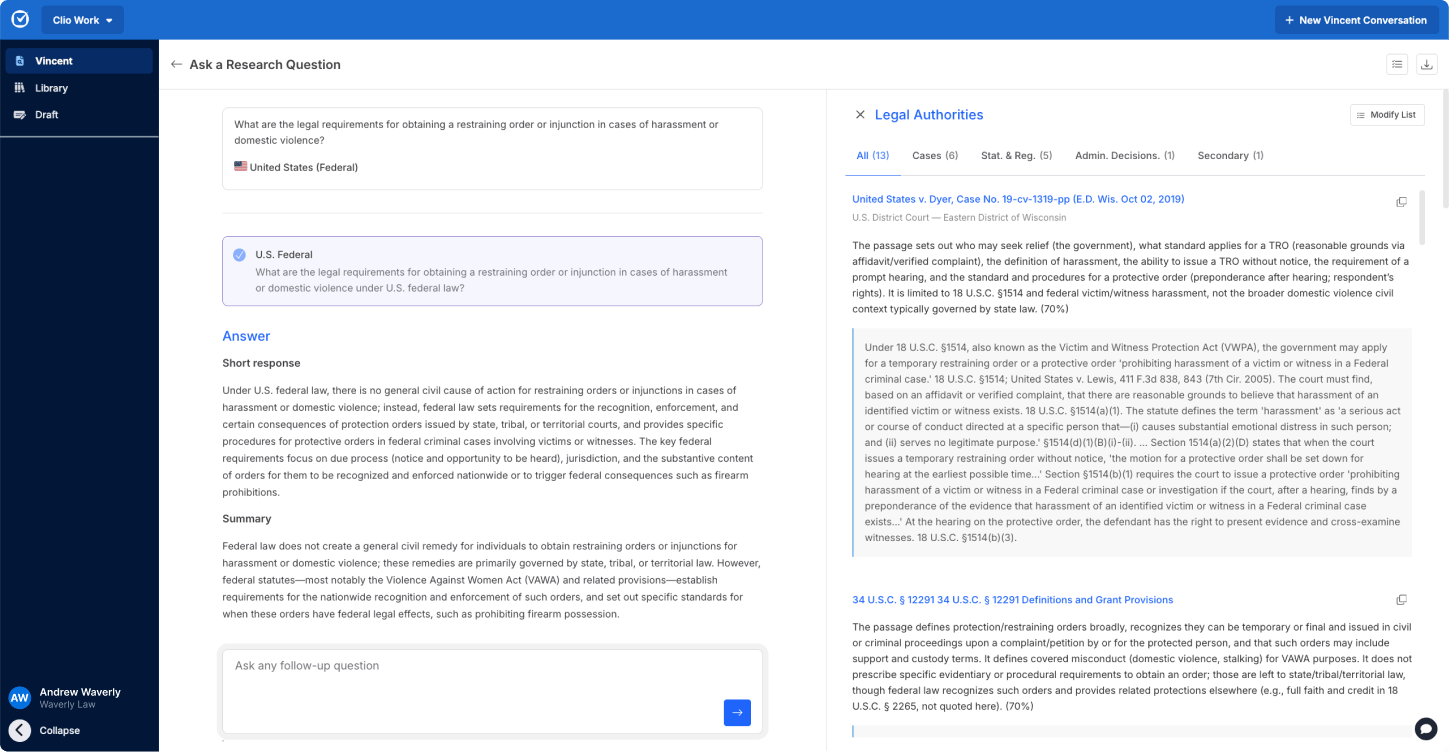
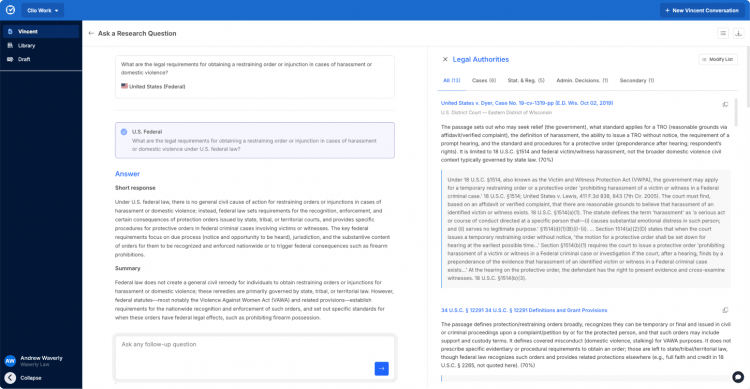
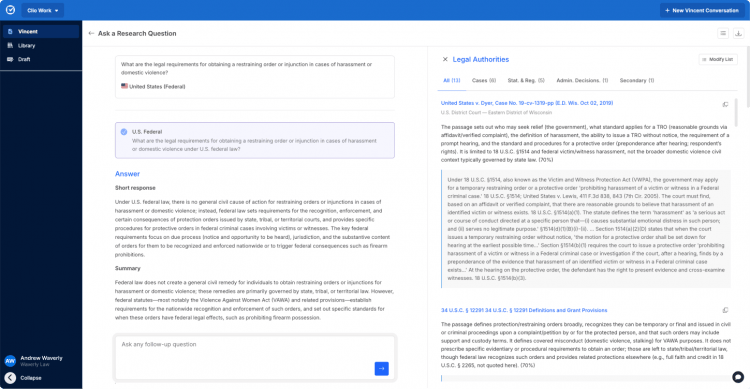
Breaks down individual clauses and explains their meaning, function, and implications in plain language. Used during detailed contract review or negotiation.
Example: A summary explaining a termination clause, including triggers, notice periods, and consequences.
Risk summary
Identifies potential legal exposure, liability provisions, indemnities, limitations of liability, and unusual or one-sided terms. Used in contract review, compliance checks, or due diligence.
Example: Highlights uncapped liability provisions or broad indemnification obligations.
Obligation summary
Extracts duties, responsibilities, and performance requirements for each party. Used to monitor compliance and manage ongoing contractual commitments.
Example: Lists reporting requirements, payment obligations, and service delivery deadlines.
Timeline summary
Identifies key dates, deadlines, milestones, and time-sensitive requirements. Used for matter management and deadline tracking.
Example: Contract renewal dates, notice periods, filing deadlines, or closing timelines.
Case holding summary

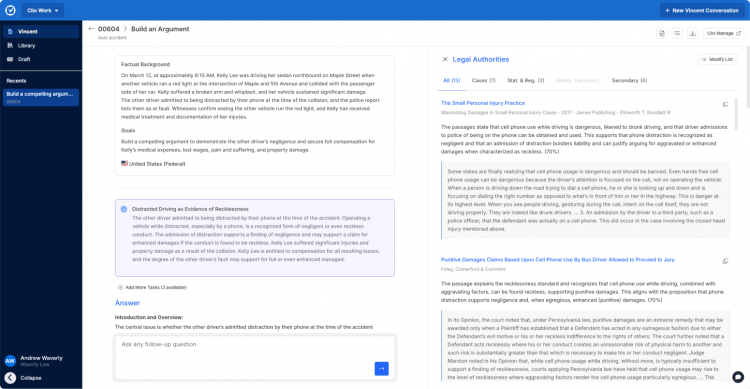
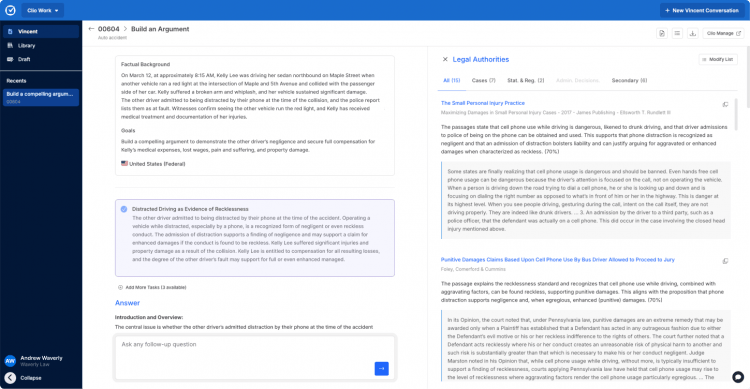
Summarizes the court’s decision, legal reasoning, and precedential value of a case. Used in legal research and case preparation.
Example: Brief explanation of the issue, ruling, and principle established by a judgment.
Multi-document synthesis
Analyzes multiple documents together to identify patterns, inconsistencies, or overarching themes. Used in large transactions, investigations, or litigation preparation.
Example: Comparing multiple agreements to locate conflicting terms or recurring risk provisions.
Can AI summarize case law for legal research?
AI can summarize case holdings, legal reasoning, and precedential value for legal research. An AI document summarizer for legal research can accelerate case review and highlight key issues, helping lawyers make informed decisions faster.
What makes a high-quality legal AI summary
Regardless of the type of summary, its value ultimately depends on how well it meets a set of core capabilities. To determine whether a legal AI summary is helpful and reliable, consider the following questions:
| Completeness vs. concision | Does the summary capture essential legal content without unnecessary detail or oversimplification? |
| Defined-term accuracy | Are defined terms correctly interpreted and applied throughout the document? |
| Preservation of conditions and exceptions | Does the summary retain qualifiers, carve-outs, and conditional language that affect legal interpretation? |
| Citation traceability | Are summary statements linked back to specific clauses or sections for verification? |
| Legal salience prioritization | Does the summary emphasize legally significant provisions such as obligations, liabilities, and risks? |
Common AI legal summarization errors
Even the most advanced AI legal summarization tools can make mistakes. Some of the most frequent errors include:
| Missing exceptions and carveouts | Overlooking critical limitations, exclusions, or qualifying language. |
| Conditional logic loss | Failing to capture the “if-then” relationships that govern obligations and prohibitions. |
| Party/obligation confusion | Misidentifying which party is responsible for specific duties. |
| Scope distortion | Overestimating or understating the breadth of rights, obligations, or provisions. |
| Temporal misinterpretation | Misunderstanding timing requirements, deadlines, or sequence of events. |
Because these risks are inherent to automated summarization, human review ensures accuracy and reliability.
The future of legal document summarization
The future of legal AI goes beyond faster reading; it enables lawyers to use their time more strategically to gain deeper understanding.
With AI rapidly transforming the legal field, legal document summarization is moving beyond static outputs toward more context-aware, actionable capabilities, including:
- Matter-aware AI: Tools like Clio Work understand the broader case or transaction context in which a document exists.
- Automatic deadline extraction: Identifying key dates and triggering reminders.
- Risk flagging: Highlighting unusual provisions, obligations, or potential exposure.
- Integrated billing: Connecting document analysis to timekeeping and value tracking.
- Case-history awareness: Incorporating prior filings, correspondence, and developments into analysis.
Looking ahead, summarizations will become continuously updated “living summaries.” They will adapt as filings, correspondence, and deadlines change, maintaining an up-to-date view of what matters most.
When summaries are matter-aware and structured, they can feed downstream systems such as risk dashboards, obligation tracking, and case timelines. In this model, summarization becomes the foundation for AI-enabled practice management rather than a standalone feature.
Ultimately, AI legal document summarization is most powerful when embedded directly into a law firm’s systems, transforming how legal work is tracked, managed, and delivered. By quickly surfacing risks, obligations, and key next steps, matter-aware summaries help lawyers focus on judgment and strategy instead of manual review.
William Penn described time as our most precious resource. With AI legal document summarization, lawyers can reclaim time as our greatest asset.
Work smarter with AI that understands your matters. Instantly generate accurate, context-aware legal summaries that highlight risks, obligations, and next steps you can act on.