
Meet Claude AI.
We call it ChatGPT’s lesser-known stepsister.
Claude is an excellent generative AI tool that helps read, write, and make sense of large, complex documents. AKA the exact work you drown in daily!
As of 2026, Claude AI has over 18 million monthly users.
But it has limits. Reviewers at The Nevada State Bar found that Claude is a cost-effective AI assistant for routine, non-confidential tasks, but it’s NOT ready to be trusted with privileged legal work yet.
In the next 5 minutes, we’ll walk you through how lawyers use Claude successfully, the best prompts, and “the point of no return,” i.e., what NOT to fully delegate to Claude. Keep scrolling!
Key Takeaways
- Claude excels at document-heavy work.
It’s especially strong at summarizing, drafting, editing, and reviewing long documents. - It’s not a replacement for legal judgment.
Claude can support the research and drafting process. Complex analysis and final review must stay with you. - Privacy and compliance require caution.
Claude Pro may not fully meet confidentiality and regulatory standards for sensitive client data. - Prompts determine output quality.
Clear, structured prompts dramatically improve accuracy and usefulness. - Best used as a first-pass assistant.
For solo practitioners and small firms, Claude works best for low-risk tasks where speed takes a front seat, and outputs are carefully reviewed.
What is Anthropic’s Claude AI?
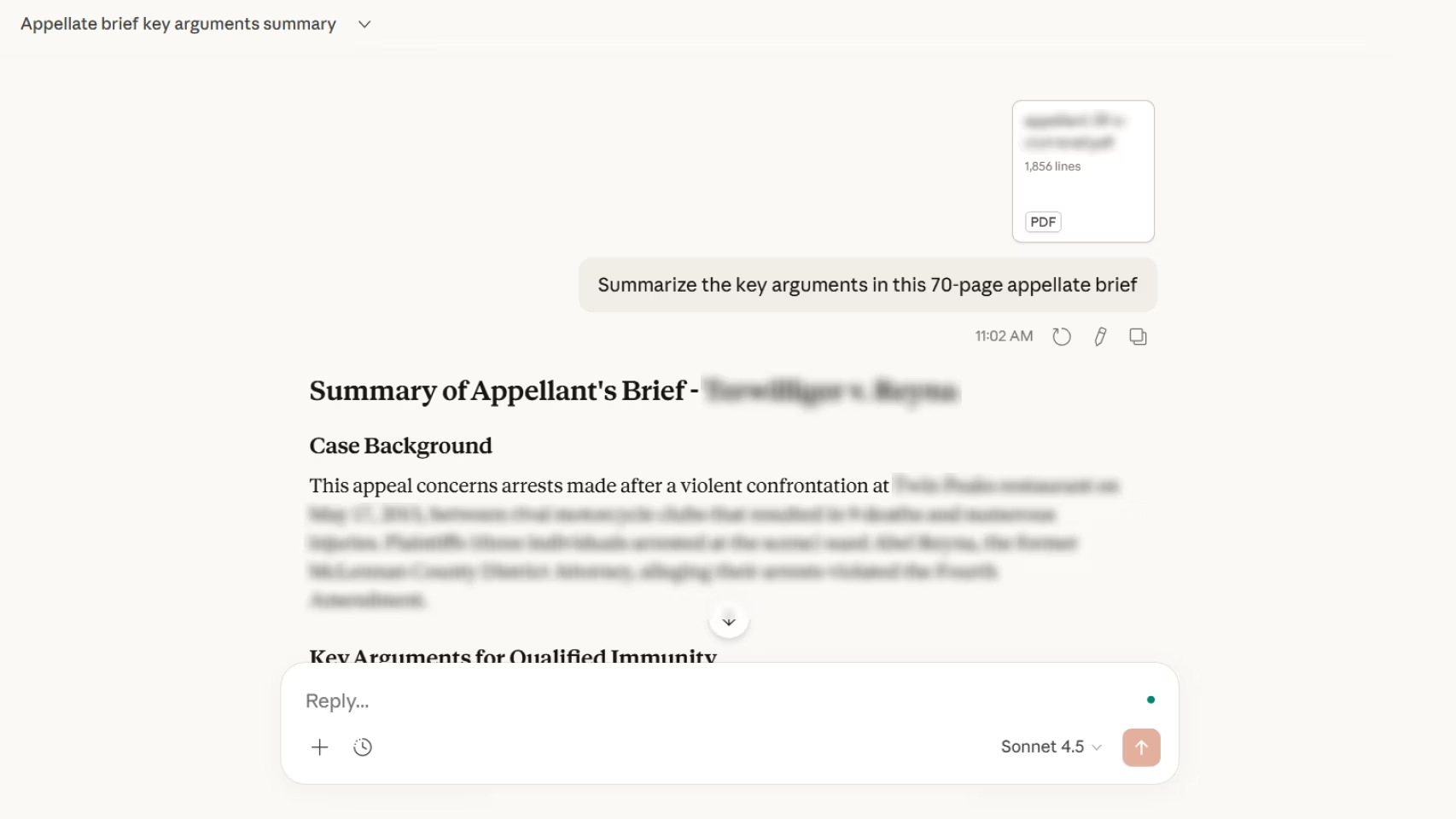
Claude AI is a family of generative artificial intelligence (AI) language models developed by the San Francisco–based AI research company Anthropic.
It was first released in March 2023 and has continued evolving through newer versions like Claude 2, Claude 3, and the advanced Claude 4 series.
The Claude chatbot specifically is trained to understand and generate natural-sounding text, summarize legal documents, answer questions, and help with complex writing tasks.
And according to Anthropic, “Early customers report that Claude is much less likely to produce harmful outputs. You can get your desired output with less effort.”
But Fat Joe’s research unearthed something interesting: “52% of Claude conversations are classified as augmentation, and 45% automation.”
This means Claude still needs guiding, refining, and reviewing its output, rather than being able to fully operate on its own.
Because Claude is delivered as both a chatbot and as a model developers can build on, it doesn’t just live on Claude.ai. It also powers tools and integrations used by lawyers, for example:
- Notion AI, which embeds Claude to enhance writing and organization workflows.
- CoCounsel, legal AI assistants that incorporate Claude’s reasoning.
- Robin AI’s Contract Copilot, which uses Claude to analyze and draft contracts.
- Other platforms like SuperLawyer that embed Claude’s capabilities into legal research.
That being said, when exactly is it recommended to use Claude as an AI legal assistant?
Use Cases of Claude AI for Lawyers
Claude can be used in dozens of ways across a legal practice… but watch out!
It is NOT recommended for all use cases.
We’re about to walk you through 4 of the most practical ways you can use Claude today.
These are tasks where it saves time, reduces repetitive work, and supports your legal judgment (without compromising it).
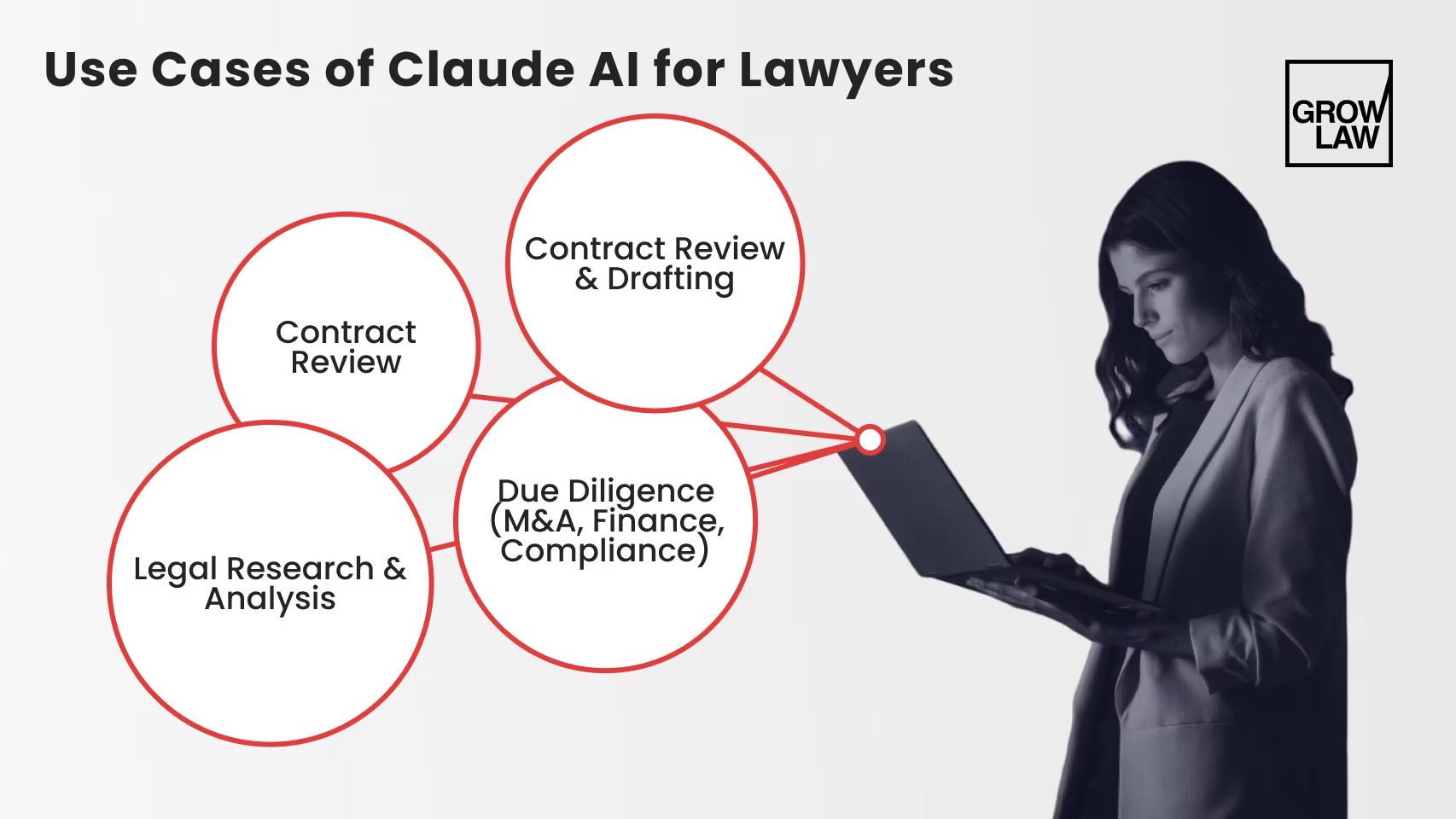
— Legal Research & Analysis
Claude is especially useful at the front end of legal research.
This is when you’re trying to get oriented fast.
A lawyer on Reddit confirms, “You can upload a PDF of prior complaints, with a note of facts of the case. You can then upload a new PDF which presents the facts of a similar case, and it can generate a complaint with 95% of what we were looking for.”
Anthropic’s own usage data shows Claude is heavily used for legal research assistance:
- Summarizing case law and statutes quickly by pulling out key holdings, reasoning, and issues.
- Framing arguments by outlining how a rule may apply to a fact pattern or where counterarguments could arise.
- Clarifying complex concepts in plain language for faster understanding.
Yes, Claude accelerates research in the legal industry.
But (and there’s a big but!) attorneys still need to verify sources, citations, and conclusions before relying on anything it gives them.

— Contract Review & Drafting
Claude tends to shine with contract work.
Claude Pro is well-suited to high-volume, text-based work, making it amazing for contracts, agreements, and other document-heavy tasks that follow repeatable patterns:
- Summarize and scan contracts quickly, pulling out key obligations, deadlines, and risk areas without reading every line manually.
- Flag unusual or non-standard clauses, so you know where to focus your attention.
- Draft first-pass language for routine contracts, amendments, and redlines, saving time on boilerplate-heavy work.
The Nevada State Bar says, “Claude Pro scores a 3.33 out of 5 in accuracy and reliability, making it generally reliable for routine work.”
We’ll say it again: Final review, negotiation strategy, and risk decisions still firmly fall in your lap.
— Due Diligence (M&A, Finance, Compliance)
Claude is most useful in due diligence when volume is the problem (which is always).
Legal reviewers note, it performs best on document-heavy, repeatable tasks… exactly what M&A and compliance reviews demand.
Qubit reports, “A well-executed AI due diligence process minimizes oversight errors, often reducing them by 20–30%.” Use Claude to:
- Scan large legal document sets to summarize contracts, disclosures, and policies.
- Surface potential risk areas by grouping obligations, inconsistencies, and unusual clauses.
- Create structured summaries lawyers can quickly validate and escalate.
State Bar of Nevada confirms this: “Claude Pro offers solo practitioners and small legal teams a useful AI tool for routine tasks like document summarization and drafting, receiving a satisfactory score of 31.62 out of 50.”
— Contract Review
Reviewing contracts is one of Claude’s strongest, most practical use cases!
Leah notes, “Claude’s document analysis capabilities show particular strength in extracting nuanced meaning and identifying inconsistencies within documents, without losing context.”
We concur! Use Claude AI to:
- Summarize long contracts by extracting key obligations, deadlines, and risk points.
- Flag non-standard or unusual clauses so lawyers know where to focus their review.
- Assist with first-pass drafting and redlines for routine agreements and amendments.
But as a lawyer on Reddit came to find when using Claude for complex legal work: “Even the best AI models hallucinate or miss small but meaningful details.”
This is a sobering reminder that while AI can assist legal work, to uphold legal standards, the accuracy still rests with you.
Best Claude AI Prompts for Lawyers
Let’s take Claude for a whirl!
Here are a couple of practical prompt examples you can use to streamline legal research.
All in all, Claude is highly impressive. To quote Claude’s documentation, “It can significantly speed up the research process, allowing legal professionals to focus on higher-level analysis and strategy development.”
THAT is the real win: The freedom you get back to focus on high-value legal services.
Speed Up Your Process with Claude. Get Clients with Grow Law.
Claude AI can absolutely make lawyers more efficient. To recap:
- Use Claude to speed up research and document review
- Apply it to first-pass document drafting and due diligence
- Rely on it to organize analysis, not replace judgment
- Write precise prompts with jurisdiction, context, and goals
- Keep humans firmly in the review loop
But efficiency alone doesn’t grow a law firm. Clients do!
Contact Grow Law today. Since 2008, we’ve helped 100+ practices compete (and win!) in very crowded markets.
With SEO, PPC, and AI search optimization, we tie every dollar back to real clients and real revenue!
One of our clients, Texas Horizons, saw a 1,300% lead growth, along with a massive 1,215% marketing ROI with our services.
Ready to join in the success?
Get Your Free Growth Plan Today ($499 Value)