
Published on 2024-04-23 bySarah Glassmeyer Now that the initial rush of excitement over Generative AI and LLMs has passed, those digging into the efficacy and sustainability of these tools are looking at topics such as the provenance of the training data. The copyright status of the material seems to be the primary issue of concern, with lawsuits
New York Bar Association New AI Guidance: Part 2
****
New York Bar Association New AI Guidance: Part 2
In last week’s column, I shared news of the recent artificial intelligence (AI) guidance handed down by the New York State Bar Association’s AI Task Force in the “
The American Privacy Rights Act: Could This Be the One?
Introduction
The chair of the U.S. Senate Committee on Commerce, Science, and Transportation, Maria Cantwell (D-WA), and the chair of the U.S. House Committee on Energy and Commerce, Cathy McMorris Rodgers (R-WA), released a discussion draft of the American Privacy Rights Act (APRA) on April 7, 2024. This announcement of a bipartisan, bicameral bill for
Generative AI Tools And Tips.
Generative AI Tools and Tips. Jim Calloway and Julie Bays, of the Oklahoma Bar, have penned a great article on the use of AI in law practice. They discuss document and deposition summaries, web based browser tools, drafting tools, video editing tools, Open AI’s Chat GPT, and Microsoft’s Co-Pilot, which integrates Chat GPT into the
Newsletter : Law Droid Manifesto
Another AI law newsletter that we ought to make you aware of This newsletter, LawDroid Manifesto, is here to keep you in the loop about the intersection of AI and the law. Please share this article with your friends and colleagues and remember to tell me what you think in the comments below. As
Real vs. Fictional: Can Reality Survive AI?

Thanks again to all my readers! Appreciate you. ❤️And to you newbies, you’ve matched the torn pieces of the map, X marks this spot! 🏴☠️
This substack, LawDroid Manifesto, is here to keep you in the loop about the
Revolutionizing Law Firm Training with AI: The Power of Large Language Models
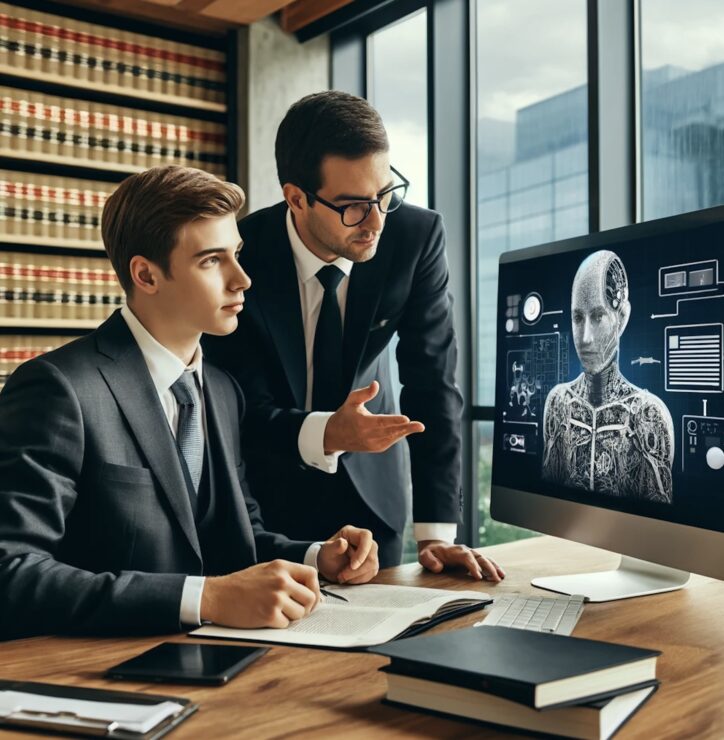
It goes without saying that one of the most critical functions of a law firm is to train its associates adequately. But time constraints and a lack of consistency, as I have previously discussed, make good, sound training of associates problematic in many firms. However, large language models and GenAI, even open models, may
Embracing AI in Patent Law: Navigating the USPTO’s Latest Guidance
The USPTO’s recent guidance on AI usage marks a critical moment for legal practitioners. This document emphasizes the necessity for both technical and human oversight in mitigating the risks associated with AI tools. The agency is committed to leveraging AI’s benefits across society while ensuring that these technologies do not compromise the integrity of legal processes. The
Overview of AI Regulatory Landscape in APAC
With the rapid evolution of artificial intelligence (AI) technology, the regulatory frameworks for AI in the Asia–Pacific (APAC) region continue to develop quickly. Policymakers and regulators have been prompted to consider either reviewing existing regulatory frameworks to ensure their effectiveness in addressing emerging risks brought by AI, or proposing new, AI-specific rules or regulations. Overall,
What’s New? April 2024
EU AI Act passed
The European Parliament approved the Artificial Intelligence Act (EU AI Act) on 13 March 2024. It has been hailed as the world’s first comprehensive and binding piece of legislation on AI, although many of its provisions won’t be enforced for at least a year or two. Rather than attempting to regulate