
Many of the traditional legal issues faced by technology startups also apply to artificial intelligence startups. Although there are some unique challenges related to model-context-protocol developers and startup companies, the foundational requirements remain largely the same. These include establishing the appropriate corporate structure, identifying and protecting intellectual property, creating contracts for contractors, founders, and employees,
Quick Thought – Prompting is Written Communication
Maybe this is another good reason to provide management and communication training to all employees, because soon we’ll all be managing our AI tools. Knowing how to communicate clearly would make a massive difference in creating that “relationship” at work.
The post Quick Thought – Prompting is Written Communication appeared first on Mike McBride Online
Live Today: The Legaltech Week Panel Breaks Down ILTACON; Plus, the Risks of Agentic AI and On-Premises Software
 Join us live today at 3 p.m. E.T. for Legaltech Week — our weekly breakdown of the top stories in legal tech — as the panelists share their impressions and takeaways from the recently concluded ILTACON. Plus, to help us do that, we will be joined by a special guest: Jeffrey Brandt, editor of Law Technology
FDA Issues Guidance on AI for Medical Devices
The Food and Drug Administration (FDA) issued final guidance Monday that explains how medical device manufacturers can use a Predetermined Change Control Plan (PCCP) to update AI-enabled device software functions (AI-DSFs) after clearance or approval without submitting a new marketing application for each covered change.
The guidance is a practical how‑to for getting the FDA
Guest Post: Ken Crutchfield on How Legal AI Innovators Can Get First-Mover Advantage On the Next Big Thing
 First movers in legal tech often win the day, says Ken Crutchfield, but without also anticipating what’s ahead, an early move can be quickly outmoded. This is particularly true given the pace of development of major AI developers such as OpenAI, Google, Meta and others. But what if an AI innovator could know — or
U.S. Tech Legislative & Regulatory Update – 2025 Mid-Year Update
This update highlights key mid-year legislative and regulatory developments and builds on our first quarter update related to artificial intelligence (“AI”), connected and automated vehicles (“CAVs”), Internet of Things (“IoT”), and cryptocurrencies and blockchain developments.
I. Federal AI Legislative Developments
In the first session of the 119th Congress, lawmakers rejected a proposed moratorium on state
How to Measure the ROI of Legal AI Implementation: A 5-Step Framework
What does ROI mean in legal AI implementation?
ROI in legal AI is the measurable value a law firm or legal department gains from legal AI, relative to the time, money, and effort invested in it. Simply put, it’s about using technology to get better legal outcomes at a lower cost.
Understanding ROI is especially
On LawNext: Reveal’s CEO and CTO Discuss the Company’s Launch of Gen AI for E-Discovery Review
 The e-discovery company Reveal Data recently announced that it will launch its new generative AI-powered document review platform, called “aji,” in late September. Notably, the company said it is offering full access to the platform at no cost through Dec. 31, in order to enable “the entire legal community to explore and master the next
NIST Welcomes Comments for AI Standards Zero Drafts Project
On July 29, 2025, the National Institute of Standards & Technology (“NIST”) unveiled an outline for preliminary, stakeholder-driven standards, known as a “zero draft”, for AI testing, evaluation, verification and validation (“TEVV”). This outline is part of NIST’s AI Standards Zero Drafts pilot project, which was announced on March 25, 2025, as we previously reported. The
Thomson Reuters CEO: Legal Profession Faces “Biggest Disruption in Its History” from AI
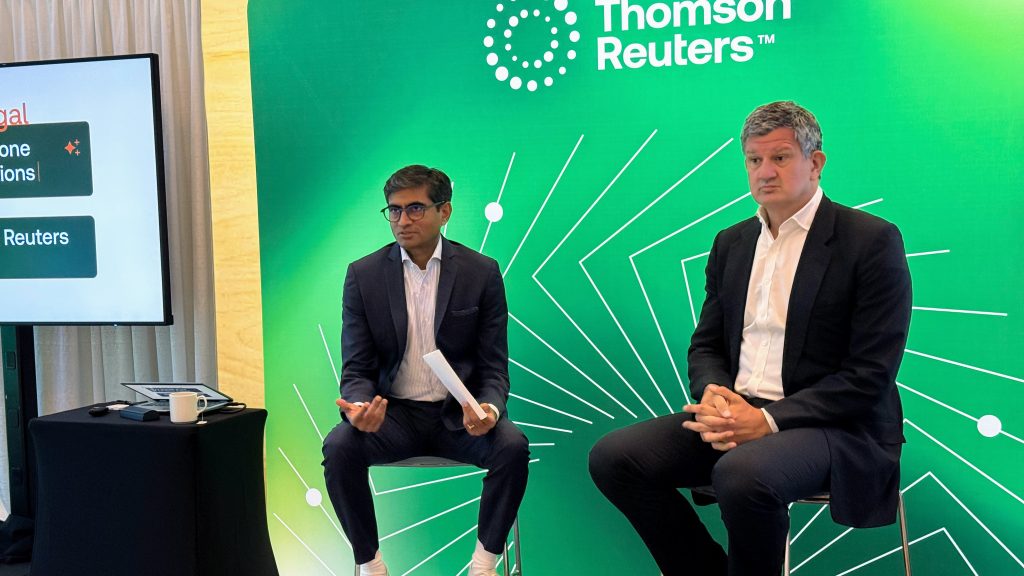 Thomson Reuters President and CEO Steve Hasker believes the legal profession is experiencing “the biggest disruption … in its history” due to generative and agentic artificial intelligence, fundamentally rewriting how legal work products are created for the first time in more than 300 years. Speaking to legal technology reporters during ILTACON, the International Legal Technology