
EmTechMIT, Cambridge, MA: When Matthew Prince, Co-Founder and CEO of Cloudflare, took the EmTechMIT stage in Cambridge, he delivered what felt less like a keynote and more like a wake-up call for the digital economy. His talk, titled Protecting the Open Web Economy, was a sharp analysis of how artificial intelligence is quietly rewriting the
Scholarship Clout Chasing
Reading Time: 8 minutes
I had a sales pitch from a program inside Elsevier’s SSRN unit. The idea was to create a Research Paper Series that showcases the law school’s scholarship. The Dean pitched the cold call over to me and so I followed up. I was interested to see that part of the pitch
The Law Bytes Podcast, Episode 249: The Debate Over Canada’s AI Strategy – My Consultation Submission and Appearance at the Canadian Heritage Committee
The government’s AI consultation concluded at the end of October with expectations that a strategy will emerge before the end of the year. I participated in the consultation with a brief submission and in an appearance as a witness before the Standing Committee on Canadian Heritage for its study on the effectiveness of technological advances
AI enablement: Setting your firm up for success
AI is no longer a boardroom buzzword — it’s here and it’s moving fast. Executives across industries are looking to innovations in AI to improve and accelerate their firms’ efficiency, performance, and growth.
But without the right foundations in place, AI initiatives will falter or fail. According to McKinsey, 88% of organizations now use
Grace Under Omission: Leadership Beyond the Room
Editor’s Note: From boardrooms and caucus chambers to corporate committees and community organizations, leadership unfolds within groups that shape decisions and direction. Yet exclusion—intentional or incidental—remains a persistent test for those outside the room. Drawn from observations across the military, public companies, venture-backed startups, and established private organizations, this reflection outlines how leaders can respond
Law Librarians Take the Lead: The Future of AI and Legal Information
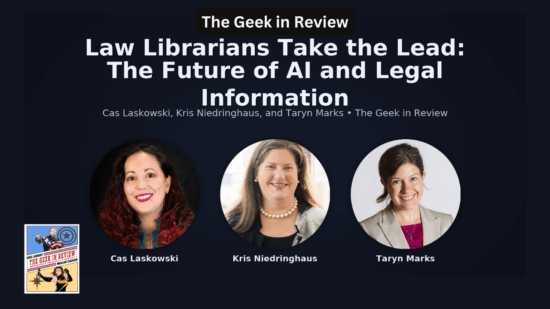
In this episode of The Geek in Review, we welcome three powerhouse guests—Cas Laskowski, Taryn Marks, and Kristina (Kris) Niedringhaus—who are charting a bold course for Artificial Intelligence & the Future of Law Libraries. These three recently co-authored a major white paper, Artificial Intelligence and the Future of Law Libraries (pdf), which we see as less of a report and more of a call to arms. Together, we explore how law librarians can move from reactive observers of AI’s rise to proactive architects shaping its ethical and practical integration across the legal ecosystem.
Cas Laskowski, Head of Research Data and Instruction at the University of Arizona College of Law, shares how the release of ChatGPT in 2022 jolted the profession into action. Librarians everywhere were overwhelmed by the flood of information and hype surrounding AI tools. Cas’s response was to create a space for collective thinking and planning: the Future of Law Libraries initiative and a series of roundtables designed to bring professionals together for strategic collaboration. One of the paper’s most ambitious recommendations—a centralized AI organization for legal information professionals—aims to unify those efforts, coordinate training, and sustain a profession-wide vision. Cas compares the idea to data curation networks that transformed academic libraries by pooling expertise and reducing duplication of effort.
Kris Niedringhaus, Associate Dean and Director of the University of South Carolina School of Law Library, takes the conversation into education and training. She makes a compelling case that “AI-ready librarians,” much like “tech-ready lawyers,” need flexible skill-building models that recognize different levels of engagement and expertise. Drawing from the Delta Lawyer model, Kris calls for tiered AI training—ranging from foundational prompt literacy to higher-level data ethics and system design awareness. She also pushes back against the fear surrounding AI in academia, noting that students are often told not to use AI at all. We couldn’t agree more with her point that we’re doing students a disservice if we don’t teach them how to use these tools effectively and responsibly. Law firms now expect graduates to come in with applied AI fluency, and that expectation will only grow.
When we turned to Taryn Marks, Associate Director of Research and Instructional Services at Stanford Law School’s Robert Crown Law Library, the discussion moved to another key recommendation: building a centralized knowledge hub for AI-related best practices. Taryn describes how librarians are eager to share materials, lesson plans, and policy frameworks, but the current efforts are fragmented. A shared repository would “reduce duplication of effort” and allow ideas to evolve through open collaboration. It’s similar to how standardized models like SALI help the legal industry align without giving away anyone’s secret sauce. We loved this idea of a commons where librarians, educators, and technologists work together to lift the entire profession.
As we explored the broader implications, all three guests agreed that intentionality is key. Cas emphasizes that information architecture—the design of how knowledge is gathered, tagged, and retrieved—is central to AI’s success. Kris points to both the promise and peril of automated legal decision-making, warning that “done well, AI can expand access to justice; done poorly, it can amplify bias.” And Taryn envisions a future where legal information professionals are trusted collaborators across the entire lifecycle of data and decision-making.
We closed the conversation feeling both inspired and challenged. The message is clear: law librarians shouldn’t sit on the sidelines of AI. They are uniquely positioned to lead, to teach, and to ensure that the technologies shaping law remain grounded in ethics, accessibility, and the rule of law. For those who want to get involved, Cas directs listeners to the University of Arizona Law Library’s Future of Law Libraries Initiative page, which includes the white paper and volunteer opportunities. This episode reminded us that the future of AI in law won’t be defined by the tools themselves, but by the people—especially librarians—who decide how those tools are used.
Links:
- Future of Law Libraries Initative
- Artificial Intelligence and the Future of Law Libraries Regional Roundtables
- White Paper: Building the Future of Law Libraries: Artificial Intelligence, Opportunities, and Advancement (PDF)
Listen on mobile platforms: Apple Podcasts | Spotify | YouTube
[Special Thanks to Legal Technology Hub for their sponsoring this episode.]
Email: geekinreviewpodcast@gmail.com
Music: Jerry David DeCicca
Transcript:
Chatbot, The Snitch
It’s unclear whether it’s the fact that people may use the internet and technology without having any real grasp of what their use entails, or that they just don’t care. But with the advent of chatbots, people are seeking legal, medical, sexual, and other interactions that involve their most intimate and personal thoughts, queries and
NATO’s Counter-Drone Solution: Inside the Merops Deployment Reshaping European Air Defense
Editor’s Note: NATO’s deployment of the Merops counter-drone system along its eastern flank marks a pivotal evolution in air defense—one that cybersecurity, information governance, and eDiscovery professionals should follow closely. Merops is a compact, AI-driven platform that integrates radar, optical sensors, and autonomous interceptor drones to detect and neutralize unmanned aerial threats, even under electronic
AI for Litigators: 6 Legal Technology Trends in Commercial Litigation | DISCO
Explore the top 6 legal technology trends for commercial litigators and see how AI is transforming discovery, drafting, and case strategy.
What Is the Best Province in Canada for Tech Companies?
What Is the Best Province in Canada for Tech Companies?
- Ontario and British Columbia lead as the top choices for most tech companies, offering deep talent pools, investor access and strong innovation ecosystems.
- Alberta and Quebec are emerging as powerful alternatives, combining lower costs, AI leadership and growing immigration pathways for global talent.
- Atlantic