
When the FTC finalized an almost $200,000 settlement order for “AI lawyer” DoNotPay back in February, some believed it would impede the spread of artificial intelligence in the industry. That hasn’t happened – instead, the line in the sand drawn by this case remains intact. For the foreseeable future, it seems that AI will be a tool to assist attorneys and paralegals, not replace them.
But what does that look like in practice – and how is it affecting hiring?
Rise of AI Tools in Law Firms
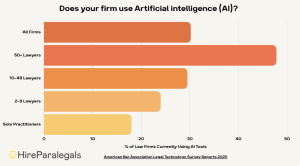
While reports of the exact breadth of AI adoption in law firms vary, leading research places AI usage at between 30.2% (ABA Legal Technology Survey 2025) and 79% (Clio Legal Trends Report 2024) of US attorneys. AI is most widely used by large firms, where almost half of all firms report using at least one AI tool, with solo practitioners being the least likely to adopt the new technology at just 17.7%.
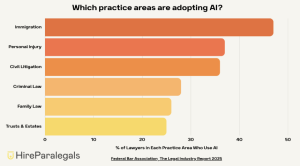
When evaluating AI use by practice area, immigration law is leading the way, with almost half (47%) of all firms surveyed having already adopted AI tools, followed by personal injury (37%) and civil litigation (36%).
By some estimates, overall AI adoption is up from just 19% in 2023 (Clio Legal Trends Report 2024).
AI Tools in Law Firms
The AI tools being adopted by law firms range from general-use LLMs like ChatGPT and Claude to specialist platforms. Some of the most popular include Thomson Reuters CoCounsel, Lexis+ AI, Westlaw AI, DocDraft, Paxton AI and Henchman, AI tools designed to assist lawyers in their workflow, often with document management and contract drafting.
Alongside these tools, “artificial lawyers” such as Harvey and the aforementioned DoNotPay have begun to emerge, which are designed to take on more of the responsibilities of an attorney. However, these are far less widely adopted by the industry so far.
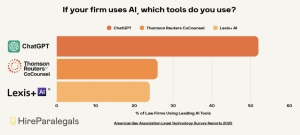
At present, ChatGPT is used by 52.1% of firms currently employing AI, with Thomson Reuters CoCounsel adoption at 26% and Lexis+ AI at 24.3%.
Benefits & Drawbacks of AI
Law firms identify a range of benefits to using AI tools. Efficiency was cited most commonly as a potential benefit, mentioned by 54.4% of attorneys, followed by document management at 9.1% and cost reduction at 4.5%. Notably, 17.4% of lawyers interviewed stated that they did not know enough about AI to accurately identify the potential benefits (ABA Legal Technology Survey 2025).
However, attorneys also report major concerns regarding the adoption of AI tools into law practices. Over two-thirds of respondents identified lack of accuracy as a major risk when implementing AI, followed by reliability (56.3%), data privacy and security (47.2%), costs of implementation (22.1%), and time to learn new technologies (21.3%).
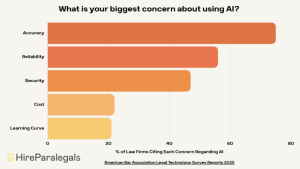
This caution is broadly supported by the data – studies show that artificial intelligence hallucinates in at least 1 out of 6 legal queries (Stanford Institute for Human-Centered Artificial Intelligence, 2024).
Hiring Trends in Law Firm
When AI reached the mainstream with the launch of ChatGPT in 2022, many thought it would begin to replace human employees, including within the legal sector. But despite the increased efficiency brought about by AI tools, legal hiring remains on the rise: in 2025, half of all law firms in the US report that they are currently hiring, with 65% planning to increase their use of contract professionals this year (Robert Half, 2025). For every unemployed legal professional, there are an estimated 4-5 vacancies in the industry (Estrin Report 2023).
One indicator of this is the graduate employment rate. The percentage of law graduates employed in the legal industry reached 82% in 2024, up from 80% in 2023 and 75.6% in 2021, a trend that has accompanied an overall increase in law school enrollment and graduation, “defying predictions that a double-digit enrollment surge would weaken job prospects” (ABA/Reuters 2025).
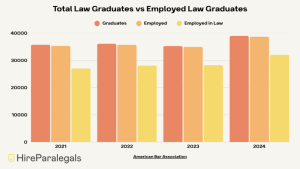
Alongside attorneys, demand for paralegals, legal assistants and other legal administrative employees is expected to grow 10% from 2022 to 2032, significantly faster than the average for all occupations (Bureau of Labor Statistics). There are projected to be over 45,000 openings for paralegals and legal assistants per year over the decade, and the US News & World Report ranks paralegals 8th overall for demand among social services jobs.
Largely, this is because attorneys continue to find themselves bogged down with administrative work that does not require their expertise. Despite the rise in AI-powered tools, 77% of small law firms reported that they spend “too much time” on admin tasks, leaving them with insufficient time to focus on their specialist work (State of US Small Law Firms Report 2023). In the 2024 Future of Professionals Report, 42% of attorneys reported that they planned to spend more time on expertise-driven legal work in the next five years.
HireParalegals.com & The New Law
While hiring among law firms remains strong, the trends governing how firms hire are being shaped by “the new law” – the direction that the sector is moving towards as a result of massive industry and technological changes. This includes the shift towards remote work, with 87% of law firms now allowing employees to work remotely, and the rise in contract work and nearshoring (ABA/Reuters).
With these shifts in hiring practices, companies like HireParalegals.com have emerged to simplify the process of hiring remote part-time and full-time legal support professionals. HireParalegals.com is a dedicated law talent marketplace, offering pre-vetted paralegals, legal assistants and other support staff available to hire in just 24 hours at discounts of up to 80% compared to traditional hiring methods. Firms can browse a curated marketplace of experienced law professionals and hire on a flexible monthly basis.
If your firm is looking to hire, you can get $500 off your first month by visiting www.hireparalegals.com and using the promo code STEVE.

The post How AI is Transforming Law Firm Operations appeared first on FRETZIN, INC..