

The FCC has proposed robocall fines against a caller and, for the very first time, against the carrier involved. First, the FCC issued a Notice of Apparent Liability for Forfeiture proposing a $6 million fine against political consultant Steve Kramer for perpetrating an illegal robocall campaign targeting potential voters two days before the New Hampshire’s
AI Tools for Legal Work: Claude, Gemini, Copilot, and More
There’s no denying that AI has become a hot topic in the legal profession. However, if you haven’t already found the AI tool of your dreams, figuring out where to start can feel overwhelming. While there are countless AI tools available that are designed specifically for lawyers, other, more “generic” tools have been touted
Stanford Will Augment Its Study Finding that AI Legal Research Tools Hallucinate in 17% of Queries, As Some Raise Questions About the Results
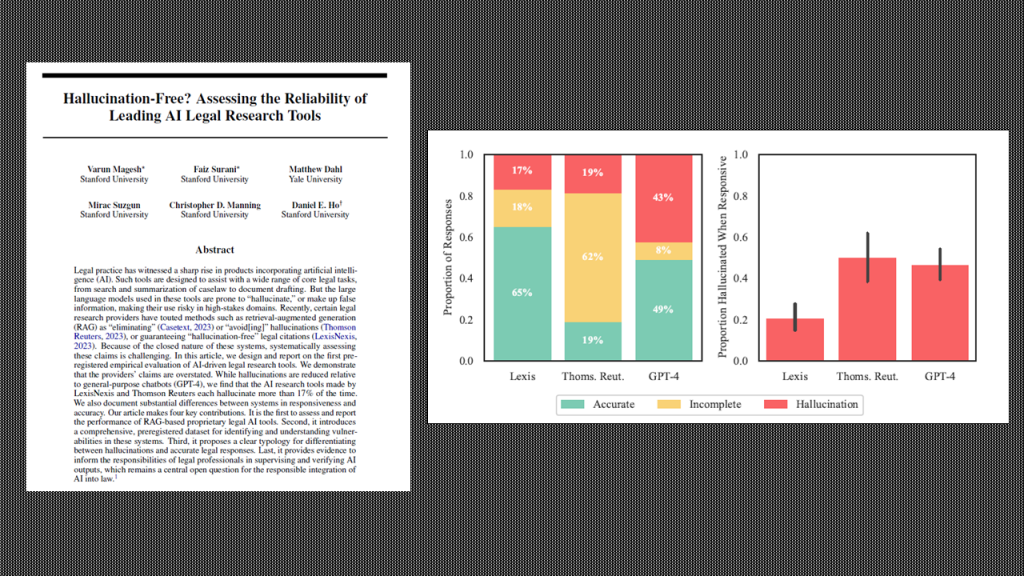 Stanford University will augment the study it released last week of generative AI legal research tools from LexisNexis and Thomson Reuters, in which it found that they deliver hallucinated results more often than the companies say, as others have raised questions about the study’s methodology and fairness. The preprint study by Stanford’s RegLab and its
Greg Lambert – An Honest conversation about RAG and Hallucination-Free Legal Research Tools
Greg Lambert writes May 28 2024 Adam Ziegler‘s post calling on Legal Research Vendors like Thomson Reuters and LexisNexis to shoulder the burden of proving claims like Lexis’ “The fastest legal generative AI with conversational search, drafting, summarization, document analysis, and hallucination-free linked legal citations” has valid points. Since I was one of the vocal
Navigating Data Privacy and Security Challenges in AI: A Legal Guide for Companies
With the advent of Artificial Intelligence (AI) technologies, it is valuable for companies to leverage their power to bolster innovation and outperform their competitors. Yet, given the vast amount of data required to train AI models, these technologies also raise concerns about the privacy and security of data. Companies need to navigate complex legal
ABA Weighs in on Listserv Ethics
****
ABA Weighs in on Listserv Ethics
At first glance, you might assume that this article was published in the early 1990s and was reprinted by mistake. If so, you’d be wrong. The truth is, the American Bar Association
Senate Releases Bipartisan AI Roadmap
Joel Roberson, Marissa Serafino, Paul Stimers, Todd Wooten Highlights The Bipartisan Senate Artificial Intelligence (AI) Working Group on May 15, 2024, released “Driving U.S. Innovation in Artificial Intelligence: A Roadmap for Artificial Intelligence Policy in the United States Senate” (Roadmap). The Roadmap comes at the end of months of high-profile forums, classified briefings and other information-gathering efforts
Unchartered Territories: Canadian Courts and Law Societies Grapple with the Use of Generative Artificial Intelligence Tools
Scott Bower, Stephen Burns, Ahmed Elmallah, J. Sébastien Gittens Canadian courts and law societies, alike, are faced with an ever-evolving challenge: straddling the line between recognizing the potential benefits of emergent generative artificial intelligence (GenAI), while balancing the associated risks of using this technology. Principle to these associated risks is the ability of GenAI to “hallucinate” (i.e., generate
UK Regulators Share Views on Artificial Intelligence and Machine Learning Regulation
Yulia Makarova On 1 February 2024, the UK government’s Department for Science, Innovation and Technology and His Majesty’s Treasury addressed a joint letter to the Bank of England (BoE) and the Prudential Regulation Authority (PRA) requesting an update on their strategic approach to the adoption and implementation of artificial intelligence (AI) and machine learning (ML)
Colorado Passes First-in-Nation Artificial Intelligence Act
Maneesha Mithal, Stacy Okoro, Christopher Olsen Wilson Sonsini Goodrich & Rosati On May 17, 2024, Governor Jared Polis signed the Colorado Artificial Intelligence Act (SB 24-205) (CAIA), regulating the development, deployment, and use of artificial intelligence (AI) systems. Colorado is the first state to enact comprehensive AI legislation. The law becomes effective February 1, 2026. Summary CAIA applies