
BARRY ZALMA, ESQ., CFE
If you are in need of any assistance with regard to insurance issues the following information to assist you came from two different AI operations.
MOST RESPECTED FROM AI
Barry Zalma is an internationally recognized insurance expert, attorney (Esq., CFE), and prolific author with over 50 years of experience in insurance
Motion to Dismiss Denial of a Service Animal Goes Down in Flames
The Society of Human Resources Management is not the only employer facing litigation for denying a service animal. On January 13, 2026, the Flaming Gorge Resort saw its motion to dismiss with respect to its denial of a service animal for an employee go down in flames (pun intended). The case is O’Connor v. Colett’s
Major HIPAA Security Rule Changes on the Horizon: Is Your Healthcare Organization Ready?

This post is part of our The Top 2025 Privacy and Security Issues Still Shaping Healthcare series, in which our team of attorneys provides essential strategies and insights for healthcare privacy and security.
Why Now? The Rising Cyber Threats Driving HIPAA Reform
In December 2024, the U.S. Department of Health and Human Services Office for Civil Rights (OCR) proposed the first significant update to the HIPAA Security Rule since 2013, prompted by a surge in cyberattacks against healthcare organizations that have compromised patient information and disrupted care.
The Hidden Cost of Cheap Legal Content
That $50 blog post looks like a bargain until your managing partner spends two hours fact-checking it, your compliance team flags three ethical issues, and you realize it ranks nowhere on Google while your $500 PPC clicks land on content that converts at half your site’s average.
Cheap legal content isn’t cheap; in fact, it
So, You Hired a Fraudulent Employee—Now What?
Figuring out that you hired the wrong person is always jarring. But what if the “wrong person” was never who they said they were at all? When an employer discovers that a current employee has misrepresented their identity—whether by applying using a stolen name and Social Security number, misrepresenting their identity using artificial intelligence (AI),
The Clarity Catalyst: Tara Waters
Hey there Legal Rebels! 👋 I’m excited to share with you the 57th episode of the LawDroid Manifesto podcast, where I will be continuing to interview key legal innovators to learn how they do what they do. I think you’re going to enjoy this one!If you want to understand how to guide law firms through
Human-in-the-Loop Is Systems Stewardship
An investigation into why serious AI work depends less on clever prompts and more on defending invariants, boundaries, and human judgment.At the end of a long, technical AI session this week, something became clear to me: human-in-the-loop is being misunderstood in ways that matter.The issue wasn’t whether the system could generate outputs quickly or
Federal court provides road map for lawful DEI programs
I keep getting asked how employers can legally maintain DEI programs in today’s political climate. A federal judge just answered that question in a lawsuit the Missouri Attorney General brought against Starbucks—and in dismissing it, handed corporate America a roadmap.
The AG argued Starbucks’ DEI policies were illegal because they “favored” BIPOC, women, and LGBTQ+

DISCO Launches Scaled Agentic AI Tool for Large Discovery and Fact Investigation Matters
Calling it “the industry’s first scaled agentic AI tool for fact investigation and e-discovery,” DISCO today announced an agentic AI enhancement to its Cecilia Q&A tool, which the company says is designed to handle large-scale e-discovery matters with millions of documents and terabytes of data. The Austin-based legal technology company’s new tool adds what it
Midpage Goes Native: Legal Research Inside Claude and ChatGPT, with Otto von Zastrow
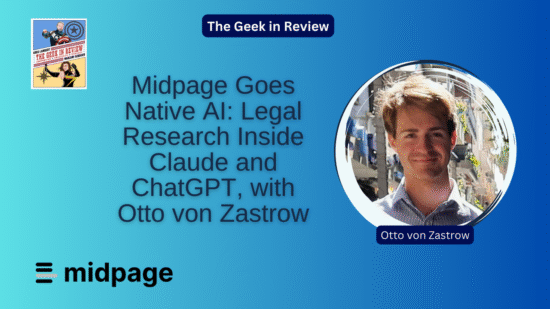
A fresh Anthropic announcement set off a week of market jitters and existential questions: what happens when the big model shops ship “legal productivity” features and the public markets flinch. This week, we bring Otto von Zastrow back for a rapid-response conversation, with a front-row view from New York and a blunt take: software grows cheaper to reproduce, so value migrates. The discussion lands on a key distinction, interface versus data, and why the old guard still holds leverage even as new entrants sprint.
From there, the conversation zooms in on “systems of record” and the uneasy truth that the safest vault often loses mindshare when a new interface sits on top. Otto points to email, calendar, SharePoint, DMS platforms, and the growing power of a single chat workspace to become the place where work happens. The hosts press on a critical nuance for lawyers: legal research data is not flat, and “good law” demands hierarchy, treatment, and reliable citation context, not a pile of cases plus vibes.
Otto frames Midpage.ai as a data company first, built on continuous court ingestion plus normalization that used to demand armies of editors. He argues AI turns messy inputs into structured repositories at a scale that favors speed and breadth, yet accuracy still requires process design and verification loops. Greg sharpens the point for litigators: the bar is not clever answers, the bar is defensible citations, negative treatment, and confidence that the record matches reality. Otto agrees on the need for trust, then flips the lens: many annotation tasks look like grind work where modern models, paired with strong QA, start to outperform large manual pipelines.
The headline feature is integration via Model Context Protocol, described as a USB-C style connector for tools and models. Midpage chose distribution inside Claude and ChatGPT rather than forcing lawyers into yet another standalone site. Otto explains the wager: lawyers want fewer surfaces, and general chat platforms ship features at a pace no niche vendor matches alone, so the smart move is to meet users where daily work already lives. The demo story centers on research inside chat, with Midpage returning real case links and citations, then letting the user push deeper with uploads and follow-on tasks, while keeping verification one click away.
The back half turns to second-order effects: pricing, agent spend, and the rise of “vibe” work where professionals act more like managers of agent teams than sole authors of first drafts. Marlene raises governance and liability when internal DIY tools pop up outside formal review, and Otto predicts a pendulum toward professionalized deployment plus change management. The conversation closes on Midpage’s “holy grail” topic, citators and the case relationship graph, plus a clear-eyed forecast: standalone research websites shrink as a primary workspace, while research becomes groundwork performed by agents, with lawyers spending more time interrogating results than running searches.
Listen on mobile platforms: Apple Podcasts | Spotify | YouTube | Substack
[Special Thanks to Legal Technology Hub for their sponsoring this episode.]
Email: geekinreviewpodcast@gmail.com
Music: Jerry David DeCicca
Transcript